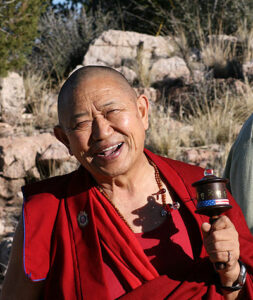
Root Samayas and Branch Samayas – H.E. Garchen Rinpoche
 There are some confusion about samayas, about keeping or not keeping samayas. Some practitioners thought that the meaning of samaya after having received an empowerment is to do the recitation of the texts or mantras related to the Yidam. Sometimes, when we do the recitation and practices, we think that we are keeping the samaya. This is, however, only the branch samaya. The real, or actual samaya, the Root Samaya, though is between people: between the Teacher and disciples, between mother and her child, between the students themselves, between the students and all other beings.
The Root Samaya and actual samaya is that of Loving Kindness, to have love and compassion to all beings, and everyone around us. It is only through loving kindness that we can overcome self-cherishing and ultimately, self-grasping. To be able to do this, we need Patience. With Patience, we can then sustain this loving kindness and compassion towards all. When you keep this samaya, you are in reality keeping all your vows, in fact, the vows of all the three levels, the pratimoksha, bodhisattva and tantric vows. This is most important. It is to have great love for others.
Many times, people disregard this, thinking that this is not important. They don’t see beings with kindness and love, thinking that doing their recitation is most important. Then they start fighting, not getting along. They think it is alright so long as they are practicing the Yidam. What is really happening, however, is that they are throwing away their Root Samaya, while protecting their Branch Samaya. In the long run, this is not beneficial. For example, not watering the roots will cause a tree to eventually dry out, even though you are taking great care of the branches. On the other hand, if you keep pouring water onto the root, even if some branches break, the tree will be fine and will keep growing. This is very important, in every context.
Now, you have received the complete empowerment and at the end, that which holds sustains the life-force of the empowerment is the holding of samaya. There many different samayas but basically there are root samayas and branch samayas. In the various classes of tantra, the four main classes of tantra, there are many branch samayas, many subtle samayas. It is excellent if one can keep them. How it was practiced in ancient times in India, was that for example those mahasiddha Indian masters would practice one single deity for their entire life. This is how they practice and that is why they had to keep all these samaya.
However, nowadays we are in different times, and secret mantra vajrayana has spread all over the world. It spread in Tibet and then all over the world. We are in the degenerate age, and this is the time where the secret mantra must be spread. It is only the secret mantra that is able to tame sentient beings in the degenerate age. How does it do that? First we receive empowerments and there are many different empowerments we can receive. When we receive many empowerments along with those empowerments there are many root samayas. However, the various root and branch samayas are actually included within the three root samayas: the samayas of body, speech and mind. and those really are most important three.
The three samayas of body, speech and mind
Even in relation to those actually, so much can be said if one wanted to elaborate on those root samayas of body, speech and mind. So, how can we really understand their essence? The essence of those three samayas is as follows.
When we practice the samaya of body, for example, if you take a single negative action of the ten non-virtuous actions [1] and abandon it; or you practice a single virtue of those ten virtuous actions [2], one of those in particular referring to the body, you are keeping the samaya of form, of the body.
Likewise with the speech, if you practice a single virtue with speech that is the samaya of speech. For example, the recitation of scriptures or of mantras and so forth. Then every time bodhichitta arises within your mind, every time a wish to benefit others arises that is when you are holding the mind samaya. These are the roots samayas of body, speech and mind.
To summarize them even further, the samaya of body is to abandon even just a single act that causes harm to others. Ideally, that refers to the vows that we take. In terms of timing, ideally you refrain from harming others for as long as you live, or if not that then for some years, or months or even just for twenty-four hours.
Like when we keep the Nyungne fasting vows, we are refraining from harming others and that is the essence of the body samaya. On top of that, when we accomplish the benefit of others, just a single benefit, that is to keep the essence of the speech samaya. Then when you apply the seal of bodhichitta every time even just a single negative thought arises in your mind, that is when you are holding the mind samaya.
These three samaya of body, speech and mind ultimately, all are included within just one: that is the samaya after mind. The samaya of mind is explained in verse number 36 in the Thirty-Seven Bodhisattva Practices, where it says in brief, ‘whatever you do look at the state of your mind, what is the state of my mind?’.
All samayas come together in one
There is a collection of hundreds of thousands vajrayana, but it is said that all these samaya are like a hundred rivers flowing beneath a single bridge. The rivers all have to go under the bridge so they all meet under that bridge. So, it just like those rivers, there are different samayas but it all is really under one bridge which is the purchase the mind. So since it’s just the mind actually from that perspective, it is something that anyone can do. The mind samaya is really the most important and precious. That samaya of mind really comes down to one thing, which is do not be distracted, sustain mindfulness and with mindfulness you recognize even the smallest afflictive emotion that arises and when you see what it really is, it becomes primordial wisdom.
That is the samaya of mind: to sustain mindfulness in this way throughout the six periods of day and night always recollecting the enlightened body, speech mind activities and qualities of the deity.
In brief, samaya all comes down to the view, the natural state, awareness of the natural state that recognizes all the coarse and subtle afflictions arising
In brief, read verse number 36 in the Thirty-Seven practices [3]. There is another way we can divide samaya such as that anything that we do that is beneficial and altruistic with body, speech and mind is the outer samaya. The inner samaya is to not be distracted and that is the samaya that’s really important to keep.
All mantras are contained in OM AH HUM
There are many practitioners among you who have established a connection to Vajrakīlaya and the Vajrakīlaya Drubchen for quite some time now. As you might know, there are many material traditions there are many different sadhanas, means of accomplishment. Whatever one you are familiar with, think that they are all one, they are all complete within one together. They are all practiced together. Their essence is that we need to recognize appearances to be the deity and sounds to be mantra. All the sounds we hear in the outer world are the Vajrakīlaya mantra. In brief, if you do not grasp at any sound, then all sound will become mantra. If you do not grasp at whatever thought arises in your mind, if you are able to let it be and dissolve, you are holding the mind samaya. That is what is meant with all mental arisings, all thoughts are the display of primordial wisdom. When all clinging to thoughts has disappeared, that is the ultimate samaya of mind.
When there is no grasping at form, that is the samaya of form. When there is no grasping at sound, that is the samaya of sound, and the samaya of mind is to liberate all thoughts that arise. Thoughts are liberated when you first recognize them and see them for what they are. So, liberating them with complete awareness, that is the samaya of mind. All samayas are complete within this samaya.
Actually, all mantra recitation is complete within the OM AH HUM mantra. Actually it is not even necessary to recite a separate mantra for each deity, because they all are included within the syllables of OM AH HUM. So Dharma friends, please practice in this way this is very important especially now where we receive teachings over the live stream.
The sambhogakaya guru on the screen
It is said that the Buddha, the transcendent conqueror, is the embodiment of the three kayas. Nowadays, you are seeing the lamas on a screen on the live stream and that actually is the sambhogakaya of the teacher. That is the real sambhogakaya. The blessings of that lama’s mind are actually present within that. Actually, the physical body of flesh and blood that we like to hug so much, actually that is just a fixation in our mind. We want to do that because we cling to the true, material concrete existence of appearances. However, the actual physical contact possesses much smaller blessings. The true guru lama never leaves, never passes away. That is also the meaning of our saying ‘please remain steadfast for many aeons’
Now, due to science, it is possible for us to see our true form through the screen. So think in this way, really think that what I see on the screen, the teacher that I see on the screen, that is the real Guru, who is always here. The physical form of the guru is impermanent so always remember that. Tashi Delek Dharma friends!
FOOTNOTES:
[1] The ten unwholesome actions or ten negative actions (Skt. daśākuśala; mi dge ba bcu) are:
- taking life
- taking what is not given
- sexual misconduct
- lying
- sowing discord
- harsh speech
- idle gossip (or worthless chatter)
- covetousness
- ill will (or wishing harm on others)
- wrong views.
The Precious Garland says:
By taking life, we will be short-lived.
Violence will bring us lots of harm.
Through stealing, we will lack possessions.
Through adultery, we will face rivals.
Through speaking falsely, we’ll face slander.
Divisive talk will separate us from our friends.
Harsh speech will mean hearing unpleasant words.
Gossip will cause our speech to lack nobility.
Covetousness will destroy our hopes.
Malice will bring us many fears.
And wrong view will bring inferior beliefs.
[2] Ten positive actions or ten virtues (dge ba bcu) are the positive counterparts of the ten unwholesome actions. They are:
- to renounce killing, and instead protect life
- to renounce taking what is not given, and instead practise generosity
- to renounce sexual misconduct, and instead follow the rules of discipline
- to renounce lying, and instead tell the truth
- to give up sowing discord, and instead reconcile disputes
- to abandon harsh speech, and instead speak pleasantly
- to renounce worthless chatter, and instead recite prayers
- to renounce covetousness, and instead learn to be generous
- to give up wishing harm on others, and instead cultivate the desire to help them
- to put an end to wrong views, and instead establish in yourself the true and authentic view
[3] Verse 36 from Thirty-Seven Practices of a Bodhisattva
In brief, whatever you are doing,
Ask yourself ‘What’s the state of my mind?’
With constant mindfulness and mental alertness
Accomplish others’ good –
This is the practice of Bodhisattvas.