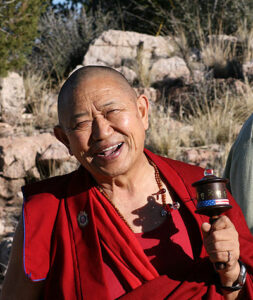
Life of Milarepa & Vajra Songs – H.E. Garchen Rinpoche
Translated by Ina Bieler & Transcribed by Florence Lee
Life of Milarepa
So, my dharma friends, we have two systems in this world. The spiritual system and the mundane traditions. Regarding the dharma spiritual path, there have been a lot of great beings who have realized the teachings and attained the fruition. A very special one among them appeared in Tibet and we have this story of Milarepa here. Generally, when we hear the story of a great being like that, an inspiration arises. We call it a lucid faith which leads to trusting faith and also longing faith. Longing faith is the longing to become free from suffering for self and other. The lucid and clear faith is when you understand the qualities of those great beings. You learn about their qualities when you hear about their background stories. I am very grateful for this translation of these books and many tashi delek for that.
There are many stories of the buddhas of the past and buddhas appear in different forms. The Buddhas physical appearance is precious but the scriptures of the Buddha are even more precious. Because within the words of the Buddha, we can actually find his mind. We cannot find that easily in the physical appearance like a statue. The statue just reminds us that this is the Buddha which is also beneficial. But the Buddha himself had said that ‘in future times at the end of this degenerate age, I will appear in the scriptures.’ Buddha was saying that we can really find him in the scriptures.
That is why to translate the words of the Buddha and to engage in these activities of distributing the scriptures and so on is really an incredible merit. What is it that we call merit? A merit is anything that benefits sentient beings and if we accumulate such merits, then a lot of sentient beings benefit from that. Through the teachings they learn to work with their sufferings and take suffering as the path. And also, to create the causes of happiness for the future. Basically, the scriptures open their eyes to the workings of karma. Knowing all that many sentient beings can become liberated from suffering and when they become liberated then you have accumulated merit. Dharma activities like that are just like a skillful business to bring you profit and if others profit then you will profit. Otherwise, if you do things just for your own profit then it will only be your own downfall. So, a great way to accumulate merit is through the teachings of the Buddha.
The first thing that we should really understand from Milarepa’s life story is how he overcame the wrongdoings that he had committed. Buddha had first said ‘do not commit any wrong’; that is because if we harm others then it will only fall back upon us. On the relative level, we perceive a duality of self and other and we think that we are separate individuals. That is really hard for us to understand how does it come back to us if we hurt someone. Of course, we don’t want it to come back to us but how does that even happen? On the relative level it seems that way because there is this seeming duality when it comes to our bodies. But that duality does not exist in our minds. We are not separate from each other.
Buddhas and sentient beings are one mind. Therefore, if we harm others, we are actually harming ourselves. For example, it is like you have your hand and you think that each finger is somebody else. You then bite on one finger but you are really hurting your whole hand. That is because in reality self and other are not separate. For Milarepa, his life really started with a lot of wrongdoings and he had a lot of anger. But in the end, he finally regretted that and laid all his wrongdoings aside through deep remorse.
And in the end having dedicated his to practice he attained enlightenment in a single lifetime. We can see many signs of that even nowadays that this is really a true story. We can see where he had lived and practiced and we can know about the exact dates of when that happened. All of these things can still be retraced back to the present day. For this reason, also Milarepa’s story is very precious in particular and the first thing that we learn from this story is that having done much wrong, he purified all of that through confession. That is the first important quality that we can learn from his story.
The next thing that we learn from Milarepa’s story is that how disciples rely on a guru by practicing the dharma and how does one persevere during those hardships. Also, what kind of conduct and expressions a guru might display; peaceful or wrathful and so forth. And how a guru cares for his disciples. Especially Milarepa, how many hardships he had endured with a lot of courage and determination. We can also learn a lot of that from his life story and also learn about the result of having practiced in that way.
The Buddha himself having completed the path had said that one attains the kingdom of the dharmakaya for one’s own purpose. For the purpose of others, one is able to benefit sentient beings and lift them out from their samsaric states. This is something that only Milarepa had accomplished. The Kagyu lineage is still so renowned because of all the hardships he had endured. We learn from his story about the qualities of a disciple and also the knowledge of a teacher. And how the disciple develops faith, trust and devotion to the guru. And also, how the blessings of the guru are received by the disciple and so on. And how he had endured hardships even at the cost of his life. It is because he had really understood the true quality of dharma practice and he would heed all the instructions that the guru had given him.
All of that is contained in the short life story of Milarepa here. Milarepa he showed us the entire path essentially from the time that the met Marpa. On how he first relied on the guru and how many hardships he had endured. Reading that in the beginning might even make Marpa look like someone without any compassion at all. That was how I actually saw him in the beginning and I was also a little angry with Marpa too. Just for how he had treated Milarepa. But then I found that it might be necessary to endure intense hardships for the sake of dharma. Or we can think of Naropa who had endured 12 major and 12 minor hardships.
Milarepa was considered to be just the worst of his disciples and nobody really liked him. There was this assembly one time where Marpa was conferring an empowerment. At that time, Marpa made a prophecy that in the future it will be due to Milarepa’s great determination and courage that the buddha’s teachings will have a life- force stream.
These are words that Marpa had actually spoken and written down. At that time when he did say those words, people who heard him say that did not really understand what he meant by that. But now when we read these words, we can really see that he made the prediction of Milarepa being the life force of the buddha’s teachings. Nowadays his teachings are still renowned in the Kagyu lineage and he is an example of someone who has attained the royal seed of the dharmakaya for his own purpose. Milarepa is someone who actually had attained the highest accomplishment in the practice. That is a true story of a historical person and it is not just a name or some legend.
This lineage is then transmitted as the Mahamudra lineage and is something that still persists in the present day. These were the words that Marpa had already spoken which now became true. So, when we read about that then a trust and a belief in the quality of this practice really arises. That is what we call the trusting faith. We need to distinguish the two kinds of kingdoms. There is the kingdom of the holy dharma and the worldly mundane kingdom. There is one story of Milarepa that shows what the kingdom of the dharma really is.
There was this one time when Milarepa stayed in Nepal and he was practicing in Kataya’s cave. At that time, he was going through some aesthetic hardships as he didn’t have any food to eat or any cloths to wear. But he was fully focused on his practice and at that time the Nepali king heard about this yogi and he felt moved by that. So, the King wanted to invite Milarepa and offer him some food and clothing. So, he sent some of his messengers to escort Milarepa to the King’s palace. The messengers found Milarepa sitting in his cave like an emaciated beggar and he was meditating. They extended their invitation from the King and told Milarepa that it would be good if he could go because he could get food and clothes from the King. But Milarepa declined and said that he is not going because ‘he is not the King and I am the King.’
Milarepa then started to explain the qualities of why he is the King and how his kingdom is the kingdom of the dharma, how he passed his 7 royal attributes and so on. At that time those messengers were really offended and they returned to the palace. Those messengers looked down him even though the King developed some devotion to Milarepa. In any case nowadays even the name of the King and the ruins of his palace is nowhere to be seen. It is all completely gone in the present day. But we can still see Milarepa’s kingdom of the dharma which has not declined. This kingdom is really a kingdom that brings actual benefit to sentient beings and their happiness. Milarepa had really attained the kingdom of the dharmakaya for his own purpose. And for the purpose of others he continues to benefit sentient beings by lifting them out of samsara.
There have also been many great Mahasiddhas in the past who had accomplished the kingdom of the dharma. It is important that we have both the mundane as well as the spiritual systems. Because if we only follow our worldly ways, we will never become free from suffering. Even if everything turns out perfect in our lives, with a lot of wealth and possessions but we will soon find out that it will not bring us happiness. And often people even commit suicide.
Even though on the outer level it seems that they have everything in the world, but precisely because of that their suffering is even more intense. Often people even take their own lives. That is because they do not understand the workings of karma. If you understand karma then you will understand the causes of suffering. And when you do experience suffering you will be able to practice it as the path. Recognizing the causes of suffering, you will be able to avoid more suffering in the future. If you have that knowledge, then in future lifetimes you will always experience the happiness of the higher realms. And ultimately you attain enlightenment.
It is through understanding the holy dharma that you really attain freedom. Milarepa’s story is a real story which shows us that someone really accomplished it in his life. Milarepa’s kingdom is very different from a worldly mundane kingdom as a mundane kingdom is impermanent. Sometimes it doesn’t even last for one lifetime. A king for the most part is not always a king as often in the end they end up in prison too.
There is nothing to rely on if you think about this worldly kingdom. Milarepa is someone who had attained the kingdom of dharmakaya who has realized the truth that is beyond birth and death. These are all things that can be accomplished and that is what we learn when we hear about his story. That is why it is so important to know about Milarepa’s story because then a real faith arises. When your faith is unchanging and steadfast, you will also be unmistaken on your path.
To me, it seems that Milarepa’s life story is actually quite easy to understand because it goes right down to the essence. We receive a lot of empowerments and for each deity there is a whole body of teachings, historical backgrounds, visualizations, different colors and implements and so on. The essence of all these diversities is also explained in Milarepa’s songs. For the empowerment, Milarepa had said that the outer empowerment is when you have the empowerment vase placed on your crown. The inner empowerment is when you meditate on your own body as the form of the deity. That is when you receive an empowerment you understand that your own body can ripen into the rainbow-like body of the deity. That is why you visualize your body in the form of the deity which is the inner empowerment. The actual ultimate empowerment is when you get to the nature of your mind itself.
Which means that you realize the non-dual nature of the mind and you realize Mahamudra. That is when you actually become free from suffering. At that point you have attained this true unchanging state of freedom. It is good to receive many empowerments because every time you receive an empowerment you are purifying downfalls and negative karma and so forth. But still even if you just receive one empowerment, all other empowerments are complete within that empowerment. This is something that Milarepa had explained in his songs where he taught from his own experience.
Each and every word that he said is the quintessence of the teaching. What is the essence of the practice? Why do we practice the deity and how do we visualize the deity? What is an empowerment? Actually, it is all for the sake of realizing the non-dual nature of mind. The deity-yoga is just a method to realize the ultimate truth. When I read about that I really found it very clear and easy to understand. I really felt that it is very beneficial to disciples as well. The reason why Milarepa’s words are so powerful is because they come from a direct personal experience. That is why even just a few words are extremely powerful. Compared to many other instructions, Milarepa’s instructions are so much more powerful because they come from his heart.
There are some practitioners who do understand the qualities of the holy dharma. They also have a lot of faith in their various Buddhist teachers. But still they tend to identify that guru with the guru’s physical form. When that guru leaves the physical form and passes into nirvana, then the disciple will think that now the guru is gone. Milarepa’s story is also a remedy for that kind of view. It really helps us to understand the nature of the guru too. In one of the stories, it was when Milarepa was just about to pass into nirvana and his disciples are all lamenting. They supplicated him ‘you have control over life and death so please do not die. Remain with us.’
To which Milarepa replied ‘the body has to perish but the mind will never cease to be’. And you know that when you look at your own mind. The mind will continue to pervade the 5 elements and that is because there is no duality between self and other. You know that when you understand the nature of the mind. Therefore, when the mind pervades in an instant it is everywhere. Pervading the 5 elements on the outer level and on the inner level we first have the 5 afflictive emotions. But secretly they are the 5 wisdoms. So, it is just like the relationship between a seed and a flower.
In any case he said that ‘my mind will continue to pervade all the elements and I cannot die.’ Therefore, whoever gives praise to me I will be right there with them.’ And these were his actual words. These are also words that Buddha himself had said before he passed into parinirvana. Nowadays Buddha’s teachings still remain and there are many teachers who turn the wheel of dharma and there is no difference between them and the Buddha himself. The sangha represents the three jewels. The body is the sangha, the speech is the dharma and the mind is the Buddha. If you understand that then you will know that the speech and the mind of the spiritual teacher is actually always here and it can never cease to be.
That is something which we can also learn from Milarepa’s life story. Buddha himself had said whoever supplicates him, he will be right by their side and always grant his blessings. Again, this is the reason why it is good to hear his story. At first, we might feel a little sad that Milarepa is leaving his body. But the next moment, we feel happy because we know that the guru never leaves as he is always there. This is also a method for us to develop a clear and trusting faith. This was what happened to me personally. I don’t really know how to read all kinds of books and scriptures but I do again and again read the different stories of Milarepa.
When I was still very young, I encountered Milarepa’s story and at that time I had already felt a very strong connection to Milarepa. However, it was only later when I arrived in the west that I was actually able to do a pilgrimage to Lapchi where Milarepa had lived and meditated. I went to Lapchi twice and I insisted on going there because I really wanted to see that place. I can say that there really is a difference in just hearing about his story and directly seeing it. It was also very powerful to actually see this place.
For example, I could relate to a certain place in the story that I heard about before. There is this one story where Milarepa stayed in Lapchi and he meditated in the ‘Maras subduing’ cave for 6 months. It was snowing and the snow finally blocked all the paths of travel. Milarepa then could not leave the place and his disciples were certain that Milarepa must have died. They then made preparations to find his dead body after the snow had melted in spring. They looked for his body but they finally found him alive and not dead. They were all amazed and asked him how it was possible to live. Milarepa then said that sometimes dakinis came and gave him food and other times he just naturally felt full as though he had eaten. Milarepa said he just felt the taste of food even though he didn’t eat. Milarepa’s disciples were quite surprised by that and they asked on which day did he feel like that. His disciples then realized that it was the exact same day that they made offerings to Milarepa. Because they thought he had already passed away and so they made him a Ganachakra feast offering.
Then Milarepa realized that all these practices must actually be really beneficial. For example, smoke offering practices and dedications for those who are alive and those who have passed away. Milarepa realized that these offerings and dedications are actually received by those beings. And that is one other thing that we can learn from this life story. The Buddha had said that we should make offerings to the higher beings and we should also be generous to sentient beings as well. When someone that we love has passed away and we make dedication prayers to them, that bardo consciousness actually receives that. During the bardo, they experience a lot of intense suffering of heat, cold, hunger and thirst and so on. We can alleviate that by making these offerings to them.
Then again when you hear the story of Milarepa, a trusting faith arises. So how is it that those beings really receive what we dedicated to them? It is by virtue of the three powers. First there is the power of your own intention and you need to have this all pervasive boundless love that wishes to benefit sentient beings. The second power is the power and compassion of all the buddhas of the three times. So, when you cultivate this boundless love, then you are naturally connecting to the love of all those buddhas. It becomes so much more powerful.
And thirdly is the power of dharmadhatu and that is the basis of our mind is one. We are naturally connected to the bardo consciousness and that consciousness is only momentarily in a state of confusion. In that state the consciousness does not have a body and it experiences heat, cold, hunger and thirst. But if we are making dedications and offerings of food to them with good intentions, then that can actually alleviate their experiences of suffering. That is why when we offer with our mind of love, then that suffering and confused perception can be cleared away. Ultimately this is because self and other are not separate. And when we pervade them with our love then they can even see the ultimate truth.
So, it is through those three powers that we can actually benefit those beings. For example, when we practice dedication prayers and smoke offerings for those who are alive and those who have passed away. it also beneficial to translate and distribute the related scriptures. When we hear those stories, then again trust arises. Then we can learn what can actually be accomplished when we do certain practices.
In general, it is very good if you can read dharma books out loud so that you can hear yourself reading it. It is extremely beneficial which also has health benefits because you move your tongue and it stimulates your saliva. So, it is good for your stomach and it can also cure a lot of stomach related ailments. Another benefit is that when you read out loud, then those things stick to your mind much easier. So, you can remember it later on. That will be very useful when you are older when you can’t read anymore. Because then you will be able to remember all of the things that you have read before. Most people have the habit of just reading quietly but that is not the best way to read.
But of course, it is not convenient if you are in a public place. If it is convenient you should really read each word out loud very clearly. Also, what is very beneficial is if you take a dharma book like this and you discuss it with each other. The songs of Milarepa really are the root of buddha dharma. Within a single word, a hundred words are contained. Milarepa really explains the essence of the dharma teachings and these teachings are extremely important. It is clearly my hope that in the future you will study these teachings more thoroughly and I am also very grateful for this book being translated. The merit for that is inconceivable because that book will remain for many future generations. And in the future, anyone who sees this book will find benefit.
Actually, any book in this world that helps sentient beings find peace and happiness is an incredible merit. Because one who sees that will find joy, happiness and the path to virtue. We do need that merit in all future lifetimes because there will always be a mind wherever we are born in the six realms of samsara until attaining enlightenment. One of the greatest ways to accumulate merit is through translating a book like this. So, it is very precious to take a special and meaningful book and translate them. It is a very important activity.
Also, to practice the dharma you don’t always have to wait for a special lama to come but it is also very important for disciples to discuss the meanings of those teachings among each other. That is really very important and the one who explains something benefits that person too. Whatever you know and understand is something that you should share with others but of course if you don’t fully understand something then you shouldn’t share it. But there are many things that you can easily understand in the teachings of Milarepa or even any other teaching.
Nowadays many lamas led by His Holiness the Dalai Lama are giving various teachings throughout the world. So, you can also discuss the meaning of all of these teachings. The essence and root of all these teachings is bodhicitta. It is the relative truth which is love. Even though there are lots of teachings that you can hear, what we really need to do is to sustain love with patience. Aside from that, the more you hear the more you learn will be an enhancement for your practice. So, I find that the discussion amongst each other is really very important.
Vajra Songs of Milarepa
First, I would like to say Tashi Delek to everyone; all the disciples and centers in all of your countries around the world. This is how we are seeing each other today. You might think that we are just seeing each other on TV but actually that is not true. The form of mine that you are seeing today is my real form; that is my actual body. The body that you are seeing today is never born and never dies. That is the body that is always there. Whenever you want to look at it it’s there. Then you hear my voice and the voice is also always present. It can never disappear throughout the three times. It is called the unceasing speech.
The body is the body that transcends birth and death. And the mind is the mind that is beyond coming and going. So those who have realized the nature of the mind, for them there is no coming and going. The Mahayana sangha who have realized the nature of the mind realize that this mind doesn’t come and doesn’t go. Until we have realized that, from our perspective there is some kind of coming and going. So today the body, speech and mind of myself that you are seeing is my true actual body, speech and mind which is stable and truthful. It is always there continuously whenever you need it, it is there.
So, you might think that it is just there when you turn on the TV but when it’s off its not there. But that is not true. Whenever the feeling of love arises in your mind, or if you have difficulties and you close your eyes then there it is. Then you hear the words that I speak and that is the words on bodhicitta, the altruistic mind. And that mind is always the same. Ultimately the mind doesn’t come and it doesn’t go. When you realize that, you realize that the Guru’s mind, the Buddha’s mind and your own mind are one. There is no difference between the mind of the guru and the mind of the disciples. But until we have realized that the mind is beyond coming and going, we have to purify our self-grasping.
The Buddha said ‘perfectly tame your own mind’ and he gave a method to do that. And the method to tame our own mind is the practice of the holy Dharma. When the precious teachings of the Buddha spread in the old days in India, there were the teachings on the scholarly tradition on one hand and also of practice. On the scholarly side, there were traditions of teachings of composition, debate and so on. And in this way the precious teachings of the Buddha were sustained into the future. Then there is the lineage that focuses on reflection and meditation; and that is the practice lineage of blessings.
For instance, the Kagyu lineage deriving from Marpa, Milarepa and Gampopa; and all the various lineage masters. Those two kinds of teachings; the teachings of the scriptures and teachings of realization have to be practiced and upheld in union. We cannot have either one of them; if we just have the practice then the Buddha’s teachings cannot remain. But then if we just have the scriptures and no practice it is also of no benefit. So, they need to be practiced in union.
In particular in the Kagyu lineage, we follow according to the practice lineage of blessings. It is a lineage where the Kagyu lineage comes together; a confluence of different lineages including the old Kadampa lineage. There have been many great masters and many great scholars that appeared in Tibet. But the one who really upheld the practice lineage of blessings was Jetsun Milarepa. First of all, it is important that we hear the life story of a master. Because every time we hear the life story, it is like our ordinary mind begins to open up. It is said when you hear the story, inspiration and clear faith arises.
And when you know about their qualities, faith arises. When trusting faith arises, then blessings enter one’s mind. Once you gain complete trust it is like having a friend that you can completely rely upon. So, when you hear about the stories of these masters, your mind opens up. Of all the great masters that have appeared the most eminent master is Jetsun Milarepa. And his life story is most widely spread around the world. Also, there is the aspiration prayer of Sukhavati by Karma Chagme which also is spread widely.
And what is unique about his teachings is that he explains the teachings in very simple terms. It is very easy to develop faith when you hear his teachings. Therefore, I am going to say a few words about Milarepa’s life story. In general, it is the same for all the different lineages; what we share in common is that we essentially speak about the same thing which is the precious bodhicitta. The four major lineages is like a big reservoir with four entrance doors. And from each door, water flushes in, but in the end, it is all the same water.
Our Kagyu lineage derives from Marpa, Milarepa, and Gampopa. First as an introduction I am going to share a few words about Milarepa’s life story. The holy Dharma is extremely precious but I myself do not have much learning. A long time ago when I was young, I came across the life story of Marpa and I learnt about how he had travelled from Tibet to India by foot. And all the difficulties he had encountered along the path. And how he had turned all his possessions into gold in order to receive the Dharma in India
When Milarepa first met Marpa’s son, he asked the son to tell him about his father. Then the son said that his father turned all of their possessions into gold and left for India. Normally when people come back from a trading merchandise trip like that, they would bring back a wealth of gold, silver and precious gems. But Marpa did not bring any of that instead he brought a pile of scriptures back and nothing else. Reading that was quite fascinating to me and it is very good for us to read the life story of Marpa Lotsawa. When you read the life story you see how precious he regarded the dharma. What he did for the sake of dharma and for the benefit of all sentient beings and all the hardships he endured.
The faith that Milarepa had in Marpa and also the faith that Marpa had in his own guru Naropa. If we really want to know about the relationship between guru and disciple, we should look at their life stories. In the beginning, Marpa treated Milarepa very badly and Milarepa underwent so many hardships. From our perspective it might seem that Marpa was a terrible person but then he did that in order to purify Milarepa’s obscurations. Now when we think about how quickly we criticize a lama of the present day when he did the slightest wrong in our mind. Then we think that he is a terrible person and criticize him.
But when we think about Marpa and Milarepa, Marpa really was very hard on Milarepa. Marpa abused Milarepa and humiliated him. When I first read that story, I felt a little angry with Marpa and felt that he was a really bad person. But I kept reading and read about how Marpa first gave an empowerment to Milarepa in the presence of his many other disciples. There were many disciples who were themselves great masters sitting under golden parasols. Marpa said this at that time of conferring the empowerment ‘It was due to Milarepa’s great determination and courage that the Buddha’s teachings have a life-tree.’ In this way, he empowered him as his regent.
Looking back at these words now we can really see how he knew at that time because nowadays it is really because of Milarepa that the Kagyu lineage is so well known around the world. So, it is really Milarepa’s great determination and courage. At that time, Milarepa was considered the worst disciple and he was the one that was abused and beaten. All of the other disciples were themselves great lamas under golden parasols.
At that time, how this empowerment came about was that Milarepa had to endure great hardships nine times. But that last trial was intervened by Marpa’s wife Dakmema who had great compassion for Milarepa. And if you just remember this line by Marpa, it is actually very meaningful. ‘Through Milarepa’s determination, the Buddha’s teachings have a life-tree in the future.’ This was what he said during the conferring of the empowerment.
You should really keep these words in mind and think about them. Is Milarepa a life-tree and how is he a life-tree? So, if you understand that about Milarepa and you just hear a single word about his teachings, these words will be so much more powerful.
Then Milarepa set out to engage in practice and he endured many hardships. Finally, he had attained the Kingdom of the dharma which is different from a worldly kingdom. We all know about the worldly kingdom and we are drawn to its great resources of money and wealth, warfare, power and so on. Then different countries compete with each other and they go to war. The kingdom of the dharma is not like that. There is also one story about Milarepa when he was practicing in Nepal in the Katayana cave. He was meditating there and the King of Nepal (of an area) had heard of Milarepa and had great devotion to the dharma. The King heard about this excellent yogi and heard that this yogi doesn’t have any food or clothing. So, he wanted to invite him and provide him with what he needs.
The King then sent out two messengers to escort Milarepa back to the palace. Then when they approached Milarepa, they said ‘something great is happening. The King is inviting you to his palace and he will offer you food and clothing.’ Milarepa said in response ‘well that is not a real kingdom. His kingdom is not a kingdom. I am the real King.’ Milarepa then sang a song to them on how he is the real King and how his Kingdom is the real Kingdom. He sang about the 7 royal attributes and so on. Then those messengers became slightly irritated and they said ‘you sing really well and have a nice voice but that is about it. You have no food nor clothing; you better accept the invitation and that is your chance to get something. You better go.’ But Milarepa refused and he told them that he is not going as he has the real kingdom.
At that time these messengers thought what Milarepa said at that time were just empty words. But now we can see how he had really sustained the Dharma kingdom. Milarepa was the one who had attained the kingdom of dharma and of bodhicitta through his meditation practice. Which brings much benefit to countless sentient beings. And it is due to his dharma kingdom that nowadays in this world the Kagyu lineage is widely renowned in its various forms. The greater, middling, lesser and so on. That is all due to Milarepa’s hardship.
On the other hand, when we think about that King, and in fact at that time there were many Kings. None of their kingdoms are left behind; not even their names are left behind. These worldly kingdoms are impermanent and compounded; and their nature is therefore suffering. So, what we need to gain is the kingdom of the dharma like how Milarepa did. To gain this kingdom, we must make an effort in the practice of the holy dharma and the practice of bodhicitta.
The more effort you make in that, the more of these qualities of the dharma kingdom you will acquire. We want to have good qualities even for the slightest well-being or bliss, we are willing to endure many hardships. I am encouraging you through these teachings to please look at Milarepa’s story in the future. Read and learn about it now; you also have spiritual teachers with you and you can ask them questions. You will find that his teachings are really of incredible benefit.
I myself do not have much learning but I have really held on to the teachings of Milarepa and I have firm trust in karma. I also have great love for you; and actually, who really benefits from this love? It is really for my own benefit too because if I do not cultivate love, then I will fall into the three lower realms and I will continue to wander in samsara. Lord Jigten Sumgon had said what wanders in the ocean of samsara is the body. We are attached to our bodies and cling to them due to identifying with our bodies. Our bodies appear in various forms; some are as large as mountains and some are tiny like a little ant. And some we cannot even perceive with our eyes as well as formless bodies.
They all are a creation of this concept of me. And with this concept of me we follow our karmas throughout the three realms of samsara. Or the three planes of existence which is on the earth, above the earth and below the earth. And all of that is pervaded by suffering which comes from the self. Buddha said that even though all sentient beings are actually Buddhas, they are temporarily obscured by adventitious stains of dualistic perception of self and other. What overcomes this grasping is the altruistic mind of bodhicitta.
Because these two states of mind are mutually exclusive. If an altruistic mind arises then the self-cherishing mind naturally diminishes. And when there is no more concept of a self then there is also no more real sentient being. Then you see the ultimate truth. That is the special quality of the Buddha’s teaching. It would be good in any case to learn about Milarepa’s story and at the end of his story he said that ‘actually I cannot die. Whenever you need me, I will be there. I will continue to pervade the 5 elements.’ So, look at that story and that is the nature of all the spiritual teachers. Do not grasp at the permanence of their bodies. But hold on to their speech and mind.
All the words and teachings of the Buddha are the same. The mind is also the same as it is a mind of unobjectified compassion. From the Buddha’s perspective, there are actually no real sentient beings. When one has realized the ultimate truth of non-duality, then sentient beings are no longer separate from you. What Buddhas are able to see are Buddhas; Buddhas do not see sentient beings. Sentient beings on the other hand can only see sentient beings; they cannot see Buddhas.
Sentient beings can only see faults so even if a Buddha is there, they cannot see that Buddha’s good qualities. Only when one attains enlightenment one will see that actually all sentient beings are Buddhas. In brief, when you realize the ultimate truth, you do not see a sentient being. Because you realize that such a perception is a confused habitual imprint that does not correspond to actual reality. When you are free of all self grasping, then you only see sentient beings as what they really are; as Buddhas.
But because we are obscured by self-grasping and when the mind is impure then all we can see is impurity. When the mind becomes pure, then all we can see is purity. This is how it ultimately becomes when you realize the union of the two-fold truth. This is my hope for you in the future. Please study and read about Milarepa’s story and todays teachings are more of an encouragement for you to go deeper into Milarepa’s life story.
When Buddha first taught the dharma, he summarized it in these four well known lines. He said ‘Do not commit any wrong. Perfectly practice virtue. Perfectly tame your own mind. This is the Buddha’s teachings.’ That is the essence and we have to purify our own mind. Then the pure mind itself; all sentient beings are actually Buddhas.’ This is the one and only thing that Drubwang Rinpoche who is Vajradhara always said. Then one might wonder if sentient beings are already Buddhas then why do we have to perfectly tame and purify our own mind?
It is because we still have this concept of a self and perceive a duality of self and other. In the mind of the Buddha there is no duality. So, a duality seems to exist in terms of bodies but it doesn’t exist within the mind. It is this concept of a self that has to become purified. It is this grasping at a self that we have habituated to since beginningless times in samsara. That is what has to become purified. These are adventitious stains which also implies something that arises momentarily. For example, in your natural state on an ongoing basis, your mind is in a space-like state.
Then a person comes along and instantly this dualistic concept of self and other arises almost naturally. Immediately you think something like ‘that’s him’. This is what we have habituated to over and over again. And this is why our minds have become like a block of ice. So, the dharma is only a method to tame that. The 84,000 dharma teachings are an antidote to the 84,000 afflictive emotions. This was taught by Jigten Sumgon in the Gongchik. So, what are these afflictive emotions? The root of the 84,000 afflictive emotions is only self-grasping. What we need to cut through in the context of Chod is that self; we need to find an antidote to the self.
Here in this story is a conversation between Milarepa and his female disciple Bardabum. You can read the story later and it is also easy to understand. It is easy to find and I have also mentioned it in many teachings. Here Bardabum is asking Milarepa a question; ‘You yogins practice some kind of Chod; so, what kind of Chod do you practice?’ To that Milarepa said ‘roaming in rugged mountain retreat is the outer Chod.’ First this term Chod, which means to cut through or sever is a forceful method to cut through self-grasping. This self-grasping or self cherishing arises on the basis of the body as we identify with this body. So, with the body we go to a rugged mountain retreat which is a frightening place where fear arises. It is a place where evil spirits and demons dwell and perform all sorts of magical apparitions. There are many stories of how Milarepa was challenged by these magical apparitions of various spirits. And how he overcame it was through understanding that it is all in the mind. When you understand that it is the mind, then there is no fear and they can’t do anything to harm you. If you see them as a dream or like an illusion, then they will just disappear. On the other hand, if one tries to struggle or run away from them then they can cause a hindrance or obstacle to one’s life-force.
So, roaming in rugged mountain retreats is the outer Chod (which relates to the body) and casting the body away as food is the inner Chod. Then why are we afraid? We are afraid because of our body and that is something to realize. So, you ask ‘is the body and mind one or are they separate?’ They are actually separate because the body will be discarded and burnt by fire and perish. But the mind will go separate ways. In the 37 Bodhisattva practices, it says ‘Consciousness the guest will cast aside the guesthouse of the body.’ So, you should understand that your body is just like a guesthouse. That is not who you really are; the body is not you. But you have to take care of it temporarily so you have to be a little careful about certain things.
But in the end, this is not yours and you are not the body. This is how it is taught in the 37 practices in the beginning. So here we are giving away the body mentally and by doing that we are giving away self-grasping; because we identify with the body. Then ‘cutting to the root of the unique’ is the ultimate chod which refers to realizing the space-like nature of the mind that transcends birth and death. When you realize the nature of your mind, you realize that there are no self and other. And when that is realized, then there is nothing that can cause you any harm
That is what Milarepa had realized based on his own experience of wandering around in rugged mountain retreats and being challenged by the apparitions of spirits and so forth. Also being challenged by actual human beings and so on. Milarepa endured many hardships including hunger and you can read more about that in his life stories. The glorious Sakyapa had said that in this ocean of suffering, our true enemy is this body. So, if one is a wise and sensible person, one will know how to make best use of it. Then it becomes a vehicle to accumulate merit.
So, we have found a precious human body and if we use it by cultivating bodhicitta, then through this existence we can liberate millions of sentient beings. And attain the actual kingdom of the dharma. Cutting the root of the unique is to directly see the ultimate truth and thereby self-grasping diminishes. It diminishes when you cultivate a mind of altruism. Normally we think about ourselves but we don’t think about sentient beings. We think about what is going to happen to ‘me’ and so on. Instead about thinking of ourselves first, bring to mind the suffering of all beings in this world.
If you are able to remember all sentient beings, that is the beginning of cultivating immeasurable love. And in this way, self-grasping gradually diminishes and as it diminishes, the mind becomes increasingly open or vast. That is the mind of a Mahayana. There is a sutra called the great liberation sutra and it says ‘the Mahayana mind is like a vast ocean.’ A vast ocean pervades the entire world and therefore it knows the suffering of all beings throughout the world. So, there is compassion for all of them.
Then the text says ‘the mind of a Hinayana is like the water that collects in the footprint of a cow,’ The difference lies in cultivating or not cultivating bodhicitta. If one does not understand the need to cultivate bodhicitta, then there is this constant sense of ‘me’ or ‘I want to be happy’ and so on’. If you that then the body becomes increasingly small and you take birth as an animal. And it becomes smaller and smaller until it becomes so subtle that it has no more body. In all these bodies, we experience suffering due to self-grasping.
Chod really is in order to cut through self-grasping. Now I am just using this song of Bardabum to give you an outline and introduction to these teachings. But in the future, I wish that you will study it more thoroughly and also discuss it with each other. Next the girl said to Milarepa ‘these kinds of chod are like a Garuda, the most glorious of birds who overpowers all other birds when he flies in the sky. They are extremely wondrous and when a yogi practices Chod, there is something called Phet to enable him to bring adverse conditions to the path. Tell me what is the meaning of Phet.’
Actually, Phet has a great meaning and Milarepa then said ‘collecting scattered thoughts is the outer Phet. By uttering Phet, thoughts are dispersed and shattered. In terms of meditation practice, this is also related to the trekcho practice of Dzogchen. It is said that the utterance of a forceful Phet shatters the endless chain of thoughts. And it is this endless thinking that completely ties the mind down. It means that thoughts arise and create very strong feelings but if you instantly recognize that these feelings are delusions, shout out a Phet. Which is like a lightning bolt striking those feelings and destroying them.
But you should only shout out the Phet when you are alone by yourself. Don’t shout Phet when you are with a lot of people. That would not be appropriate. But when you are by yourself you shout out a forceful Phet like an exploding bomb. And when you do that, in that instant the mind becomes completely lucid and clear. So, collecting scattered thoughts is the outer Phet. When it is difficult for your mind to abide in a state of Shamatha, if thoughts constantly arise and disturb the mind then shout out a Phet or mentally think of Phet. Then all of these sensations will go away. So, it is like throwing a bomb on all of these thoughts.
It brings the mind back but the mind didn’t actually go anywhere because there is no going or coming. But it seems that thoughts come up in the mind so the Phet destroys them. In that instant where Phet is exclaimed, it is also related to your wisdom mind. When Phet is exclaimed and wisdom is sharp then thoughts melt away just like morning frost melting away by the sun rays. So, Phet and the wisdom mind have a very strong connection. When you experience sufferings and difficulties, many thoughts arise in your mind. Then all of these thoughts create very powerful feelings and in those moments it is very beneficial to destroy them by shouting out or mentally thinking Phet.
That is how we can do in our daily practice but also on an ongoing basis at any time whenever you encounter difficulties. Think about the suffering of others and cultivate bodhicitta. When you think about the suffering of others then your own suffering diminishes. When you experience difficulties, then think about the suffering of the world and your own mind will feel so much lighter when compassion arises for others. So, love and compassion is said to be actual antidote to suffering. Bodhicitta is the method to liberate you from all the bondage.
For those who are familiar with the practice of Phet and looking at the nature of their mind, the Phet becomes extremely beneficial when these kind of thoughts arise. It benefits yourself and others but what is really important is that when you encounter difficulties, it is important to bring an end to these endless chain of thoughts. Because they are like ropes that bind you down.
In the end you become completely tied up and you can’t let go of those thoughts anymore. That will drive you crazy and suffering becomes unbearable. So that is an important point to remember. Then ‘rousing dull awareness is the inner Phet.’ When you are practicing meditation sometimes you lose your mental clarity and you become sleepy. At that time if you practice the Phet, it will instantly make your mind clear. Then, ‘resting in the abiding nature is the ultimate Phet.’ What is the relation between the outer and the inner Phet? It is to ultimately come to abide in the ultimate nature of the mind. So that is most important. It is said ‘I never recognize that my own mind is actually Buddha.’ But the nature of your mind is fundamentally the Buddha. We call it Mahamudra or Dzogchen and so forth but it is the mind that is without thoughts; the space-like nature of the mind.
And when you recognize or glimpse it even for just a single moment, that is the actual sky-like nature of your mind. That recognition is also referred to as liberation on the ground. The thoughts that arise are like the clouds in the sky and when thoughts appear do not pursue them or hold on to them. Just let them be. So ‘resting in the abiding nature is the ultimate Phet.’
And this abiding nature is resolved through the practices of Mahamudra, Dzogchen or according to the scriptural tradition or the Madyamaka Middle Way. Or according to the practice blessing lineage. But these are all various methods that lead to the same goal. It is said that the Vajrayana secret mantra is rich in skillful means and yet requires the least difficulties. And is the distinguished teachings for vessels of sharp capacities.
When you rest within the state of your mind with clarity, then eventually it is clarity seeing itself. Then there is no more duality between someone who sees and something that is seeing. It becomes pervasive like space and that is when you realize freedom from conceptual elaboration. At that point there is no more grasping thoughts of existence or non-existence. There is no thought in the mind whatsoever. Mind just abides clear and self-knowing like a lamp-flame.
Then, if you just continue to remain within that state, you will not be mistaken or confused. Try to sustain that state without following whatever thoughts that arises. If you let it be without pursuing it, the thoughts can become liberated. And liberation of thoughts means that the thoughts does not leave any feeling behind. For example, if you get angry with someone, clear awareness instantly recognizes that you are angry. So, it does not engage in the anger but let it just be.
There is nothing to be done just let it be. You just have to sustain clear mindful awareness and nothing else. Then the actual quality of that anger that has transformed emerges. That anger has the quality of clearing away all sleepiness or dullness of the mind instantly. That is why anger has the nature of clarity and emptiness. Desire or attachment has the nature of bliss emptiness and this is how the afflictive emotions are transformed into primordial wisdom.
So, rest and abide continuously within this nature of clear recognition. Moment by moment recognize its clarity and it is a dynamic recognition that arises. Then you continue to remain within that state and it naturally becomes an offering for all the Buddhas. Such an abiding and resting in the ultimate nature is extremely powerful. So, it is this natural state of the mind here that needs to be sustained.
Vajra Songs of Milarepa
Rinpoche says thank you; our minds are together and also we can see each other. Yesterday we began with the song that came from the 100,000 songs of Milarepa. The purpose of introducing you to these teachings is so that later you can read and learn more about these stories. These 100,000 songs of Milarepa is available throughout the world in Tibetan, English and Chinese. And the story we discussed was about Bardabum and she was one of Milarepa’s greatest disciple who had attained the rainbow body.
We can read in Milarepa’s 100,000 songs about the story of how they met and there are many funny stories also in the context of Bardabum. There are also stories which make you feel compassion and also very interesting parts which are useful for our practice. What I am introducing you to are these essential points that we need in order to engage in practice because we want to make good use of our time. So, I am just introducing you to these from a practical perspective.
We spoke about ‘Phet’ yesterday and the story here continues. Bardabum said to Milarepa ’These kinds of Phet are extremely wondrous. They demand swift and firm action like a great King’s battle trumpet or command. Through practicing this way, what kinds of manifestations have dawned for you?’ The kinds of manifestations refer to what arises within the mind. So, she is asking Milarepa what has arisen in the natural state of his mind? This is important for all the practitioners. When we are introduced to the nature of the mind, then we are introduced to these aspects of the ground, the path and the result.
The ground is the mind itself and here it says ‘the uncontrived ground dawns as great all-pervasiveness.’ Milarepa’s mind is all-pervasive and is our mind all-pervasive? Not at the moment because we always think of ‘me’ and ‘I’. There is so much self clinging. All the sentient beings in the six realms of samsara; even the smallest lifeforms have this sense of ‘me’ and ‘I’. For as long as we have that grasping, the mind will not be pervasive. At that time the mind is like a solid mass and that is not all-pervasive.
So how we shatter this solid mass is by shouting ‘Phet’ as we mentioned yesterday. First there is this concept of me that is naturally there. Then when you shatter it with a ‘Phet’, it disperses just like the clouds in the sky. Then when all the clouds are gone, then the mind truly becomes vast and all pervasive just like light energy. In this world there is just one light energy and that is just like the nature of the mind. In terms of the body there seems to be an outer, inner and in between but the mind is all-pervasive just like space.
People think that the sky or space and the earth are separate but actually we are not separate. For example, I can pick up a piece of earth and scatter it. I can scatter it because there is empty space. Or I can spin my prayer wheel because there is empty space. So, the earth or the prayer wheel spins in the emptiness of space. And that shows that it is not just the sky up here or the ground below but there is space everywhere. That is why there is the possibility of movement and that is true for anything related that exists in the natural environment in this world.
In this world, Buddha Shakyamuni taught the precious teachings extensively. He taught 84,000 different teachings and the essence of all these teachings lies within bodhicitta. So, we need to think about what’s the benefit of giving rise to bodhicitta and the fault that comes from not understanding its meaning. The harm is that if one does not give rise to bodhicitta, then one will become controlled by the six afflictive emotions.
As a result, one will continuously wander in the six realms of samsara like an ever turning wheel and one will never become liberated. So, what is the actual cause which causes us to wander in those six realms of samsara? It comes down to the dualistic self-grasping of self and other; and to think that everything is real. It is his fixation that everything is concrete and real which causes us to wander in samsara. And it has made us become like a solid ice block. If one gives rise to bodhicitta, then that ice block will melt into the ocean; and become one with the ocean.
How can we tame those six affective emotions? It is through the practice of the six paramitas and this is how we become liberated. Of these six paramitas, through the perfection of wisdom in particular, the Buddha realized that self and other are non-dual. Each of these paramitas is an antidote to an afflictive emotion. There are many different teachings and methods that are given so this is how we have the 84,000 dharma teachings.
Jetsun Milarepa was the one who condensed all these teachings into their essence. Here we are not speaking about hearing the scriptures and summarizing them into words which we then follow. It is that Milarepa had understood the meaning of the dharma and practiced it. Milarepa also endured a lot of hardships for the sake of dharma and gradually realized its nature. Having realized it, Milarepa condensed it all into a single essence in the form of his words.
Each of his words in those teachings contains that distilled essence. Also, even if we were to expand and elaborate on the perfection of wisdom, there are so many volumes of scriptures that deal with the Prajnaparamita the perfection of wisdom. So, whose kindness is that? It is his guru Marpa Lotsawa’s kindness. First, we should understand the connection that Milarepa had to his Guru. In general, we can take this relationship between Marpa and Milarepa as an example of a relationship between a guru and a disciple.
The song begins with ‘Lord Marpa the translator who is so kind, please be a refuge to all sentient beings of the polluted age. Grant your blessings that dharma may pacify jealousy.” So, this polluted age is the degenerate age and please protect sentient beings of the degenerate age. We speak about the five degenerations but what is the root of all these? It is within the mind of sentient beings. It is the mind that has become degenerate and the opposite of that is the pure mind which is a mind of wisdom and compassion.
In these degenerate times, wisdom and compassion have become very small; but self grasping have increased which is the opposite of wisdom. Therefore now, even though one is a dharma practitioner, a lot of jealousy arises. Milarepa said ‘do not just follow the words of the dharma” and also Jigten Sumgon said in the Supplication to Tara that ‘even though they know the tenets of cause and effect, they are still ignorant as to what to do and what not to do. Still falling into the two extremes.”
Because there is self-grasping, beings develop pride which leads to jealousy. For example, in the case of Milarepa, even though he had so many great qualities, many people still saw his faults. Milarepa also said that in future times things will degenerate further. Sentient beings will increasingly degenerate in their self-grasping and afflictive emotions. So, the six afflictive emotions are complete within the degenerate mind of self-grasping.
The six paramitas are the essence of a pure undegenerated mind which are wisdom, compassion and the altruistic mind. In the 37 Bodhisattva practices it says, ‘The perfect Buddhas arise from the altruistic mind.’ So, when one gives rise to the altruistic mind, then according to the Pratimoksha individual liberation, one naturally practices the six paramitas. And according to the secret mantra Vajrayana, it is the ten paramitas.
Then he says ‘Listen Darlo, you teacher wishing for fame:
While never thinking that you will die,
You’ve pondered over words, connections or contradictions,
Thirty-two years of your life have passed without your noticing. ‘
So, Milarepa is telling the scholar ‘look at your life; you have spent his entire life following those words. Figuring out what is their connection and contradictions. You are able to speak very eloquently but now two thirds of your life has already passed. If you do not practice but only follow words, that is of no benefit.”
A sign that this is of no benefit is to look at your mind. Your mind is filled with pride and when there is pride, jealousy arises. The six afflictive emotions will arise. Pride is by nature ignorance and jealousy ultimately is anger or hatred. Pride leads to birth as a God and jealousy leads to birth as a Demi-God. So, these are the seeds that will bind you to samsara without liberation. It would be much better if you would do some practice.
‘The afflictions of beings in the polluted age are coarse, impossible to bear for those with negativity.’ We mentioned before that the root of degeneration is the mind which is self-grasping. The degeneration of self-grasping are the afflictive emotions and all of that has caused the mind to freeze into an ice-block..And if you throw an ice-block up into the air, it will fall back down. For example if you spread water into the air through evaporation, then it turns into clouds and becomes the sky. So water and dust are just like that.
It is unbearable to experience the suffering of the lower realms however we have no choice but to bear the suffering for as long as the mind remains within this ice-block like state. When the Buddha first taught the dharma, he taught the paramita of generosity. What is the benefit of being generous and what is the harm of not being generous? Being generous is an antidote to self grasping and what is the problem with self-grasping? It is that no matter what you have or how much you have, whether it is your own body or resources you grasp and identify with it.
For example if you have ten dollars and want to purchase something, every cent counts. You would then compare to see which one is cheaper or more expensive. So that is the self-grasping that you identify with when you think ‘this is my money.’ But it is anything that you claim ownership of like your body, spouse, your children or your possessions. Anything that you think is yours is pervaded by your mind. First there is the notion of ‘I’ or ‘mine’ and when you think in this way, then your mind merges inseparably with that object that you claim ownership of.
Later when this impermanent body comes to an end, then the attachment in the mind remains and merges with the object of attachment. Then it manifests in the form of the four elements as the natural reflection of the attached mind. So the body which is like a heap of dust has disintegrated but within the mind the five afflictive emotions will continue to manifest out of self-grasping. Therefore, for as long as self-grasping is not destroyed, one will continue to experience suffering.
And within self-grasping, the six afflictive emotions are complete. In particular there is stinginess, pride and jealousy. These afflictive emotions dwell within the self grasping mind which is the main thing to abandon. It is not the material possessions that causes harm but our own fixation thinking that its ours. Therefore, Milarepa says ‘Aside from relinquishing self-clinging, there is no other perfection of generosity.”
By abandoning self grasping does it mean you have to give up everything you possess? It doesn’t mean that. It means to understand that everything that you do possess is a result of the merit you have accumulated in the past. And if you have merit, then it doesn’t take a lot of effort to gain a lot of wealth and so on. But if you do not have the merit from the past then no matter how hard you try, you will not gain anything. So, understand karma and that everything comes from karma.
Whatever you have is due to karma so do not cling to it as there is nothing that you can bring with you. The ultimate self-grasping is the body and the body is compounded; therefore, it is impermanent and will disintegrate. Consciousness the guest will cast aside the guesthouse of the body. So, there is no benefit to hold on to anything at all. Everything will be cast aside even your own body at the time of death.
However, of course, you can enjoy whatever you have or whatever comes your way. But without any stinginess you enjoy it, you let others enjoy it and practice generosity for the poor. And you practice making offerings to the higher beings but the point is that you do not hold on to it. You let go so that is how we give up self-grasping to our possessions. First of all, you look at what you are attached to and it is the body. The body will perish and then look at the self-grasping mind.
As long as you grasp at a self, you will bring this habitual imprint with you into the bardo. Then, the afflictive emotions will continue to manifest so look at the one who is grasping. If you give rise to bodhicitta, then self-grasping will naturally disappear. Then you will naturally be able to be generous to others. Over and over again cultivate bodhicitta and immeasurable love. Reflect on the self that you cling to which is ungraspable and that you cannot bring with you.