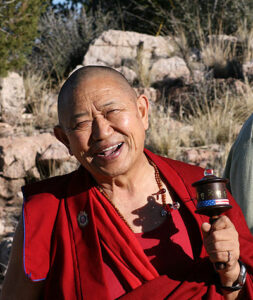
Four Applications of Mindfulness by H.E. Garchen Rinpoche
Four Applications of Mindfulness by H.E. Garchen Rinpoche
March 5, 2020, Garchen Buddhist Institute
Introduction
When practicing shamatha, the four applications of mindfulness are very important. In general, the khenpos teach all the explanations of these, and reading the detailed commentaries again and again is very important. I don’t know the scriptures well. However, if we reflect on the key points of the four applications of mindfulness, we can easily understand a little, and that is of great benefit.
Mindfulness of the Body
What are the four applications of mindfulness? The Buddha first taught mindfulness of the body. When we sit like this, and the body feels some pain or discomfort, we all think this body is so important – our precious human body. It seems so important to us, but if we reflect on it, this body is conditioned – it is not independent. For example, it is like a phone. If the phone’s battery dies, we can’t do anything with it at all. The body is like that. The mind is like space; the body is impermanent.
Thinking, “It is conditioned by nature and not independent,” when deluded thoughts about the body arise, whether about the body or the things of this life, search for their root and see they bring no benefit at all. The body is a passing illusion – a guesthouse, and the mind its guest. If you recall again and again that the body is like a guesthouse, many streams of your delusion will be cut off. Thinking again and again the body is a guesthouse cuts the root of grasping – that is very important for mindfulness of the body.
Mindfulness of Feelings
Then, based on the body, the Buddha taught mindfulness of feelings. Mindfulness of feelings: based on the five sense objects, attachment arises toward the pleasant, aversion toward the unpleasant. If you follow all of that and chase after feelings, tobacco and all sweet things seem pleasant, but they are a great basis of illness. They are all causes of suffering. Medicine and such seem unpleasant, but the unpleasant is a delusion, and the pleasant is delusion too. Even everything unpleasant is beneficial in one way. This body is delusion.
Once you understand it is like a guesthouse, when feelings arise based on the five sense objects such as thinking, “I need more and more nice clothes,” you will notice those feelings right away. You will realize that there is no need for more than three sets of clothes – one to wear, one to wash, and one to change into. Based on the five sense objects such as food and clothing, the afflicted thoughts of attachment and aversion arise within the mind. Whatever arises in this way, they are all causes of suffering for the mind, and causes of obscured wisdom. Once you see all these faults, that is the mindfulness of feelings the Buddha taught.
Feelings arise based on the body. Chasing after feelings, you go astray: “I absolutely need this one!” Strong attachment arises for what you want, strong aversion for what you don’t. Regarding the inner five sense objects, and the outer friends and enemies, the Buddha taught mindfulness of feelings.
Mindfulness of Dharma
Then mindfulness of Dharma: looking toward pure nirvana, there are many different religions. If we reflect on the Dharma, what actually is the Dharma? It is simply a method to purify the mind. The Buddha taught it so that in this life we experience happiness and wellbeing, and in the next travel the path of liberation. Thus, the sublime Dharma is for happiness in both this life and the next. In this world, when each country makes its own laws – decrees and laws based on both worldly custom and religion – if you think these are true and strong clinging to them arises, you just follow after karma.
When you reflect further, in truth they are not independent. That is mindfulness of Dharma.
Now when the Dharma involves partiality towards tenets and the like, attachment and aversion arise based on tenets. Based on that, all kinds of thoughts arise toward lamas and spiritual friends, and all kinds of feelings and thoughts will arise toward all the Dharma they teach. If these bring grasping and aversion, there is no point. Understand the Dharma’s root: It is a method to purify the mind. And what purifies the mind? Grasping at things and signs – all grasping at things and signs obscures the mind, and because of that, phenomena are ruled by karma, cause and effect – they have no independence. Knowing that all joy and pain come from past karma – that is the mindfulness of Dharma the Buddha taught.
Then, when you practice meditation on the mind and look at the mind’s nature – then within the mind, ultimately there is no self and other. Until you see that, relative cause and effect never fail. The essence of all Dharma – love and compassion – is the mind’s friend. Meditate on emptiness joined with compassion. The mind’s only friends are love and compassion. They are also its great protection – love and compassion – compassion joined with love. Thus the mind’s only friends are love and compassion – what does this mean?
Based on love and compassion, when they are in the mind, then naturally – even if you never say a single word to anyone, if love and compassion are in your mind, then naturally, to that same extent you become a cause of joy and happiness for all beings – you bring benefit to yourself and happiness to others. The essence of all Dharma is love and compassion. Through it comes benefit for yourself and happiness for others. All the many words, tenets, and texts that are taught are needed only so the unrealized may come to realization. What is the Dharma, really? The Dharma itself is love and compassion – compassion joined with love. And it must be vast – not just for your own family and relatives. That is mindfulness of Dharma.
Mindfulness of Mind
Then, mindfulness of mind: if you investigate the nature of the mind – as taught in the Middle Way view, and in Mahamudra, Dzogchen, and so on – until you see the true nature of the mind, the ultimate truth, you need the relative truth: immeasurable love born in your mind. Then, examining the mind’s nature, you will understand it right away. The mind becomes vast – it becomes like space, like an ocean. Through immeasurable love, all this can be understood a little.
But without immeasurable love and compassion in your mind, even when you look at the mind’s nature, past karma and merit let you glimpse a little – then it clouds over again. When thick clouds fill the sky, the sun shows a little, then is hidden again – hidden again and again. It is like that. But when love becomes immeasurable, and non-referential compassion joined with emptiness enters your mind, then naturally this nature of the mind is free of every single cloud – it becomes like a sky free of clouds. You see at once that the two are not separate things – emptiness and compassion are not different; they are inseparable.
All the qualities of the three kayas are complete in the mind. The empty essence, like space, is the wisdom of emptiness – like space, free of dualistic grasping. The clear nature is the wisdom of clarity. Its essence can be seen vividly, directly. And compassion pervades all beings.
In general, beings who don’t realize this suffer greatly. For example, take two people. The one with realization stays steady as the earth, whatever joy or suffering may come; nothing can shake his mind at all. Without realizing the nature, even a little suffering is overwhelming, and a little happiness lifts you right off the ground – pride arises from it. For all such suffering beings, based on this realization, as a natural condition, non-referential compassion arises. Even with no single object to direct compassion toward, love naturally pervades everywhere. Compassion pervading all is the nirmanakaya. In the mind’s own nature there is no grasping at all – it is free of grasping. That is the mindfulness of mind the Buddha taught.
The Inner Meaning
As for the inner meaning of the four applications of mindfulness: first, when delusion arises about the body – the guesthouse of earth and stone – cut clinging from the root. Mindfulness of feelings: when clinging to the six objects arises, see they have no essence at all and are causes of suffering. Thinking this, close the door on them – that is mindfulness of feelings. As for mindfulness of Dharma: the Dharma is your path to find happiness and to be free of suffering. Love and compassion are the essence of your happiness. Moreover, you know how to bear the suffering of the present and how to abandon the causes of future suffering. In short, knowing karma, cause and effect, is important. Of all teachings, knowing cause and effect matters most.
Also, in mindfulness of mind – ultimately, one realizes that cause and effect never fail. Knowing they never deceive, self-grasping fades away, and the altruistic mind grows ever greater until it becomes immeasurable. That is mindfulness of mind. As for the mind’s nature: ‘Sentient beings are buddhas themselves.’ What we call ‘buddha’ is the mind. If you realize your mind’s nature, there is no buddha apart from that, anywhere else. You decide this for yourself. Setting that aside – in my own limited understanding, the fruition of the four applications of mindfulness is like that – it is why they are needed, I think. Mainly, it is important to read works of scripture and reasoning.
Aim and Fruition
If you know the aims of the four applications of mindfulness, you think, “this is what I must attain.” With mindfulness of the body, grasping at ‘my body’ must grow smaller. The thought of tending this body with sheer pampering – that way of thinking is cut bit by bit. With mindfulness of feelings, your needs must grow fewer – whatever the sense objects may be, whatever comes along will do. Care mainly for your health, and desires grow smaller – that is mindfulness of feelings. As for mindfulness of Dharma – body, feelings, and Dharma – in mindfulness of Dharma, knowing cause and effect is very important. Cause and effect is the main thing.
Then, in mindfulness of mind – the mind’s nature – understanding cause and effect well, you need the root of bodhicitta. When bodhicitta, the altruistic mind, boundless love and compassion arise, then in the true nature of the mind, there is freedom from all grasping. Knowing this, the mind’s nature is not real – hold it neither as real nor as unreal – be free of all grasping. The mind is like space – that is its nature. Leaning on one side, some think, “it’s emptiness” – that is a mistake. Thinking “it’s a thing” is a mistake as well. Think nothing at all: ‘Without a single thought, decisively look at your own nature.’ In fact this is the view of Mahamudra and Dzogchen.
Mahamudra, Dzogchen, Middle Way – one view under three names. In Mahamudra, the mind is emptiness – nothing at all to identify. And therefore your own mind is vast, like space. In Dzogchen, all of samsara and nirvana is in the mind’s ground. What does the Great Middle Way come to? Non-grasping – grasp nothing at all. Grasping at nothing, resting upon the mind itself, it naturally abides just so – that is the Great Middle Way.
Ordinary Awareness
Mahamudra, Dzogchen, Middle Way – Jigten Sumgön taught these as three natures. Milarepa taught it too – he spoke of the knowing of ordinary awareness. As Gampopa told it, for many years he strove on until the realization of the eighth bhumi dawned. Then, through Milarepa, he understood the practice where ordinary awareness suffices. Dwelling among his five hundred disciples, he said: ‘This practice where ordinary awareness suffices I found through the kindness of a buddha in human form.’ Thus he praised Milarepa. Such ordinary awareness – all of this is Mahamudra and Dzogchen. It goes by great names, with many explanations.
Ordinary awareness is the present consciousness – your own vivid knowing of this present moment, the knowing that does the work. Once you know how to look at it directly, its nature is like space, without self and other. That is the key point of the practice where ordinary awareness suffices. When ordinary awareness turns outward, there is dualistic grasping – self and other.
If you look again and again at awareness’s own nature, self and other become non-dual, and the mind becomes like space. In that, the Middle Way view is naturally present. But if you grasp at it, grasping enters, and there is no view at all. The ultimate goal of the four applications of mindfulness is mindfulness of mind. That is the fruition. There is no thought at all when you know the mind vividly. Then, rest in that state – ‘without a single thought, decisively’ – that is how you gain certainty about the four applications of mindfulness.
At least that’s what I think – but I cannot decide that it is so, for I don’t know much scripture and reasoning. My Dharma friends, this is what I have to say on the four applications of mindfulness.