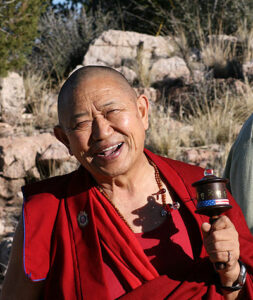
Vajrakilaya Empowerment Teachings w/ Q & A – H.E. Garchen Rinpoche
Translated by Ina Bieler & Transcribed by Florence Lee
Vajrakilaya Empowerment
First, I would like to say Tashi Delek to all my dharma friends, high and low or in between. This gathering is very significant today because it is an assembly of the Sangha. As a Sangha, all of you have come here today to liberate all mother sentient beings from the many kinds of suffering that they undergo, and to bring about their happiness. So that is your purpose of coming here today and I would like to say thank you and first of all to greet you with one Tashi Delek.
In general, Buddhism consists of three levels of the path that is of individual liberation, the bodhisattvas and the Vajrayana path. So today, the empowerment that we receive belongs to the Vajrayana path. These three levels of the path are just like the growth of a flower. From a seed into a sprout and then into a flower. And Vajrayana is like the fully ripened flower. Then the individual liberation is like the sprout that is already growing. But the ultimate fruition is the Vajrayana or the secret mantra. Why is it called secret mantra? It is because although sentient beings possess Buddha nature, they do not realize that. And due to that, they temporarily wander in samsara just like ice blocks floating on the ocean. And in the six realms of samsara they experience various kinds of suffering. But they do not realize what is happening and think that there is this me that is experiencing all this misery. They believe that there is a self that actually does not exist. Due to this false belief in a self, they continue to wander in samsara. As it is said “All suffering without exception comes from wishing for one’s own happiness.”
When that self-clinging is cleared away, then all the other afflictions will be cleared away. Then one attains the state of a Buddha which is just like the water. The afflictions and self-grasping is like an ice-block. So, when the ice has melted, then all sentient beings by nature are actually Buddhas. Ultimately then it is like the ice is merging to become one with the ocean water. Therefore, from the ultimate perspective, Buddhas and sentient beings are actually indivisible. But we have not realized that. So, the reason why we refer to it as the “secret mantra” is because no one has realized one’s own true nature.
We have the three levels of the path of individual liberation, Bodhisattvas and Vajrayana. It seems that the Buddhas teachings are vast and endless. And that may lead one to think that there are so many different teachings and they are all separate. There are different lineages, different traditions and so on. Even though there are a lot of teachings, you should not think in this way. Because the ultimate fruition of the result and the actual essence of the path is really one and the same.
It is just when we follow the Vajrayana path and receive empowerments, we are following the swift path. What we also need to understand is that within a single empowerment, we are actually following all the three levels of the path. Within one empowerment we practice the Pratimoksha, the Bodhisattva and the Vajrayana path. Because during an empowerment we take refuge and we recognize our own suffering and the suffering of others. We want to become free from all suffering, so we take refuge which is the individual liberation. However, we realize that if we want to be free from suffering, for as long as we do not become free from self-grasping, we will never become free from the afflictions which causes all of our sufferings. We realize that the only way to become free of self-grasping is by cultivating bodhicitta. Secondly, also in the empowerment we develop immeasurable love. And when love arises, self-clinging disappears. For example, if you think of the happiness of every being in the universe day and night, then self-grasping will naturally diminish. So, they are usually exclusive. If you are thinking about yourself then you are not thinking about others. If you are thinking about others, you are not thinking about yourself. So, the ultimate path then is the Vajrayana. After having cultivated bodhicitta, you realize that there is no real self. There are no self and no other. That is the actual liberation when we become free of all dualistic thoughts. The ultimate fruition of Vajrayana is to realize non-dual primordial wisdom. If you understand that within one empowerment, you actually follow the three levels of the path. Then we become free of any doubts and we will know that there is actually no separation. It is all inclusive within one single empowerment.
The Buddha taught many teachings and even though he taught 84,000 different dharma teachings, each of them can be further divided into 84,000. Still, we should not just follow words and conventions but rather we should follow the meaning of the teachings. And the meaning of the teachings is complete within a single empowerment. So, the individual liberation, the Pratimoksha, the bodhisattva path and the Vajrayana path are all practiced within a single session of receiving an empowerment. The Buddha taught according to the different mental capacities of sentient beings but still we should understand that the entire path is all included within just a single empowerment.
So, where does the deity from whom we receive the empowerment come from? It is an enlightened being so it arises from the Buddha. It is said that the Buddha is an embodiment of the three kayas. When one attains the state of enlightenment, one actualizes the three kayas. Even though there are three kayas, they are actually not separate. Jigten Sumgon also said that within each kaya, the other two are complete and they are all inseparable. When one attains the state of enlightenment that is when one’s Buddha nature awakens. And within that nature alone, the qualities of the three kayas are complete. Mind itself in essence is nothing but non-dual primordial awareness which is like space. Within space there is no division and no duality. That is the nature of all the Buddhas. Even though there are many we cannot speak of them as either a singular or many. They transcend all these limitations of conceptualization.
Within the space-like nature of the Dharmakaya, all the Buddhas are one at vast expanse. And then the Sambhogakayas appear like rainbows in the sky. But there are two kinds of Sambhogakayas or illusory bodies. There are pure and impure illusory bodies and the pure illusory body is the form of the deity. They have a physical form but also possess great abilities and powers. And it is without any grasping at a concrete true reality of appearances. Limitless pure lands and Sambhogakayas manifest but still from their perspective there is no grasping at a duality.
Then, there are other sentient beings who do grasp at a self and other duality. And when they pass away, they become an impure illusory body like the bardo consciousness that has a mental body. But that is still grasping at a self and other duality and therefore bound to experience much suffering. Within the state of the pure illusory body that is the Sambhogakaya, there is no dualistic grasping. Even though they may see each other in billions of ways, it is like seeing their own self projections.
Sambhogakaya also means enjoyment body because they are enjoying or partaking of their own self perceptions. Even though you may have millions of different Sambhogakayas, they do not see each other as separate. And while they interact with each other there is no grasping at a duality.
For example, it is like a large tree with many branches and the tree knows that the branches are not separate. So, there is no dualistic perception from the side of the tree. But samsaric sentient beings think that they are the branches and are all separate individuals. Due to this belief in a separate existence, they develop many ordinary thoughts of attachment, aversion and ignorance. So, this is what creates the impure illusory body.
Regarding the pure illusory bodies of the Sambhogakayas, they are there clearly appearing but yet ordinary beings cannot see them. That is because for as long as we have not purified dualistic grasping, we cannot directly see them. Bodhisattvas can see them directly but whether we see them or not, they are always naturally there. The Sambhogakayas are said to possess five certainties and if we understand that then we will know that whenever we practice and supplicate them, they are right there. When we supplicate them it is like opening a temple door to see them.
When you understand that you will develop a trusting faith that they are always present. These five certainties of a Sambhogakaya are first, the certainty of the place which is the Akanishta Pureland of the Dharmakaya. Secondly the certainty of the time which is the timeless wheel of time. Thirdly is the certainty that the teacher is the 6th Buddha Vajradhara. Fourth, that the certainty of the dharma is the teachings of the Mahayana. Fifth the certainty that the retinue are the Bodhisattvas dwelling on the higher bhumis (the tenth bhumi and so on). So, these are the five certainties of a Sambhogakaya. There are limitless emanations of these Sambhogakayas and Purelands.
So, then there are many different purelands such as the Pureland of Dewachen and so forth. Within these Purelands there are these limitless pure emanations or pure illusory forms of the Sambhogakayas. And that is the nature of the deity from whom we now receive an empowerment. So, the deity from whom we receive an empowerment is a Sambhogakaya. And because their nature is a single one, although they might be many we need to understand that within a single deity all the deities are complete. The mind of all the deities is the Dharmakaya and their physical appearance is the Sambhogakaya.
They appear in various different ways, peaceful and wrathful just like many rainbows appearing in the sky. Each of the strips of rainbows having different colours. Yet even though they appear in different colours, they have the same essence. Their essence is empty and their nature is clear. Even though there are many deities, peaceful and wrathful and so on, it is important to know that when you receive the empowerment of a single deity, you are connecting to all the deities. Therefore, if you practice a single deity, it is like practicing all the deities. And if you understand that you really have understood the meaning of the Vajrayana.
Otherwise if you don’t understand then you might think that I have to practice this deity and run into conflict. Because you might think that if I practice this deity then the other deity will get jealous as you have neglected him. Then you begin to see everything as separate. Don’t approach it in this way but really see them all as one and the same. Even though they appear in different forms, colours and different implements (peaceful and wrathful), their essence is the same.
So next, we come to the conference of the Vajrakilaya empowerment. And for that we will read the historical background. In brief the peaceful form of Vajrakilaya is Vajrasattva and the wrathful form is Vajrakumara. If you understand the highest view, you understand that in essence there is no difference between peaceful, wrathful and so forth.
The disciples who are receiving the empowerment and also the vajra master who confers the empowerment are all Nirmanakayas. Moreover, all sentient beings are Nirmanakayas because all sentient beings of the six realms of samsara possess Buddha nature. So, there is not a single being that is impure by its nature. By their very nature all beings are pure. Buddha had said that all beings are only obscured by adventitious temporary stains. And that is why all beings of the six realms of samsara are actually Nirmanakayas.
Often disciples ask “so then if that’s the case in the three lower realms for example the animal realm. If they are tulkus or Nirmanakaya then whose tulku are they?” Here Jigten Sumgon had said that karmic ripening is the momentary appearances and reflections of one’s inner thoughts. Which means that hell for instance is the natural manifestation of hatred. So, hell beings are the tulkus of hatred. And in the animal realm, an emanation of hatred would be a poisonous animal like a snake or a scorpion. Some animals that causes a lot of harm and scares humans or other beings. So that is just a temporary appearance and ultimately, they all possess Buddha nature. But temporarily they are under the control of the affliction of hatred.
So hungry spirits for example are tulkus of stinginess and the animals are the tulkus of ignorance. Tulkus or Nirmanakayas also means that it is something that arises only temporarily. Ultimately, when their karma becomes purified through bodhicitta, then again they become liberated from these states. It is a temporary illusory state and when we reach the state of a vajra-like form of enlightenment then there is no more change.
Jigten Sumgon also said that on the ultimate level the two truths are actually indivisible. So when one attains the state of enlightenment, there is no more division between the two truths. And that is because the relative truth is the workings of karma, cause and effect. That is ultimately empty because what is empty is the self. The self does not actually exist and when the self becomes eliminated then naturally all karmas and habitual imprints become eliminated. Then there is no more cause, the cause has become empty. When there is no more cause then there is no more wandering in samsara. It is because ultimately all beings possess Buddha nature and whatever appears is only temporary. And this temporary appearance is the tulku or the Nirmanakaya. In the human world there are us human beings who are ordinary and who are to be tamed. And then there are those spiritual masters who tame them.
There are many great masters in this world who are just like Buddha himself, for example His Holiness the Dalai Lama. So, all of us appear as human beings but the difference is within the mind. Their minds are liberated and they are also able to show the path of liberation to others. Ultimately, all beings are Buddhas, those who tame and those to be tamed. So, us who are receiving the empowerment, we are all Nirmanakayas. With that knowledge you seek refuge in the three jewels with faith and you cultivate the basis of bodhicitta. In this way, the mind becomes pacified and ripened, and that is the purpose of the empowerment. The Nirmanakaya is still in an unripe state and in order to ripen, it needs to cultivate bodhicitta.
Bodhicitta is like the seed of a flower. You plant it into the fertile soil and then you water it. Then finally the flower can grow and the purpose of making it grow is the empowerment. The deity from whom we receive the empowerment and the blessings of the empowerment falls down from space. The Sambhogakaya deity is always like a mother and even though the mother wants to protect the child, she can’t. It also depends on us if we have no faith and no devotion, then it would be difficult for the deity to protect us. But if we supplicate to the deity with great devotion it is like opening the temple doors and we receive all the blessings of the deity.
This is because sometimes people think that I only receive the empowerment if the vase has been placed onto my crown. And if it has not, then I have not received the empowerment. But this is completely untrue and it mainly depends upon your devotion. For example, His Holiness the Dalai Lama confers the Kalachakra empowerment also though the internet. And people all over the world receive the empowerment. In fact, this is also how I myself receive empowerments and the benefit is exactly the same. Sometimes it is even better because then you don’t even have to undergo all the hardships of going somewhere and so on. This is how we need to understand the blessings of the deity. So, the quality of the deity is that they possess omniscient wisdom. They are always present and also always regard all sentient beings. Secondly, they love all sentient beings just like how a mother loves her only child. This is why we can receive the empowerment from wherever we are.
So, if you have an ideal disciple and an ideal vajra master, then the blessings of the empowerment can really be tremendous. But even if the vajra master doesn’t have all these great qualities but the disciple has strong devotion. Then just through the power of great devotion, he will receive all the blessings of the empowerment. In any case, the most important quality a vajra master must possess is great compassion. Milarepa also had said that “It is more important for a true authentic master to possess immeasurable compassion than to possess all the various transmissions and instructions.” So, if we connect in this way, to the vajra master and the deity, then the mind stream can ripen. So, the disciple must cultivate faith and if the disciple doesn’t cultivate so much faith, then not many blessings can be attained.
Let’s say if the vajra master doesn’t have a lot of compassion and if the disciple doesn’t have so much faith then this empowerment becomes more like an ordinary business deal. But still the results will ripen and it is said that at the very least the results of the empowerment can ripen after 7 lifetimes. So, this is how precious an empowerment actually is. And in the Sutra path, we speak about the practice called “sojong” or the restoring and purifying. How we purify is by having received a bodhisattva vow. Then when we receive an empowerment, the empowerment is like the “sojong” of the vajrayana or the secret mantra. So, when we practice a deity, we should know that the deity is always present. It is just that when we practice and supplicate to the deity, then we will connect to the deity. Next, we come to the historical background of the empowerment and then I will offer the empowerment.
The torma ritual of the single form of Vajrakumara form the three cycles of the secret drop or the inner essence. The single motivation of bodhicitta thinking in order to set all sentient beings extensive as space on the level of Mahashri Vajrakumara, I shall receive the profound blessings of the empowerment and engage in the practice of the path. During times of peace the Bhagavan Heruka Vajrakilaya manifests as glorious Vajrasattva. In the context of the outer sections of the secret mantra he appears as Vajravidarana. When manifesting as a bodhisattva he is Vajrapani the lord of secrets. In brief all Buddhas are emanations of Vajrakilaya. His essence is the primordial wisdom of all Buddhas. He appears in the form of Karma Heruka, the embodiment of the secret enlightened activity. It is said in the tantras that he is the wisdom form of all Buddhas. The terrifying form of blazing wrath that arises from the very nature of Vajradharmadatu. The tantra of secret states Vajrakumara’s form is the fundamental nature of everything.
In India and Tibet, masters who have attained common and supreme siddhis relying on the exalted deity appear like stars in the sky. In particular at this time when maras and samaya violators who have infiltrated the Buddhas teachings are rampant. This exalted deity is praised as the means to subdue them. Padmasambhava said “if one who practices this and nothing else without hesitation or doubt would not accomplish the wishes. Then I, Padmasambhava, would have deceived the people of future generations.” However as his vajra speech is undeceiving, in this final age of strife when other mantras lose their power, Vajrakilaya’s form will become manifest to subdue obstructing demons.
As the attainment of siddhis has been uninterrupted, this deity has become renowned as the single meditational deity amongst scholars and accomplished masters of the new and old tantric schools. There exist concise and extensive sadhanas in different traditions through which these teachings were transmitted. Namely as the lineage of karma, the oral transmission lineage, the lineage of Terma, the lineage of discovered treasures and the lineage of pure visions. Of these, these teachings endowed with wisdom blessings belong to the near lineage of terma and are like the warm breath of a dakini from which the vapor has not yet disappeared. Beyond doubt these teachings are timely and profound. The great treasure revealer and king of the dharma Orgyen Chokgyur Dechen Lingpa who discovered the ocean- like number of termas revealed this terma on the tenth day of the monkey month in the year of the sheep. From the secret cave of Padmasambhava situated on the right cavern in the shape of Heruka at Tsadra Rinchen Drak. It is at a sacred place in the Upper retreat centre at Palpung Monastery.
The activities conferred in the torma empowerment of the single form of Vajrakumara called the vajra essence from the three cycles of the secret essence are completed. Next the disciple should offer a mandala.
The root of suffering of all mother sentient beings limitless as space is self-grasping. The self-grasping of all those beings and your own is really one and the same. So, bring that to mind and think that you are offering it all up along with the entire outer universe and everything that appears and exists. Offer it all up to the Buddhas abiding in the space before you. And think that in return having made this offering, they grant their altruistic mind which then falls down like rain. In this way think that you and all beings have now received their mind of the four immeasurables. So, thinking in this way, we now offer a mandala.
Now, think that all the Buddhas of the three times appear in the sky before you in the form of the glorious great Vajrakilaya. Just like clouds gathering in the sky and think that in their presence you supplicate to receive the empowerment.
So next, please repeat the following supplications: “Great glorious Heruka, having bestowed blessings on me through Vajrakumara and consort. Please bestow the supreme empowerment of body, speech and mind. From today onwards until attaining enlightenment, I and all sentient beings limitless as the sky take refuge with one-pointed devotion with our three doors. Repeat the following supplications in the presence of the guru who is indivisible from Heruka Vajrakumara who embodies the essence of the three jewels and three roots.
Guru, three jewels, Heruka and Dakini, I take refuge in you, ocean-like places of refuge until attaining awakening. So, we just said “I take refuge until attaining awakening” and that is a very significant point. There are two kinds of bodhicitta of the mind of awakening. First for as long as we still perceive a duality of self and other, we have to consider others as more important than ourselves. So, until the point where we only think about others and nothing else, we have to train in the altruistic mind.
Finally we cannot even think about ourselves anymore. So, then you have cultivated the four immeasurables and all concept of self and others have disappeared. Then you realize that all beings are actually Buddhas. So, you realize that your own mind, the guru’s mind and the Buddhas mind are indivisible like space. Because within space there is no duality. Ultimately there is no duality between the protector and the protected. But until that is realized, we need to engage in practice and we need to protect others until there is no more dualistic grasping. And when that happens, that is when you attain awakening. So, it is important to understand the difference between primordial wisdom and ordinary consciousness.
Primordial wisdom realizes that there is no duality of self and other. Whereas the dualistic consciousness perceives a duality. So that is the point that you should reflect upon over and over again.
I shall attain the state of perfect awakening for the sake of all sentient beings. I shall receive the profound blessings of the empowerment to ripen my mindstream and thereafter engage in practice in order to subdue the host of evil forces who cause hindrances on the stages and paths. Ultimately, I will attain the state of the great glorious Vajrakumara. Thinking thus, please repeat the following supplications.
Wishing to attain complete Buddhahood for the sake of all sentient beings, I shall attain the state of the great glorious one in order to subdue obstructing demons. I offer the eight branches of confession, the essence of accumulation and purification. By paying homage and so forth to the oceanic clouds of the infinite field of accumulation. The guru, yidam, daikini and dharma protectors. The space pervading mandala naturally manifests from the liveliness of all pervasive dharmadhatu, the heart of the glorious guru Heruka Vajrakumara. Contemplating thus, please repeat the following:
Homage to the vajra master, who is indivisible from all the glorious Buddhas and who is present throughout the three times. In the three jewels which are the basis of the teachings, I take refuge with an undivided mind. Please accept these pure offerings both real and imagined. I confess all wrong doings without exception. The hindrances that cut the flow of accomplishments. I rejoice in the activities of three fold purity performed without attachment throughout the ten directions. I give rise to perfect bodhicitta untainted by the four extremes. I offer the body of three purities to the Buddhas and Bodhisattvas gathering in the virtues collected throughout all lives for its great awakening.
So, there are eight branches according to the secret mantra and in the sutra path we speak about the seven branches. So, what’s the difference? In the eight branch is where we say “I offer my body of threefold purity.” What that means is that the three purities are the pure fields or recipients of the offerings that is the three jewels. Secondly the pure offering is one’s own body and the pure motivation is the altruistic mind. In this way we offer our body, speech and mind single-pointedly to the Buddhas by directing body, speech and mind of virtue. And now having offered body, speech and mind to all the Buddhas, means that from now on we must engage in the acts of benefitting sentient beings. So, this is the difference between the seven and the eight branches
The main thing that we need to offer up is our self-grasping and that is why we offer the body. The body, speech and mind actually arises from the concept of ‘me’. So that’s what we need to offer up. When we come to the practice of the deity, then we visualize the form of the deity at the generation stage. We purify the ordinary habitual imprints and obscurations of ordinary form. It is said that in general, the visualization of the deity is the antidote to this grasping at the body as the self.
But for a beginning practitioner, it is very difficult to begin with the entire visualization of the deity. If you are able to bring to mind the deity, then you should do that now. Like the picture you have received, bring the image of Vajrakilaya to mind. It is enough if you just have it in mind. And for your ongoing practice, the visualization or the focus that you should sustain is the “Hung” ཧཱུྃ syllable. Visualize it either at your heart or at the navel. The “Hung” represents the mind essence of all the Buddhas of the three times. Even though you might receive a hundred empowerments, all the deities have a single mind essence.
The body, speech and mind of all the deities therefore are represented by the syllables “Om, Ah, Hung”. Ultimately all the different sadhanas gather into the seed syllable Hung at the dissolution stage. As the Hung represents the minds of all the Buddhas of the three times, so if you want to practice all of the Buddhas then you should just visualize “Hung”. ཧཱུྃ
If you just think of “Hung” in your mind then there is no concept of a self. Then just naturally there is no thought of self and other and the mind remains in its natural state. Single pointedly now meditate on the “Hung” clearly and what is important here is the sound of “Hung”. So, have this sound “Hung, Hung, Hung” in your mind. For as long as that is clear in your mind, no ordinary thought will arise. And so, for the beginning this is sufficient as the generation stage. First you cultivate a wish to benefit all sentient beings and then think that in an instant, this altruistic state of mind becomes the syllable “Hung’. And then your mind has become “Hung”. So now focus on the Hung syllable single pointedly.
So, now you can close your eyes and just focus single-pointedly on the ‘Hung’ syllable. And if a thought of others arises, then think of self and others all as ‘Hung’. When you visualize and focus single-pointedly on ‘Hung’, then naturally a protective sphere of refuge forms around you. That is because all ordinary imprints and karmas arise from this sense of a self. When that is absent, and when there is only an altruistic mind, one naturally becomes included in the protective sphere.
However, if one’s mind is not focused and you don’t have “Hung” in mind, it would be difficult to find yourself in this protective sphere. Because then there is this concept of self and that will naturally follow ordinary karmas. So, the ‘Hung’ syllable is really very precious. Now you close your eyes and visualize ‘Hung’ and later when you are asked to open your eyes, at once look at the image of the deity that you have received. And have that appear in your mind. Also repeat this again and again later on when you engage in practice. Look at the image and close your eyes and have that image appear in the mind over and over again. Have this image appear with the greatest faith and devotion toward the deity. Eventually the deity will appear in your mind with all its clarity. But mainly what makes the one thing that causes the deity to arise clearly is the altruistic mind. When the mind is altruistic it is clear, just like a clean mirror.
So now, in this way, you will actually accomplish the deity. Please remember this and keep that in mind. It is said that in general when we visualize the form of the deity, we purify the obscurations of ordinary body. So, what really happens is that when we keep the deity in mind continuously, you begin to forget about your ordinary body. For example, it is just like a mother who only has one child. She can only think of her child even when the child goes out. She never forgets about her child. Similarly, you practice the deity to the point where the deity never again leaves your mind. The trust and the love that you have developed for the deity is so strong that the deity can never leave your mind.
For example, you train yourself by instantly calling the name of the deity whenever you encounter difficulties. There is actually one tradition which Tibetans have is that whenever they encounter some difficulty, immediately they will call for Tara or the three jewels. And if you have this habitual imprint, then later in the bardo, when the terrifying manifestations appear. If you are able to remember the deity then at that time because your Buddha nature is there, you will actually be protected. So that is why this point is extremely important.
So, it is important that you remember the deity over and over again. Especially when you encounter difficulties, immediately remember the deity. Because the mind is like a mirror and if the mind is clear, you will be able to remember the deity. When the form of the deity appears in your mind again and again, then the imprints of the body becomes increasingly purified. And through the mantra recitations, you purify the imprints of the speech. So, the visualization and the mantra recitations are like the soap that you use for washing clothes. As you keep applying it the impurities and defilements will eventually disappear. So that is the purpose of visualizing the deity and reciting the mantras. You purify the imprints of body and speech. When these become purified then these fixations (on form and sound) will not arise any longer and the mind will remain in an unobscured state. Then everything that appears becomes just like an illusory display.
What’s most important is to purify the mind through an altruistic mind. In fact, if the mind becomes pure in this way, then everything else becomes naturally pure. This is a very significant point that you really have to experience through your own personal practice. And if you attain such freedom of mind through the generation stage, then in the second bardo you will attain enlightenment as the deity by only remembering the deity.
Now, we take a break for 30mins and during this time continue to remember the ‘Hung’ syllable and also you can say it out loud verbally. In fact, from now onwards until the end of the Drupchen visuslize the ‘Hung’ either at your heart or at your navel. That is why many people have it printed on the T-shirts or other objects so that we always remember it. So, think that every person here is ‘Hung’ and you are ‘Hung’. Because what the person really is, is the mind. The mind really is ‘Hung’ so in this way, if you sustain awareness of the ‘Hung’ then that really becomes the generation stage.
This empowerment is conferred based on the torma and it is the sacred substance that authorizes us to engage in this practice. In general, these various objects like the torma, the vase or the stupa, have all the same essence. These are also skillful methods given by the Buddha to benefit beings. The torma is like a large hotel and it is the celestial palace of the deity. Basically, the torma has four main qualities. Number one is that it is the immeasurable palace or the mandala of the deity and all the wisdom deities can fit in this large hotel. What fits in there is their space-like nature of mind that is love. They can be very large or they can be very small. They can even fit within one single mustard seed.
There is also a story about Milarepa who made himself small to enter a yak’s horn so he could still fit in there. And at other times he could be very large for example when he travelled over the Manasarova Lake. The same is true for the deity who is a wisdom being. It can be anything large or small because as we mentioned before, everything is possible because everything is empty. Anything can arise. So, with the mind we can create anything and that is because it is empty of self nature.
The first quality of the torma is that it represents the immeasurable palace of the deity which is like a large hotel. Tens and thousands of deities can all fit in there. The second quality is that the torma represents the deity itself. Just like in a large hotel you have a lot of people staying in there. The third quality is that the torma also represents the offerings just like in a large hotel you find many things that are pleasing to the senses (the five sense pleasures and so on). Nowadays in this world, we can find examples like that like a large hotel. In the past, there wasn’t any example for people to imagine or visualize when this tradition emerged. But now in this world everything is already here so it’s easy to imagine or visualize anything.
The third meaning of the torma is that it is an offering. From the torma limitless offering goddesses manifest who all perform offering mudras and bring offering substances which are made to all the Buddhas. So countless offerings are emanated from the mind. The fourth quality is that the torma represents the siddhi or the accomplishment (or the blessing). The torma is really like the essence of all the blessings of the deities combined. What it means is that the root of all suffering is self-grasping and the only method is the altruistic mind which is all the minds of the deities.
For example, a mother raises her child by giving the child milk. So, in the future he will be healthy and strong. Similarly, the medicine to all suffering sentient beings is the altruistic mind. It diminishes self-grasping. Normally the torma is made out of some dough that we can eat. But today you will receive those blessing Mani pills which actually have the same meaning. They exist throughout all the different buddhist traditions. What they represent is the condensed essence of all the deities love. The love abides within those pills and that is really what we call a blessing. It is something that is infused with the deities’ love.
And then also through the torma the four enlightened activities are accomplished. In this sense it is also a siddhi or an accomplishment. Whatever prayer you make will be accomplished. For example, the peaceful activity of pacifying illnesses and difficulties. Increasing activities of increasing merits and life span. And overpowering activities of overpowering the afflictions and all appearances. Wrathful activities of taming and destroying all obstacles and afflictive emotions. These four enlightened activities are also represented by the four directions of the mandala itself. So, this is the fourth meaning of the torma which is a blessing. In this sense it also becomes a skillful means for taming our afflictions. These are the four meanings of the torma.
Whatever object you have at home (like a torma or a stupa) think that when you put it up on your shrine, the deity is always there. And everything that you possess in your family home, whatever you eat or drink think that you are always offering to the three jewels. Also think that ‘I own nothing, everything that I have is owned by the three jewels’. If you always think in this way it will become a very powerful antidote to self-grasping and it is also a way to accumulate great merit. So that is a very important instruction.
So today, we have received the empowerment of body, speech, mind, including the qualities and activities of the deity through the torma. First, we receive the form empowerment and Rinpoche is holding up the torma with the image. So here you visualize and think that the deities who abide in space are reflected in this image just like in a mirror. Then gradually light rays radiate from the deity. First from the ‘Om’ at the forehead, white light radiates and dissolves into your forehead. In each sunray you have many light particles and think that each of these light particles in those light rays become small wrathful ones whose nature is primordial wisdom. This light then shines onto your forehead and dissolves into your body. All ordinary imprints of form are purified and you have attained freedom of form.
What’s the quality of that? If you remember the deity now, you will also be able to remember the deity in the bardo. For example, every time you wake up from sleep, if you are able to remember the deity instantly, then also in the bardo you will remember the deity instantly and enter the form of the deity. What happens if you do not attain this freedom? It is then that ordinary consciousness will go into the bardo which follows the winds of karma. This will bring you to wander anywhere in the six realms of samsara. That is why it is very significant to habituate to the deity. This is really how you gain actual freedom through the empowerment.
So, that is the form empowerment and then for the speech empowerment, red light rays radiate from the ‘AH’ from the deity’s throat. This purifies grasping and fixations to speech and sound. This is what most of us probably cling to the most which is the sound that we hear. So through these light rays, think that the imprints of the grasping at sound becomes purified and we attain freedom of speech. And for the mind empowerment, from the ‘Hung’ syllable at the deity’s heart, blue light radiates and dissolves into your heart. This dissolves dualistic clinging and you attain freedom of the mind. So, in this way, light radiates through three stages. First white ‘Om’, second red ‘AH’ and third blue ‘Hung’. We will now read the visualization for each of these sections when we get there. We will introduce you to the visualizations in stages.
The torma vessel is a terrifying blazing palace arisen from the dark blue triangular expanse of dharmadhatu. Which has arisen from a blazing mass of fire and the torma appears as a wisdom being. The Bhagavan Vajrakumara with the consort, the ten wrathful ones, the tratap deities, the gatekeepers and the assembly of old gone ones gather like billowing cloud. From the ‘OM’ at the wisdom deity’s forehead, white light and limitless small white wrathful ones stream out and dissolves into your forehead. All misdeeds, obscurations, illnesses, negative influences and hindrances related to the body are cleared away. And you attain the siddhi of magnificent power. Think that the blessings of enlightened form have entered your body.
Next visualize that red light rays radiates from the throat of the deity along with small red wrathful ones and dissolves into your throat. Now think that from the ‘Hung’ at the deity’s heart blue light radiates and along with limitless small blue wrathful ones stream out and dissolves into your heart. Purifying the mind and so in this way, your body speech and mind becomes purified and your body is rendered into a rainbow-like body.
Together with the speech empowerment you also receive the mantra transmission and for that, visualize that the mantra syllables descend down from space. Falling down like rainfall and as you repeat the mantra, think that you receive the mantra which is the nine syllable mantra. (Om Benza Kilikilaya Sarwa Bighanen Bam Hung Phet). Which then begins to circle around the ‘Hung’ syllable. The mantra that we are going to recite is a little bit longer. But this is a root mantra which begins to circle around the ‘Hung’ syllable. So, think that you have now received the mantra transmission.
Now, we have gone through each of those visualizations. But later when the torma is actually placed onto your crown then think that from the torma multi-coloured light nectar emerges like a stream which enters your crown. This pervades your entire body and having pervaded all the channels of your body, think that your body has now become translucent like a rainbow. Then think that the blessings have dissolved into the ‘Hung’ at your heart or navel. And after that throughout all activities remember the syllable ‘Hung’.
The blessings descend down from space through the power of our faith and devotion. Then it is absorbed into the entire universe and all sentient beings. Therefore, everyone who is following us on the live stream also receives the exact same blessings as everyone else.
Now, we come to the conclusion of the empowerment which is the samaya and it is said to be the life force of the empowerment. The samaya is two-fold, there is the root samaya and the branch samayas. The root samaya is always the same even if you receive a hundred empowerments. If you do not keep the root samaya then all the other practices and samayas will be empty. The root samaya is really indispensable. Some people say that it is better if you don’t receive an empowerment because if you do, you will also receive a samaya. And if you don’t keep that samaya, you will go to the lower realms. But that’s entirely not true because as we have learnt before, the ultimate samaya is love. It is the precious bodhicitta, the love for all sentient beings. It doesn’t matter whether they have received the empowerment as whoever separates from love will fall into the lower realms. And they will never be able to raise themselves from the lower realms.
That is why the Buddha said as a special method that you have to by all means cultivate love. That will be the temporary and ultimate happiness. We also received the Bodhisattva vows the other day and we said that this is the one and only cause of all happiness. And if you just keep this samaya that encompasses the samaya of one hundred empowerments. Because what we call a deity is really nothing else but bodhicitta. Bodhicitta is the mind of all the Buddhas of the three times. Regarding the other branch samayas, if these are broken, they can always be restored through confession. But bodhicitta really is indispensable and if you neglect bodhicitta then you will fall into the animal realms after this life. Therefore, hold on to bodhicitta really well. We will now repeat the bodhicitta prayer in Tibetan then in English and Chinese too. Remember just that because otherwise then all these teachings and many words that I have spoken will become meaningless.
May precious bodhicitta arise where it has not yet arisen
May it not decline where it has arisen
And may it ever further increase
Vajrakīlaya Q&A
Translated by Ina Bieler in 2019, transcribed by Fiona Rose and Jeniva Yeo in 2019, and edited by Dan Clarke in 2020
Question: Why does one of Vajrak ī laya s vajras have nine spokes, while the other has five?
The nine spoked vajra is a sign of his having traversed and mastered the nine vehicles of the path of the Secret Mantra Vajrayāna. There are three main levels, or vehicles, of the path the Individual Liberation, the Bodhisattva, and the Vajrayāna and each of these is further divided into three subdivisions, making for nine vehicles in all. Each vehicle denotes a further progression of our experience along the path; thus, having reached the highest pinnacle of the path, Vajrakīlaya has a nine spoked vajra. But you should also ask Khenpo Tenzin about this.
The five spoked vajra is a sign of the five buddha families and their consorts, so it is related to the five afflictive emotions that ripen into the five wisdoms. It is also related to the five elements of our bodies, but in general, the vajra represents the mind, wherein the five afflictive emotions are found. So, taken all together, on the outer level we have the five elements of the body; on the inner level we have the five afflictive emotions; and on the secret level we have the five wisdoms. So in summary, the five spoked vajra is related to the five buddha families, while the nine spoke d vajra is related to the nine vehicles or stages of the path.
Question: If Amoghasiddhi is the crown ornament for Vajrakīlaya and the ten wrathful ones, why do the depictions of the field of merit on the thangkas always show a garuda above Vajrakīlaya s head? Why isn’t Vajrasattva above his head?
The garuda is more like an outer ornament, or an outer sign, of the deity s wrathful ornamentation. For example, in the Yamāntaka Praise of Signs, it says that, on the outer level, the garuda is a sign that the deity has conquered the earth lords. Similarly, the eight charnel ground adornments and the glorious adornments of a wrathful deity also have symbolic outer meanings. In terms of the activities of the five buddha families, their wrathful enlightened activity is mainly assigned to Amoghasiddhi. So Amoghasiddi is the crown ornament, while the garuda is more of an outer ornament. There is probably also a deeper meaning to the garuda, but here it is Amoghasiddhi, who represents the wrathful enlightened activity.
Question: What does the mass of fire that he is holding in his hand represent?
The mass of fire that he holds is a sign of the primordial wisdom that burns away all karmic and saṃsāric imprints. Powerful thoughts and afflictive emotions all arise due to dualistic grasping, and here they are all burned away by this fire of wisdom awareness. And since they do not inherently exist, all feelings generated by such thoughts and afflictive emotions are also destroyed by the power of this awareness. In reality, there is no duality, so the mass of wisdom fire is a sign of wisdom awareness having burned away all of the afflictive emotions.
Question: In the fourteen root tantric downfalls, it says, To conceptualize phenomena that are without names and labels is the eleventh. What does this mean?
This means that on the ultimate level of reality, there is no duality. Still, we often conceptualize this ultimate reality: we analyze it conceptually in terms of how it does and does not exist. So even though ultimate reality has no names or labels, we still conceptualize it, and in doing so, we are conceptualizing something that is actually like space and the dharmakāya is like space. And because ultimate reality transcends duality, all of our grasping toward it and all of our conceptually biased thinking about it are all based on confusion. Conceptualizing ultimate reality in any way is confusion.
But since we are speaking here about the root downfalls, the most important downfall these days is the third, which is to get angry at a vajra brother or sister. This downfall is highly neglected nowadays; people don t pay much attention to it. A vajra brother or sister, or a vajra sibling, is someone with whom we have received empowerment and with whom we are practicing the Secret Mantra; thus, such an individual is like our sibling from now until enlightenment is reached.
Whenever a transgression occurs between vajra siblings, it must be confessed and purified immediately. Often, people think: I got angry; now I’ve lost that samaya. And we do break it by getting angry, of course, so we must confess the anger. Anger does a rise; there is nothing we can do about it: it arises. But if it arises in the morning, we should be able to feel sorry for it, apologize for it, and confess it by that afternoon, by relying on the two truths and so forth. And through making our confession, no more grasping at the anger will remain within the mind. In any case, the anger needs to be laid aside.
Question: In the last paragraph on page seventeen, it says, Within the heart of myself as the principal deity is Vajrakīlaya. Is this deity alone or in yab yum aspect?
The wisdom being at the heart of yourself as Vajrakīlaya is without a consort. Actually, on the ultimate level, there is no male or female; it is only due to our ordinary thinking, our holding on to the reality of appearances, that things appear in a dualistic way. In reality, though, there is no duality, not even between a couple. Even though they appear separately as male and female, their mind is of a single basis. So this is what is represented here by the wisdom being at the heart.
When shown in the aspect of male and female in union, or yab and yum, the deity represents the mind s quality of clarity and emptiness in union. The male, or yab, represents clarity the clear mind while the female, or the yum, represents the mind s emptiness. So the crystal clear awareness, which is the male, is empty, which is the female. In the Restoration section of the text, it says that the samaya with appearance the father is restored, and that the samaya with emptiness the mother is restored. And ultimately, this state of union between the yab and yum this innate unity of clarity and emptiness is a state of great bliss. This means that if you always remain within the clear and empty nature, there is really no suffering whatsoever.
However, until we realize the ultimate, we still speak about the relative and ultimate truth, so there is this union of emptiness and compassion. Therefore, in terms of whether or not you should visualize yourself with a consort, if the deity has a consort, you should also visualize the consort but with the understanding that, ultimately, male and female, or yab and yum, are indivisible. So as long as we still have a dualistic perception, we visualize the yab with consort, but with the understanding that their basis of mind is one and the same. And in this way, for example, we see all males as Chenrezig as the yab and all females as the yum, the female principle. But we do this knowing that, ultimately, male and female do not exist. So even though all beings appear as male or female, when you realize the ultimate truth, the experience becomes non dual: there is no more duality between male and female.
Question: For the mantra recitation at the top of page eighteen, there is a golden vajra with a HŪṀ at its center, and the HŪṀ is encircled by the mantra. Do the vajra, the HŪṀ and the mantra all rotate, or is it just the mantra that rotates?
It is just the mantra garland that rotates, that spins. The HŪṀ and the golden vajra do not turn. So at the hub of the golden vajra is the HŪṀ which is surrounded by the KĪLI KĪLAYA HŪṀ PHAṬ mantra, and this mantra is what rotates, not the HŪṀ or the vajra.
Question: The mantra is so small in this visualization. Does one need to visualize each mantra syllable clearly?
Here a beginning practitioner would focus more on a coarse visualization of the syllables. Over time, you can then begin slowly reducing the size of the visualization, making it more and more subtle, to the point that it eventually becomes non conceptual very, very subtle. But this happens naturally as your awareness becomes increasingly more clear: as your focus becomes more and more sharp, the visualization just naturally becomes more and more subtle. And when the mind becomes extremely sharp, extremely clear, you will be able to visualize even the tiniest of syllables. Then the mind is so clear and the wisdom awareness so sharp that the visualization arises very clearly in an instant. But, of course, this is more difficult in the beginning.
Actually, scientists do something similar to this nowadays when they perform very subtle work. For instance, when they are producing a watch, their work becomes very fine, very detailed. Even though we often can t even see it with our eyes, they are still actually fabricating the watch with their hands. Their work is very fine, very small, and in this way, even this kind of scientific work has a quality of wisdom.
But for us, for now, in order to accomplish the visualization of the mantra, we need to approach the practice in stages, which is why we follow the four branches of the approach and accomplishment. To do so, you begin by first just visualizing the mantra syllables of the mantra garland. Once this visualization is stable, you then begin slowly rotating the mantra, accelerating the rotation over time, until the mantra is turning very fast. Lastly, you visualize light rays radiating out and gathering back.
Accomplishing all of this is something that requires intense and persistent practice over a long period of time. As you recite the mantra, you will need to focus single pointedly on the mantra garland visualization. We have been accumulating karmic imprints within our mind since beginning less time in saṃsāra, and we have habituated to them to the point that they are very thick. They can only be eradicated slowly, over time, through the training and practice of visualizing with single pointed focus. Through such practice, the mind will become more and more clear, which is a sign of having purified obscurations. And in the end, after all obscurations have been purified, you can simply remain within the visualization, without even needing to meditate. This is what happens when you achieve a state of non distraction. But until then, you need to habituate through training and practice to the visualization.
Question: What is the meaning of the term life force in the Vajrakīlaya sādhana?
Life force has both a relative aspect and an ultimate aspect. From a relative perspective, there is a life force that endures for as long as we grasp at a duality between self and other. But from the ultimate perspective, the life force is primordial wisdom. Here in the sādhana, toward the end of the lineage supplication, the life force is mentioned from t he ultimate perspective, in the context of conquering the four māra demons.
According to the lineage prayer, when you attain the life force of immortality that is, when you see the ultimate truth and you attain the state of the Buddha Vajradhara you conquer the lord of death. But until this happens, you must hold the relative life force and on the relative level, everything is compounded and impermanent. The wisdom life force, or the ultimate life force, however, is attained when the mi nd reaches a state of continuous non distraction, remaining clear at all times, day and night. When this natural clarity is attained, this means that you have realized the life force on the ultimate level: the life force of primordial wisdom. And when you attain the life force of primordial wisdom, you understand that the body is just like an old pair of clothing. You realize that the real life force, the actual life force, is the mind that transcends birth and death: the space like mind. This is what is accomplished when you become entirely free of all dualistic grasping, and this is what we call the life force that is primordial wisdom, or the ultimate life force. But to accomplish this, first we need to realize the relative life force, which is love and compassion, because if we do not first seize this relative life force, it will be difficult to ever find the life force of primordial wisdom.
But what is the relative life force? What does it mean to retain the life force of love and compassion? The relative life force, primarily speaking, is the bond of love and compassion between vajra brothers and sisters. If we allow this bond to break, we must restore it right away. Ordinary people don t bother to repair the bond; they just sort of throw it away without confessing it each and every day. They don t recognize the preciousness of this bond of love, so they just discard it like they re throwing away a pair of old shoes. But, actually, we have taken the bodhisattva vow, and the main thing to recognize with the bodhisattva vow is that love is the most precious thing. Therefore, I know that if I lose my love, I should immediately recognize it. I should go to that friend, apologize to him, and tell him, Let s not hold on to that. And by doing this, you restore the vow. All of this is actually explained in the refuge vow, so you already learn this at the very beginning.
So you must not allow this bond of love to become broken. If you uphold the bond of love, the life force of wisdom will arise along with it, which is why the bond of love is so precious. Wisdom arises together with love, and karma arises together with self grasping: they belong together. Therefore, in order to attain the ultimate life force of primordial wisdom, you first must cultivate relative bodhicitta, which is encompassed by the prayer: From now on until enlightenment, I will apply my body, speech, and mind to virtue. And this mostly refers to your companions, to those with whom you spend your time.
Thus, during the refuge vow, we learn that the one and only thing that we really need to take with us is love. This is really the whole purpose of the refuge vow this and nothing else. So if you have love, eventually you will also seize the ultimate life force, which is primordial wisdom. And then dualistic consciousness transforms into primordial wisdom.
Question: Could you please share more details about the meaning of the second mantra on page twenty four?
Normally we think in terms of there being a separation between self and other we think that there is the self, and then there is the other. But here, as you visualize the circulation of the mantra garland during the second mantra recitation, you realize that such a duality only exists in terms of bodies. The mind itself is non dual; so here you realize that no actual division exists within the mind. Therefore, the afflictive emotions of self and others as well as our aggregates, sense sources, and elements are actually inseparable. They are one and the same; there is no division be tween us. And here, this inseparability is realized here through the union of the yab and yum, wherein ordinary thinking stops and the experience of great bliss arises.
When ordinary thinking stops and no more thoughts exist within the mind, you come to the actual, fundamental basis of the mind. The ultimate bliss of this experience is innate; it is your true nature. This is not the temporary pleasure of the bliss experienced on an outer level, which is related to the five sense objects, and is therefore contaminated. It is said that everything that is contaminated is ultimately the cause of suffering, so as long as you have it, there is bliss, but if you lose it, you suffer. But true bliss the ultimate bliss that is your true nature does not hinge upon any outer factors: is your true nature. And when you realize this nature, you experience a state of unchanging bliss, which is what is introduced here in this visualization. This is also related to the new tantric tradition practice of tummo, or the practice of the channels, winds, and drops, so the experience of tummo is being introduced here as well. Regardless, the experience here is that of the non dual natural state of the mind itself, which is blissful by nature. We call it the greatly blissful dharmakāya, and this is what we are being introduced to here.
Earlier in the sādhana, the explanation for the first mantra recitation mentions that, within the channels and places, the deities are present as the forms of the ten wrathful ones and so forth. Thus, the ten wrathful ones are perfectly complete within the body of Vajrakīlaya. So while the deity possesses an enlightened body, speech, and mind, the ten wrathful ones appear as the embodiments of the Buddha s ten powers. In this way, the ten wrathful ones appear in limitless ways as aspects of Vajrakīlaya s qualities and activities, and on the inner level, they are all complete within the maṇḍala of Vajrakīlaya himself.
The ten wrathful deities, however, do not only exist as this one set of ten deities: they also manifest in infinite ways on the outer level. So while, in one sense, they are all included within Vajrakīlaya s body maṇḍala, they also emanate from him in infinite, limitless way. And this all represents the qualities inherent to on e s own mind. From an impure perspective, anyone with a mind naturally possesses the five afflictive emotions and carries the notion of self and other. But when bodhicitta overpowers self grasping, the pure qualities already inherent within the mind will reveal themselves. Thus, within one living being, the qualities of the three kāyas and the five wisdoms are all naturally complete: they are the natural qualities of anyone s mind. So the qualities of mind can temporarily manifest in either a pure or an impure way, and when they manifest in an impure way to us as sentient beings, we practice in order to actualize the pure qualities that are already inherent within the mind.
So that is what is meant by saying that the channels and places are pervaded by the deities. The Buddha spoke about one million two hundred thousand different kinds of life forms or organisms within your body, and scientists nowadays also say that the body is made up of many different microorganisms, many kinds of life forms. So it is no t just you in the body: there are many different life forms present, and if you cultivate bodhicitta, all of these millions of organisms within your body all become the pure deity. In Dzogchen, it is also said that if one person attains enlightenment, all the microorganisms within his or her body also attain enlightenment. So this body is not just one solid thing, one single entity that is just you; therefore, when you eat, you can think that you are eating for all these microorganisms. Then your food will become like a feast offering to all those deities in particular, when we are practicing the Unsurpassed Yoga Tantra. But as far as the different levels of the vehicles and so on, there is much to be said, so you should also ask Khenpo Tenzin about this. Bu t, in brief, this body is not just this one solid entity that is you, and this is why in the visualization we say that the body is pervaded by many different deities.
Question: On page twenty four, what does it mean to combine the accomplishment and engagement activities?
In general, the practice consists of three stages: the approach, the accomplishment, and the engagement in activities. First, during the approach, we recognize the deity; then, during the accomplishment, we practice and accomplish t he deity; and finally, once the deity is accomplished, we engage in activities. So here, this particular recitation combines the accomplishment of the deity with the activities of the deity into one practice. And by combining the deity and the retinue of t he deity into one, this shows that the retinue of the deity is nothing other than an emanation of the deity s body, speech, mind, qualities, and activities. It is just like how rainbow lights emerging from a crystal are not separate from the crystal. So although it seems that the outer appearances the various activity and quality emanations perform their activities separate from the deity, in actuality, they all arise from the deity. Ultimately, they are all combined with the deity into one; thus, this mantra recitation combines all of them, together with their activities, into one. And since they are all recognized as having arisen from one ultimate truth, here you recognize the ultimate wisdom of great bliss. So this method combines everything into the ultimate and the great accomplishment practice, or the drubchen, can establish the foundation for this understanding.
Question: Can we already start accumulating the second mantra now?
You can accumulate the second mantra, but its essence is already included within the shorter mantra; therefore, you can just accumulate the main shorter mantra. It is like a crystal from which everything else emerges. In the main mantra, VAJRAKĪLIKĪLAYA refers to the deity Vajrakīlaya: in essence, to his clear, powerful awareness. The syllables SARVA BIGHNĀN BAṀ HŪṀ PHAṬ then collectively destroy all hindrances: they overpower and bring under your control all hindrances, evil forces, and so on.
And what are these hindrances, actually? All of our suffering our disagreeable circumstances, illnesses, and so on all arise from dualistic grasping. All of this suffering comes from the negative karma we accumulated in previous lives while being driven by the afflictive emotions that arise from self grasping. Now that karma has come back around and ripened in this life, and if we continue to allow the afflictive emotions to remain within the mind, we will just continue to accumulate more karma for the future. This is why Milarepa said that the greatest demon is your own thought. Therefore, this is the demon, the hindrance, that we overpower or destroy.
So this is what we bring under control here because this is the one who creates all suffering now and in the future. And if you are able to destroy these thoughts now, you will not accumulate more karma for the future.
This can be seen, for example, when two disciples get angry with each other. When anger arises, if you just look at your own mind and recognize the real fault, which is your own negative thought, the anger is then already gone. And once you have recognized one thought, you will have gained the experience of h ow to practice with all other thoughts. Then, even if you have tens of thousands of different thoughts, you will know that they have all a single essence, and you will know that the only problem is that we grasp at their reality, their truth. So one way to overcome this grasping to the reality of thoughts is to meditate on the syllable HŪṀ which brings us back to the approach, accomplishment, and activities of the deity. During the accomplishment of the deity, by reciting the mantra or meditating on the HŪṀ you gain the experience that Oh, when I meditate on the deity, I am able to let go and destroy all of these thoughts. If I don t cling to anything in my mind, my mind actually can abide just like space. So this is the experience you gain with the practice.
All of these aspects of the approach, the accomplishment, and the activities are actually all complete within the recitation of the main KĪLAYA mantra. In the Vajrayāna, there are three kinds of mantras: the secret mantra, the awareness mantra, and the dhāraṇī or retaining mantra. And for Vajrakīlaya, the secret mantra is HŪṀ, the awareness mantra is the nine syllables of VAJRA KĪLI KĪLAYA HŪṀ PHAṬ in which VAJRA is the main syllable; and the dhāraṇī or retaining mantra is the hundred syllable mantra. So here it like we are having a conversation with these three types of mantra, in which we think: I’m having all these negative thoughts and I want to purify them, so please let me purify them.
Question: What will be the signs of having accumulated the second mantra?
When you first being doing the practice, you start by establishing a relationship with the deity: you get to know the deity. Then, after getting to know the deity, you accomplish the deity. And then after accomplishing the deity, you engage in activity, wherein you recite the activity mantra and visualize the form with one face and two arms and so on.
An outer sign of having accomplished the deity is that whatever you think of o r whatever your aspiration may be, it will be accomplished in your activities. But this is only an outer sign. An inner sign the actual sign of having accomplished the deity is that the afflictive emotions become primordial wisdom. This is the greatest sig n, actually, and it also becomes the secret sign of accomplishment. But as an outer sign, on the outer level, your activities and your conduct will generally become peaceful. Your appearance will be peaceful and subdued, your mind will be filled with love and compassion, and you will also be very patient. And then, through the qualities and enlightened activities that have been accomplished, you will be able to benefit others as well. So this question here about the outer, inner, and secret signs of the accomplishment of the deity is an important one. In the general sense, the outer sign of having accomplished a deity is that you have the ability to benefit sentient beings with your body, speech, and mind: you can actually do things to benefit them.
For example, whomever you come into contact with, whether they see you or hear of you, whether through direct contact or just by hearing about you, will be benefited naturally. And as the inner sign of accomplishment, great love and compassion arise. Immeasurable love arises in your mind. And finally, as a secret sign of accomplishment, all dualistic grasping disappears. So these are the supreme outer, inner, and secret signs of accomplishing the deity, stated in a way that is easy to understand.
In the Treasury of Pith Instructions, the omniscient Longchen Rabjam says that when one unifies with the ultimate reality, all dualistic thoughts and all grasping diminish naturally. And when there are no more dualistic thoughts within the mind, all afflictive emotions will be overcome. As long as there are still dualistic thoughts in the mind, however, it will be difficult to overcome the afflictive emotions, which is why it is so important to see the ultimate truth. And it is also why Milarepa said that when you see the ultimate truth, the ten virtuous actions arise naturally and spontaneously, and the ten non virtuous actions are naturally clarified into the natural state.
Question: Rinpoche, please explain the exact meaning of the KĪLAYA mantra.
VAJRA refers to the nature, which is unchanging the state of Vajradhara. K ĪLI KĪLAYA is Vajrakīlaya, also known as the Vajra Youth. SARVA means all, BIGHNĀ N refers to all hindrances, and BAṀ HŪṀ PHAṬ means to destroy these hindrances, or to bring them under ones control.
Question: Is better for a beginner to visualize the mantra garland three dimensionally, with the HŪṀ at the center of the spinning mantra, or two dimensionally, with the garland going clockwise around the HŪṀ And does it face inside or outside?
The nine mantra syllables of VAJRA KĪLI KĪLAYA HŪṀ PHAṬ face inward, and they circle around the HŪṀ three dimensionally. You can imagine that this maṇḍala here at the front of the shrine is like the HŪṀ syllable, and when you circle around the maṇḍala, you re like the syllables of the mantra going around the HŪṀ syllable, sending out your blessings. So the maṇḍala, or the HŪṀ stays in the same place; it doesn’t turn. The mantra syllables turn around it.
Question: Can you please explain how to meditate in order to actualize the third kīla of subtle bodhicitta that is, how to awaken the wisdom winds within the channels, winds and drops meditation?
The kīla of bodhicitta is related to immeasurable love and to wisdom. There are two kinds of winds: the wisdom winds, and the winds of the afflictive emotions. And as long as you cling to dualistic thoughts of self and other and so on, you are controlled by the winds of the afflictive emotions. Being controlled by the winds of the afflictive emotions means that you believe in the true existence of external appearan ces, as well as in the appearances within your mind.
The wisdom winds, however, come from recognition of the view, and if you have this recognition, you will be able to destroy the afflictive emotions. As long as you cling to a duality, though, you will not be able to destroy the afflictive emotions. And then, when you come to the bardo, you will become controlled by the karmic winds. So a sign as to whether or not you will become controlled by the karmic winds in the bardo can be seen now in how you react to anger. When you become angry with someone, look at your mind. What happens to your anger? You can know what will happen in the bardo based on what happens with your anger, what you do with your anger. If your awareness is clear and you recognize the anger, and if you uproot it so that it is eliminated completely, this means the wisdom winds have gained victory. This means that you have control, that you are free. On the other hand, if you recognize the anger but then you still focus on the other object and you become controlled by the anger, this means you will be taken by the karmic winds. This is really the point to recognize.
As for the practice of the channels, winds, and drops, it is related to the practice of the Six Yogas of Nāropa. Drubpön Rinpoche here can explain this to you; it is really something that belongs within a different context of instructions. It is not so easy to just explain the channels, winds, and drops, as such a practice needs to be explained within the context of its practice So you can ask these questions to an experienced disciple or to Drubpön Rinpoche, who has the blessings. In the Drikung Kagyü lineage, for example, most masters of the Six Yogas of Nāropa have completed nine years of retreat, or have done the three year retreat three times. Or in the Drukpa Kagyü lineage, it would be twelve years of retreat, as it was for Nāropa. But in any case, truly recognizing the difference between the afflicted winds and the wisdom winds requires long practice.
Question: What does it mean when Rinpoche waves the katak scarf during the Vajrakīlaya drubchen? Also what is the black triangle, and why does he wave it?
The black triangular cloth is the fierce cloth that is waved toward anyone, especially a disciple, who doesn’t want to listen. And the five colored katak scarf means: Please wisdom deities, come, so it represents the five wisdoms.