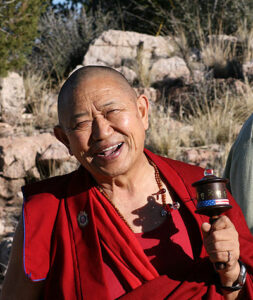
Guru Stories of H.E. Garchen Rinpoche – by H.E. Garchen Rinpoche
GURU STORIES of 8th Garchen Rinpoche – by H.E. Garchen Rinpoche
Transcribed, written and compiled by Adele Tomlin, October 2021
Garchen Rinpoche explained about what really caused his faith in karma to arise during his time in a communist Chinese jail. Then about the qualities of a guru and student, with pith instructions from Milarepa and Thangtong Gyalpo.
Then Rinpoche explained how he got his refuge vows, with his mother climbing onto the roof of a retreat house to get them from Drubchen Tengye who was in closed retreat. As the secret, illegimate child of a yogi who was married, his father was kept secret until the time came to recognize him as the incarnation of Garchen Rinpoche. Then, his father was forced to leave his retreat to be his main teacher, a fact his father was continually angry and resentful about.
Rinpoche then explained how his father insisted he get all the empowerments and transmissions from an actual practitioner, not just a big name lama. That practitioner was Drubchen Tengye, who was the main lama of the Nangchen King at that time. His father was told that it would not be possible to get such instructions but he insisted the young Garchen tulku get them from him, and so it was all done secretly.
The teaching was concluded with Rinpoche describing some of the pith instructions he got from his father, which found most memorable about anger, mindfulness, why it was important not to carry many personal possessions and to wear a meditation belt at all times.
May we all remember the kindness of our gurus and teachers at all times!
Compassion and devotion qualities of an authentic guru and disciple– advice from Milarepa and Thangtong Gyalpo
Although I do not have much to say about the Dharma, I am not learned and do not have a lot to say, people watching me on the livestream, I love them very much and they love me too. When they see my face and waving around my hands, it makes them happy. That is my merit, if I make them happy. Pleasing the Buddhas is the Dharma, as is making beings happy. We have to make sentient beings happy. So even though I don’t have much to say, almost every day I am sitting here talking to you [laughs].
When it comes the actual Dharma teachings that is Khenpo Tenzin’s responsibility, he kindly took that on. I personally feel much lighter because of that, and he also spends every day speaking to you students. I just talk about things every day, and make people laugh.
Starting today, I am going to talk about the different lamas I have met in my lifetime and the significance of these meetings. Generally, speaking it might be different from what you will hear about the life stories from other lamas. When you read their life-stories, it normally begins that at a very young age, that had started to study, reflect on and practice the put the teachings into practice; how they received different empowerments and transmissions. I am not like that.
For me, it is the other way around. I did not go out and seek the lama, they came to me, took me. By having no choice, at a very young age, my parents brought me to get the refuge vow and so on. At that young age, I did not know how to have proper devotion to those lamas, but they had great love and compassion for me. Now, looking back on it, they were really incredible. This is what I will talk about, the qualities of these lamas.
Even though I cannot speak about the Dharma very eloquently, I want to speak about how kind and precious my lamas were. Every single one of them has been extremely kind and precious. When you hear these stories, then you will understand the qualities of a guru/lama.
Thangtong Gyalpo and the number of Root Lamas
 Regarding the life story of a guru in general, something important should be understood here. First, generally there are some people who say that it is better not to have too many gurus, the lesser number of gurus, the better. They say that if you have too many gurus and they have all kinds of disciples and so on, so it is better to stick to one lineage and one guru. But others say it is good to have many gurus. Actually, the nature of that is explained in the Prayer for Excellent Conduct and the Samantabhadra Prayer. So, Khenpo Tenzin has been giving commentary on the Prayer for Excellent Conduct, and when we know that, then even if you have hundreds of gurus, it is good.
For example, there is a story about the Mahasiddha Thangtong Gyalpo [see image on left] who taught about what qualities a guru must have: ‘a guru must be able to show the workings of karma. Anyone who can teach on what is virtuous or non virtuous is actually a lama’. For this reason, Thangtong Gyalpo himself said: ‘I have 500 root gurus including prostitutes and butchers and so on’.
He is someone who became renowned globally. Even now, there are signs of his miraculous powers that we can see today. This is a true story. He was able to perform great miracles and signs of accomplishment, and he said he had all these gurus.
Jetsun Milarepa
 How do we rely on a guru? We have an example here and that is what the guru has to conform with. So, we analyse and examine the guru. Many people also say that first you have to examine them, and the guru has to examine the disciple. How long do we have to examine? For a very long time, could be five or six years or even more. These days, that is not so realistic or practical. We are in different times now and by the time you have finished examining the guru, maybe he already passed away. And vice versa for the length of time for a guru to examine the disciple. We just do not have the time anymore nowadays. Life span is diminishing, there is more sickness and disease and we can see many people dying all over the world, and we do not when we will die.
As we can see in the world today, when we think about the pandemic, we think there are so many people dying now. That is a mistake, it is only that now we are just more aware of it. People are constantly dying all the time. We just were not aware of it so much before, and now we are. It is like a never-ending wheel that never stops of birth and death. Once born, one is bound to the suffering of sickness, old age and death. These sufferings exist. We think these things are happening now because we are continually being told about it, but it was always like that. Before it was not so much in our face, as it is now. When we die, it says our only refuge are the Buddha, Dharma and sangha. There is no other source of refuge. That is why the guru is so precious.
There are many different types of lamas, name and title and lineages. The word ‘Lama’ – la means the life-force essence of all beings, and ma is like a mother to all beings. Milarepa said regarding the qualities of a lama: ‘There are many lamas with transmissions, instructions and lineages but isn’t there one who possesses compassion?’
Milarepa said the most important quality a lama must have is compassion for the disciple. Even though a teacher may have lots of qualities and learning, what is most important is compassion for the student. Regarding the disciple, Milarepa said that: ‘Even though there are disciples who are suitable vessels and may feel love and compassion for the guru. But isn’t there a disciple who also possesses real devotion to the guru?”
So, that is the most important quality for a disciple to possess. What is this devotion? For example, when you love someone very much, when you think of them, then tears come to your eyes naturally out of great love. Like when you think about their kindness and great love for you and beings, we weep. This is how the guru and disciple establish a connection. Through the guru’s compassion and the disciple’s devotion. The nature of a guru-disciple relationship is well illustrated in the example of the mahasiddha Thangtong Gyalpo.
In prison, developing faith in the truth of Karma, Suffering and the Precious Dharma
 The first thing I really developed faith in was karma, that really arose when I was in prison [When Rinpoche was 22, he was imprisoned by the Chinese for 20 years and put in a labour camp.] Before that, I had a a little bit of faith in karma but real faith, from the bottom of my heart, a trusting faith only arose when I was in prison, looking at it retrospectively. Only through that experience that my faith increased more and more.
Before that, I also got an instruction from my guru, Chime Dorje, who quoted from the Gong Chig, which says that:
‘Karma, cause and effect is the natural manifestation of one’s moment to moment thoughts.’
These words are something I always remember, like a torch on my way. Especially when I encountered difficulties. Another quote I always remembered in those times, was a Tibetan proverb:
‘When I am happy it is the kindness of the three jewels, and when I suffer, it is my own karma.’
And I began to really think about the suffering of all sentient beings in the six realms of samsara and in comparison, my own suffering did not seem that significant.
So, when I first developed real faith, it arose in the Dharma. Yet, where does the Dharma come from? It comes from the guru, without a guru, you do not know any of the Dharma. Even if you carried hundreds of scriptures on your back, you would not understand it without a lama to explain it to you. That is why Jamgon Kongtrul said in ‘Calling the Guru From Afar’: ‘the guru is the actual Buddha, there is no other Buddha than that.’ This is something that stuck in my mind, and I think Sherab Pasang’s father said something about that.
When I came out of prison, this is what I remember. It left me with real faith in the Dharma, which is an understanding of karma, which is the natural manifestation of one’s moment to moment thoughts and my happiness is based on the grace of the three jewels and so on.
Other masters speak about this in a similar way, like Milarepa, when things go well and I am happy, that drags me deeper into samsara. When I suffer and things are not going well, it stirs me up and lifts me out of samsara. In this way, understanding that everything is my own karma, I never developed hatred or angry at the country at putting me in prison, there was no one else to blame, when things go wrong it is one’s karma. Through that understanding, I was never angry and never blamed anyone for putting me into prison. Even though we had to work like an ox, like in India, I always kept in mind that it was the ripening of my karma.
This attitude, or state of mind, is really due to the kindness of the Dharma. That is why the Dharma is so precious.
If you think about this quote, that karma is the natural manifestation of one’s moment to moment thoughts. For example, if you reflect on the suffering of the sentient beings in the three lower realms, such as humans and animals, as we can see each other. If you think about the suffering of animals, then my own suffering seems so much smaller. If you think like that again and again, for myself it made the burden of my own suffering much lighter. I understood this was my own doing and was able to see the suffering of others. Then I gained certainty that this is really what the Dharma is about.
It is important to recognize suffering. Buddha himself said in the beginning, first you have to recognize suffering. The words of the gurus and Buddha are the same, if you listen properly. This is why the guru is the Buddha. So, it was really in prison I had my first real experience of the ‘flesh and bones’ of the workings of karma.
Refuge Vow from Yogi lama, Drubchen Tengye – Mother climbed on the roof
First, when I got the refuge vow, when a piece of hair was clipped from my crown when I was very young. I got it from Drubchen Tengye, who was a retreatant, they had a small retreat area there where they spend their entire life in retreat and have their house and cabins totally sealed off. There is no way to enter the cabins through the normal way. So, at that time, when my mother took me there, there was no way to go inside the house, so she climbed on the roof of the building and able to meet Lama Tengye there on the roof and get the refuge vow for me. There were a few other retreatants there and later, after Drubchen Tengye passed away, two of them were able to keep maintaining that area. Later on, the Tara Foundation sponsored the reconstruction of the buildings in the retreat village.
Drubchen Tengye was a disciple of the previous Garchen Rinpoche. When you read the White Tara sadhana, at the end in the small print, it says that Lama Tengye was the one who requested the previous Garchen Rinpoche to compose the sadhana. So, he probably was looking for his incarnation. He was in retreat and wouldn’t normally go outside. I was very young and do not remember much of it. I was very young and still suckling my mothers’ breast. I was actually brought there in secret because no one knew who my real father was. When he bestowed the refuge vow, there were a few Ngagpas retreatants around and I had not been recognized as a tulku at that time. So, they said it was good we now have another monk in our row. When they said that, Lama Tengye was laughing and said that is not how it will be, he will not be under us. We can consider ourselves lucky, if we are under him in the future. At that time, when he said that it seemed a bit odd for the people and people did not really understand what he was saying then. They told me that he then offered a katag to me and gave me the refuge vow.”
Second recognition and father’s identity made public
 The second time when I got the tulku name, or the second refuge vow, was through the father of Gyelpo Rinpoche and the Nangchen King who delivered that message to Drikung and at that time, the official recognition had to come from Drikung Kagyu head, [Zhiway Lodro]. At that point, it had to be very clear who my father and mother were.
My father was kept secret because I am a secret child. the reason was because my father was a yogin and he had a wife, who was not my mother. She was a young girl who came to make offerings to my father in retreat and then a child came, and that was me. So maybe I am a bit of a bad child, we might say. Nobody knew at that time he was my father because he was already married. His wife knew about it later, but she was not jealous about it, and both she and my mother got along very well and became good friends. My mother was always there in their home serving her and his wife gave my mother gifts and ornaments. So, his wife also knew about this child and had no issue with it at all. But it was kept secret because it was generally not acceptable, the secret was lifted at that time because they had to disclose the identity of the father at the time of recognition of the tulku.
 The Drikung Kagyu head recognised me as the tulku and I was given the tulku name [ Könchok Gyaltsen (dkon mchog rgyal mtshan)] by Lho Chagme Rinpoche, who was the main lama of the King of Nangchen. He was an exclusive lama for the King but he had to bestow the ceremony/enthronement and give the name. That is why he became the second lama. He passed away in 1958 or so at Gar Monastery. That was when he came to lead the 8th Heruka Drubchen practice. Actually, he was not supposed to go because the King of Nangchen did not allow it because he was the exclusive lama but then he really insisted on going to Gar Monastery to lead that drubchen and at that time he passed away. He clipped the hair at my crown.
When he recognized me, he took me to a temple with many different statues and asked me which statue will you pick, I pointed at Jigten Sumgon’s statue and said: ‘this is my lama’ and this was seen as an auspicious sign. He was also the Nangchen King’s lama. So, he was not really going out much, but he insisted on coming. He was the second lama. I was seven years old when they clipped my hair and recognized as a tulku. That is what I remember, but before I do not remember that much of how I got the name from the Drikung Kagyu.
As I was very young, I only went to the monastery once and I stayed at home and my parents were instructed to care for me. At that time, my father was in retreat, he had to come out of retreat and be my teacher. So, he was angry all the time and wrathful, he always had an angry, dark face and he would beat me and accuse me and tell me that ‘it was because of you I have to live in this ocean of samsara and you have thrown be back into samsara. Now, I have to come out and teach you to read and write.’ He was very frustrated about that and would beat me. So, the family line was Mazey Senge.
So, anyway, since the age of 7, my father had to do that, and I went back and forth between there and the monastery. Then later, at the age of 11, I had different teachers. My first teacher, in terms of learning how to read and write, was my father and he was also the one who told me which retreat to do first. He told me you have to do the Vajrakilaya secret accomplishment retreat.
Getting the transmissions from Drubchen Tengye and White Tara text
This was the first retreat I had to do and it was my father’s idea. I got the empowerment and transmission for that from Drubchen Tengye, because my father wanted me to get all the empowerments from him. My father did not really like high, big name practitioners. At that time, Drubchen Tengye did not have a name or was well-known. But my father always said to me, if you want to get retreat instructions you need someone who has sat down and done the practice.
He felt there was no point getting it from someone just because they have a big name and sit on a throne, if they have not actually done the practice. My father had a natural dislike for high lamas, he was a yogi and wanted me to get instructions from yogis and real practitioners. But it was not so straightforward because the person whom I would get the instructions from was the lama of the Nangchen King.
Lho Chame was previously a Garchen monk but then he became the lama of the Nangchen King. He was very traditional and he did not agree that I would get instructions from a normal yogi like Drubchen Tengye and thought you have to get it from someone with a very big name. However, that is not what my father wanted. Even though the lama was scolding my father and telling him you cannot do that, my father did not listen and brought me there secretly without anyone knowing and insisted I get the instructions from Drubchen Tengye. So, I was brought there secretly and I got all the empowerments, transmissions and instructions from him including the Nyingma, the Drikung Kagyu and so on. So, he was very kind to me. At that time, I did not recognisze the preciousness and did not really appreciate it. Whenever I had to get an empowerment from him, I was pretty tired and bored and did not really want to go, but I was forced to go and my father would beat me to go.
Later, one time after I had received an empowerment, before I went home. Drubchen Tengye invited me to his chamber and that was filled with thousands of books there. he told me “I will give you a gift today, so just pick one of those books”. So I pointed my finger at a small book, but it looked very fancy and nice, and said I want that one. So then he said, ‘now I know who you are’. The book I pointed at was the White Tara Wish-Fulfilling Jewel, which was actually reprinted by Norbu Rinpoche and was a terma by Rinchen Phuntsog, who had a vision. This was a sign for him that I was the tulku of the previous Garchen Rinpoche, because I had picked that text. Then my father was happy and smiled, and said today you picked a good book. My father was happy that one time. So that was how I got the empowerments and transmissions and all the pointing out instructions for the first time from Drubchen Tengye.
(The White Tara text is The Immeasurable Root Life Force of all Deities and Samaya: White Tārā teaching by 8th Garchen Rinpoche (April 2021)]
Pith Instructions from his Father on Anger and Mindfulness
So, my father asked me what is it you have understood? You have to understand one thing, and that is about the Vajrakilaya wisdom awareness, kilaya. So, when a thought arises in your mind, do you know that? I said yes I know that. Then he said: when anger arises do you know you are angry? I said yes of course I know that. So then when you know you are angry, then what happens? If I know I am angry, then it goes away. If I do not really know I am angry then it does not go away. That was the one thing I had to understand. He said you do understand that one thing. You understand that when you know you are angry it goes away. So you are like an instantaneous realizer. You really understand the nature of the mind. So that is the one thing he taught me about the Vajrakilaya.
Another main thing my father taught me was that never lose your mindfulness or be distracted. Never lose the mindfulness wherever you go. We had to ride around a lot on horseback – you can see that in the movie of my life story. So, when we were riding on the horse, he told me that you should also pick a rock or road sign you use for your support as mindfulness and say until I reach that rock I will not be distracted. Then when you reach it, you pick the next one and so on. So that is how I would walk and go around.
Milarepa also said ‘take all appearances as the path’. He said if you understand that always, that is enough. If you always have that there is no question in your mind.
So, when you have that and have this one who knows and is aware of what arises, then you will always be happy. If you lose the one who is aware then you will always be suffering and miserable. That is what I learnt from that.
My father told me in the future you must always continuously practice Vajrakilaya, and that is what I am doing. Chakrasamvara and Vajrakilaya really have the same essence. So, I was 8 or 9 years old when I did the Vajrakilaya retreat. At that time, I also had to go around on horseback practicing mindfulness, as the monastery was very poor at that time, there was not a lot of food there. I had to go around and bring the food, even from my own family, to collect it and bring it back to the monastery. We were poor but we had one very precious object at the monastery which is the Gyanagma Prayer Wheel.
He also told me not to act like a high lama and to learn how to do everything the other monks do. Whatever they learn, you should learn it too. Like playing the trumpet, instruments, and rituals and so on. That I should not let them do everything for me because I am the lama. He also advised me that when you travel places on horseback, only take minimal, necessary personal belongings. Only what you really need. Since whatever you load onto that horse, is the load you will have to bear in the future, your own karma. If you load the horse with hundreds of things, you will create negative karma. That is also a great instruction I got from my father. You just take your own personal belongings and not the monastery stuff.
My father also made me tie a belt around my belly very tightly because otherwise you will get a very big belly and then high lamas are known for just sitting and eating and getting big stomachs. So in order for that not to happen, you should always tie your stomach with the belt. To this day, I still have this belt around my belly, it is almost like I have two bellies. It is completely separate. I cannot take it off, it is impossible. My father really was my teacher. There are many other stories about him but he was extremely wrathful and resentful towards me that he had to come out of retreat. He was always upset about that. It was not like I had asked him to do it. He had really done it to himself. I needed two monks on each side to pull the belt tightly and tie it around me. So that is one thing my father did and also to learn everything the monks did, and that is why I know how to play the instruments well and not to put heavy loads on the horse when travelling.
The Guru Stories above explained the powerful and profound impact Garchen Rinpoche’s yogi father had on him as his first teacher. Explaining how his father was descended from the family lineage of Mase Mahasiddha Lodro Rinchen, founder of Zurmang Kagyu, Garchen Rinpoche spoke about how his own family from the side of his father, were mostly Dharma practitioners. His father was the first to introduce him to the nature of mind in the context of the Vajrakīlaya practice and the four kīlas, particularly the primordial awareness kīla. So even though his father was wrathful and not ‘nice and gentle’, Garchen Rinpoche has complete devotion to him as a great teacher.
The rest of the Guru Stories was on the life of the Drikung Siddha, Chime Dorje, the next teacher of Garchen Rinpoche. First, Rinpoche explained Chime Dorje’s close relationship to the former 7th Garchen Rinpoche, Trinley Yongkhyab, and how they had done long retreat together and were very close. He then shared a ‘hilarious’ and inspiring story (well it made me laugh out loud) about how Chime Dorje came to spontaneously leave some footprints in a rock, out of desperate, unbearable devotion, after he had been suddenly and inexplicably kicked out of the monastery by the previous Garchen. The image of these footprints is truly a sight for sore eyes too! Then, Garchen Rinpoche shared some other stories of Chime Dorje’s miraculous signs and displays of inner realizations and qualities.
Finally, Garchen Rinpoche spoke about the both tragic and inspiring demise of Chime Dorje due to gross maltreatment and abuse in a Chinese communist prison; and how even some blood he left on the ropes, which they had tied him very tightly with, and caused him to pass away, developed into precious relics.
As Garchen Rinpoche spoke about this rope, and how he found out about how his precious lama passed away, a deep sadness and love for Chime Dorje’s special qualities arose and it was impossible not to weep profusely at the tragic and heartbreaking nature of samsara and how even such great beings are subject to cruelty and karma.
One can only wonder if that ‘harsh, heartbreaking’ teaching given to Chime Dorje by the former 7th Garchen Rinpoche, was not only to reveal Chime’s incredible inner qualities and devotion, but also to prepare him for patience and compassion in such harsh circumstances. Or perhaps it was premonitory advice to Chime Dorje to leave Tibet when told to do so, something he did not do when the Chinese communists took over Tibet, which led to his tragic death. One can only wonder and weep at it all.
These Guru Stories are a source of laughter, tears and inspiration indeed!
Today, am going to tell you more stories, maybe it is a waste of time, but as people like to listen, I will also share it. Before I speak about Chime Dorje Rinpoche, I will speak more about my father. Before I went to the monastery, when I was a young child, my father, was actually my first teacher, I stayed at home with him and he taught me to read and write and so on.
Garchen Rinpoche’s Father’s Lineage – descended from the great mahasiddha and Zurmang Kagyu founder, Mase Lodro Rinchen
I will tell you some history about my father that I have previously not explained before, as it is perhaps unsuitable to tell stories that highly praise one’s own father. However, as you are all my Dharma friends, I will tell you more about him.
 My father was inconceivable and incredible. His history and family line, goes back to a mahasiddha called Mase Lodro Rinchen [Drung Mase Lodro Rinchen (1386-1423, founder of the Zurmang Kagyu tradition, a sub-school of the Karma Kagyu (Karma Kamtsang), picture on left] from the Mase family clan. He was a great siddha and some also called him Chokyi Lodro. The history goes back quite far. Mase Lodro Rinchen lived in the Golok area, called Mase Thang, the Mase plain in Golok. That is where the name Mase comes from.
At that time, there were many different divisions of the Kagyu lineages, two smaller divisions: the small one and even smaller ones: Nyendo kagyu and the Zurmang Kagyu, the smaller Kagyu lineages. These are not smaller in terms of being better or greater. In Mahamudra, there is no division between high and low, good and bad and so on. Greater and lesser means the extent of the activities of that particular lama.
When these people from the Mase Plain area migrated to our area, they asked them where they came from and they said Mase, so they were called the Mase clan. My family is from the Golok area of Tibet. So, from this mahasiddha, up until this day, this family line remains unbroken.
This Mase family line were distant and for most part, over the generations, the lineage of the Dharma practitioners was uninterrupted and an excellent lineage of practitioners. However, some descendants like Mase Sogam Norbu, was like a criminal/bandit and was well-known for that. That is important to know in this story. Most descendants formed this excellent line, but some of them were a little criminal.
8th Garchen Rinpoche’s Uncles
As for the present day generation of my family line, for the most part they became excellent practitioners. There were five brothers including my father, only one of those five became someone who lived just a worldly life, who didn’t engage in any practice. Four of them became really good Dharma practitioners. One of them was my father who abandoned worldly life and spent a long time in retreat completely sealed, without ever coming out. Also, the three other brothers were doing retreat. One of the brothers was practicing near Mount Kailash are in a place called Nyingsham, Nepal, where now one relative Ani Dudrul now stays. So, one brother was there.
The brother who pursued a worldly life is called Mase Zador. So, four of the brothers spent their life in retreat. I was born and I was a secret child and then he had to end his retreat. When I was recognized as a tulku that compelled him to give up his retreat, and enter more worldly life. The other brother, after he was released from prison. Mase Sogam Norbu had a wife, Dekyi Drolma, in the area where he stayed it turned out that Mase Sogam Norbu,then became a great practitioner, and a lot of people in that town developed faith in him. Then, another of my uncles, one of the retreatants, Mase Kanyen, he traveled to Orissa in India, which was the same Tibetan settlement of Nedon Chagme(?). He became a great, well-known practitioner there and passed away in Orissa.
Father’s Introduction to the Nature of Mind and Vajrakīlaya
When I was very young, I stayed with my father as my teacher, and there was a time when he told me to go to a monastery, but before that he told me to do the Vajrakīlaya Secret Accomplishment retreat which is the one am practicing now. In the context of that retreat, he introduced me to the four kīlas [daggers], mainly the wisdom awareness kīla. In that way, through that kīla he introduced me to the nature of mind. Then I completed the mantra accumulations of Vajrakīlaya in retreat. So, he really introduced me to the nature of mind. It was through him I felt I really understood the nature of the mind at that time.
Normally, people might say that one needs a really famous or high lama to introduce one to the nature of mind, but actually it was my father who did that first for me. That is why I have faith and devotion to him as a lama. There is no difference. I supplicated him and have faith in him without any doubts.
I really think that the first time of understanding the nature of the mind was through the kindness of my father. By giving me the Vajrakīlaya practice and specifically of the four kīlas, the fourth wisdom awareness kīla, which we also find in the lineage supplication that I have explained quite a lot before. Due to this connection, I have with the Vajrakīlaya practice that is why many disciples like to engage in the practice.
So, that was when I was very young. I did the retreat and mantra accumulation and my father gave me the pointing out on the nature of mind and understood that from him. Actually, aside from that, my father was not very nice or gentle to me, but when I understood the nature of mind he showed some approval and said ‘you understand the nature of mind, so you are doing well’.
In the context of Vajrakīlaya, he called that kīla of all-pervasive primordial awareness. In that context, he said ‘look at your mind; look at the thought-free mind, when you look at the thought-free mind, there is nothing there. It is experienced just like space. In that moment, you should see, is there any difference between the outer space and the mind space? Then you will experience that there is no distinction, and no real difference’. That is all he said, but that is when I really saw and understood the nature of the mind and how I then explained it myself in the future. That is all he said when he introduced me to it. When you know the nature of mind, you will know everything. When you see the nature of mind, you see there is no self and no other. All you need to do is look at your mind. You have to continuously look at the mind. If you stop looking, then it is lost. At that time, I really gained some certainty and understood that I just need to watch my mind. That is what I explain to others and some like to listen to what I say on that.
Meeting Chime Dorje and his Pith Instructions to 8th Garchen Rinpoche
 Siddha Chime Dorje (sgar dgon sgrub thob ‘chi med rdo rje, ?-ca. 1959)- former lama of 8th Garchen Rinpoche. The photo is part of a large mural in the shrine hall of the Gar Nunnery known as Gargön Ne Dechen Tsal (mgar dgon gnas bde chen tshal), which has been established at the sacred place of an ancient Meditation Cave of the Masters, Ne Lama Phug (gnas bla ma phug).
I was still very young at that time, and my father was my teacher and I would go to different places with my father and go to the monastery. That was when I met the siddha Chime Dorje, when I first saw him, I liked him very much and wanted to hug him. He said to me, it seems like you really like me, and I said ‘I really like you so much and you are my lama’. So, I probably recognized and knew at that time he would be my teacher. He did not give me a lot of instructions, he did not say that much. He did tell me to memorize the Ganges Mahamudra, and gave only once the reading transmission of it. After that, he didn’t say much. Also, mostly, he did not stay at the monastery. He would only come there sometimes.
So, he mainly gave the Ganges Mahamudra and repeatedly said ‘the mind is like space’. When I heard that, I also remembered my father’s words and it was very similar to what my father said. So even though I did not understand all these words but I did understand that this is exactly what my father taught.
Chime Dorje’s thirteen years retreat with 7th Garchen Rinpoche at the cave of Gar Chokyi Nyima Rinpoche
 Lama Chime Dorje, was a disciple of the previous 7th Garchen Rinpoche, Trinley Yonkhyab (mgar chen sku phreng bdun pa dkon mchog bstan ‘dzin ‘phrin las yongs khyab, ca, 1880-1935, picture on left), and was a monk at the Gar monastery. He had different positions at the monastery, he was a disciplinarian, a chant-master and so on, and he really protected the monastery with his life. So, Chime Dorje and Trinley Yongkhyab spent thirteen years doing retreat together. The place where they did that retreat was behind the nunnery of Gar Monastery at Nelama phug – a cave called Nelama. That was the cave where the previous 4th Gar Chokyi Nyima [Konchog Tenzin Chokyi Nyima (mgar chen sku phreng bzhi pa dkon mchog bstan ‘dzin chos kyi nyi ma)], did thirteen years of Chakrasamvara retreat and accumulated hundreds of millions of Chakrasamvara mantras there. At the end of Chokyi Nyima’s retreat, it was said he was able to fly in the sky. There are many stories about that too.
The seventh incarnation, Garchen Trinlé Yongkhyab, was recognized by the 32nd throne holder in the Drikung succession, Kyabgön Chökyi Lodrö. From Hlo Bongtrül Nüden Dorje, he received most of the empowerments and teachings of the Drikung lineage, as well as empowerments and transmissions of several of the tertön’s terma teachings. From Gar Ajin, he received the Fivefold Path of Mahāmudrā and the Six Yogas of Naropa. He practiced and mastered them and attained the state of accomplishment. He took Karzang Chödrön as his consort. His main disciple was the Siddha Chime Dorje, and many other disciples from various places who also attained accomplishments, such as Palmé Khyentrül Künzang Drodül, Rathro Tertön Tashi Namgyal, and Drubwang Gejung. Because he took another consort it became troublesome to stay at the monastery, and thus he had to move elsewhere. However, two years later, he was invited back to live at the monastery again.
See the images below of the cave where the 4th Garchen Rinpoche was said to have done thirteen years retreat and left handprints. Below the upper meditation cave is the Gar Nunnery known as Gargon Ne Dechen Tsal (mgar dgon gnas bde chen tshal), Groove of Great Bliss of the Power Place of the Gar Clan. This spacious rock cavern is closed with a wall in the style of a three-story façade (gsum brtsegs) and enshrines a large statue of an Eleven Faced Avolokiteshvara (spyan ras gzigs bcu gzig zhal/Ekadashamukha) together with many old statues and two body prints left in solid rock.]


“So, the 7th Garchen Rinpoche and Lama Chime Dorje, spent thirteen years in retreat together there. After it finished, then Chime Dorje came back to the monastery and did some retreat there.
The 7th Garchen Rinpoche and Chime Dorje both stayed at the lower monastery, of which there is an upper and lower place. So, Gar Trinley Yongkhyab stayed in the upper part, where there is the temple of the lower monastery. Chime Dorje’s retreat cabin was behind and below that. They could both see each other, as it was very close.
7th Garchen Rinpoche’s wrathful kicking out of Chime Dorje from the monastery and miraculous footprints in rock due to intense devotion
Normally, Gar Trinley Yongkhyab would treat Chime Dorje nicely, but all of sudden, one day he started to scold and yell at him and insult him and came to his cabin and said,’ you don’t know how to practice, or recite mantras, you have no meditation experience, go and stay somewhere else’, and told him to leave the monastery. Chime Dorje was very heartbroken by it and wondered why he had treated him like that as he had cared for him with so much kindness.
Previously Gar Trinley had said to other monks that Chime Dorje was Garcho Dringpa’s emanation. When actually, it was Garchen RInpoche who was, but he had so much regard for him, that he said you are Chodringpa’s incarnation and ‘I take refuge in you’ and so on.
So, he always had so much admiration for Chime Dorje, he didn’t say that directly to Chime Dorje but said that to the other monks. So, he was very sad about it and wondered what happened.
So, then he left the monastery and Gar Trinley kept scolding him until he could no longer hear him. He was still scolding Chime Dorje when he arrived back at his upper area and Chime Dorje could still see his head but the rest he could not see anymore, but he could still hear him putting him down as to how awful he was. Then, eventually he could not see his lama’s face anymore but could still hear his voice scolding him. However, as he had so much devotion to the lama, he felt that ‘I can hear his voice but I still want to see him’. So, as he desperately wanted to see him out of devotion, he went outside and there was a huge rock in the courtyard, the size of a table, and he climbed onto it so he could see him. He stretched himself on the rock to get a glimpse of him, and when he did that, his feet sank into the rock and left two footprints. So when he came down from the rock, he saw those two huge footprints and he worried that if the lama sees that, he will scold me again.
 Later on, some Japanese examined their authenticity and concluded that they are true human footprints and are still at the monastery and we have images of them. So he, left these footprints on the rock but was worried that if the lama came and saw them, maybe he will be upset with him about it. So he turned the huge rock around, so he wouldn’t see the rock. Later, the lama came there and still scolded him. He picked up the rock and turned it around and saw the footprints and did not say anything, other than HA HA and clapped his hands laughing and then turned around and left. So then Chime Dorje thought, well he saw the footprints but maybe he gave me his great blessing, and burst into tears out of great devotion.
The reason for mentioning those footprints are also because they are really authentic and are still at the Gar Monastery and have photos of that we can pass around to others. So that is one of the stories of Chime Dorje.
Footprints left in rock by Siddha Chime Dorje when desperately trying to maintain a glimpse of his teacher, 7th Garchen Rinpoche, who had suddenly kicked him out of the monastery. This stone has been excavated and enshrined in the shrine hall of the Lion’s Sky Fortress of the Gar Clan’s Monastery, Gargon Senge Namdzong, aka Gargon Changchub Choling, the Pure and Perfect Dharma Abode of the Gar Clan’s Monastery (mgar dgon seng+ge rnam rdzong’am mgar dgon byang chub chos gling), which has been established at the upper rock cliff some miles upwards the narrow valley of the Dza river.
I also received from Chime Dorje, and had to memorize the Thirty-Seven Practices of a Bodhisattva as well as the Ganges Mahamudra, and some short teachings on those. At that time, I was very young and did not want to go to all these teachings and transmissions and just wanted to play outside. At that time, Chime Dorje was staying in the previous Garchen’s chambers and so he asked me to come and gave me some candy and locked the door. I wanted to go but he gave me some teachings and transmissions but the door was locked so I had to stay. So he gave some teachings and transmissions, and this one quote from the Jigten Sumgon text Gong Chig, which says: “Karma, cause and effect is the natural manifestation of moment to moment thoughts.”
He said this is all you really need to understand as a practitioner. At that time, I was not able to understand that much and not that interested. He said as a lama you have to understand karma, if you do not understand karma, you will not become a Dharma practitioner. If you understand karma you will know the Dharma. If you do not understand karma, you will not know the Dharma. You might be able to speak about it but you do not understand the true meaning. Because of that quote on karma, I always thought about it again and again. For example, when I saw small animals, I thought ‘our mind is one and the same’. So I was able to develop some love for different animals that stopped me from killing them. If I didn’t do that maybe I would kill flies and insects so on, but because of reflecting on that quote, I didn’t kill them.
Chime Dorje would travel to different villages and monasteries and he always stayed in a yak hair tent and not in a house. In the villages, people had a lot of devotion to him. In terms of practice, he held the one million Mani accumulation retreats, wherever he went just staying in these yak hair tents. People saw him as a very precious and special lama.
One time, he travelled to Mahog, which is a place quite far away in the Golog, Amdo area and there is a holy pilgrimage mountain and people would go there for circumambulation of it. People went there because they had great devotion for him and whenever people met him, they would bow down to him and even the horse would also lower its head to him. So, on the kora route around the mountain, at some point, the horse jumped up and down and left hoof prints on the rock there too. Hundreds of people saw it and it is probably still there today. It became quite famous for leaving a footprint there.
There was a lama in this Mahog area, called Mahog Jetsun Rinpoche, who started a retreat area there and he regarded Chime Dorje as extremely precious. When they met, Jigme Dorje said: ‘you are my lama’ and the other yogi also said: ‘you are my lama’. So, they both mutually admired and praised each other. Then Chime Dorje left again, so Jetsun Rinpoche started a monastery and retreat center there. After that was completed, Chime Dorje had arrived back in Nangchen, which is quite far away from that away in Amdo and then Jetsun Rinpoche invited him to come for the consecration of the new retreat village. It was very far away and if one had to go on horseback it would normally take 15 days to get there. At that time, Chime Dorje was staying at the Drubgyu Monastery which is in the Yushu area, which is the monastery where Tulku Jigme Rinpoche stays. That is very far away from Amdo, so Chime Dorje was unable to go there.
However, he told Jetsun Rinpoche that I am going to perform a consecration from afar at that particular time. As Jetsun Rinpoche had great devotion for Chime Dorje and gathered all the people in the area and told them that on that particular day, Chime Dorje will perform the consecration, and gathered all the people together at the retreat area at that time. So, they made a date and time for when the consecration would be performed.
There was a monk called Konchok Tsering who accompanied Chime Dorje who told him that ‘today we are going to go up the mountain and perform the consecration ceremony for Jetsun Rinpoche in Amdo because I cannot got here’. So, they gathered the grains that were coloured, white, red, green and so on. When they performed the ceremony, they would cast/throw those grains. At the same time, the people in the retreat area in Amdo had all assembled knowing he was performing the ceremony. Even though it was very far away, at the same time Chime Dorje was casting the grains, like rain falling down from the sky there were colors falling down like the grains in the ceremony and everyone saw it. That became quite a well known story.
So, Chime Dorje didn’t come to Gar monastery for a few years, and when he was going to come back, we arranged for a large Buddha statue, the size of a house wall to be constructed. So, we had to build a structure for it, and to build such a structure at Gar Monastery is not an easy task. We were wondering how to do it and where to put it and so on. At the small temple where the 7th Garchen Rinpoche stayed, there were all kinds of different statues arranged, and there was an empty spot. Some of the old monks used to say: ‘maybe it’s possible that he wants to put the statue there because there is this empty spot’. However, the statue itself was constructed a long distance away and had already been arranged with measurements.
Despite that, when the statue arrived, it fit exactly this empty spot next to the 7th Garchen Rinpoche’s small temple and that is where it was placed. Everyone was really amazed by that. Chime Dorje knew that the previous Garchen Rinpoche had all these statues arranged like that, and he knew that it would fit that spot exactly. It was seen as clairvoyance between the guru and disciple. So, that story became quite famous.
That was the statue offered by Chime Dorje when he returned to Gar Monastery. Then, he performed the ordination ceremonies for the Getsul and Gelong monks. Then, he started the Summer Retreat, which they held for one and a half months, and for that he offered exactly one hundred female yaks, as like an endowment fund for the summer retreat, because during the summer retreat they are not allowed to eat meat and only consuming butter and milk. So, he offered these female yaks so they could milk the yaks during the summer retreat.
Chime Dorje and the Drubchen of the Eight Herukas
 The temple where they held the summer retreat was called the summer retreat house and things started to improve at the monastery, more things were taking place there. He also started the Drubchen of the eight Herukas, which he considered to be very precious. He gave all the empowerments and transmissions of the eight Herukas and said he would give the great empowerment of the eight Herukas and that would take one whole month to complete together with the Drubchen. That is because he considered the eight Herukas to be very precious and he also said in the future, you have to uphold this lineage and it must spread and not be broken. This is the Drikung eight Herukas which is more extensive than the Nyingma one.
The Nyingma tradition great accomplishment practice takes about one week but in Drikung Kagyu, it takes one month. This tradition comes from the Drikung Rinchen Phuntshog (and also Chodrug) and it comes from their vision. From that meditative vision, appeared the Cham dancing together with the eight Herukas. That would take around a month to complete. During the time of the 5th Dalai Lama in Tibet, Cham dancing was not really allowed. However, when the 5th Dalai Lama was staying in Lhasa, he said he accepted the transmission of the Drikung eight Herukas and allowed them to perform that Cham from the Rinchen Phuntsog.
So, Chime Dorje started that eight Herukas Accomplishment Practice. He gave the great empowerment of all the eight Heruka deities, which is a total of 725 deities. Normally, when one confers an empowerment one needs an image of the deity. However, there was no image of those 725 deities, so the way he conferred the empowerment was he had a thangka painting of each of these deities and would go around holding each of those thangkas to their heads. That is how he conferred the empowerment of the eight Great Herukas and he told people the lineage must not be broken in the future.
Regarding the Eight Great Vidyadharas who passed the Mahayoga or Means of Attainment Tantras to Padmasambhava, here is a list of the eight Mahayoga teachers: Vidyadhara Manjusrimitra came from Suvarnadwipa and was proficient in the secret practice of the wrathful Bodhisattva Manjusri, called Destroyer of Death (Yamantaka). Vidyadhara Nagarjuna-garbha came from Bengal and was proficient in the secret practice of the wrathful Bodhisattva Avalokitesvara, called Hayagriva. Vidyadhara Vajra Humkara, who came from Nepal, was proficient in the secret practice of the wrathful Bodhisattva Vajrapani, called Sri Samyak Heruka. Vidyadhara Vimalamitra came from Hastivana in the West and was proficient in the secret practice of the wrathful Bodhisattva Samantabhadra, called Vajramrita. Vidyadhara Prabhahasti came from Zahor (modern Mandi south of the Kulu Valley at the foot of the Himalayas) and was proficient in the secret practice of the wrathful Bodhisattva Nivaranavishkambin, called Vajrakilaya. Vidyadhara Dhanasamskrita came from Gandhara and was proficient in the secret practice of the wrathful Bodhisattva Akasagarbha, called Matarah, or Controller of the Matrikas. Vidyadhara Guhyacandra came from Mount Kailash and was proficient in the secret practice of the wrathful Bodhisattva Ksitigarbha, called Lokastotrapuja-natha, or Lord of Mundane Sacrifice. Vidyadhara Santigarbha came from Khotan and was proficient in the secret practice of the wrathful Bodhisattva Maitreya, called Vajramantrabhiru, or the Curse-pronouncing Diamond.
Of the eight Vidyadharas whom Lord Padmasambhava studied under in the Sitavana grove, it should be noted that initially the chief guru was Vajra Humkara, the guru of his teacher and abbot Prabhahasti. We have already described how Humkara met with Sri Simha in a forest and received from the latter the fundamental instructions for the Sadhana of the Lord, Vajrasattva. It was after practicing for six months with his yogini-wife in the cave of Lang-le-sho in Nepal that Humkara gained the final Great Seal of Buddhahood and beheld the Divine Being (Vajrasattva) face to face.”
There are many more stories which I do not have time to explain today, Chime Dorje was accepted as a great mahasiddha by everyone, just by looking at his activities.
‘One cannot escape one’s karma’ – Chime Dorje’s refusal to escape from the Chinese and miraculous stories of escape in prison and relics from bloody ropes used to bind him
 Then later, when the turmoil and troubles broke out in Tibet, at that time everyone was staying in the monastery in the mountains, everyone was about to run away to escape the communists, and he told them don’t escape like that. If you have the karma to experience difficulty you cannot escape it. So, Chime Dorje Rinpoche stayed and did not escape, and he was then was imprisoned and later passed away in the Chamdo prison. There are some stories about the time he was in prison too.
There was a time when they put shackles on his ankles and handcuffed him and he miraculously released himself, and sometimes left his locked cabin in the early morning and went outside for a little while. The police then would catch him and bring him back inside. This happened several times.
As they kept putting him in shackles and cuffs and he kept releasing himself, so they tried to find another way to restrain him. So, they then bound rope really tightly on his wrists and legs, so tightly that blood came from them. That was how he passed away. An official, one of the prison guards, who was actually a Tibetan, considered Chime Dorje as a very precious lama, after he had passed away, there was the rope that was still left behind that had all his stains of blood on it. When they cut off the rope from him, he secretly kept a piece of rope that had the blood on it and hid it because he saw the lama as very precious.
Later, that prison guard travelled to Bemo Drang prison in another area, where he became the leader of the Bemo prison in that area. This official then met with an acquaintance called Ture Tsenam, who was the one who had produced the precious pills, and who was friends with Zhingjang who was my friend, and he told Ture Tsenam about this great lama [Chime Dorje] who had been imprisoned and how he had kept the rope with some blood on it. Then from the blood on the rope some relic pills appeared, and he was so amazed by that, he shared that story with his friend, who was also amazed by it. Later, Tsure Tsenam told my friend, Zhingjang. So when I had leave from prison, and was travelling with Zhingjang (who knew Chinese very well) and going to meet my mother I found out about that the bloody rope; as he told me about it. That was when I heard that Chime Dorje had passed away in the Chamdo prison.
Chime Dorje’s main monastery was Gar monastery but wherever he went he held Mani retreats and if there were girls, he would make them nuns and start a retreat place for them. In the different areas, they might have different lineages, for example, if the area was Sakya he would leave it like that and just build retreat places and advise them to follow that tradition. He built 113 retreat places but he mainly looked after Gar Monastery. In 1979, when I was released from to meet my mother, that is when I heard about the prison guard, whom I also knew, because I had to get a letter from him to go to Thangtang. That official was the one who issued the letter of permission, so I could cross the border to meet my mother. That is the life-story of Chime Dorje.
Seeing our gurus as Buddha and protection
When we hear the stories of a guru, outwardly they seem like an ordinary human being, just like us but inwardly they are different, their activities, knowledge and enlightened intent, wisdom and so on is different. So, when I think about my guru’s life story, my devotion and pure perception increases and that really helps my practice. So, every time you feel a pure view and devotion towards a higher being like your guru, your mind becomes purified. That is why it is so beneficial for the practice. When devotion arise, the mind become purified. What need to be purified? The dualistic perception and thinking needs to be purified, and that happens when we cultivate compassion for sentient beings, then the obscurations become purified. The obscurations will not become purified if we try to wash them with water. Although water is actually the deity. Here, we are talking about the inner obscurations of the mind and these can only be purified when we cultivate compassion and devotion. So, I have seen my gurus as actual Buddhas. For example, when I saw those footprints of Chime Dorje and signs of his accomplishment like that (which have been examined and confirmed by Japanese scientists). they are still present at Gar Monastery and we have shared many photos of these footprints. It really inspired me with devotion.
So, when I think about my gurus it really benefits my practice. If I can understand one guru like that, then I can understand all gurus are like that. They are really one and the same. What they speak is the same, the holy Dharma and so therefore, their body is the sangha, their speech is the Dharma and their sacred mind is the Buddha. Actually, on the ultimate level Buddhas and sentient beings are all one, they have a single basis, but the unique mind of those gurus is they possess bodhicitta for all beings and possess immeasurable love. So, they are the main gurus, from the one who gave me the refuge vow, up until all those gurus who gave empowerments, transmissions and instructions.
We say, the guru is endowed with the threefold kindness, the transmissions, empowerments and instructions. Dharma friends, you should also see your own gurus like that, from the refuge up until the one who gave you empowerments and so on. If you see those Gurus like the actual Buddha, then in this lifetime and all future lifetimes, they are your true protection and there is no greater protection than that.
Now, I have offered you another story of one of my gurus, it is a brief account of Chime Dorje, but there is so much more that could be said about him. His activities, accomplishments and miracles are countless and limitless and as I do not want to waste your time Dharma friends, I just gave a brief summary of his great activities.
Invincible Courage And Love: Life-Threatening Bravery In A Chinese Jail And Root Guru, Dzogchen Master, Khenpo Munsel
“The Guru’s mind, the Buddha’s mind and my own mind are one.” — Je Jigten Sumgon
‘In that moment of anger, instead of looking at that person or what made you angry. Look at the anger itself. Meditate. You know the nature of the mind, you know how to meditate on that. So when anger arises, realize that self and other do not exist and are not separate. This dualistic perception of self and other is delusion’. — Khenpo Munsel’s pith instructions to 8th Garchen Rinpoche while in a Chinese prison
“Demons and heretics will never harm them,
And all three worlds will honour them with offerings.
They will quickly go beneath the bodhi tree,
And there, they will sit, to benefit all sentient beings, then
Awaken into enlightenment, turn the wheel of dharma,
And tame Mara with all his hordes.”
— excerpt from Prayer for Excellent Conduct, cited by 8th Garchen Rinpoche regarding the miraculous conduct of Khenpo Munsel
This Guru Stories part focused mainly on Garchen Rinpoche’s time in prison and meeting ‘one of the greatest teachers in Tibet, Dzogchen master, Khenpo Munsel (mkhan po mun sel, 1916-1993).
 Longchenpa (1308-1364), picture on left is said to be of an old statue made at the time of Longchenpa himself. The recent Dzogchen master Nyoshul Khen Rinpoche treasured this image highly and had it reproduced innumerable times. It is said that when Munsel was a boy he was identified as an embodiment of the great Nyingma master, Longchen Rabjam (klong chen rab ‘byams, 1308-1364).
Garchen Rinpoche first spoke about the importance of seeing the guru as no different from the Buddha. Then, he spoke about about his life at the time of the Chinese Communist regime’s takeover of Tibet. When he travelled to the Chinese prison, he was in the same sleeping compartment with another Tibetan Buddhist master, Buddhist master, Adeu Rinpoche, who gave him some short instructions and also later told him that Khenpo Munsel was the greatest lamas among all the lamas and tulkus inside the ‘lama’s jail.’
Then, Garchen Rinpoche explained the very strict restrictions in the jail that forbade any Dharma practice and Mani recitations, and how people were constantly monitored to make sure no one was practicing. He then spoke about how he went on a secret hunger strike and gave his food to other prisoners out of compassion. He explained how he wanted to die and risked his own life to express his wrath at the hospital boss as so many people were being killed by hard work and starvation in the camp. It was both heartbreaking and hilarious to hear how while lying sick in bed, he punched and spat at the hospital boss in order to express his annoyance at the situation there and the communist regime, yet was met with compassion and later, at his request, unlimited food.
Later, after Garchen Rinpoche had recovered, his act of courage had got back to Khenpo Munsel, still in the prison, who asked him about it and gave him direct instructions on how to bring anger onto the path, and that practice and daily activities are never separate.
 Garchen Rinpoche then spoke about the miraculous power of Khenpo Munsel and how he was able to stay in the prison for twenty years, feigning sickness, without working and meditating cross-legged without moving much for more than twenty years. How he taught prisoners in the camp and was able to recall the entire oral transmissions of Nyingma perfectly. How he even managed to conduct a secret 100,000 Guru Rinpoche recitation and accumulation feast, despite the fact it was strictly forbidden and punishable even by death. Then, when Khenpo Munsel was finally released from prison, he just got up and walked out without any crutches or assistance. Garchen Rinpoche said it was like the verse in the ‘Prayer for Excellent of Conduct’, not even armies of maras could harm him.
Garchen Rinpoche ended with a reminder why it is important to have devotion for the gurus and that this was one of Khenpo Munsel’s important instructions too. Their life-stories inspire us and thus open the heart and mind for the blessings of the guru and lineage to enter our minds, without which attainment of superior qualities is not possible.
One can only imagine how inspiring it must have been to be in the presence of such ‘living Bodhisattvas’ in such ‘harsh and brutal’ conditions and to see them practice the actual Bodhisattva way.
So, Dharma friends, nowadays, the world is going through many difficulties and we have to stay inside and maybe people get tired of staying inside, so even though I may not be able to teach the Dharma that eloquently, but I thought of sharing some stories about my ow gurus, the lamas I personally have connected to. That is very significant. Jamgon Kongtrul said, the guru should be seen as the actual Buddha in human form. The guru is a human and often people make these distinctions and they say the guru it the guru and the lama is the lama and the Buddha is the Buddha, they are different. But actually if you think about it again and again it is not like that. As Lord Jigten Sumgon has said: “The Guru’s mind, the Buddha’s mind and my own mind are one.”
So, this is how you see it, if you see how it is. We can actually see that the Buddha and the guru really are one and the same, how they are one.
So, all the gurus, my own gurus as an example, all of them is really a Buddha, that is not because I am went towards them out of respect but is because they all came to me and helped me with kindness. It is very meaningful to hear the stories of those gurus and that is why I am going to continue with more guru stories.
Last week, I told some stories about Lama Chime Dorje, before the turmoil broke out in Tibet, and today, I am going to speak about the time the turmoil and troubles broke out in Tibet. Generally speaking, first of all, all the difficulties we encounter in this world, arise from the cause, which is negative karma and obscurations. That leads to the condition of the obstructors, evil spirits and harm-doers and so on. They cause the result of illness and suffering, there are different age/kalpas in this world, so there is the age of weapons, starvation and of disease, during that time, it was the time of weapons and starvation. Now, we are in an age of disease. In brief, all these difficulties arise from karma and negativities and obscurations. What is that cause? From self-grasping and from that arises attachment and aversion, and then stinginess and greed and from that arises hatred. From that, we end up in times of disease and starvation and weapons.
Meeting Adeu Rinpoche on the way to prison and in the same sleeping area
 So, during that time, it was a time of starvation and weapons. At that time, due to the force of my own karma, I ended up in prison, we were first transported there. I was together with many other different lamas and lay leaders and so on. Among them, was a great master from Nangchen, called Adeu Rinpoche (a lde’u 08, 1931-2007). There were also seven lamas from the Ngachu Yarney Shabten Monastery, which is in Ngachu, close to Lhasa. There were also other Rinpoches. That is when I met him myself, as I came from Nangchen, I have seen him before but only from far away, I was never able to speak to him before that and I could not really come close to him. However, at that time, I met him directly, he was a lama of great kindness. He was very peaceful and loving like a real Bodhisattva, that is when I met Adeu Rinpoche for the first time.
At that time, we had not actually yet arrived at the prison. I was in the same sleeping area as Adeu Rinpoche, so from my time with Chime Dorje Rinpoche I had memorized the 37 Practices of a Bodhisattva. Within the 37 Practices, especially at that time, he mentioned one verse:
“Buddha taught that all suffering of the lower realms, comes from wrongdoing, Therefore, never commit negative deeds, even at the cost of your life, this is the Bodhisattva’s Practice.”
He said the unbearable suffering of the lower realms comes from negative actions, and he also said that, however, the suffering we experience in a precious human body, is actually a great merit. The more we suffer as a human being the greater merit. It is said that in the precious human being’s body, a single headache purifies the negativities that would cause one to wander for a long time in the lower realms. One might have the karma to experience suffering for a long time in the lower realms and in a very short time as a precious human being one purifies all the suffering. So, he said we should really rejoice in that and that what we experience is the full ripening of our own karma. He spoke a lot about, and went into great depth on the teachings on karma. We were in the same sleeping area and he gave many instructions.
Then, finally, we arrived at the actual prison in the Xining area, which is a higher security prison where all the higher lamas and leaders from the various areas of central Tibet, Amdo and Kham and so on, all came together. There were about four hundred or so lamas, monks, chant masters, leaders and so on. Especially those whose names were well-known like leaders and so on.
About a year or two after we arrived, I asked Adeu Rinpoche, in the prison there are so many lamas but which one is the most precious one? He replied secretly to me, that among all of them, the most precious was Khenpo Munsel and that I should really meet him. So, at that time, sometimes I was also in the same sleeping area as Adeu Rinpoche and he had received instructions himself from Khenpo Munsel and wrote these down secretly in the form of notes that he kept hidden. Anyway, he was the lama who first gave me the opportunity to me meet Khenpo Munsel.
Khenpo Munsel’s outer life in prison – miraculously sitting cross-legged for over twenty years
 In terms of Khenpo Munsel’s outer life story, he was in prison but he was one of the sick people. Basically, the entire time he was in prison for over twenty years, he never had to work, he was sitting crossed-legged the entire time. He had some wooden crutches, he could only get up on them, otherwise, he would not walk and was crippled, or so they thought!
At that time, the officials would examine everyone who claimed to be sick or unable to work. As there were people who would try to feign sickness, etc. They would take these people and really examine them, and give them all kinds of injections and examine them all over until their lie was exposed and they had some difficulties. Basically, whoever was able to work had to do so. It was really difficult to hide that from them.
However, Khenpo Munsel was different. For the entire twenty years. he claimed to be sick and crippled in his legs and no one ever actually examined him, they just took his word for it and thought he must be right. No one ever checked that, the entire twenty years, he never had to work and they saw him walking on his crutches the entire time.
Yet, when he was released in 1979, he basically just stood up and walked out of prison. That was the time the Chinese President released everyone from the prison. Khenpo Munsel was released with others, and he instantly got up without any signs of being crippled and walked out of prison. That is his outer story.
Dharma Practice forbidden but entire collected oral Nyingma instructions teachings from Khenpo Munsel taught to others from memory
In prison, people were always monitored and were not allowed to do Dharma practice, or hold a mala or count mantras, we were not even allowed to say OM MANI PADME HUM. Often the officials would walk around and monitor and see if someone was secretly silently, reciting the Mani mantra. When it looked like someone was doing that, then they would demand: ‘What are you doing? Are you reciting the Mani mantra?!’
There was one prisoner, a businessperson from Nangchen who was very feisty and one of the prison officials accused him of reciting the Mani mantra. As he was quite feisty and thought ‘if you die, you die’, he said to the official: ‘don’t you know that to say the Mani mantra, you have to move your mouth and lips when you say the mantra? Have you seen my mouth moving? I have not moved them. So, you do not know how to recite the mantra it seems.’ So, the official said ‘I have seen your neck moving’, so then the prisoner said ‘that is just my life vein moving, it is a sign I am alive and not dead yet, that is why it moves’. They were arguing and he said’ just take me then, just kill me’. So, then he was handcuffed and taken. That is how it was in prison, we were not allowed to even read any Dharma texts, or have a mala or recite Mani mantras.
Khenpo Munsel had memorized the entire collected tantras of the oral lineage of the Nyingma tradition and he taught us, and Adeu Rinpoche would take notes and write it down. All the teachings came from Khenpo Munsel’s memory.
Khenpo Munsel’s biography estimates he studied one hundred voluminous texts, out of which he mastered twenty-five. His performance during the public tests administered by the monastery is remembered as a demonstration of this erudition. He was also known to have specialized in the Dzogchen Nyingtik (rdzogs chen snying thig) tradition. Khenpo Munsel eventually founded a dharma center in Ponkor Ngakgon (dpon skor ngag dgon) where he served as the Abbot for around twenty years.
Later, when we were released from prison, we were given a notebook of Adeu Rinpoche’s writings of Khenpo Munsel’s teachings from memory. It was amazing how accurate it was compared to the original texts. Adeu Rinpoche was amazed at how precisely matching they were. That is how Khenpo Munsel preserved the lineage of Nyingma instructions.
Hunger Strike, Sharing Food with Others, Punching the Hospital Boss
In the early 1960s, I got very sick, there were two sections of the prison, lower and upper, in the lower section, there was the hospital, and so they sent me there. There were a lot of very sick people, and many who died there every day. When I was there, I had a thought that I would rather die and not live. So, I made up my mind to stop eating any food. If I ate a little bit of food, I got hungry really quickly. However, if I didn’t eat any food at all, I would not get so hungry and thought it would be better to die. So, I stopped eating, and shared my portion of food among the cellmates, there were seven of them, secretly and gave each one a little bit of food. I stopped eating and I did not feel that hungry. My father had taught me how to retain the winds and extract the essence. So, I did not feel hungry despite not eating and shared my food with the sick people.
However, one day they started fighting over the food and so the doctors found out about my sharing my food portions. There was one person there who was an official, who spoke both Tibetan and Chinese. Anyway, I really wanted to give the others food out of compassion for them. So, then the doctors found out and came and restrained me. I was already in a poor, physical state, I could not get up anyway, and they said ‘why are you are not eating’ and in my mind I felt quite angry and annoyed. Because what this communist regime has done is not just to one country or one city but to the whole world, they were destroying with their ideology the Dharma and also the worldly ways. Thus, in my mind they really were like an ‘enemy in whom the ten grounds are complete’; beings who cause a lot of harm to Buddha’s teachings and to all sentient beings. So, at that time, I was very annoyed and thought it would be better if they did not exist and to destroy them. So, they restrained me and put me in solitary confinement.
I was told by this friend who knew Chinese and Tibetan, that he leader of the hospital wanted to speak with me, so I asked him how to say ‘bring him here’ in Chinese, and he taught me how to say that (Rinpoche said it in Chinese), and I asked them to bring the hospital head like that. This person I knew was translating, and so the head came and I basically thought to myself that if I do something bad, then they will kill me. At that time, I was lying in the bed, and very weak and could not get up. I wanted to punch him but I could not move. So, I asked him to come closer. Then, he came closer and closer, and when he was really close, I spat in his face and punched him. After I punched him, he started laughing. The doctors came and they restrained me again and said ‘oh he is crazy and has lost his mind’.
In the prison kitchen, one of the cooks was Gabe Lama’s father, there were some 40 cooks or so, they were in a better state as they had more food to eat. Later, that is where I ended up. Anyway, so I punched the hospital chief and they restrained me and said I am crazy and he brought the same translator, and asked me, ‘why did you hit me and beat me?’ I said, whichever way you look at it, this regime is causing a lot of harm to beings and the Dharma, I did not want to live and thought it would be better to die and so stopped eating. Then I thought if I hit you, as that is a grave offence, I will be killed and that is why I punched you. Again, he was laughing. He said ‘you poor thing, you have a mother and father and it is better you do not die. I know why you punched me because you wanted to die, you thought I would be angry and then I would kill you. However, he said ‘I understand, but it does not matter to me, it does not harm me, I am not angry or upset with you. I am not upset because we have a personal issue etc., like you killed my father and vice versa, you punched me because you are angry with the communist regime, so I cannot be angry with you.’
This official, who was the leader, had a lot of compassion and love for me from his heart. I was still in bad shape, and he really took care of me and visited every day and said you have to eat. I told him, ‘it is not that I do not eat, it is that you people do not give us anything to eat, look around! There are so many people here are dying of starvation. Can you not see that?!’
He then said he would provide food, and would I eat it? So I told him ‘if you want me to eat. you have to give me as much as I want, or I won’t eat it’. Then, he then wrote an official letter to the cooks saying whatever I ask for, they should give it to me. Generally, in the hospital, there were different levels of how much food a sick person was apportioned, based on their level of sickness, such as getting four, five or six portions. That official said give him what he wants, so I got all the six portions, and was eating all the time. If I did not eat, I felt hungry again, so I was eating a lot, and day by day I got better. After one month I recovered and was able to get up again. The hospital boss had a lot of love for me and his mind was relaxed and laid-back. I wondered why he had that much compassion for me.
Also, later after I was released from prison, his official secretly created paintings of each of the things that happened to me in prison. He called it the ‘sixteen enlightened deeds of the sick person, Konchog Gyaltsen’. He painted it almost like a mandala thangka, of different images in picture form where he painted my story, such as getting arrested, going to the hospital and so on. Looking at the images later, it really was exactly my story and there was one called Nangchen Trinley Kunkhyab, who was the son of the Nangchen King, who said what he painted was your story in the sixteen deeds when you were in prison. Around that time, I was still in the hospital when these images were painted. I was able to leave the hospital there, put on my working clothes and got ready to leave. Before, I left, I went to see Lama Drubchen RInpoche who also did not eat. I encouraged him to eat and said ‘Rinpoche, please eat for the sake of sentient beings, this is what happened to me and I am now better and I can get up again. So, he said ‘OK’ and there was some bread which he ate, but then soon after passed away.
Then I left the hospital and went back to the working prison where I met Khenpo Munsel Rinpoche.
Back in prison with Khenpo Munsel – Pith Instructions on bringing anger onto the path
He had already heard about what happened in hospital. ‘I heard you punched that official. You have learned how to take suffering as the path’. Then he introduced me to the abandoning, transforming and knowing, the three levels of the path of practice. He said: ‘you know the 37 Bodhisattva practices, you really are a Dzogchen yogi. You have already abandoned, and transformed, but now you have to know. Knowing means, from the Vajrayana perspective, you have to see the essence of your anger/hatred. The reason why you got angry with that official was not because of self-grasping though. Out of concern for others, you gave up even the thought of your own life and that if they kill you that is alright, there was no self-grasping. No thought of ‘what will happen to me?’ In that moment of anger, instead of looking at that person or what made you angry. Look at the anger itself. Meditate. You know the nature of the mind, you know how to meditate on that. So when anger arises, realize that self and other do not exist and are not separate. This dualistic perception of self and other is delusion’. In that way, through anger, he introduced me to the teachings of Dzogchen. That was really beneficial and was an instruction to take the afflictions as the path.
Before I got those teachings, I saw practice and the work I had to do as separate. I was angry with that official and punched him, and he had great compassion and love for me and that was what caused my mind to feel more relaxed. That is why we say in the Bodhisattva path, we transform the affliction through love and compassion. So, I was angry at him, but my anger was transformed through his love and compassion. That was how my mind calmed down. That is what I learned from Khenpo Munsel Rinpoche. He said there is nothing else necessary to practice, there is no separate practice from the work you do. Putting those teachings into practice, I learned how to take anger as the path. Khenpo Munsel said to me that in the Dzogchen path, where one particularly takes anger as the path, ‘You are the perfect candidate for such practice. Now you did that well and you know how to take anger as the path’.
Secret 100,000 Guru Rinpoche mantra accumulation and Tsog offering in the Chinese prison
Then later, when we came closer to the actual cultural revolution, another event happened on the tenth day of the lunar month, which is Guru Rinpoche’s day. At that time, Khenpo Munsel, Adeu Rinpoche and Aten Tenzin Gyamsto?, seven great lamas met secretly on that day to accumulate 100,000 Seven-Line Prayers to Guru Rinpoche, which was followed by a Tsog offering. At that time, I was with an official and a tulku, we went there with seven people and got some of the Tsog blessing, which was made from butter and sugar. We knew about the secret Tsog offering, as did the tulku. At that time, when we left, I did not really trust that tulku. Later on, he ran into some trouble and it slipped out of his mouth and he told the officials that we had this secret Tsog offering and accumulations of the seven-line prayer. That was a huge offence in prison, and could mean even a death sentence.
At that time, there was a secretary who was Tibetan, he was a great scholar too, and he ended up in the prison hospital because he fell out of an airplane and broke his legs and he was the secretary in that hospital there. So then, miraculously, doctors were brought together to issue a letter to say that there was no fault and that they did not perform the Tsog offering and so on. Even though the tulku had snitched on them. They did not even investigate it and did not say anything and they were not accused of any wrongdoing. In addition, as I said, there were doctors who accepted Khenpo Munsel was not sick and he was never examined. They were not allowed to beat or harm them in any way.
This was like a miracle to me, and I thought about the line in Samantabhadra’s Prayer for Excellent Conduct; that even the legions, armies of maras and tirthikas cannot defeat them. That was how it was, no matter what he did, they could not defeat Khenpo Munsel. Even though he was not sick at all , he never had to work for twenty years and nobody questioned it. Same with the secret Tsog offering, even though it was exposed still nothing happened and it fell back onto the tulku, who later got into trouble.
Later, in 1979, when we were released from prison, Khenpo Munsel (despite there being laws that it was a great offence) just walked out of prison and died a natural death. That is a story but there were many incredible and amazing stories about him. That is just an example of how he was able to remain completely unharmed, without having to work, without being accused of any offence, and spend his whole time sitting down cross-legged and teaching the Dharma and them writing it all down. Then, he left prison and died a natural death.
The benefit of hearing the life-stories of great teachers
So, what is the important point to keep in mind when hearing this? So, now when we think about the enlightened activities of these great masters, like Khenpo Munsel, he did not have to work in prison, and got up and left like nothing had happened. He sat for twenty years without moving, and even that would cripple most people, even if they were not crippled before. So, he remained completely unharmed. Others were also not allowed to move their mouths reciting the Mani mantra but he managed to do this 100,000 supplications and secret Tsog and nothing happened. So, the officials not only not accuse them of any offence, they also praised them for being really great. When we were all released from prison, Khenpo Munsel then turned the Dharma wheel extensively.
This is the kind of root guru I have met. He is really the greatest guru in all Tibet. His enlightened activities are really like it says in the Prayer of Excellent Conduct, and many lamas were like that. What is the benefit of hearing that? Guru Rinpoche said that when you hear the life stories, then clear inspiration arises in you, and due to that the mind can slowly open up and then grasping at a concrete reality and clinging thoughts diminishes. Then, Padmasambhava says by seeing the qualities faith arises and then when trust arises, the blessings enter one’s mind. This is why the teachings of the Buddha’s three jewels have become so widely renowned.
Through hearing about these masters and getting their blessings, the Buddha nature that all sentient beings possess can awaken and open up. By cultivating trusting faith, blessings will enter one’s mind, and when the mind is free of doubts, then one’s wishes will be accomplished.
As for this trusting faith, Khenpo Munsel said it means you must have devotion. It is said that if you have great devotion to an inferior or bad lama, you will become the best Dharma practitioner. However, if you have little devotion, to a great lama then no blessings will enter your mind still. It depends mainly on your own faith and devotion and pure perception. This is what Khenpo Munsel also taught me, that guru devotion is very important. It has benefited me greatly and that is why I thought sharing these stories with you my friends will also benefit you.
At some point in 1959, Khenpo Munsel was assaulted by members of the Chinese People’s Liberation Army. He was beaten close to death, but was said to have remained mentally stable and peaceful during the attack. Afterwards, he was imprisoned in the district jail for about a year, and was then transferred to the so-called “Lama’s Jail” in Xining, the provincial capital of Qinghai. The facility lacked sufficient food, clothing and shelter, causing great hardships for its residents, but it is reported that the conditions did not adversely affect Khenpo Munsel, and that he was able to continue to practice in secret. He was known to have given a share of his food to his companions in jail, and at one point lived without food for several weeks during a period when nourishment was scarce. Despite fasting for such a long time, his health was observed to be even better than before his imprisonment; as a result, many of his fellow prisoners and even many of the jail’s staff are reported to have become his students.
As conditions slowly improved, Khenpo Munsel began to give Dzogchen instructions to those imprisoned with him, including a number of high lamas. While in jail, he became the root guru of the 8th Garchen Rinpoche, Konchok Gyeltsen (mgar chen 08 dkon mchog rgyal mtshan, b.1936), an important Drigung lineage holder who currently travels widely; and gave Dzogchen instructions to the 8th Adeu Rinpoche (a lde’u 08, 1931-2007), a Drukpa Kagyu lineage holder. One of his elderly Chinese devotees was even said to have attained a rainbow-body (‘ja’ lus) at the time of his death.
Khenpo Munsel spent a total of eighteen years doing hard labor at Dzagyo Factory (rdza gyo bzo grwa) in Xining. His biography relates that he practiced Dzogchen throughout this period by mentally visualizing the factory as a meditation cabin and the tools he was using as ritual implements. Through these methods, he is believed to have gained great spiritual accomplishment. While in jail, he composed a note on the essential teachings of Dzogchen, but burnt it when he acquired a similar note that was written by his teacher, Khenpo Ngawang Pelzang. After spending a total of twenty-two years in prison, Khenpo Munsel was released.
So, when you hear the stories of various gurus, faith and devotion increases. Personally, that is why I find it important and benefited myself. Generally, you can read the life story of any guru that you are devoted to yourself, like Guru Rinpoche and Milarepa. For example, I read Milarepa’s life story again and again and it really benefited me. I saw how through reading those life-stories faith and trust really can arise in the mind. When they arise, the obscurations in the mind, such as doubt is eliminated. Then, one realizes that all the Buddhas are actually one. They all are an embodiment of the three Jewels. Their body is the sangha. their speech is the Dharma, and their mind is the Buddha. In this way, one can also recognize that their mind is also Buddha and your mind becomes free of doubts. As Jigten Sumgon said, your own mind, the guru’s mind and the Buddha’s mind are one. The Buddha is like space or an ocean.
Clear Rain Melting Frozen Snow, The Guru’s Blessings: Meeting His Mother, Life After Prison, Mahasiddha Karma Norbu, Finding Khenpo Munsel and Getting Monastic Vows
The mind of sentient beings, or the mind of self-grasping is like frozen snow, whereas love and compassion are like rain water. As long as there is self-grasping, it is like being stuck in snow and ice, and that kills sentient beings. In the end, snow is actually water by nature, so if one understands the ultimate truth, then everything becomes transformed into bodhichitta and self-grasping diminishes, one realizes emptiness and thus one becomes flowing just like clear water.” –8th Garchen Rinpoche
In the following Guru Stories, Garchen Rinpoche first speaks about how he was able to take some leave from prison to meet his mother, whom no-one knew was his mother etc. and yet was considered to be a very kind and friendly person by everyone. When he returned back to Tibet, everyone had left the prison and he was sent home.
Garchen Rinpoche showed his clear non-sectarianism when seeking out teachers after leaving prison. He always asked for the ‘precious lama’, not for their name, lineage and so on. He spoke about a Gelugpa Geshe Ngawang Phuntsog revered for his extraordinary practice in prison and yet kept under house arrest in Lhasa.
Then, he met a Sakya Khenpo, Rating Khenpo who gave him a brain relic of a master from the past, called Dodrul Rigchen said to be one of sixteen masters from the Chod tradition of Machig Labdron, and some other precious objects like Guru Rinpoche and Yeshe Tsogyel’s robes and so on.
Garchen Rinpoche then spoke of how afterwards they constructed a Guru Rinpoche statue at Gar Monastery with some of these precious relics in it. Then, Rinpoche explained about the search for his root lama from prison, Khenpo Munsel, only to be scolded by Khenpo Munsel when his secret meditation hide-out in the mountains was discovered by Garchen Rinpoche. Khenpo Munsel eventually started to teach Dzogchen in Tibet, and gathered many disciples. Garchen Rinpoche also described how a siddha called bestowed Gelong monastic vows to Gar Monastery monks at that time but that refuge and monastic vows had to be given in secret, often in the middle of the night.
Garchen Rinpoche describing how important it is to meet authentic lamas again and again and get their mind blessings. Describing it as like rain pouring down and melting icy, frozen snow away, we need to melt the frosty, deadly state of self-clinging and afflictions to become like clear flowing water.
So, I am going to tell some stories about my gurus. They are not really Dharma teachings, but since they are stories of the Gurus they are also Dharma because we are expressing the Guru’s qualities. A supplication to Guru Rinpoche said, ‘when you hear their story, then inspired faith arises, when you see the qualities then, trusting faith arises, when trusting faith arises then the blessing will enter your mind. When you become free of doubts, all intentions will be accomplished.” So, even though they are not strictly Dharma teachings, they are Dharma because they are my own personal stories about their qualities.”
Taking leave from prison to see mother – meeting Geshe Ngawang Phuntshog
 8th Garchen Rinpoche’s mother – called ‘name-less’ and ‘wealth-less’, no-one knew she was Garchen Rinpoche’s mother when he met her on leaving prison.
In 1979, at that time I was in a lighter, less strict prison and was granted leave from the prison for some time. I was not sure if my mother was still alive, but I heard from some Tibetan border guards that there was some talk that she might still be there. So, the prison officials externally would always speak much about our faults, but inside they had great love and trust in me. And they said you are so truthful and you are a good person, you work hard and learn well, and trustworthy. The only problem is you don’t believe in the communist regime, and that is why we cannot lessen the prison sentence. In order to get one’s prison sentence reduced, one has to speak about the faults of others and I have never done that or spoken about their faults. I was always honest and truthful. There was a higher official who had great love for me, he asked if I had a mother and I told him I think she is still alive. So, he then arranged for me have some temporary leave to meet my mother. Apparently, the place where she lived was near the border region and it was difficult to get a pass to go there. At that time, I had a friend, Jingjam, he was Tibetan but he also knew Chinese well and was well-educated. He had some connections to the prison officials, so he arranged for me to go and visit my mother and I got the permission to leave.
So, I got permission letter to leave and to cross the border. The status I had in prison, they would not allow me to cross the border, so they had to create a different ID and a permit that would say I was a worker, as they were considered to be very good, even though I was not a laborer at that time. However, they issued that document saying that and were travelling with my friend. The prison official kept the documents and they said if you have any problems then you should call us. So, we left and arrived in Lhasa, and then it went fine.
When I got there, I asked which precious lama is here, and they said there is a Drepung Geshe, an accomplished Mahasiddha called called Ngawang Phuntshog and have never met him before. At that time, I had a lot of faith, I wanted to meet any lama, regardless of their lineage, because we all are followers of the Buddha. I really wanted to meet him, but it was difficult to meet as he was locked up in his residence with two different locks that were guarded by two guard attendants. Unless he gave his personal permission, they would not let anyone in. So, we arrived there and the attendants had probably heard we were coming from prison and they told the Geshe and he asked them to let us come in. The attendants did not expect that and were amazed he requested that. So, we were let in.
In terms of Geshe Ngawang Phuntshog, he was arrested during the Cultural Revolution and was only in prison for one month. It was said every day, he would only eat only no more than one bun/dumpling per, and day and night he would just sit upright and practice. In prison, the prison the people would say you are really a Dharma practitioner and you have not done anything wrong. So they let him out after one month, but kept him under surveillance and that is why he was locked up so it was a secret residence/house arrest. So, we had a secret audience with him.
When I was in front of him, I told him that for several years, I had fought in the army and was a soldier and I have committed so much wrong, such as the five heinous deeds and probably all of the ten non-virtues. That I have great fault and have lost my vows. So, I requested his blessing and he said he would give me the Mahayana Sojong vows, which are very important. I will give you the transmission, text and the teachings. If you ever get the chance in the future, it would be very good if you passed that on to others.
He also gave me some precious pills and this very precious text which is of the Mahayana Sojong vows. In any case, this lama had a lot of blessings. So, he gave me the vows and the texts that explain how to confer these vows. So that is what I have received from him.
Regarding his outer life story, he spent one month in prison, day and night sitting and practicing and never taking off his robes. He would only change the robes, no more than once per week and would sit there day and night. He was imprisoned but he never opposed the communist regime and that is why he was given a lighter prison sentence. So, when I met him he gave me precious pills and also gave me texts on Chakrasamvara . My friend was educated and knew how to write questions and so he was really asking him questions and so on.
On the secret level, it is just as it said in the Prayer for Excellent Conduct that the Buddha’s teachings cannot even be destroyed by demons and tirthikas. He showed that in his conduct, he was like a lamp in the darkness. He was in Lhasa and he really showed that. He had many disciples and many spiritual masters of the Gelugpa tradition will know about him. I will keep the story short, but that was his outer story. The secret story is that he was this lamp in the darkness, in these difficult times. He was able to live the way he lived because of his incredible enlightened qualities within his mind. That was my encounter with this Geshe Ngawang Phuntshog.
Meeting Sakya lama – Rating Khenpo
The next lama I met was a Sakya Khenpo, Rating Khenpo, who was also very precious who was at the same place in Lhasa, he was a sick person and he did not meet many people or allow people to visit him, so he didn’t have a big following of people. I tried to get an audience, and as it was not allowed, they said I would have to meet in middle of the night.
So I connected to another lama called Jong Rinpoche, and tried to get an audience with the Khenpo. I could only meet in the middle of the night, around 1 or 2am. When I visited this lama, in Yalung Shel gi Draphug, a cave, he gave me some very precious items and blessings, for example, a brain relic of a master from the past, called Dodrul Rigchen and when I asked him who that was, he explained to me that he came from the Chod tradition of Machig Labdron. There were sixteen masters to whom the Chod lineage was conferred and he was one of them. He was also referred to in different texts, such as Thob Rinchen Zhonu (?). He also gave me some other precious objects like Guru Rinpoche and Yeshe Tsogyel’s robes and so on.
Later, when I met Khenpo Rating, but not just him many lamas at that time, he spoke about karma and said that all difficulties in the world come from karma, and how to accept our difficulties and to transform suffering into happiness. That no matter how many difficulties we encounter, it is all from our past life karma. The Buddha himself had said, even a headache for a human being purifies the negative karma that would lead to birth in the lower realms. So, he spoke about how all suffering comes from our own karma, negativities and obscurations. That was the main thing I learnt from him.
At that time, he was very close to where my mother’s stayed in Pema Go, so then I set out to meet her. I was still on the road with my friend Jinjam. As I mentioned before, the real document that would confirm our status as laborers was left in the prison. We were stopped by officials and they asked for the letter, and we told them we left it at home so we lied a bit. They then told us to call them. However, to call them it was a telegram call, and so we had to wait for about a week for an answer to come back from Xining. So then after one week, they informed them we were actual laborers, and good people, and sent a nice letter for us. So then, they let us travel to my mother’s place and helped us along the way. That was how I got there and how I got these blessings, the brain relic and Guru Rinpoche and Yeshe Tsogyel’s robes as well. This was a place where they had practiced.
I took these precious blessing and relics later back to Gar monastery and then we set up a large Guru Rinpoche statue there. We used those blessings to fill the statue. It was Lama Bu Nyima who was filling the statue and that is how he became such an expert in filling statues.
Meeting H.H. Drikung Kyabgon Chuntsang, Chokyi Nangwa
At that time, I also briefly met HH Kyabon Drikung Chokyi Nangwa. It was not easy to meet him and we had to be very careful. Also, I met Nubpa Rinpoche, it was easier to meet him because at that time he was working for the government. I also briefly met Rating Trichen Rinpoche, who was also a great Gelugpa lama. However, the meeting with H.H. Kyabgon had to be kept more secret at that time. So; these are the other lamas and blessing I received.
Meeting my mother in secret
Then, I met my mother, and actually she’s really the first person I had great faith and devotion, since I was very young back home when I was very young she was known for never having been angry at anyone in the village everywhere knew she was famous for that. Nobody ever saw her being angry, everyone liked her and they called her like mother Dega and so on. She was friendly to everyone, everyone was her friend, and she would treat everyone with great kindness. When I met her, nobody actually knew she was my mother when she stayed in Pema Go and for the entire 20 years until I met her no one ever actually spoke about it. When she first got there, she was basically called name-less, and then she was called like wealth less. So, that’s kind of the name they gave her, because they didn’t really know who she was and where she was from. Anyway, then when I arrived, also that time people did not know that she was my mother and so, she was told that that I would come there with my companion, Zhingjam, and also an official who accompanied us. She was known for treating everyone really well.
When we arrived there, they arranged a very nice visit for us, the government officials would ask for the best food like oil and grain and so on, to be bought for this visit and then brought to my mother’s house. So, they treated us really very well. At that time, nobody knew that this is actually my mother and they just said that there are some laborers coming to visit and she was hosting us, and so this is how I met my mother again. Everyone called her Ama Deka. There are many more stories about her but that is the story in brief of how I met her again. She stayed there really hidden secretly and she really must have endured many hardships and still she would not get angry and would treat anyone with great respect and kindness. That was in Pema Go and this is also how I had received many blessings in that area.
Leaving prison and returning to Gar Monastery
 Then after that I returned back to Tibet, before going back to Gar Monastery, I had to return back to prison. However, when I got there, all the lamas were gone and had all been sent home. There were just some bundles of their clothes but all the rooms were empty. They said to me that I also have to go home now. I said I don’t want to go home, I want to stay here. They told me that I had no choice and must go home, as everyone had gone home. They sent me home to my homeland, and that’s how I arrived back to Gar Monastery in 1979.
When I arrived back in Gar Monastery, Bu Nyima Lama was also there, and it was the last day of the year, the 30th day of the month: the full moon. I arrived right on time for Losar, the next day would be Losar: the first day of the new year. I was in prison from 1960 until end of ’79. I arrived back to Gar monastery. in 1980 Losar, which would be around February 1980.
The construction of the Guru Rinpoche statue
 The Guru Rinpoche statue was the first statue that was set up was that year, 1980. [Picture on left is 8th Garchen Rinpoche with Guru Rinpoche statue constructed in 1980 at Gar Monastery, Tibet.] It was actually very difficult to establish this statue. However, finally we were able to accomplish it without any obstacles. Many of the great lamas were really pleased about that because it was the first one that has been erected since we came out of prison. Then, during that time, the restrictions on religion had relaxed somewhat and we had a little more freedom to practice the religion, and some of the monasteries had re-opened. At that time, there was a master called Pema Gyurme, who held empowerments and transmissions who conferred the Kagyu Ngag Dzo empowerments and transmissions in 1981. He’s also a very precious master and great scholar too.
He was from the Tana monastery and belonged to one of the eight smaller Kagyu lineages the Yelpa Kagyu (yel pa bka’ rgyud) , which was established by Druptop Yéshé Tsekpa (drub thob ye shes brtsegs pa, b.1134). [The Yelpa Kagyu tradition was established by Yelpa Yeshe Tsek, a disciple of Pakmodrupa. It thus counts as one of the “minor branches” in that it stems from the students of  Pakmodrupa rather than Gampopa. Yeshe Tsek established multiple monasteries, chief among them being Shar Yelpuk in 1171, which served as the seat of the tradition]. So, this monastery was the main seat of that lineage and it was also the place where Pagmo Drupa’s bone relics had been kept at that time this monastery was rebuilt. For the opening, he conferred the empowerments and transmissions of the Kagyu Ngag Dzo and I had the opportunity to be there and meet him. At that time, the situation for practicing dharma had improved somewhat in Tibet, so there were a lot of people and many lamas at that event.
As I mentioned before, it was not his monastery but it was the monastery where he gave these empowerments. During that time, the law was that no more than 30 monks were allowed to stay in a monastery.
Then, we had the precious Gyanagma prayer wheel and our monks would turn that wheel 24 hours around the clock.
Meeting Siddha, Karma Norbu Rinpoche and getting the ordination vows
We only had around 30 monks but and maybe a few more. At that time, there was a great mahasiddha, Karma Norbu Rinpoche. There was no one really who would confer the fully ordained monk vows, or who would perform the full ordination vows. So, Karma Norbu Rinpoche was really like Milarepa, his stories are like Milarepa’s story. He spent his time  meditating in a cave during summer and winter alike only wearing a cotton cloth. During that time, we had these 30 young monks among them also Bu Nyima Lama was there. They were yet to receive the full ordination vows, so they received the vows from the siddha Karma Norbu. He said that because it was just him giving it and there was nobody else there that, strictly speaking according to the Vinaya [prescribed rules for monastics], in order to become a fully ordained monk, one must have at least four other sangha members present. However, at that time, it was to confer the vow and it was just him, so he gave them the vows but he also said that in the future you should receive those vows again in a proper way, in the presence of four sangha members and so on. This is how the first fully ordained monks were established at Gar Monastery.”
It is said that “Karma Norbu was a great Mahasiddha, meaning “great accomplished one” or Drupchen (sgrub chen) in Tibetan) who was traditionally trained in and accomplished the Karma Kagyu path – including the 6 Yogas of Naropa. He accomplished this full path before the Cultural Revolution. After the Chinese occupation, those who knew him could not find Karma Norbu, as he had established himself in a cave at a nearby mountain.
In 1980, the Chinese government started allowing people to engage in a little bit of Dharma practice and the government also began to release many Rinpoches from prison. Many monasteries started a rebuilding process. Every Rinpoche in Tibet also began looking for great Masters that had survived the revolution. Sure enough, someone found Karma Norbu at that time Karma Norbu was living in a cave surrounded by a rock edifice — this is where many disciples came to receive teachings, instructions directly from him. The journey to Karma Norbu’s cave (from Gar Monastery) took about 6 days and had to be done on horseback. Many practitioners, monks went there to receive ordination and teachings from him.
Finding Khenpo Munsel in the mountains
When we were released from prison, Khenpo Munsel was also released from prison. However, after he was released nobody knew where he was. I really wanted to find him. I was asking around, ‘where is Khenpo Munsel Rinpoche?’ and nobody knew where he was. So, he was probably hiding out somewhere in secret. However, I really wanted to find him because I knew he was such a precious lama.
So, I assigned Bu Nyima Lama to find him, that was his responsibility. First, I sent him to go and travel to Xining and find out more about where he might be and if he might be hiding somewhere. So, I sent Bu Nyima lama. However, the way he left though was more like a secret escape, he left secretly it was not an official mission. Basically, Bu Nyima suddenly disappeared. One day, his brother and mother came to my place and they said ‘we lost Bu Nyima, he is such a good boy, we do not know where he is, can you do a Mo?” I did a Mo and said ‘don’t worry he’s fine he’s probably somewhere very close by’ as I knew that he had gone to Xining to find Khenpo Munsel, he already left.
Then, Bu Nyima lama met Reting Namhka Jigme Lama who knew the whereabouts of Khenpo Munsel and told him he is hiding on top of a mountain somewhere, in secret, in the Golok region. So then, Bu Nyima traveled all the way from Xining to Golok and he wrote a letter for another Lama and was told to ask a lama from Tharling monastery who was in prison together with Khenpo Munsel. So, I was referred to him to find Khenpo Munsel and finally he was located. However, when Khenpo Munsel met with me, he scolded me a bit and said ‘I was actually trying to hide and you sent Bu Nyima to spy on me!’. This is how we located Khenpo Munsel.
Bestowing and receiving refuge and monastic vows and Khenpo Munsel’s teaching Dharma
Later, when Bu Nyima returned back to the monastery, not just our monks but several monks from various monasteries needed to receive monastic vows. I felt that they should meet Khenpo Munsel Rinpoche. Also, many other monasteries would send their monks to receive the monastic vows from Khenpo Munsel. So, for example, there were the monks from Tsechu monastery which was Adeu Rinpoche’s monastery, and there was Dana monastery and Loba monastery (which is also a Drikung monastery) and Gar Monastery.
Bu Nyima Lama continued to stay together with Khenpo Munsel for a few months. Then, later he returned to the monastery. After that, he was sent back to Khenpo Munsel together with all these monks to get the monastic vows. Bu Nyima Lama brought about 70 monks from different monasteries, from Tsechu monastery, Tana monastery and Loba monastery (about one or two monks). Then from Gar Monastery there were four monks, including Bu Nyima. In total, there were about 70 monks. They all went together up to the mountain to receive the vows from Khenpo Munsel Rinpoche.
At that time, we had a little more religious freedom, but it was still very difficult to give the refuge vows to people. It was forbidden to give the refuge vow to anyone under 18 years of age, they had to be at least 18. However, in our area it is customary that the mothers would come with their little babies to receive the refuge vow but it was forbidden. So, whenever I had to give refuge vows, or any transmissions and empowerments and so on, it had to be done in secret, in the middle of the night, somewhere in the hills. People would then line up to receive the refuge vow in the middle of the night. The first time it was given properly was when there was a lama meeting in Yushu I was attending. I was invited by the people of that area to give refuge vows to their children, which was of course not allowed. So, on a Saturday evening, I went on a lorry because there were no cars at that time, like a tractor, into the empty hills in the middle of the night, to give the refuge vow and then returned in the early morning for the meeting in Yushu. At that time, when I gave the refuge vow it was close to Zopa Tulku Rinpoche’s monastery. It was actually a nunnery, and they had arranged a throne but in the middle of nowhere. There was no building or temple or anything, so they constructed a throne there and so many people received the refuge vow in secret then.”
So, I met Khenpo Munsel Rinpoche again and he turned the wheel of dharma extensively and gave teachings on the Dzogchen Yeshe Lama to many of his disciples. He had gathered many disciples and even some of them were officials who were good hearted. At that time, it was a bit more relaxed and we had some freedom to receive some teachings. Many lamas and disciples from various monasteries came to receive his teachings on Dzogchen. I also went there sometimes. For me, that was how Khenpo Munsel turned the wheel of dharma the second time, this time outside of prison.
Getting genuine Guru’s blessings like rain melting snow
These are the short stories of the various masters I have met after leaving prison, about Khenpo Munsel and Lama Pema Gyurme, Khenpo Rating and Geshe Ngawang Phuntsog and H.H. Chungtsang Rinpoche and Nubba Rinpoche and so on. I have told you a few short stories about how I have met some precious lamas and that is enough for today.
I have met many llamas from that time until now and no matter how many lamas I have met, there is always an obvious, special feeling that arises. It is just like rain falling down, the more it rains the better, and so it has to rain all the time. It is just just like that when we meet these real masters, over and over again because through their blessings they confer from their mind every time we meet them, it slowly opens up the Buddha nature. It awakens the Buddha nature that all beings possess.
That is why it is so important to meet such masters again and again, and to receive their teachings again and again. It is just like we need to have rain again and again, because every time you meet an authentic lama and every time you receive the teachings, a special feeling arises, and renunciation and so forth arises in the mind. Whatever they speak of is not something new, it it not that you hear something new at all. What they speak of is the two-fold truth: the relative and the ultimate truths. When they teach on the relative truth, they speak of the infallibility of karma, cause and effect. Everything depends on causes. The ultimate truth is the truth of emptiness, or the union of clarity and emptiness. When one sees the truth of emptiness, and everything becomes empty, but if one does not see the truth of emptiness, then the relative becomes more important.
What is the relative? It is bodhichitta, which is really the four immeasurable, and of the four immeasurables, immeasurable love is most important. I am just speaking from my own experience, all dharma teachings are included within love and compassion, and that is included within love. Or it is the compassion that is imbued with love. So, all the teachings are the same, they are not separate, but every time you receive them, or you meet a guru, a special feeling can arise, over and over again just like it is raining again and again.
This is what I wanted to share with the stories of my gurus. I thank you for listening and the next time I am going to continue to speak about another Drikung master. In general, when we really think carefully about the qualities of these gurus, their qualities are immeasurable. When you really see the qualities of a guru, then really from the bottom of my heart whenever I see each and every of one of them, I felt that there is no one higher, there is no other Buddha than that. These gurus really are the Buddha and this is what I really made my mind up about, I really decided upon that. There is really no greater, no other Buddha than that. Even if the Buddha actually be present, the Buddha would not actually say anything else, the Buddha would not say anything beyond, or higher than what these lamas say. This is the kind of certainty that should arise in the mind.
With that certainty, one becomes like them, like a Buddha. A Buddha is someone who has cleared away afflictions and ignorance. Buddha means sangye and sang means to have cleared away self-grasping. How is it cleared away? It is through the altruistic mind. Without love and compassion, self grasping will not disappear. So, self-grasping has to melt away. The mind of sentient beings and the mind of self-grasping is like frozen snow, and love and compassion are like rain water. As long as there is self-grasping, it is like being stuck in snow and ice, and that will kill sentient beings. In the end, snow is actually water by nature so if one understands the ultimate truth, then everything becomes transformed into bodhichitta and self-grasping diminishes, one realizes emptiness and thus one becomes just like clear rain water.
So, that’s the essence of the dharma, it is love and compassion. It is the essence of the 84 000 teachings of Buddha, bodhichitta. So, that really is the essence of all teachings of these stories. It is the essence of all practice – it is all for the sake of destroying and subduing self-grasping. Now, please keep this in mind.
Tashi Deleg my Dharma friends, I saw your faces today and am so happy to have seen you today!”