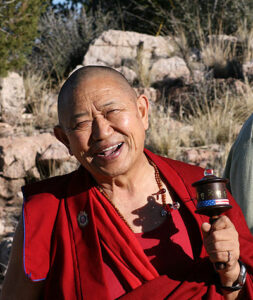
Questions & Answers – H.E. Garchen Rinpoche
QUESTIONS & ANSWERS
Translated by Ina Beiler & Transcribed by Florence Lee
Welcome everyone, thank you for joining the Question and Answer session with His Eminence Garchen Rinpoche. First question is:
Q1: Many disciples are born in western nations and have been deeply influenced by Catholicism and the original sin. It is taught all are condemned to suffer permanently in hell realms unless one is baptised in the Catholic faith and forgiven by God as part of the church ritual controlled by the priesthood. The effect of this teaching causes many to totally reject any spiritual path and continue to deeply suffer. Those who come to Buddhism because karma seems so similar can have these old fears arise. Can you please explain karma, cause and effect to gain freedom from the negative impact of this belief in original sin.
A: In this world, there are only two traditions. There are the traditions of the different religions and the traditions of the humans, the worldly traditions. Often also based on religions we utilize it for our own side. Buddha had said that the Dharma is good but then often what is misunderstood here is that in order to refine one’s understanding of any religion or the Dharma, according to the Buddhadharma or the scriptures it is said that there is this debate to refine each other’s understanding.
But then if one misunderstands that and uses these statements or arguments made in a debate, then one might say that my religion is good and their religion is not good and so on. So that happens everywhere but regarding the original sin, that we can say is ignorance. However, the Buddha said that the actual nature of the mind is pure. He said that all sentient beings are actually Buddhas. So, in its natural state, the mind is completely pure.
There is something that Lord Jigten Sumgon said in the Gongchig. Some people think that the Gongchig is just for Buddhists but that is actually not true. It is useful for anyone; for all different religions. In the Gongchig, he said that if one is grasping at any philosophical viewpoint then one becomes ordinary. Externally it looks like there is a debate but this is happening more on a verbal level. Actually, when one has really understood the view of the middle way, one must be free of grasping. So, when the mind has become free of grasping, it becomes like a cloud-free sky or completely pure water. And this is the meaning of a Buddha.
It means to have cleared away all grasping and when it is cleared away, the mind becomes vast and extensive like space. That is really the ultimate teaching of the Buddha which is not to grasp at anything. Even if it appears that there is debate and so on, it is only a temporary use of words. But ultimately there is no grasping. So according to the middle way one has to be free of all grasping ultimately.
Q2: Do you have instructions for those of us who cannot visualize. What can we do instead? Looking at a picture and quickly closing my eyes repeatedly does not work. Many people over the years have believed they could teach me to visualize because they can visualize and think that everyone can. This only leads to frustration. Is there some other way to practice where the usual instructions are to visualize?
A: The purpose of the deity yoga is to purify the obscurations of body, speech and mind. And when we visualize the form of the deity, we purify the obscurations or imprints of the body. Ideally, we practice the three aspects of deity yoga which is clarity, recollecting purity and stability. But what is most important when you practice the deity is to understand the nature of the deity. The deity really is bodhicitta but when a person dies the mind doesn’t die. There are two kinds of forms or manifestations that comes from this mind. If the mind perceives a duality and is grasping at a self, and there are many karmas and habitual imprints, then that mind will be controlled by karmic winds and take birth in the three lower realms or anywhere in the six realms of samsara.
The other one is bodhicitta. Even if you do not visualize the deity clearly but cultivate bodhicitta, the purelands and the deity is the natural manifestation of that. When you cultivate bodhicitta, the concept of ‘me’ becomes purified. For example, a person who has immeasurable love are together with their friends, they will see the good qualities. So, when you remember the qualities of the deity, it is just like that. Just like water being completely pure you remember in an instant the qualities of the deity. When you think of Chenrezig what is the quality of Chenrezig? The quality is that Chenrezig possesses omniscient wisdom, love and the power to grant protection.
When you know these qualities, then you remember that Chenrezig is very precious. So, you remember Chenrezig just like a child thinking of a mother. And this is the love Chenrezig has, like a mother loves her only child. If you are able to do that then it is sufficient. The Sambhogakaya arises from a mind that does not grasp at the true substantial existence of appearances. That is the essence of the Sambhogakaya or the deity. So, if you are not able to visualize anything just remember the qualities of the deity instantly. And remember the love of the deity like how a mother loves her child. The mind is like a mirror so if you think of Chenrezig then instantly Chenrezig will be reflected. Then there will be no more thoughts of “I”. If you keep remembering Chenrezig then slowly all ordinary thoughts will come to an end. Chenrezig’s love and omniscient mind will arise in your mind and this becomes the cause of taking birth in the Purelands.
Of course, if one is able to visualize the deity clearly then that has the power to accomplish the four enlightened activities and so on. But what is really most important is that you have a single-pointed faith and trust in the deity. There are three kinds of faith. First there is the clear faith which means to recognize the qualities of the deity. Secondly there is the longing faith which is the longing to become liberated from suffering. But not just oneself; you should think that may all sentient beings be liberated from suffering. If you think ‘May I be liberated from suffering, it becomes a fault.’
This ‘I’ that constantly arises is something that we cannot see with our eyes but it is always there. And we believe in its existence although it actually doesn’t exist. So, to remedy that, we think about others instead of thinking about ourselves. If you are able to just think of the deity in this way, then all the powers of the deity will also come to you. And that is due to the power of the deity’s aspiration. In brief if you cultivate bodhicitta, the Purelands are the natural manifestation of bodhicitta. If you only have that you will be able to take birth in the Purelands.
Even if you don’t know anything else, and just understand those three qualities of the deity’s omniscience, love and power to protect then the three kinds of faith will arise. And if these arises, trust will also arise that is why we need to understand these qualities. But if you still can’t understand then you can also make a prayer to be born in the purelands of dewachen. If you pray to the Buddha Amitabha ‘May I be born in dewachen’, of course you will be born there but you could also include all sentient beings. And say that ‘May I and all sentient beings be born there.’ So, it doesn’t seem too difficult to include sentient beings.
Regarding also this original sin that we just mentioned, what ‘sin’ really is; is the grasping at the self which is ultimately empty. Original sin is also similar to us saying ‘since beginningless times we grasp at a self’ but that doesn’t mean that this is our natural state. Buddha had said ‘Beings are obscured by temporary adventitious stains and when you meditate or look at the space like nature of your own mind, you can observe how this notion of ‘me’ always arises in the mind. Or when you encounter the slightest difficulty, then this ‘I’ arises. It momentarily arises therefore it is temporary.
In order to turn it away the antidote is to cultivate bodhicitta which is the single medicine that cures a hundred illnesses. So always have the wish to benefit all sentient beings and hold the altruistic mind. And if you never separate from it then with a hundred percent certainty, you will take birth in dewachen because dewachen is the natural manifestation of bodhicitta. Even if you still don’t trust then just think that in this world there are some people who do not experience much physical illness and who are happy in their minds. Some animals have a beautiful body and beautiful voice and so on.
Even the slightest degree of love leads to a certain level of happiness. So, the cause of all happiness clearly is love and all happiness like the purelands are the manifestations of love. For example, if you are together with a friend or companion and you cultivate immeasurable love for them, then naturally you will be happy together. And this is what the Buddha had taught. He had cultivated immeasurable love and immeasurable compassion. You can read about that in the King of Aspiration Prayers for Excellent Conduct where the Buddha speaks about the power of love. And it is all pervasive like space.
It is also said that the mind state of a Mahayana is like a vast ocean. So when you hear these stories of the Buddha, then some trust will arise within you. So what you need to trust in is that it is through the power of love that with a hundred percent certainty you can take birth in the purelands of Dewachen. It is very important to remember the deity because the more you are able to do so, the more the deity will also protect you. But if you are not able to remember the deity, then the deity also cannot protect you.
There are some who immediately think of Tara when they run into the slightest difficulty. And then Tara will really be able to protect you with a hundred percent certainty. And how does Tara protect you? Later in the bardo, when various frightening appearances manifest, if you are then able to remember the deity then the deity will be able to protect you. In that moment when you are able to remember Tara, she can protect you. That are the words of the Buddha which are always truthful. So, when we encounter difficulties, we have to be able to remember.
Many people remember their mothers when they experience difficulties. That is of course the mother loves them but the mother is also in samsara. So, by just remembering the mother, you are bringing samsaric imprints. The deity is a wisdom being and if you remember the deity, then with a hundred percent certainty, the deity can protect you. In Dzogchen we speak about the mind being liberated on the fundamental ground which is called the ‘liberation on the ground’. So instantly the deity can protect you at that time.
Maybe you think that the deity cannot protect you when you are alive but that is also not true. If you have a very big tree trunk that needs to be transported, even a hundred people will have a hard time carrying it. But if you submerge it in water and transport it, you can pull it just on a thin rope. It would be very light. That is similar to the state when we are in the bardo. It is easier to be liberated in the bardo because in the bardo we don’t have a body. And if we don’t have a body it is easier to liberate the mind. At that time the mind is on its own without the body. And then if you are able to remember the deity like Tara or your Guru, that really is what’s most important. That is what will protect you and this is also how you can measure your level of deity practice.
Q3: How can we loosen self-grasping when the body is ill; including preventing us from sitting up straight for practice. I’m finding concentration on sadhana much more challenging when I am lying down and uncomfortable.
A: When you are very ill and in pain, then you don’t have to recite the sadhana. You can just remember the deity and think of the deity. All suffering and sicknesses is like a friend even though it is very painful right now. It is actually a good thing because it is purifying our negative karma that we have accumulated with afflictive emotions. It will have to be purified eventually; now by you being sick and suffering, you are purifying all of these negative karma and obscurations. That is the first thing to understand. But if that is very difficult to bring to mind, then just think of the deity outside of yourself. Send your mind outside into space and think of the deity as being there in space.
Think that your suffering and pain is your friend but you still are able to bear it. Think of the deity with great love and send your mind out into space. Then your pain will also subside. Keep repeating that and if you practice this way even though you have an illness, it will not harm your life-force. You will live your life-span to its end without experiencing an untimely death. Even if you are not able to practice a sadhana or recite the mantra, just remember the deity in this way.
One other thing you can do when you experience some illness is you can practice the Om Ah Hung vajra recitation. Think that first when you inhale, think that the blessings of all the Buddhas in the form of ‘OM’ is inhaled and goes into your belly. With ‘AH’ think that now your body is completely burned away and there is nothing left. With ‘HUNG’ just think that there is nothing else other than ‘Hung’. That is very beneficial if you practice this again and again if you are ill. I myself also have a lot of illness and I personally find that it is very beneficial.
Q4: What is the difference between ‘Samadhi’ and ‘Mahamudra’?
A: This term Samadhi is a state of concentration which is a general dharma term that can be applied to whatever one is concentrating on. Like meditation or certain kind of visualization or focal object. Samadhi means the mind is held with stability and Mahamudra is the actual natural state of the mind which is clear and empty. It is vast and spacious. It is also free from the faults of eternalism because it is empty. And it is free from the fault of nihilism because it is naturally clear wisdom awareness. So, Mahamudra is the natural state of clarity and emptiness and Samadhi is a general term that is applied to various objects of focus.
Q5: Rinpoche had taught that during the bardo you understand all the empowerments given to you as long as you receive them with devotion. By understanding them do we get liberated or is it that we can practice them during the bardo?
A: First of all, what happens in the bardo depends on one’s own level of faith and bodhicitta. There are some whose karmic imprints are very strong and depending on the level of these karmic imprints, sentient beings are liberated gradually depending on where they are at. For example, those sentient beings who are to be born in the three lower realms take birth in the three higher realms. Those sentient beings who are in the higher realms encounter a precious human body and the dharma. Those who are already at that level are caused to cultivate bodhicitta. And those who already have bodhicitta will be liberated.
There is this prayer ‘I will liberate those not liberated, release those who are not released and give breath to those without breath.’ Step by step sentient beings attain the state of liberation in this way. In the text it explains the benefit of receiving an empowerment. It says that ‘when you receive an empowerment, even though you don’t understand a single thing, just through receiving the empowerment the result of that empowerment will ripen within seven lifetimes.’ As it ripens you will then be able to engage in practice. So, in the bardo, everyone possesses clairvoyant abilities. But those whose karmic imprints are very strong they might not develop faith. And if we have no faith and trust in the dharma then it is a little bit more difficult in the bardo.
But generally, in the bardo we experience intense fear and therefore faith in the dharma can very easily arise in the bardo. All the Buddhas are the same in essence so it doesn’t matter what deity we practice; they are all the same.
Q6: Rinpoche said that all the Buddhas are of the same essence so it doesn’t matter what deity we practice. They are all the same. He also gave an example that in India practitioners practice just one deity for life. What I find confusing is why there so many empowerments given in Tibetan Buddhism. And it makes me think that different deities have different attributes. For instance, now for the pandemic, Parnasharvari practice is recommended. When someone is sick most teachers and disciples do Medicine Buddha practice. When someone wants to purify karma, we do Vajrasattva practice. So why is there a distinction made for every deity if all Buddhas are of the same essence?
A: The mental dispositions and aspirations of sentient beings is different. So even though all we need is just to eat, if you serve everyone the exact same food it will not suit them and they will not be happy about it. Or if one friend says that he practices this deity and you want to practice another deity because he is doing this. That is why the Buddha taught different methods to suit the aspirations and wishes of sentient beings. It is just like one person having many different names.
It is explained in both the new tantric and old tantric system; that all the deities are included within the five Dhyani Buddhas which again are included within a single Buddha. Ultimately, all the wisdom deities are just like one person. They appear from the enlightened mind of the Buddha. When one realizes the nature of mind, as Milarepa had said “consciousness is transformed into primordial wisdom.’ When you realize that your consciousness is non-dual, you realize primordial wisdom and that is the Dharmakaya which is like space. Within space of primordial wisdom all the Buddhas are one within the Dharmakaya.
But then sentient beings have different aspirations so there are different dharma teachings. Actually, all the deities are complete within a single deity. Likewise, all the gurus are complete within a single guru. A guru’s body is the sangha, the speech is the dharma and the mind is the Buddha; of all the Buddhas of the three times.
Ideally, you practice with this understanding knowing that there are different deities due to the various aspirations of sentient beings. But it is sufficient to just practice a single deity and the benefit is the same. When you visualize the form of the deity, you purify the imprints of the body. By reciting the mantra, you purify the imprints of speech.
Mainly we have to purify the dualistic grasping from within the mind. When the mind becomes purified, these imprints of body and speech will naturally become purified. Which is why Milarepa only meditated on Mahamudra.
So, it is all about purifying our own mind and nothing else. If you just understand that, it is enough to practice a single deity; they all have the same benefits.
So, the benefit of deity practice is that through visualizing the mantra garland, three unceasing benefits come about. The first one is that by visualizing the mantra garland and practicing the deity, you are making an unceasing offering to all the Buddhas. Secondly the obscurations of sentient beings are being purified and thirdly there is an unceasing attainment of siddhis for yourself because your mind remains without distraction.
In this way, remaining without distraction again and again you purify your mind continuously until you become just like the deity. Your own siddhi is attained through your ability to abide without distraction. If you understand that then even though there are a hundred deities, you know that they are all included within a single deity. That is what you have to resolve.
So, it is said that within the expanse of primordial wisdom all the Buddhas are one. They all arise from the natural basic space of Dharmadhatu and they act in accordance with the needs of sentient beings. So, for deity practice, there is a lot in the new tantric system and also in the old tantric system. But actually, if you only remain within a meditative state of Mahamudra, within that mind all the deities are complete.
It is said that the scholars need to uphold the lineage and the fools need to practice without bias. The latter being us and for us practitioners it is most important that we develop a pure perception that is free from any bias.
Basically, there are only two fields of reference. The lower ones are the sentient beings and these are our source of cultivating love and compassion. Then there are the higher fields which are all the religions. So once anyone follows a religion, they are a sangha and we must have faith in all of them. This is like a field of reference which needs to be vast just like when you want to grow crops, you need to have a vast field. Just like that our minds must be vast.
This is how I practice and to me there are only those two fields of reference. There is the higher field toward whom I have faith; they are all sangha. And then there is the lower field which are the sentient beings to whom I cultivate love and compassion. Personally, I practice immeasurable love and I must have bodhicitta. There is nothing much else to do and it is quite simple.
Q: Your Eminence, you taught us that we can and should practice only one deity. As a Vietnamese practitioner I have a great aspiration to be reborn in Amitabha’s pureland but traditionally for practicing Amitabha we often recite Om Ami Dewa Hri in Sanskrit yet the deity I am practicing is not Amitabha Buddha but Red Tara Kurukulle. Should I practice two deities at the same time or only Kurukulle? If I only chant Kurukulle’s mantra how should I maintain my aspiration to be born in Sukhavati and my connection with Buddha Amitabha?
A: Kurukulle is an aspect of Tara and you can practice only Kurukulle also. Nowadays, a lot of people in the world are practicing Amitabha and Amitabha is one of the five Dhyani Buddhas in the western direction. You can practice whichever one you like and it is just fine to just practice Kurukulle. But in brief what you need is Bodhicitta, a wish to benefit all sentient beings. If you have that then you will surely take birth in Dewachen. So, the difference is not the deity.
Q9: His Eminence Garchen Rinpoche often speaks about mother’s love. Why mothers and not any other good example of loving kindness such as our father, good friends, spiritual teachers etc. I know of mothers who physically and psychologically abuse their own children or they were drinking and taking drugs while pregnant; causing physical and mental difficulties.
A: Whether your mother treats you good or bad is also your own karma. If your mother treats you bad then in your previous life, you have done something to her which is now coming back to you. But in any case, if you didn’t have this mother you would also not have a precious human body. Generally, you can just bring to mind anyone in this world that you feel the greatest love for and cultivate love from there on. So, if it is your mother you think that all sentient beings have been your mothers; not just this mother.
In countless lifetimes, everyone has been your mother and when you remember this then whoever you meet you will see them like a family member. That kind of feeling will arise and when you see an elderly man, you will think that he is your father. Or when you see a younger woman, you will think that ‘this is my sister’ and so on. Real love arises and this love that arises creates a feeling in your mind. It is that feeling that melts the ice block of self-grasping and this is what we call purifying obscurations.
Although the mind is actually Buddha, it is frozen into ice due to self-grasping. It is melted through the feeling of love arising within you; that feeling of love which is most important. If your greatest love in this world is a dog then you can think that everyone in this world is just like this dog; and you cultivate love in that way. So, we say all mother sentient beings limitless as space and so on, but actually if you didn’t have a mother, you wouldn’t have a precious human body. If you didn’t have a teacher, you wouldn’t learn anything.
If you didn’t have a country then you would have no means to really live a life. So, think about these three points and cultivate love for them. Especially think about your country; it doesn’t matter whether a president of a country is good or bad, still if you have a country, it protects the people of the country. How would it be without a country? If we have the slightest problem, the country is there to protect us. But sometimes not; due to our own karma. So, cultivate love for your mothers, teachers and your countries. Especially your teachers.
All the qualities that you have come from those teachers. So, you should respect all of your teachers. That is actually the greatest benefit in this life; the kindest one really is your teacher. Especially the dharma teacher who shows you a path for this and future lives. But also, the worldly science teachers and so on. They give us a means to be happy in this lifetime. So have a pure perception and respect for all the teachers and think that they are all good. If you think that they are all good, then a feeling arises again. And it is very important that this feeling arises.
Q10: Milarepa’s secret name was Sherpa Dorje or laughing vajra. Is this a sign of enlightenment or siddhi; a person who is laughing all the time?
A: That is actually a quality of love and compassion having arisen within one’s mind. If one sees the nature of mind then love and compassion arises and immediately one is smiling. When somebody doesn’t experience such joy and bliss in the mind, then also one will not laugh or smile. It is a quality and an external expression or manifestation of love and compassion.
Q11: I have recently started practicing tummo. Can you give some pith instructions on the practice?
A: Through the practice of tummo, warmth or heat is generated in the body. And there is also visualization where we visualize a fire at the navel. But the most important point of tummo is for the winds to abide at the navel. If the winds abide at the navel then that leads to an increase of physical and mental power. The navel is like the royal main seat of all the winds. And tummo is a method for the winds to abide there.
When warmth arises, then bliss arises which then pervades ones channels and ones entire body. So in this way, one’s body becomes powerful and one’s mind becomes clear. So, most important in tummo practice is that the mind winds abide at the navel and here this wind is not the breath that comes through our mouth. But it is the natural and subtle winds which pervade our bodies that gives us strength and so on.
For example, when you are applying some strength like when you are straightening your back, then naturally there is a force coming into the navel. That is the wind that comes into the navel. Therefore, it is good to have all visualizations at the navel such as the Hung and so forth. Then when you visualize a fire at the navel in the tummo practice heat arises through that.
So, the qualities that arise from tummo arise from abiding at the navel. And if you abide there, all the good qualities arise naturally. What is important is to sustain mindfulness and a state of non distraction. Which is also connected to practicing meditation without distraction. A sign that the winds is always abiding at the navel is that this naturally pulsating Hung sensation will be felt throughout your body. That is the subtle winds and not the breath that we are breathing. Then all the channels will reverberate with Hung Hung Hung naturally with each pulse. Hung is the sound of this wind energy. Then if you have all kinds of pain or different physical sensations, you can visualise a Hung at that place. Then just feel the vibrations pulsating through those channels.
For example, when you are sitting up completely straight, you apply some strength and this strength causes some firmness or contraction in this navel area. What happens at that moment is that all the energies gather at the navel chakra. Therefore, it is very important to have a straight posture at all times. If you don’t understand this point, then you might think that it is all about the coarse winds or breath. And the coarse winds might have some short term benefits but they will not lead to real qualities. So you need to understand those subtle winds and how they function in your body.
If you are sitting sluggishly then you are loosing the force of those winds. And if you apply force again and straighten your back, then the sensation of the energy coming back will be recognized. Therefore, it is very important to sustain a straight posture at all times. Through that you will also develop a state of non distraction in your mind. So dear dharma friends see you tomorrow and Tashi Delek.
Q12: It is said that when the yidam appears in the bardo, it will give us important instructions. But what if the deity gives me instructions in the dream. How can I know whether such a dream is meaningful or just delusions?
A: It is better if you do not try to hold on to what happens or appears in dreams at all. Because what we dream about are the various appearances that we encounter in our waking state during the day time. Also during that time we think that appearances are true and thats how it is or this is good and so on. It is better not to analyze it at all as Milarepa also had said that even when the dream is recognized, if you cling to the truth of it, then it will constitute a hindrance on your path and the attainment of siddhis.
So if a good quality arises, you should not feel contentment or develop pride. But if it is something negative, you should also not become discouraged by that. Let it all be the same then you will also not loose your inner strength. Do not engage in thoughts of attachment or aversion thinking that it is a good dream and so on. Don’t analyze dreams at all and if you just let it be without grasping, then it could turn into a siddhi or an attainment. Any hindrances will naturally be pacified so it is better if you do not pay too much attention to the dreams at all.
Q13: I am old but not that old. I have increasing trouble with my memory and I am concerned about loosing my ability to practice the dharma. Is there a specific negative type of karma that has caused this? And is there anything that can be done to reverse this? Could having done many years of practice without understanding the meaning of the Tibetan words be part of this problem?
A: It is not because of having done the practice in Tibetan without understanding it. But generally, there are 7 different states of mind that are related to ignorance. One of them is this loss of memory, forgetfulness and also for example feeling sad or lazy. Individuals are also of three dispositions depending on their winds, bile and phlegm. An imbalance related to phlegm is related to ignorance.
Then there is the fault of having greater ignorance, forgetfulness and so on. What you should do is to sustain the practice of mindfulness consciously at all times. So, when you practice Vipassana and sustain clear awareness, gradually your mind will become clearer. You have to practice in this way or else it will get worse. Also some tibetan medicine can be very beneficial like the Jamyang or the Yangchen Rilbur pills.
Q14: I am afraid of taking birth in samsara and wish to be born in Sukhavati. But also I don’t feel ready to practice Vajrayana and take the Amitabha empowerment. How should I practice to be born in Sukhavati?
A: What causes us to be born in Sukhavati or Dewachen is the power of our faith in Buddha Amitabha. That is the essence so if you don’t have any faith then you also have no method to be born in Sukhavati. But even if you are not born in Sukhavati, you can still be born as a God or obtain another body in the higher realms. For that it is most important to be kind and generous to others and to have a good heart. If you have that you can attain birth as a god.
Q15: What is the “Lha” vital essence?
A: The consciousness wander all over the place and from our perspective, when you are sleeping at night, your body lies in bed. But your consciousness goes around and travel the entire world. The same when someone has died, he perceives various different things and manifestations. But in reality, the mind is all-pervasive and things just appear momentarily. For example, the way we perceive it is here we are lying in bed sleeping then there is this consciousness that is going around. So, we see it in this dualistic way but that is a confused perception. The mind pervades the entire universe wherever there is space. That is what the Buddha had realized with his omniscient wisdom that all of these perceptions are only projections of one’s own mind.
So, we perceive ourselves lying in bed but the consciousness goes around or we have died and we leave our dead body behind. Our consciousness goes around into hells and so on. Actually, it is all one and the same mind it just appears in a dualistic way. Someone who has realized the view perceives everything in a non-dual way. As it is said “the way things appear is one’s own mind”. Until one has realized the natural state, one perceives things in a dualistic way”. One suffers and wanders around all over the place like in the bardo and so on. This is how it seems to us but for someone who has realized the view, one taste appears as a diversity and diversity has one taste. Therefore, there is no duality and one thing can appear in many different ways.
Q16: I am new to Buddhism and feel discouraged already because my buddhist friends aren’t as friendly and are much more judgemental than my non-buddhist friends. How do I get started in a Buddhist group having had a negative first impression?
A: There is an outer and inner aspect to what we call a Buddhist. Not necessarily everyone who appear in a certain way is a certain way. For example, there are many non-buddhists too who have understood the non-dual nature of the mind and have cultivated love and compassion. There are also many non-buddhists that mainly consider the outer world’s material things as most important. What really makes someone a buddhist is the magnitude of one’s love and compassion. That is something that does not just develop momentarily but one brings that continuum from previous lives. There are some Buddhists who possess great love and also many non-buddhists who bring that from previous lives and who possess great love.
Only when immeasurable love has arisen in the mind then one actually understands the true buddhist view. In this experience you should recognize the preciousness of love and compassion. And that the mind is most important. If you understand that then you have finally understood the actual Buddhist view. Until that has actually arisen you have not ultimately understood the buddhist view. So, it is not that someone enters Buddhism then one is a Buddhist and immediately one is like a Buddha. It is also not like that. It also depends on the imprints that one brings from previous lives, we still have to follow that. And even if we enter Buddhism, it takes some time to develop immeasurable love.
Q17: How do you know when you are ready to start teaching the dharma and accepting students? What is the proper motivation for doing this?
A: For teaching the dharma, there is also an outer and inner aspect. The outer criteria is that you have learnt something and have gained confidence that this is how it is. But the inner criteria that needs to be met is an altruistic mind that wishes to benefit sentient beings. If you really have this mind of benefitting all sentient beings then this mind is the Jewel that will benefit yourself and others. That is the sign that you are now ready to teach them the Dharma.
Also, Milarepa had said that when you see the root guru as the actual Buddha then that is the time when you are ready to teach the Dharma. What Milarepa is really saying is having realized the view that the Guru, the Buddha and one’s own mind are indivisible. In brief, if you have cultivated an altruistic mind then whatever you do will be of benefit.
Q18: Sometimes when I meditate, my body, winds and mind is calm and seem to connect as one. When I open my eyes, the world looks different because I don’t fixate on a specific object. Is this experience related to Shamatha or the union of Shamatha and Vipassana?
A: It is an experience of Shamatha calm abiding and it is also an experience of the greatly blissful dharmakaya. In the actual true nature of the mind there is no suffering because the mind is just like space. All our discomforts arise from dualistic thinking that something is real. These thoughts of attachment and aversion pollute the mind so the mind becomes like dirty water. Then we become attached to pleasurable blissful experiences and want to avoid suffering.
When the experience of the body and mind become calm and relaxed, it shows that you have gained some experience of the nature of the mind. Longchen Rabjam also had said in the treasury of pith instructions that when you see the natural state of the mind, the mind becomes at ease. Then nothing will affect you so suffering and painful experiences will not overwhelm you. You will also not develop so much attachment to blissful experiences. The mind is very even and unchanging. Also in the Golden Temple Prayer, this is referred to as the spontaneously accomplished mind. That is when you see the nature of the mind and this is a sign of having gained an experience of the Buddha within your own mind.
In the Vajrakilaya practice, it says “overcoming the demon of the lord death, May I attain the power of immortality.” So, you overcome the demon of the lord of death when you realize that the nature of the mind transcends birth and death.” This nature is what we call the Buddha Vajradhara. We do experience suffering and painful experiences but you can still understand that within the mind these do not exist because the mind is like space. Space is beyond birth and death so this is how you realize that your mind cannot die. These various appearances of suffering are just like an illusion or a tv show that does not inherently exist. The ultimate buddhist view is to realize the great bliss mind that is without any suffering.
Q19: What are your thoughts on people wearing the red and white Ngakpa shawls and what are your requirements for someone to be allowed to wear it?
A: When we see the outer red and white Ngakpa robe it reminds us of the great qualities of the Buddha in a moment. That is why is it of great benefit. There are two classes of sangha; the lay and the ordained according to the sutras and the tantras. Any robe is a symbol of belonging to the buddhist sangha community. It does bring many benefits in wearing such a robe and this is from the outer perspective. From the inner perspective, the most important criteria that you should possess for wearing this is a wish to benefit all sentient beings.
If you wear it with a motivation of being happy yourself, then it will be a fault. If you think that you are wearing the Ngakpa robes and sentient beings see it, they may rejoice in that and recognize Buddha’s qualities. They will think that this person is not an ordinary householder but a Ngakpa tantric practitioner.
Then that will be a good reason for wearing it because in this way it becomes symbolic and others recognize the meaning behind it. It doesn’t matter which kinds of robes they are; it could be the robes of the Vinaya, the Ngakpa or any virtuous robes. Most important is that you have a wish to benefit others by wearing them.
Q20: During the Chakrasamvara practice, I can produce overwhelming amounts of bliss but no inner heat results from the bliss. My hands remain cold and I also live in a cold environment. Is there something I am doing wrong?
A: There is nothing that you are doing wrong. First bliss arises and from that arises the warmth of tummo. But when the warmth doesn’t arise, you should make a greater effort in practicing tummo and keeping the wind energies at the navel. It is actually through the power of the winds that bliss arises from the navel. Also, it is possible to only practice with the bliss even if the heat hasn’t arisen. Because when the bliss arises you should look and think ‘where is that bliss?’. And you recognize that the bliss is the natural state of your own mind. So, the various visualizations and methods that we apply are only methods to ultimately come to the nature of the mind.
And the experience of the nature of the mind is one of great bliss which is called “The Great Bliss Dharmakaya.” There is no other bliss to be sought elsewhere and this great bliss is unchanging. Nevertheless, even if no heat arises you can practice different yogic exercises together with the tummo practice and the visualizations. Also, when Milarepa himself was practicing meditation in Lapchi, there was also a time when no heat arose in him. Then he practiced a yogic exercise that he had received from Marpa which stirs the dakinis within his body. And that generated the warmth so there are different yogic exercises which one could practice.
Also, not everyone’s body is the same and people have different levels of physical strength and energies. But the most important point is to meditate on that experience of great bliss. Basically, it is to meditate within the state of Mahamudra and the power of Mahamudra practice is exactly the same. In brief if that is your experience then you shouldn’t consider the warmth or the heat to be most important. Because the heat is just a common and ordinary attainment. What is more important is to recognize the nature of bliss which is Mahamudra.
So, you should regard Mahamudra as most important whether or not the warmth arises. You should look at the nature of the mind and recognize how it is unified with the state of great bliss. When you realize that then it is called the Supreme Siddhi of Mahamudra. The warmth that arises is just an ordinary siddhi and not the most important thing. The reason why this is very important is that it was also mentioned in the Chakrasamvara practice where it says ‘I am Heruka, the essence of all the deities abiding in the nature of great bliss of the mind of beings.”
Therefore, whoever has a mind there is also a state of immeasurable love and bliss that is selfless. And when that is recognized, then this mind naturally pervades. The pervasiveness of this great bliss naturally becomes an offering to all the higher beings. And it purifies the obscurations of the sentient beings so it is this experience of great bliss that stays and received as an offering. And when you recognize the nature of the mind, you come to the state of Mahamudra.
That is why it is said that it is of a greater benefit to meditate in a single session than it is to save the lives of all sentient beings in the three realms of samsara. So, this is speaking about the benefits of Mahamudra practice. When you practice Mahamudra and experience great bliss, you need to recognize its all pervasive nature. Since it is all-pervasive there is no distinction between the higher and lower beings. When you see that a great feeling of joy arises within you. Then just naturally through the power of your own body, heat arises but the heat itself is not really the beneficial part of the practice.
Q21: I want to practice dream yoga but due to health concerns I cannot sleep on my right side. Do you have any tips for dream yoga?
A: The reason for sleeping on one’s right side is because less delusions will arise within the mind. But it really doesn’t make a difference if one practices so you can either lie down on whichever side. Or fall asleep while you are sitting up. The point is that you should remain within a state of practice. When you are sitting up and falling asleep, then you should wake yourself up over and over again throughout the night.
Because it is this state between falling asleep and being awake that we need to recognize. The experience is connected to the visionary appearances of red, white and black and falling into unconscious state. Then there is a feeling that is similar to fear so it is this in-between state that needs to be recognized. Also, in terms of the dream itself, we can practice with the dreams on the basis of understanding.
Normally how we understand things is that we think that daytime appearances are the reality and that the night time appearances or dreams are not true. But during day time appearances we consider our physical body as most important because we believe that it is really us. So, we fixate and cling to the body; however, if we keep clinging to that, later when we die we continue to go on just like in a dream-state. This lifetime of having a body is actually a false perception and that is one thing that we need to understand when we practice dream yoga.
This life time experience of having a body is actually false perception and that is one thing that we need to understand when we practice dream yoga. That there is no difference between the waking state perceptions and dream perceptions when sleeping. When you recognize that then also during waking state you will not have so many hopes and fears arising in the mind. It is all just like a dream so understand this over and over again.
Regarding recognizing the dream state, it is good to wake up from sleep throughout the night repeatedly. Because we need to recognize the in-between state of waking and dreaming. That is what is most important and not the body or the posture of the body. It is fine if you are not sleeping on the right side. Also, for the dream state, you need to see the similarities between the perception that we have during the day time and during the night when we are sleeping.
It is because we believe in the true existence of the waking state that our experiences of suffering are very intense. Then also in our dreams we experience suffering but the day time waking state perceptions and the dream perceptions are the same. They are illusory and when you know that you will instantly be able to let go of whatever feelings arise. From the moment you enter the womb of your mother until the day you die, this entire life is just like the dream of a single night. This understanding will also help your dream practice.
Regarding the three samadhis of the sutra path, I understood that once by reading the Maitreya Aspiration Prayer. I do not have much learning so this is just my own take on that. The three samadhis of the sutra path are the illusion-like samadhi, secondly the hero-like samadhi and third the vajra-like samadhi. There are probably many explanations on that but regarding the illusion-like samadhi, here one realizes that all phenomena of samsara and nirvana are illusory by nature. They come and go just like waves in the sea or clouds in the sky but lack any true existence.
When one sees that things are illusory, then thoughts of attachment, anger and fear will not arise within the mind. Secondly there is the vajra-like samadhi and this awareness which is buddha nature is the vajra. It has never been confused by any object even though it seems that we temporarily experience confusion. It is a temporary layer on top of that confusion where the mind clings to external objects. Due to that the mind develops thoughts of attachment and anger and believes in the true existence of all appearances.
Due to that one accumulates karma and habitual imprints which leads to the appearance of the six realms of samsara. The fundamental nature of the mind has never been confused which was also explained in the Samantabhadra Prayer. The vajra-like samadhi is also related to our perception and habitual imprints. In the 37 Bodhisattva Practices, it says ‘The way things appear is one’s own mind.”
And vajra is the abiding in the empty nature while Kumara means youthful which is another name for Kilaya. Youthful because he possesses perfect strength and the power to destroy all thoughts and habitual imprints. Then Sarwa Bighanen Bam Hum Phat means to destroy all these thoughts and habitual imprints. Most mantras of the vajra class are n essence the same in meaning as the vajrakilaya mantra. So the essence is to destroy conceptual thinking and discursive thoughts through sustaining mindfulness. And also undistracted single-pointedness without clinging to any thought.
Thoughts come and go just like waves on water so one just abide within the state of mahamudra. It is indeed very difficult to visualize all kinds of visualizations but the best visualization is to be in a state of mindfulness. Therefore, it is fine if you recite the mantra without any distraction. For the visualization the Hung syllable is the easiest to visualize. You may think that it is difficult when you visualize the shape of Hung in your mind. But the way you should see Hung is not as a physical shape or form but more like a vibration, a sound or wind energy.
That is very helpful especially when different feelings and thoughts arise in the mind. When a feeling arises, you just bring to mind the feeling of Hung as a sound or a pulse. When you focus on your heartbeat, you feel the pulse going through all your veins in your body. The Hung reverberates naturally throughout your entire body and all the channels in your body pulsate with Hung, Hung, Hung. However, you should focus and have awareness of the Hung at the navel. That is because the navel is the seed where our wind energies or power is concentrated.
Q22: My daughter is 17 and has been suffering from depression for two years. She tried to commit suicide and is now taking anti-depressants. How can I help her?
A: What you can do to help her is to give her blessing pills or other sacred substances. Also, it would be beneficial to hear the sounds of dharma. For example, like the Aspiration Prayer of Dewachen or any beneficial mantras. But she also has to experience her own karma until it is purified.
Until then she will have this problem but she becomes your support to cultivate love, compassion, generosity and patience. Basically, the support to practice the six paramitas. Also, the fact that you are now taking care of her is a sign that in the previous lives she was taking care of you.
So, recognize that and recognize her as a source for you to cultivate compassion and merit. You are also then purifying negative karma so for both of you it is actually a good thing. You shouldn’t consider it as negative or a situation of suffering.
Q23: I can recite mantras for many hours but have difficulty visualizing the Hung syllable. If I force myself to visualize I become tired and loose my enthusiasm. Sometimes flickers of visualisations spontaneously appear. My intention is to focus on the mantra while feeling the quality and presence of White Tara. And also connecting with the nature of mind without worrying about the visualization. Is this correct?
A: It is okay if you are in a state of relaxation and when you recite the mantra, recite it single-pointedly. That is also the reason why we have to recite a great number of mantras because when we excite them single-pointedly we are purifying our grasping at sound. And through the visualization we are purifying our grasping at the body. Sometimes even our perception of being physically in a retreat cabin diminishes.
Mainly if you recite the mantra within a state of mindfulness and free from distraction, then just through that the thoughts of grasping at object, sounds and their meaning stops. The meaning of all mantra is included within the Vajrakilaya mantra. When you recite the mantra, you can also reflect on the meaning. Om Benza Kilikilaya is the name of the deity Vajra Kumara and together it refers to clear intrinsic awareness.
Q24: This question is from a 7 year old girl. “Why bother living if you will die at some point? “
A: Don’t think about whether you will live or what is the point of living. What has to be eliminated whether you are alive or not is the karmic imprint of grasping at a self. Whenever that arises, think of any deity for example Tara. Basically, whenever you have some difficulty, whether it is being alive or not the best if you are able to remember the three jewels. Because then there is no thought of “I” in the mind. All the karmas and imprints arise out of this “I”.
So this thought of “I am going to die or I am going to get sick”; all of these difficulties that we experience come from this sense of “me”. Ideally you should remember the refuge of the three jewels because then this imprint will go away. Also remember that your mind actually is Buddha nature so for this reason you can remember the three jewels. But even if you can’t at least you can think about sentient beings and wishing to help them.
Without thinking of whether you die or not, think that you want to benefit sentient beings no matter what is the circumstance. Just don’t even think about what is the point of living and so on. No matter what is the circumstance, remember love and altruism. Then you will definitely not be mistaken so even if you are not able to remember the refuge of the three jewels, always remember love and the wish to benefit others.
Q25: I have done many years of practice but I still encounter many obstacles. Can we improve our karma for this life or will the karma we create manifest only in our next life?
A: Your practice will be beneficial in this life and also in future lives. Whenever you encounter obstacles or difficulties, you should think that you are repaying a karmic debt. It is said that if you wish to know what you did in the previous life, then look at your present life. The imprints we have accumulated in previous lives must become purified. Until then it is stored in the mind just like a picture in a camera.
Therefore, the benefit of that difficulty is when you recognize that this suffering purifies your past karma. And when you recognize that you will also suffer less. Also, it is said if you wish to know where you will go next, then look at your present actions. So, whatever you do now is mainly also in preparation for the purpose of future lives.
Q26: How can I balance between the two extremes of laziness and excessive effort in my practice?
A: You do not necessarily have to have this balance but of these two things, excessive effort is much better and laziness is not so good. Whenever you feel that you are making an excessive effort in your practice, then you should recognize that you are actually not wrong. And whenever you are lazy, then you should recognize that now you are wrong because you have to purify your mindstream from previous lives. The purpose of that is to practice and karmas are just like pictures that are stored in the mind. In this moment therefore, develop an even greater trust in karma.
Q27: How do I know if someone is my root lama?
A: There are many different lamas and among them all, if there is a lama where you think that it is through this lama that you have understood and seen the nature of the mind, then you have found your root lama. But actually, don’t even think about who is your root lama because most people don’t really recognize that.
It is better if you think that all lamas are precious that is because the lamas open our eyes to karma since previous lives. Because if you don’t know karma, you are like a blind person. Therefore, remember the kindness of all lamas and think that all lamas are actually one with the Buddha. So, it is better to have devotion to all of them in general. But also, it is said that the first root lama that you encounter is the one that gives you the refuge vow.
Q28: From the perspective of a simple practitioner, do the experiences of the four yogas of mahamudra arise in order or can they arise in a different order?
A: Depending on your own channels and subtle elements, it is possible that they arise in a different order. It is basically an ongoing experience and a habituation that develops. Habituations also arises differently for different practitioners. For example, if one is a practitioner of the channels, winds and drops or tummo, it is said that this practice is a skillful means to recognize the four levels of joy or bliss; which is equivalent to the four yogas in a single instant. It is mentioned that it also happens through receiving the secret mantra empowerment.
It is said that through the empowerment, the four levels of mahamudra may arise in a single instant. But generally speaking, we habituate to the practice in a gradual way. The different levels are our personal improvement in the practice. For example, as years go by, you may recognize that you are less distracted and your practice improves. But we can’t really determine certain levels of practice or which bhumi and so forth. Some develop very quickly while others develop slowly.
As you habituate to the practice, you will see how your mindfulness develops. It is also said that the four yogas can arise in a single session. For example you are meditating and practicing calm abiding and the mind is in a calm thought-free state. Then within that same state of one- pointedness, whatever thought that arises will just naturally dissolve. That is freedom from elaboration. As you continue on in this state, you will continue to abide within this equal state of mind in a natural way. And that is called “one taste” where there is no grasping in the mind. As you continue on in that state, finally you might come to the point where you feel that you don’t need to meditate deliberately anymore. It just happens naturally and there is no effort needed. The mind just abides in its own natural state and there is nothing to be meditated upon.
Q29: We are told that we should observe our thoughts during meditation. When I look at thoughts they disappear. How can I make them stay so I can observe them?
A: What is most important is to be mindful and aware of whatever arises at all times in whatever you do, whether you are walking, sitting and so on. So, the key point is mindfulness and Milarepa had also said that to practice and develop an equanimity of the six sense consciousness, one should take all appearances as the path. When your mind is very clear, then whatever you do will be unmistaken. If you are unmindful in your activities, then you are following the ‘self’ which is the path of distraction.
In the 37 practices, it sums it up when it says that no matter what you do or where you are, always look at the state of your mind. Always recognize whether you are mindful or unmindful. Even if you think about an ordinary samsaric activity, if your mind is unclear or distracted then you will make mistakes. Also, what is helpful to sustain mindfulness is to supplicate to Tara like in the Supplication to Tara Prayer it says ‘I pray to the Mother Goddess of mindfulness.”
So, Tara is the ‘Goddess of Mindfulness’ which is connected to your own mindfulness. Therefore, whenever you accomplish an activity perfectly, think that this is the blessings of Tara with the recognition that Tara is indivisible from your own mindfulness. Tara is also connected to the perfection of wisdom and your own wisdom. They all have the same meaning.
Q30: The samaya of the Shitro Empowerment says that ‘if I get angry, I am going to hell.” I tend to get angry but doesn’t everyone? I heard that even His Holiness the Dalai Lama is said to have dealt with anger. How can I keep this samaya?
A: If you know how to keep the samaya, then even a very fierce thought of anger can be by nature primordial awareness. When anger arises within mindfulness, the affliction and mindfulness co-emerges and arise simultaneously. It is like wood helping the fire to burn just like the afflictive emotions enhances one’s awareness.
Also, a sign of Vipassana or special insight is that an afflictive emotion does arise but one will not accumulate any karma. The afflictive emotion will disintegrate and there will be no feeling left behind. For example, anger has the nature of clarity and when attachment is transformed, it turns into a luminosity of bliss. When ignorance is transformed, it becomes non conceptuality. So, there are these three kinds of awareness that arises. When the three afflictive emotions ripen, they ripen into bliss, clarity and non conceptuality.
A quality of vipassana is that even though an affliction arises it actually becomes an enhancement to your practice. For example, when you are meditating, a person comes along to shove you, you will normally get upset or angry immediately. So, when that anger arises, don’t look at the person but look directly at the anger. Then you see that you have directly come to the natural state of the mind or mahamudra. A sign of having recognized it is that the feeling of anger is completely gone and all there is is a feeling of complete pristine clarity. That is the special method of the secret mantra of Vajrayana where the afflictive emotions are actually taken as the path without abandoning them.
Q31: General question for Garchen Rinpoche to best describe how to do the Nyungne retreat from afar especially people who have health problems.
A: What the term Nyungne itself implies is like a sick person who doesn’t have anything. So, it is a practice for those kinds of individuals who really have nothing. We can use this lack and take a vow in our mind; for example, if you are not eating food, then you can take a vow not to eat food. There is nothing else that you actually need but whatever difficulty there is, think that you are representing all sentient beings and may all of their illness become purified. Just think about the benefits of the practice, meditate on emptiness and there is nothing else that needs to be done. Just take the vow within your mind. For example. if you are not sleeping at night for however many hours, then you can take a vow to not sleep for that many hours.
So whatever difficulty you have, you can take a corresponding vow and then supplicate to Chenrezig. And you can recite the few words of the sojong liturgy. For example, you can recite the Mani mantra “Om Mani Padme Hung” or you can just spin the prayer wheel and that is fine.
If you know and remember the ‘Praise to Chenrezig’ (written by Gelongma Palmo) that ends with Po, then it would be good to recite that praise. And also, by spinning the prayer wheel, the virtues of the body are complete within that. For example, when you are prostrating along with the praise. Also, at times just look at the image of Chenrezig and look at his face, his arms and legs and so on. Bring to mind his qualities, close your eyes and have the image of Chenrezig appear in your mind. So, what is important is that Chenrezig appears clearly in your mind and if you are able to recite this praise, then do that when you get up in the morning. Recite the praise, do prostrations and cultivate faith and devotion. In the praise itself, it mentions that any man or woman who gets up at dawn, prostrates and brings to mind Chenrezig then that is sufficient already. If you are able to memorize this praise, that will be best. Just think that Chenrezig is there in the space before you surrounded by all the Buddhas and Bodhisattvas. And then on an ongoing basis, thinking that you are prostrating to them while you recite this praise.
Q32: Compassion seems to be a very high level feeling and it seems to include within itself over virtuous high frequency feelings such as love, generosity etc. At the same time, it is not certain things that some people may mistake it with. For example, is it not pity? It also seems that one needs to have much spiritual strength as well as powerful mental and spiritual energy to feel compassion. Garchen Rinpoche please describe and explain what is compassion and what is not? Garchen Rinpoche what do you feel is compassion?
A: There is this term loving kindness and compassion. First, it all begins with those that we hold to be ours. For example, ‘my mother and my child’ so based on this connection identify this feeling first. Buddha actually said that we have to first bring this love between a mother and a child to mind. Or a friend that you love very much. Then when this person encounters difficulties, then you want to do something to protect them and that is compassion. So, all sentient beings possess buddha nature; the cause of awakening in the mind. To cultivate it, first we need to identify this feeling of love. All sentient beings have love in their minds and Buddha just taught how we can increase our love. And he pointed out the nature of how it first arises; it arises first between a child and a mother. There has not been a single being who has not been our mother. Or if you love your friend, think of beings who have been just like that.
Before that, Rinpoche said that there is a feeling of great love and from that arises a feeling of great compassion. For example, if it is your own child or your spouse and when they encounter difficulties, there is an unbearable feeling that arises. So that needs to be recognized; and that is compassion. And when compassion arises, wisdom also arises. When wisdom arises from this feeling, even though another person doesn’t suffer physically, but they might suffer in their mind. So, if you have compassion then you feel that from mind to mind. Or for example there is this disease in the world and depending on your level of love, wisdom arises. But there is a difference between a samsaric love and Buddha’s love. Samsaric love considers the self as most important and even if it comes with altruism it is one that is motivated by the self.
When you take this feeling and begin to think even in a smaller sense, a person who has love, will begin to think about how can they help others. What is their suffering and how they can clear it away and so forth. So, the stronger your compassion is, then the greater your wisdom will also be. Somebody who doesn’t have much love is only concerned about themselves and that mind becomes like an ice-block. Ice is also water but for as long as it is frozen, it cannot connect and moisten the ground. Then one lacks wisdom and starts smoking or taking intoxicants or ends up having no friends. And even committing suicide. That is because one’s compassion is too small. Even in a samsaric sense, if you have some small extent of love, you will still experience perfect happiness.
For example, there are two companions and they get married. If he thinks ‘I just want her to be well and happy’, and if he gives her that kindness, she will love him very much. Then they will be able to stay together until they die. That is due to the connection between kindness and love. Then there are others who think that ‘for as long as others are nice then I am going to be nice to them. But if they are starting to be unpleasant then I will return unpleasantness to them’. That kind of compassion is ordinary compassion. It is almost like you are deceiving or cheating the other person to get their love. So, if their love is not sincere, then later on you will separate. But that is the fault of ordinary compassion where you consider yourself as most important. “First I have to be happy” and the love that you feel for the other person will still be ordinary and you will not be able to stay together for a long time. That is a sign that true love is too weak.
If love is really strong, then due to the quality of this kind of love, you will be able to be together until you die. Otherwise, if compassion is ordinary then this kind of companionship does not become stable. So, then the Buddha’s compassion comes from the perfection of wisdom which means that Buddha has realized that self and other do not inherently exist. The Buddha had realized that the compassion that is concerned only about self is a mistaken view. What needs to be cultivated is vast compassion; a perfect and complete compassion that is selfless. Because there is no self and what we call a self is a creation of the mind. Because if you keep thinking about “me, me, me” then you are creating an idea of a self that doesn’t actually exist. So, Buddha had realized the ultimate truth; therefore, his compassion is vast and feels compassion for all beings including enemies and obstructors who do harm. He loves them and holds them with patience. So, the Buddha possesses the four immeasurables and it begins with immeasurable love. And from that comes immeasurable compassion, joy and equanimity.
But if immeasurable love is lacking in the beginning, then the other three immeasurables will also not arise. So, this is the compassion of the Buddha; which is an immeasurable or unobjectified compassion. Garchen Rinpoche has already answered many of the other questions with his last response so we will skip to the next question.
Q33: When I contemplate renunciation, it seems that at times I become sad and experience depression when looking at all the vast suffering of beings. Sometimes it feels hopeless that suffering can be diminished as it appears that human beings are doing more and more harm all the time to each other. And also, to the earth. It seems that the earth and the environment is doomed to destruction. Clearly bodhicitta is what we can and need to do but how do we not become sad and depressed and have hope that we can make a difference.
A: If you are starting to feel depressed or sad, then first you have to understand karma. When you understand karma, then suffering actually becomes an encouragement for you to practice virtue. Suffering becomes beneficial. So, when you understand karma what you understand is that this is the karma of sentient beings and it comes from very powerful afflictive emotions. And by experiencing suffering, they are actually purifying these negative karma and obscurations. They are purifying the obscurations of attachment, hatred, ignorance; the causes of birth in the three lower realms. But even if they go to the three lower realms, buddha nature will again become liberated. Think that the root of all the suffering in the world are the afflictive emotions. So now we have a lot of afflictive emotions though we act out on them all the time and we experience suffering as a consequence.
Even though we experience suffering, the suffering purifies the negative karma. Along with that, some joy can actually also arise. So, you understand the cause of suffering then next you realize that the cause is within your own mind. It begins with self-grasping and from that other afflictive emotions like hatred and jealousy arise. They create all of the suffering then you recognize that you have created your own suffering. No one else in the world has done that to you; you did it yourself. Ignorance is to not understand the fault of these afflictive emotions. For example, you think that you need to be angry and jealous because these emotions protect you. So, this unknowing is ignorance.
But in any case, you are purifying these obscurations by experiencing suffering and the mind itself is still the cause of Buddhahood. Because you have that, you are purifying negative karma, you can rejoice. Then think of a deity like Chenrezig and think that may the obscurations of all sentient beings quickly become purified. So sentient beings are still going to die and when they die then again, they continue to suffer in the bardo. Anyone will have to die but the mind still possesses buddha nature. Therefore, those beings can become liberated from suffering again in the future. We have to however hold on to bodhicitta and if you hold on to that, then in the future you will become liberated from suffering. So, supplicate a deity and the three jewels but do not hold on to the suffering in your mind. But rather think of any deity that you have devotion to; like Tara or Chenrezig and think that within that deity all the deities are complete. Or if you pray to a guru, think that within one guru (the guru you are devoted to) all the gurus are complete. So, think of the deity, recite the mantra, supplicate and pray; and then you will not lose heart.
There are a lot of illness and death but that has a good quality too. Buddha had taught that in the human world we all experience the suffering of birth, aging, sickness and death. We all experience that and no one can do anything about it. When we really think about it, even if we are not fully aware, it happens all the time continuously day and night. Uninterruptedly there is birth and death all the time. It is the wheel of birth and death. As humans and gods, we experience some pleasure and happiness in our lives. But we are distracted by these pleasures and are not really aware. Then when it all comes to an end, happiness stops and suffering arises. When even the slightest suffering arises, we begin to understand sickness and death. Then what shall we do at those times?
It is said when you are sick or when you die, remember bodhicitta. So, when you are sick how should you think? You should think that this is a karmic obscuration and you are purifying your negative karma that you have accumulated. And you understand that these were created by your own afflictive emotions and now it is cleared away. So, if you understand that and bodhicitta arises, you will see it in a more positive light. And you will see that even though it is painful now, it is like a surgery. When you do a surgery, even though it is physically painful, in your mind you have to think that it is beneficial and you have to do it. What is actually happening is the you are putting an armour onto your body but the way you think about it is different. So, you change your way of thinking about it and just feel that suffering is a beneficial thing. And think that because you lack bodhicitta and have accumulated karma with the afflictive emotions. As a result, now you are suffering and when you die remember bodhicitta.
Then if you have bodhicitta you will think that even if you die there is no harm because you have bodhicitta to bring with you. For example, you can see in this world there are many people who do not have a lot of suffering. They do not experience physical or mental suffering and that is because they have not created those karma in previous lives. And those who have created the karma are now experiencing suffering. So, if you have recognized karma then you know that you have to be mindful of karma and hold on to love and compassion. When you die this is what you have to bring with you. Therefore, when you are sick, think of bodhicitta. When you die, think of bodhicitta. Take the vow and make your prayers; then you will have confidence and assurance.
Q34: Then the next question is “Rinpoche mentions some of the oral instructions that Khenpo Munsel gave him; is it possible to give us a guided meditation instruction for the tonglen.
A: ‘Tong’ means to send out and ‘Len’ is to take in. What we are sending out is love and compassion. So basically, it is the function of love and compassion; sending and receiving. First love arises for all sentient beings and then your compassion goes to them. Then what comes back to you is their suffering. For example, if you have a friend who has a lot of suffering then naturally it comes to you and you feel that suffering yourself. So, when love first goes out to others, then you become aware of their suffering and it comes to your own mind. So that is what you are receiving. What we need is to cultivate love for all beings in the world. According to the buddhist view, we recognize that all beings without exception have been our parents.
So, we say ‘all mother sentient beings limitless as space.’ But when we say that we must also feel that this is really how it is. In that moment, a feeling must arise and you habituate to that again and again. Then whenever you witness suffering in the world, then this feeling arises. For example, when you yourself experience suffering, then you would naturally feel that all sentient beings have this kind of suffering. And you think that ‘may I have it instead of them; I represent them’. So, you are taking on their suffering and your own suffering also gets much lighter. There is this wish of ‘may they be free from suffering and have happiness.” At that time, that is when you actually take in and receive all their suffering when you have that wish.
When you are sending, what you are sending is love when you experience happiness. And you think ‘May all sentient beings have such happiness’ and you are giving away your own happiness to them. That is really the instructions on Tonglen. It is how you perceive things in your mind and it is the feeling that has to actually arise. Whenever you experience even the slightest suffering, think that all sentient beings suffer like that and may you represent them all. And if you experience the slightest happiness, think that may all sentient beings receive this happiness.
Q35: Many translators translate the sadhanas from English to Chinese and most translations are done that way. Some say that before they translate there are no obstacles and their mind is not tense or narrow. But then after they finish the translation, then all kinds of things start to happen. Please then speak about avoiding obstacles and difficulties in this regard.
A: There is nothing greater than translating the texts. When it comes to translations of texts; if you have an intention of becoming famous or being known as a great scholar then you will encounter difficulties. It is important to understand the meaning of what you are translating. You convey the cause of happiness of all sentient beings which is love and compassion. This is what needs to be conveyed. Once you understand the qualities of bodhicitta, it doesn’t actually matter if you are a Buddhist or not. The mind must have love if you want to be happy.
The meaning of the text that you are translating is significant and of course because of that, if it is mistaken, then it is a great fault. So, for example, when you translate from Tibetan to English, you have to be very careful to pay attention to each and every word. There could also be mistakes in Tibetan so you have to be very careful. Because once it is translated it will remain for many generations. And the benefit can really be incredible. But it is also important to be very careful about the quality because we do need merit until we attain enlightenment.
However long those texts remain, the merit will be uninterrupted as it continues to benefit sentient beings. Buddha also said that the words are more important than the form. When the disciples look at the text and read one word about the refuge, they will think about its meaning. It is not just about reading something but they actually reflect upon the meaning, so therefore is very significant.
Q36: Regarding new Buddhist practitioners who just took the refuge vows but still do not really understand the view and the practice of Buddhism. So how can they engage in practice?
A: Practice the Mani mantra, supplicate to Chenrezig and also practice love and compassion. When you take the refuge vow now, if you don’t understand the meaning the imprint will still be in your mind. You will understand it in future lives. For example, even if a bird sits here and sees the liberation by seeing mantra. In the future the bird takes birth as human being; encounters the dharma, and cultivates bodhicitta. Slowly throughout several lifetimes they can attain enlightenment. Once they have seen it once, this imprint is already placed into their mind and this will pull them up from lifetime to lifetime. That is why the liberation by seeing mantra is so important.
The Buddha provided some methods (the liberation by seeing, touching and hearing) for those without any other method. The Mani mantra is the liberation by hearing and the liberation by seeing is whatever liberation you come into contact with like the refuge vows.
Basically, they are receiving a way or a direction to the path to enlightenment. It is just like a guide when you are travelling on the road in a car so you know where to go. It pulls you in this right direction.
Q37: Sometimes two companions have the same lama and become each other’s vajra siblings. That happens because they are a couple; they argue and get into a fight. So, would that destroy or break their samaya of being vajra siblings? What can they do?
A: If one doesn’t really understand the dharma, this is what happens. A lama or sangha is someone who possess immeasurable love and compassion. This is what he has to pass on to others. Immeasurable love and compassion must be practiced between two companions or between a mother and a child. This is the love; this is the samaya we are talking about. The lama teaches how to cultivate love where it hasn’t arisen and to not let it decline where it has arisen.That means we have to keep the samaya. The samaya between you and the lama and the companion is the same. It is a bond of love and in order not to lose this bond of love, you have to have patience.
You must not become controlled by anger and dualistic thinking. So, if you understand that, then this is the meaning of the dharma as explained in the 37 bodhisattva’s practices. This means that you have to be in harmony even with our enemies; not just between loving companions. This is what happens when one doesn’t really understand the true essence of the dharma. If one understands the quality of love, then everyone you encounter becomes an object and a support for you to cultivate love. Even those objects of aversion which normally triggers anger within us. And when anger arises, then you can recognize the anger which is the root of all suffering.
Recognizing that, then you will know that actually your anger is like a sickness or a disease in your body. Through the enemy, the illness comes up to the surface and you would feel quite grateful. If you don’t recognize it due to anger and jealousy arises, then bodhicitta is destroyed. Bodhicitta really is love and first we have to use these companions to develop our love. If you love your companion or friend then you should think that everyone has been my friend. Each time you meet someone, you have to develop this thought every moment and in this way, it becomes all pervasive. Eventually whoever you meet will become just like a family.
Q38: Some people want to do the smoke offering but don’t have the transmission. Can they do it?
A: Anybody can do it because the smoke offering is like an act of generosity. A transmission is more like an explanation but even without that you can practice it. As long as you have love and the wish to benefit sentient beings you can do it. Even if you think about your own benefit it is still generally speaking ok to do this practice. The benefit is often greater when you receive a transmission but anyone can do it at anytime.
Q39: Some people don’t have much courage and determination in their dharma practice. How can they cultivate such courage and determination?
A: The preliminary practice is bodhicitta; the wish to benefit sentient beings. And for this to first arise, you have to apply a method and not allow it to decline. Think about the four thoughts that turn the mind and think that when you die, you must by all means be able to bring love & compassion with you. So, the altruistic mind is the actual preliminaries and it is the antidote to self-grasping. The real benefit is wishing for the benefit of others. And if you wish for your own benefit, it is like mixing medicine with poison. That’s the greatest poison which is this thought of ‘me’. When you are eating food, there are a lot of bugs and organisms in your body. If you think that you are eating for them then it becomes an act of bodhicitta. But if you think that you are eating for yourself, then you are placing a samsaric imprint into your mindstream. So, this is the skillful means taught by the Buddha.
Q40: In order to train our mind in love, aside from seeing everyone as your mother or reciting the Mani mantras, is there any other method?
A: Rinpoche says it is immeasurable love. So, what is the essence of the Mani mantra? Chenrezig possesses great compassion and that is why we recite the Mani mantra. Every time we recite it, we remember Chenrezig, his love pervades all of space. On the level of relative bodhicitta, we have to remember the kindness of beings. And want to repay their kindness. We think about our teachers, our parents and our country. Among the teachers the spiritual teachers are especially precious. And of the three jewels, the noble sangha is the most precious as they have been kind to us. Why are they so precious? It is because this love that we develop is normally very ordinary because it could be love today but turns into anger tomorrow.
But still love is the cause of temporarily taking rebirth in the higher realms. Only the Buddha knew how to increase and develop love so it becomes boundless. In the beginning we have to think about it; every time this gratitude and love arises it is to your own greatest advantage. When you understand this, you would want to cultivate love. First you understand that as you realize that if you want to benefit yourself then it is not to your greatest benefit. Because self-grasping is like an ice-block; even though it is water by nature. Self-clinging makes you a frozen ice-block and the altruistic mind is like the sun. When it melts, the ice-block merges to be one with the ocean Buddha-mind and this is what we call bodhicitta. When you understand the benefit of that you will want to cultivate bodhicitta. And by thinking about it, it becomes greater.
So, you think about the kindness of your teachers, your parents, and your country until this wish to benefit all sentient beings arise. Once it has arisen, you have developed a mind of boundless love and until then you have to cultivate it. The essence of all the deities is Chenrezig, the Mani mantra. It is like the father of all the Buddhas but the form of Chenrezig is not what is most important; it is only an example. A thousand arms can help and support all sentient beings with compassion and a thousand eyes means that he sees the suffering of all sentient beings. It is only a symbol as he is all-pervasive. And when we say ‘May all beings have happiness and the causes of happiness’, Chenrezig’s true nature is like that. It pervades all of space and the entire universe and that is the inner Chenrezig. The actual Chenrezig is love and compassion. A male with compassion is Chenrezig and a female with compassion is Tara.
The body is not what’s most important; the mind is most important. If a mind of love and compassion arises, that is Chenrezig. Even the slightest moment of love is the mind of Chenrezig. That is the mind of the lama, the mind of the Buddha; the love that you have for all sentient beings. When it becomes great, you bring to mind Chenrezig then your mind begins to pervade all of space as you recite the Mani-mantra. Then there is no self; this is a supreme method to cultivate love and compassion. That is why we accumulate hundreds and millions of Chenrezig mantras.
Q41: Some people feel very happy in life before they study Buddhism. For example, there is a loving couple but through studying the Buddha dharma it seems that they get more distanced from each other and they feel more unhappy. So why is that?
A: All happiness experienced now is the result of karma from previous lives. It is said if you want to know what you did in the past look at your present body. We don’t have so much control over our happiness and suffering in this life. Whatever you have done with body and speech with a mind of love in the previous lives is now ripening as happiness. Anything you have done with anger and jealousy arises as suffering now
Everything that you experience now is the karma from previous lives. So, if you practice virtue now, it doesn’t mean that you experience suffering as a result. Whatever you do now is for future lives; for example, if you are planting rice or wheat and it is something that you will harvest next year. Right now you purify your negative karma and you are paying back your karmic debts.
If you understand that, you understand the actual Buddhist view of karma, cause and effect. For the future we know that we need to cultivate and sustain love. We always learn that when we take the refuge vow. Right now, it will already be of benefit because through understanding the refuge vow you will recognize the afflictive emotions and learn how to avoid them in order to avoid suffering in the future.
Q42: Sometimes we don’t get along with the views of our family members and they get angry if I spend a lot of money on dharma activities or things like that. So, what can we do in that case?
A: You should not insist but make mental mandala offerings if the family members don’t agree with that. Because if you insist then it could lead to negative karma. You can also make dedications and can set up a shrine with holy objects of body, speech and mind. But you must not insist. What is more important is that the family members get along and are in harmony. Make dedications, rejoice and don’t get angry. Just think of those poor beings who are greedy or stingy and cultivate compassion for them.
Q43: Some husbands have negative personalities and do not understand the Buddhist view. So, what can we do to help them?
A: You need to cultivate love and compassion for them. If you don’t have a connection to the three jewels in the previous lives, now you will have strong ignorance. With a strong ignorance you will not believe in karma, cause and effect. And you won’t believe in past and future lives. For example, when somebody smokes, drinks and takes drugs, this is a sign of great ignorance. But don’t think that they are bad; cultivate love and compassion for them as they still possess Buddha nature. Their pure natural state is enlightened but it is just a temporary affliction towards which you must cultivate patience. Because our afflictions are one and the same. And if we eliminate our own affliction then all of our collective afflictions become lesser. The mind of all sentient beings is the Buddha so in this way, cultivate a pure perception and don’t get angry at them. Cultivate compassion for them.
Q44: Some people have very strong devotion and faith towards the guru. When they see the lama, they feel very happy but at the same time they don’t really love their parents very much. Isn’t there a contradiction here?
A: If you love the lama and through this love, the love for your parents must be even greater. Because your parents have been extremely kind to you. Also, if you have had a negative relation to your parents in the previous lives then it will be negative in this life. Through the love of the guru, the love for your parents should increase. Eventually respect for your parents and for your teachers becomes the same. What we really need to respect is the words of the guru but what you really need to serve is the bodies of our parents. Not just in future lives but even in this life it is important. It is important that children really serve and respect their parents because right now there is karma that is accrued from that. In particular towards our parents we need to cultivate love and kindness.
Q45: Our parents are very old and have a lot of sicknesses and they can’t go outside so it is very difficult for them. Sometimes we have to put them in a nursing home or the wife has to be the nurse for many years and it becomes very difficult. So, what can they do?
A: It would be better if somebody else takes care of them. Then you will have to pay them and there is a benefit because it becomes generosity. For those with difficulties, it also helps them make some money and also practice generosity, patience and discipline. That is why it would be good to entrust them to somebody else’s care. This is extremely important as a lot of people don’t have a job in this world and if you give them a job it is a great benefit.
And those who have not accumulated merit in previous lives now experience difficulties like unemployment. If you help them then you will also have the cause for wealth and possessions in future lives. Ultimately if you do that with bodhicitta then it becomes a cause for attaining enlightenment as well. Therefore, helping someone to have a job and also taking care of someone in this way is also of mutual great benefit.
Q46: According to the Chinese tradition, most want to have a son. Sometimes, the woman is infertile and cannot have a child. But then the husband insists again and again and the woman suffers. So, the parents of the husband need heirs for the family and the wife gets even more sad. So, what can we do?
A: Whether you have a child or not is dependent upon karma from previous lives. If you don’t have the karma then you won’t have a child. If you take care of a child then it is a great merit but if you think it is your child then it could also cause a lot of difficulties. For example, you can adopt a child and think that it is even greater benefit. Then it becomes a support for really practicing the six paramitas and in this case it is even better to have an adopted child than to have a real biological child. But if you push for it or insist on it then it will only make things worse.
Q47: Some people enter Buddhism but they don’t want to do a lot of work. They think that it is worldly and so it’s better not to do anything. They become unmotivated to work so what’s up with that?
A: Relative bodhicitta is most important; not body and speech. if you have a wish to benefit others even when you engage in worldly activities (even if you work in a factory) it becomes a cause for bodhicitta (a bodhisattva activity). Because if you own a company then many people will have a job. What’s most important is the mind and motivation. Think that whatever I do, I must have bodhicitta, love and patience. Even if you work in a company, it becomes a cause for bodhicitta. If you are selfish then even if you do a retreat, then the benefit is very small. It mainly depends on the motivation as it is said that all dharma depends on the motivation.
If you do a worldly activity in a factory or a company with bodhicitta, it becomes a perfect practice of the six paramitas. If you have the karma to stop your job and do your own retreat then that is one thing. Why do we do worldly activities? Through your activities, you can perfectly practice the six paramitas. Then you do the best in your job and you will be honest and not deceive others. Practicing the dharma also means practicing while you engage in mundane activities.
Q48: Some people are very worried that they might get some serious illness or disease and they can’t feel a lot of compassion for others. So, what can they do?
A: Whatever sickness you get comes from causes you have accumulated in the past with a mind of anger and jealousy. Basically, activities you have done with the body leads to illness but the illness purifies the negative karma. It is important to know. So, if you can’t think about others think that in the end if you only think about yourself it becomes so heavy that you even want to commit suicide. So, think that there are so many beings in this world who experience much worse sufferings than you. We are all human beings and we are bound to experience this kind of suffering. Who created it? It is our own afflictive emotions and where are they? It is our anger, our jealousy and they did it. Once you have created a karmic debt, you have to purify it and there is no way around it.
If you are able to purify the karmic debt in this lifetime, then you will become free. The cause of happiness is love and compassion. So, recognize that and think that if you cultivate love and eliminate anger now, then in future lives you will experience happiness. If you get angry at anything at all, don’t develop resentment towards your illnesses and be determined to sustain love and compassion. Recognize that any sickness and difficulties is just like undergoing a surgery that is painful yet necessary. In this way, you will see the sickness as a friend and a good thing, then it will eventually go away. But if you think that you don’t want it, you are actually holding on to it and it becomes closer.
Q49: Some people have cancer so how should they think?
A: All sicknesses are the same as it all comes from previous causes. For a long time, we have habituated to self-grasping, anger and hatred. It results in terminal illnesses but no matter what illness you have, don’t think about this illness; instead, you bring to mind and visualize Chenrezig or Tara or the Hung syllable. Or any other religion or whatever support that you have and don’t think about the sickness. It is possible that the sickness goes away but even if it doesn’t you are purifying the negative karma which is necessary.
This kind of illness arises because you have not really believed in karma for a very long time. That leads to very powerful illnesses. Some people create illnesses because the doctors tell them but anyway in the end you will have to die. So, when you die, what you need is Amitabha. The body is just like an old car and you will need to leave it behind. So better pray to Amitabha to be born in Dewachen. The body is just like a guest-house and consciousness the guest will cast aside the guesthouse. And that is ok because the consciousness will go on. If you think in this light way, it actually extends the life-span so therefore make a prayer to be born in Dewachen.
When we are in a lot of pain due to illness, if we think that we have this illness and if we hold on to it, it develops even more. For example, I have a lot of pain in my hand. If I apply more pressure on it, and hold my winds at the navel (and recite Hung). Then through this power and energy, the illness will then be sent out. I press my hand really hard and apply more pain than I actually have. That helps me to develop patience and acceptance to my pain. It actually goes away but if you feel that you have this illness then you are losing your winds and the illness appears stronger. Therefore, it is important to train and hold your winds. Together with the winds, the sickness and pain go away. For example, when you are in a lot of pain you might sweat. So, it is a sign that the energy of the pain is leaving your body. It benefits right at that moment but you have to do it again and again.
Q50: There are some non-Buddhist practitioners who practice curses and spells. What can we do?
A: There are no real curses or spells. People in this world always talk about spells and black magic. If you don’t understand karma then that is what you say. Buddha had said that the cause is negative karma and obscurations are like the seed of a flower. We have already created it in previous lives. The conditions are the spirits and the obstacles or when somebody wrongly accuses you or abuses you or takes all your wealth. It could be people or beings without a body (spirits) and the result is suffering and pain.
If you don’t have a karmic connection with the one who wants to curse you then they can’t do anything to harm you. For example, if you don’t think about it and just visualize the Hung, there is nothing that they can do. Just be determined that it is up to karma. The actual harm from black magic comes from when you think that he is harming you; then he can really harm you. Even if he doesn’t want to harm you, you are already harmed because you think about it. If you don’t think about anything and think that everything is karma anyway, even if they want to harm you.
For example, if you wear the liberation by seeing mantra, humans and non-humans become your friends. Their anger and hostility calms down. That is why we have those stickers to protect your house and your car; all these are very beneficial to turn away any kinds of curses or spells and all kinds of temporary conditions or obstacles. But ultimately the most supreme protection sphere is bodhicitta and of course the liberation mantras are of great benefit.
Q51: Some people see gods and spirits or the yidam deity. They basically see all kinds of disembodied beings and they are scared when that happens. What can they do?
A: Due to the force of karma some people can see that but when you see it think of Tara or Chenrezig. At once do not think of anything else. Do not develop hopes or fears or any expectations. Just stop all normal thinking and think of ‘Hung’ or Chenrezig; then all dualistic thoughts will stop. But don’t analyze it or think about it and mainly just think of Tara.
Many people already practice Tara or even if it is a different religion like Christianity and so on. Whatever is your source of refuge you can just call upon them. But if it is a three-year old child who sees the spirit, then give them blessing pills like Mani pills. Sometimes, this kind of seeing could also be a harm. There are also some blessing balm or consecrated oils that you can put at the back of your neck. There is a very important channel that blocks evil influences so you put it on the nape of your neck.
For example, the precious balm from the Gelongma Prayer wheel (from Gar monastery) is the best. Recite 9 Om Mani Padme Hung then blow on your thumb and then tap 9 times on the nape of your neck with the blessing balm.
Q52: When family members or close ones get really sick and will pass on soon, you see them and feel very unhappy. In order to help them, we practice virtue like life-expanding practices or printing texts and things like that. What else should we do to help them?
A: When you see the suffering of your family, a small compassion arises because you grasp at them as ‘mine’. If you don’t grasp at anyone as ‘mine’, then you won’t feel it. So, think that everyone has been your parents. And if you love your father, then think that everyone has been your father because we have taken birth for so many millions of lifetimes. If you want to benefit all beings this is great compassion and that will benefit them all. It is just like rain falling down from the sky. If you only think of one person it is just like pouring a little bit of water on one flower. But it quickly dries out because that is small compassion.
So you cultivate great compassion by understanding the true nature of things; that everyone has been our parents. And this is very powerful because it connects to the love of all the Buddhas. This is how you benefit anyone whether they are dead or alive. Everyone is the same. If you think of your mother, then think that everyone has been your mother. If it is your father then everyone has been your father. If it is your girlfriend then everyone has been your girlfriend. In this way, your mind becomes pervasive; pervading all sentient beings.
Q53: When I see sentient beings with a lot of problems and also someone who is really suffering alot, it makes me feel unhappy. So, what should I do at that time?
A: When you see the suffering of others, you feel unhappy about it; this is compassion. This is a good thing and when that happens immediately think of Chenrezig, Tara or any other deity. Think that they are up in space before you and you can’t keep thinking about the suffering. If you really want to help them, Chenrezig helps them. It is the suffering that arises from afflictions and self-grasping. What alleviates that is love and compassion. All sufferings are created by self-grasping therefore love eliminates it all. Think of Chenrezig or Tara and stop thinking about it. Also think that they are purifying negative karma by experiencing these difficulties and they are created by afflictive emotions. You can also rejoice in the purification of negative karma.
Q54: In order to help others, we practice the dharma, recite mantras, practice the sadhana and in the end we do dedications for them. For example, if I dedicate for a sick person, but feel that I also have problems and sicknesses. So, what can I do when I think like that?
A: That is good as it is the practice of Tonglen and a sign of compassion. A feeling of compassion arises within you otherwise it wouldn’t arise. If you think that you are sick and you must dedicate then that is a good thing. But whatever you experience now, often there is nothing we can do about it. Everything you experience now you have already created it in your previous lives. There is not much you can do anyways in this life. Through praying for others and doing things for others, this will not lead to you also having problems or taking on their illnesses.
If you want to know what you did in the past, look at your present body. That is the only important thing. If you want to know where you will go next, look at your present actions. Whatever you have done now is like a preparation for the future. If you just understand that, you will not have a lot of questions.
Q55: Some people are deaf and they cannot hear. What to do to purify that kind of karma? That is karma from previous lives so how do we purify the karma of being deaf?
A: If you don’t hear anything at all, you can’t hear the sound of Mani but you can think of Chenrezig or Amitabha. If there is no thought then a natural ringing sound will come in your mind, which is not heard by the ear but you hear it. Even without the ear you remember the Mani sound that you heard before. It comes back like a memory; like the voice of Chenrezig which is talking to you, within you. You can also think in this way.
Q56: When family members or close ones get really sick and will pass on soon, you see them and feel very unhappy. In order to help them, we practice virtue like life-expanding practices or printing texts and things like that. What else should we do to help them?
A: When you see the suffering of your family, a small compassion arises because you grasp at them as ‘mine’. If you don’t grasp at anyone as ‘mine’, then you won’t feel it. So, think that everyone has been your parents. And if you love your father, then think that everyone has been your father because we have taken birth for so many millions of lifetimes. If you want to benefit all beings this is great compassion and that will benefit them all. It is just like rain falling down from the sky. If you only think of one person it is just like pouring a little bit of water on one flower. But it quickly dries out because that is small compassion.
So you cultivate great compassion by understanding the true nature of things; that everyone has been our parents. And this is very powerful because it connects to the love of all the Buddhas. This is how you benefit anyone whether they are dead or alive. Everyone is the same. If you think of your mother, then think that everyone has been your mother. If it is your father then everyone has been your father. If it is your girlfriend then everyone has been your girlfriend. In this way, your mind becomes pervasive; pervading all sentient beings.
Q57: One of the causes to be born in Dewachen is to cultivate bodhicitta. But we hear that for some even though they don’t cultivate bodhicitta still they are being born in Dewachen. Someone said that they just have to say Amituofuo or say the name of Amitabha just like a prayer. And there are stories that they are being born there without bodhicitta.
A: Rinpoche said that this is also possible through the connection of Amitabha which is the best. But the translator said what about having no bodhicitta? Rinpoche says that if you have great devotion you can also be born there. If you just think of Amitabha, it never leaves your mind and you will be born in Dewachen. Naturally the four causes are complete within that. So, if you have great faith and trust in Amitabha and Dewachen, then Amitabha appears naturally in your mind. Only through that alone you can be born in Dewachen. It is said that it is very easy to be born in Amitabha’s Pureland but some people have doubts about where it actually is and so on. For example, the copper coloured mountain is a Pureland of dakinis just like the Pureland of Dewachen. Of course, if you cultivate single-pointed devotion to Guru Rinpoche then you can also be born there. So, you take birth in the Pureland of the copper coloured mountain but there are many explanations about that. In any case, the easiest Pureland to be born in is Dewachen. But actually, Guru Rinpoche is also a heart emanation of Buddha Amitabha. From the right hand emerges Chenrezig, from the left hand Tara emerges and from the heart Guru Rinpoche emerges. There is no contradiction.
Q58: When one’s grandparents die, what can we do to help them?
A: Whether they are close or far, think of Buddha Amitabha. Have great faith and trust in Buddha Amitabha, even if your grandparents have died or still alive. Instantly when you love someone, think of your parents. The moment it arises think of Buddha Amitabha. Every time you think of your parents, think of Amitabha instantly. That will benefit them. Then recite the mantra and even if it has been many years that your grandparents have died, still you can practice and supplicate to Amitabha now. It will benefit both of them and also yourselves.
Q59: When somebody dies and you want to help them by practicing Phowa can we benefit them even if they are not Buddhists (and don’t trust in Buddhism). If we practice Phowa for them, does it help them?
A: There is no harm. It doesn’t matter if one is Buddhist or not because everyone has the same mind which is Buddha nature. When one has died, then the mind is very clear. So, if you dedicate for all sentient beings limitless as space, everyone benefits.
Q60: When somebody dies, they invite the lama to practice Phowa for them but sometimes they can’t get there in time. So, is it okay to play a CD recording of the Phowa instead?
A: Rinpoche says it is exactly the same. If Amitabha appears in the mind of the one who is dying or if they just hear the name of Amitabha is enough. Mainly, what is most important is trust. But even if they don’t trust and just hear the name of Amitabha, they will benefit from that because their nature is the Buddha. There are different levels; some are born in the God realms and so on but in any case, they will at least be born anywhere in the higher realms.
Q61: It is said that after someone has died we shouldn’t move the body of the dead person. According to the Taiwanese tradition, we are not allowed to leave the dead body in the hospital for too long so what can we do?
A: It depends on your karma and fortune in terms of the timing so you have to do whatever that suits the circumstance. If there is nothing you can do, you do the best and supplicate to the three jewels. If you can’t stay for a long time that is also due to karma and you have to follow the customs of your country. Basically, whoever you love, think of Amitabha and cultivate love. It is not so much to do with the physical form or the dead body.
Q62: After some people have died, and their bodies are cremated, sometimes there is a little hole right on the skull. Is that a sign that they are born in Dewachen?
A: Rinpoche said that some people have that while others don’t. But we can’t really look at physical signs too much. Of course, it is a good sign but even if you don’t have a sign you could be born there.
Q63: Once you have recognized the nature of mind, what happens and what do we practice?
A: You will always stay in that state; within this state of recognition, there are no more dualistic thoughts. Then any kind of thought that might arise will disappear upon arising. The moment a feeling arises, if you just stay in the natural state of the mind, the feeling will naturally just go away and you will attain freedom of the mind. This ability is a sign of having realized the nature of the mind.
Q64: There is a sick person who is in a coma-like state but he is not dead yet. He still has consciousness so in such a state can we still donate his organs?
A: Rinpoche said that we do that voluntarily in America and people sign up for something like that. If they die, they want to be an organ donor which is an incredible great benefit. It is very beneficial for science and it is also one of the most beneficial form of generosity of offering your human body. It is the most supreme kind of offering you can make. For example, people also donate blood which is also a great benefit.
Q65: We do our daily prayers and practices like smoke offering, the 37 practices and meditation. But aside from that what should we do?
A: On a daily basis we have to practice the deity’s mantra or the Om Ah Hung vajra recitations. In all your activities like when you are driving a car, be undistracted and don’t forget that within that all the mantras are complete. But if you know a certain mantra then you can practice that. If you don’t have a special mantra then just practice the Om Ah Hung.
Regarding the Om Ah Hung recitations Rinpoche always taught that we should always visualize at the navel a Hung syllable. So, why do we have to visualize it at the navel because it is the royal seed, the main centre of the winds. All the energy and power of your body arises from the navel. When you are afraid and lose all the winds at the navel, then you will fall down and break your bones. But if you hold your winds at the navel and you fall, you will not break anything. That is a big instruction. So, a method to abide the mind at the navel is to remember Hung Hung Hung at the navel. Every time you are afraid remember the Hung and you will not break anything if you have an accident. That is very significant in all activities.
Whenever you feel afraid, then you will naturally loose the winds from your navel and all kinds of feelings arise. When you think about your courage, determination and inner strength is when your winds abide at the navel.
Q66: I saw Rinpoche’s teaching on livestream where Rinpoche said ‘when the mind becomes very narrow and unhappy, then one wants to commit suicide at that time. Don’t commit suicide but send your mind out to space. That is also good for releasing physical pain’. So how do we meditate or practice on sending the mind out to space?
A: Rinpoche says at that time remember Chenrezig and think that all of space is pervaded by Chenrezig, Tara or any other deity. So, the attention goes out into space and this is what releases the mind as self-grasping binds the mind. Also, if you cultivate love and compassion, and cultivate awareness of Chenrezig, ordinary thinking stops. Or you can meditate on the Hung so basically the feeling has to be destroyed. The Hung is like a bomb that destroys all kinds of feelings or thoughts in the mind. When the mind is ‘narrow-minded’ recognize that this is because of self-grasping and the more self-grasping the more it solidifies into an ice-block. Therefore, on an on-going basis, you have to train in loving kindness and compassion by remembering the kindness of your parents or teachers and so on.
Q67: What’s the best method to cultivate bodhicitta and renunciation?
A: You think about how difficult it is to find a precious human body and you need to know the impermanence of this life. You need to know that this human existence is very precious and think about how hard it is in terms of numbers. Everyone in this world has to die and when we die the mind goes on. And wherever it goes depends on karma. If you have love then temporarily you will be born as a human being or ultimately attain enlightenment.
All the happiness in this world is the result of love and all suffering comes from self-grasping. Even if you have a million dollars, it is only useful in this life. But if you have love it is like the money for all your future lives. You will get friends, possessions, and everything desirable from love. There is nothing more precious than love. The purpose of this life is that once you have found a precious human body, you need to cultivate love. If you do that, you have found a real jewel.
Q68: When some people do mantra recitations, something happens to their breath.
A: Rinpoche says whatever arises, hold the winds at the navel. If you visualize the mantra at the heart, it could lead to emotional instabilities. And once it is up it is hard to bring it back down. If there is no great stability then it is better to bring it to the navel and stop any thought that arises immediately. The thoughts are like the rope that binds you. The more it binds you then you might even want to commit suicide eventually.
Q69: When you visualize yourself in the form of Chenrezig or Amitabha, what size is Amitabha?
A: It fills up the entire space but then there are many Amitabhas above the crown and every being is Buddha Amitabha. The root is your own mind because the natural state of your mind is connected to Amitabha. The purest state of your mind is Amitabha and the defiled state of the mind is us. It is like pure and impure water. Those who understand the view and know that your own mind is the Buddha; then the mind will be completely purified. That state is what we call enlightenment or the Buddha. For example, at Losar we have fireworks and it’s just like that. Buddha is just like the sun-rays pervading the entire world. What is most important to understand is that the Buddha is the mind.
Jigten Sumgon had said that everything that is done in the field of noble things is done by the Buddhas. Everything that you do with your mind is done by the Buddha because your mind is the Buddha. Just that we are now worldly beings obscured by the self and everyone is a Buddha because your awareness is the inner Buddha. When you know that then you know the nature of the mind.
Q70: The other day we received the empowerment of Chenrezig according to the Ratna Lingpa tradition. If we want to practice this on an ongoing basis, how do we do that? Also is Amitabha and Chenrezig the same?
A: Just recite the Mani mantra and think that you want to benefit all sentient beings. It is just enough to recite the mani mantra and if you really want to practice and have the opportunity you can get a short sadhana. But all forms of Chenrezig in the world are the same. As long as you want to benefit beings that is Chenrezig. Om Mani Padme Hung and Chenrezig pervades all of space. Before you, wherever you go there is this face of Chenrezig. Just think that whoever you go there is Chenrezig and that is why we made this image of Chenrezig. Of course, if you want to practice there is a brief concise sadhana that you can do but you still have to understand that all Chenrezigs are the same.
Chenrezig is Amitabha’s child and his daughter is Tara. And Guru Rinpoche is Amitabha’s child. If you recite the wishing prayer of Dewachen again and again, there are many things that you will understand. Of all the prayers it is probably most important and also the 37 bodhisattva practices. These are the most precious of prayers and most easy to understand.
Q71: When we do our personal practice for example the Amitabha sadhana, if we can’t do the mudras or can’t play any of the instruments like vajra and bell so how can we do the practice?
A: Rinpoche said there is a difference between wanting to do and not knowing how to do. If you want to do but don’t know how to do it is fine. But if you don’t want to do something even though you can that is ignorance. You need to train your mind in love and compassion. That is more important. Think about your parents and how kind your parents and dear ones are and so on. A beginning practitioner should begin in this way.
Q72: In Garab Dorje’s ‘the three words that strike the vital point’ there is this term ‘startlement or wonderment’. There is no thought in the mind whatsoever, just a startled state of wonderment. When the mind is completely empty, then within that state, how does one do beneficial things?
A: When the powerful ‘Hung’ is at the navel, naturally the mind becomes without inner or outer. The moment you think of ‘me’ then there is obstruction and no penetration. When there is no more thought, the mind becomes ‘sang tar’ which means all penetrative, unobstructive and naturally unimpeded.
Q73: When some people meditate, they look at the nature of their mind. Sometimes there is a clear awareness but then there is a thought of whether it is a cloud in the sky. Then they conceptualize how it is and thinking if it is dualistic grasping. These kinds of doubts arise.
A: Rinpoche says that doubts arise due to self grasping. Don’t think of anything at all and don’t analyze. Whatever thought arises, whether good or bad don’t judge or label it. Let it just be as what it is and like a cloud in the sky, it will dissolve. Understanding and knowledge will arise naturally. As you begin to judge and examine you become confused again.
Q74: In Rinpoche’s movie, Rinpoche spoke about Khenpo Munsel’s instructions on tonglen. So how did he teach Tonglen?
A: You know how the suffering of others arise; it arises due to afflictions. Then you also have these afflictions which is in your own mind. When you suffer, think that all sufferings are the same. So, you say ‘may I experience it instead of everyone else’ which benefits you and also others. When you think that you suffer so much you become very heavy. But if you take on the suffering of others, you become lighter and you also purify negative karma. Likewise, when you experience happiness, think that may everyone experience such happiness. Mainly when you suffer, think that you take on the suffering of all. When you are happy, think that you want to give this happiness to everyone.
How you benefit others is that on the ultimate level, self and others do not exist. Because self and others is inseparable, you can help them. But if you think about the ‘I’ then suffering increases. If you realize non-duality, you purify negativities. There are three powers, the power of your own intention, the power of all the Buddhas compassion and the power of the dharmadhatu. Here self and others do not exist; and the afflictions of self and others are the same. For this reason, because we are one, you can send happiness to others and take on their suffering. And also benefit self and others.
If one person is very angry, you recognize it and liberate it through the two-fold bodhicitta then the anger of all sentient beings is a little lighter. There is only one affliction; it is like a huge mountain suppressing all the sentient beings. If you take a little bit off then it becomes lighter for everyone. So, see all afflictions as one and if you liberate one then all beings benefit. If you cultivate love, then all beings benefit and that is due to the power of the ultimate truth.
Q75: How do we do the daily practice of Yamantaka and how much do we have to do in one day?
A: It depends on your time. If you have time then you take your time. But if you don’t then just recite the mantra and visualize the Hung. Just practice the Yamantaka mantra and remember Yamantaka. If you don’t have time just let it be and don’t push yourself because it will just make you feel tired.
Q76: In Amitabha’s sadhana, in the mantra recitations section, we visualize a mantra garland. How do we visualize that?
A: We do it according to how it is said in the text if you can. But if not just practice according to the sadhana. There is nothing in addition to that or you can ask some teachers to explain it to you. If it is difficult just think that Amitabha is large and you are Chenrezig. Just cultivate love and compassion and if you just cultivate love you are already Chenrezig naturally. Amitabha is before you and you love Amitabha when you send out those light rays. If you have love, even if you don’t know how to visualize anything, the deity arises naturally. If you just have faith and devotion to Buddha Amitabha, the visualization is complete within that naturally even if you don’t know how to visualize.
This is very important as Jigten Sumgon said that the generation stage is primordially complete within the natural state of the mind. The generation stage or the visualization just illustrates how things really are and that is why if you cultivate bodhicitta, the generation stage will naturally arise. If you cultivate devotion to the Buddha it becomes a natural offering and if you cultivate compassion towards sentient beings, obscurations are naturally purified. The generation stage naturally exists inherently but it becomes clearer if you visualize because that is its natural state. This is what Jigten Sumgon meant with his explanation in this verse.
Q77: When we do our personal practice for example the Amitabha sadhana, if we can’t do the mudras or can’t play any of the instruments like vajra and bell so how can we do the practice?
A: Rinpoche said there is a difference between wanting to do and not knowing how to do. If you want to do but don’t know how to do it is fine. But if you don’t want to do something even though you can that is ignorance. You need to train your mind in love and compassion. That is more important. Think about your parents and how kind your parents and dear ones are and so on. A beginning practitioner should begin in this way.
Q78: Some people see the deity or different drops and light rays when they meditate.
A: Rinpoche says that’s a manifestation of the mind just like the rainbow light appearing from the crystal. Ultimately, everything that appears is the natural reflection and the light of one’s own mind. No matter what appears, don’t think about it. Things come and go; and know that everything that arises is the projection of your own mind so don’t analyze it.
Appearances are one’s own mind means that their mind and our mind is the same. It doesn’t mean our bodies are the same but the basis of our mind is the same. Like the mind of the animal and our minds are one and the same. When you know that you have realized the view and that is what is meant by appearances are one’s own mind. There are many different forms of light but all are one light.
Q79: Some people when they meditate all outer objects doesn’t seem to appear but in the mind there is also no feeling. Is that true meditation?
A: When there is no feeling, but there is clear awareness that knows that there is no feeling. That is emptiness when there is no feeling but the clear knowing of it is enough. Just know whatever there is, when a thought arises it again disappears. You can do important things with your thoughts and you also have control over your them. If you want to do something you can but if you don’t want to do it you don’t. That is what we call liberation upon arising. This is what is meant by empty and clear awareness. There is no thought but there is clear awareness of what arises.
Q80: Some people when they meditate they become very light and clear and they feel everything in their bodies. They feel their hands and legs and even the pores of their skin with a very sharp feeling.
A: Let all feelings be don’t be happy about good feelings which becomes attachment. Also don’t get tired when negative feelings arise; let it all naturally be as it is. Don’t do anything to it and it will become liberated on its own. Milarepa said when there is no difference between happiness and suffering, that’s the perfection of meditation. When happiness and suffering, pleasure and pain have become the same. Happiness and suffering is a thought and when you realize that, everything becomes the same. That is the best meditation practice.
Q81: When I rest in my own awareness, a feeling of bliss or non-conceptuality arises. But then I am not sure if my winds enter the central channel or not.
A: We don’t know that but when there is no thought in the mind and when the mind is really clear, that is when the winds abide in the central channel. A sign is that you are able to let go of thoughts and they do not affect you. So, this is sometimes what happens when thoughts disappear and dissolve into the central channel. There are three times when the winds merge at the central channel. It is when you fall into a deep sleep state, during union and at death when the consciousness transfers. At those times, there is no thought in the mind and you come to the natural state of the mind. The state of the dharmakaya is extremely blissful and joyful.
Q82: When some people meditate the mind becomes very relaxed and peaceful. Even the thought of a ‘self’ disappears and they hear a sound outside. Then, appearances arise but none of it is there. It is like there is nothing there.
A: That is the sign of having come to the natural state of the mind; that is calm-abiding. When you do not get involved in thoughts, you become confused and deluded only when thoughts generate feelings. In the natural state the mind is very peaceful and blissful. This is what we call calm-abiding. When feeling arises, the clear awareness recognizes and that’s what we call special insight. That awareness must be recognized but even when you experience bliss you should not be distracted by it. When you recognize it with clear awareness then it makes no more difference whether the mind abides or not. It all becomes the same if it is recognized by clear awareness.
Q83: Sometimes we use a mala when we recite mantras. Why do we need to count the numbers if we are reciting the mantras our whole life?
A: We count numbers as an encouragement because if we don’t have numbers, we won’t even hold our mala. Of course, for someone who practices the ‘Om Ah Hung’ and recite the mantra continuously, then there is no need to count anything. If every sound becomes mantra, then even when you go on the plane, every sound becomes mantra. And when all sounds become mantra, then there is no need to even hold the mala or count any mantra.
Q84: Some people have a shrine in their home but sometimes it may not be so comfortable because the family members might not agree to it. If we put the Buddha Shakyamuni statue in the bedroom will it be considered disrespectful?
A: If you just have a statue the size of a thumb, think that everything you have belongs to the Buddhas. Whether you have a statue or a thangka think that it all belongs to the three jewels. It is just a representation but the Buddhas always abide in space. Every time you see the statue you remember the Buddha and you can put it anywhere.
Q85: When I am at home in bed I don’t sleep so well but when we have a puja in a group practice, then I can sleep very well and very quickly. But it is not so good to fall asleep in a public puja.
A: If you can’t sleep, listen to the mantra of the puja then maybe you can fall asleep. But if you keep thinking that you need to sleep then you won’t be able to sleep. But if you think that you don’t sleep and you meditate then you will see how quickly you can fall asleep. But if you don’t want to sleep and want to practice, then you will fall asleep. Because our fixation to the appearances of this life is very strong. And we don’t have a lot of connection to a deity and mantra because we don’t really know the quality of the deity and his mantra. That is why we are not so impressed by it. But if you really understand the qualities the mind will be very clear.
That is why again and again train in the qualities of the deity; the omniscient mind, the love and the power to protect beings. And whenever you see a thangka, you will generate a very strong feeling. Then your mind will be very clear and awake and you will not fall asleep.
Q86: Rinpoche always speak about how important it is to cultivate immeasurable love. Please give one pith instruction on how to cultivate this.
A: What is it that we call love? So, you love your mother. Why? Because she is very kind and you feel grateful and love arises from that. From loving kindness, gratitude arises and from that arises wisdom. From wisdom arises patience and from that you accumulate merit. When you feel grateful towards your mother think that everyone has been your mother. Then whoever you meet you will feel like a family. So, you need to identify the feeling; what is the feeling of love and gratitude? Recognize it and that’s it. And when you have a friend that you love or a mother who loves her child, you treat them with kindness and care. When you have that, then naturally you will be very gentle and kind in all of your activities.
From this gentleness arises compassion and then first you cultivate it and think about your parents. You also think about your teachers and your country; if you don’t have a teacher then you wouldn’t even know how to use the toilet for example. Worldly teachers teach you everything you need to know in order to be happy in this world. This gratitude is love and this is the method to cultivate a boundless mind of love. Only the Buddha has found this method and love is nothing that you can buy. You have to identify and recognize the feeling of love.
For example the roads, water and electricity in the schools and hospitals and so on. Without a country what would you do? You wouldn’t have any of that. So, again a feeling of gratitude arises and if you always train in it, eventually the feeling will stay. And then you will feel happy wherever you go. In Taiwan you think about how much well being is there and a feeling arises ‘May everyone be like that’. The mind pervades the country and if you only think about your family, eventually you will separate from them. Think about the quality of boundless love and recognize the feeling. If you just talk about immeasurable love, there is no benefit. You really have to identify and recognize the feeling.
Q87: Please give an explanation on the main mantra of the guru yoga practice of yours.
A: Whichever lama you practice you can visualize that. All the lamas should be seen as the same as their minds are the same. Regarding the main mantra to be recited, often it is abbreviated. ‘Om Ah Hung Maha Guru Jhana Siddhi Hung’ is a common guru mantra that can be applied to your own guru. It refers to bodhicitta and that is the actual guru. You can apply this mantra to any guru. Basically, you can see all lamas as the same if not then disciples will all get into a fight. If you understand that the guru is bodhicitta, then there is no conflict. The gurus are of different bodies but their minds are one and the same. If you understand that then there is really no difference or contradiction between any of the gurus.
Q88: What does one do if they might be ready to get rid of (or move on from) an attachment, but it might be harmful to those who are attached to you; like older children? Chronic illness, etc., may cause you to stay longer.
A: The point is not to be attached. If you are already not attached to them, there is no need to abandon them. If they need your help, then you must not abandon them, but should take care of them. This becomes your practice of compassion, and this is more beneficial than to abandon someone that you are already not attached to.
If you take care of them with love, you will naturally practice the six paramitas.
- You will serve them with your body, which is generosity.
- You will not hurt them, which is moral conduct.
- You will not be angry with them, which is patience.
- You will always love them, which is meditation.
- From your love and compassion, wisdom increases.
- And you will persevere in all that, which is diligence.
Once again remember that Longchen Rabjam said, “When mental arisings settle in their natural state, there is no need to abandon samsara.”
When your passions are subdued, there is no need to abandon samsara. Then it is time to take care of beings. If you abandon them at this point, it would be a transgression of your bodhisattva’s vow [bodhisattva vow].
Q89: If one has recited many prayers, praises, offerings, and supplications to the guru in order to arouse and cultivate devotion, what is the best way to practice during the mantra recitation? Should one, for example, put aside thinking about the qualities of the guru and focus more on maintaining the clarity of the visualization and listening to the sound of the mantra, while resting the mind in awareness, allowing devotion to arise spontaneously? Or, should one actively try to arouse devotion?
A: The deity’s mind and the guru’s mind are inseparable. When you practice the deity and recite the mantra, you should not think about different qualities.
The essence of the deity, bodhichitta, is the guru.
The mind is the lama; the body is the yidam; and the speech—the mantra recitation—is the dakini.
Q90: Rinpoche, I would like to sleep less so that I could have more time to practice. I don’t want to waste this precious life! I have chronic illness that leaves me so fatigued that I am unable to concentrate my mind. I become very dopey and drowsy.
Do I just have to accept that this is the ripening of karma, and that although it seems as if there is time for practice, I must sleep? Or are there practices I could do to balance the energies so that my mind will be more alert and my attention will be better?
A: You should reflect upon death and impermanence and upon karma, or cause and effect.
If you do not purify your mind now, you will take your afflictive emotions with you into the bardo where they will manifest as frightening perceptions, plunging you into the lower realms.
Even if you cannot always sit up and meditate, you should always remember death and impermanence. To the best of your abilities, you should practice virtue for as long as you can. If you have to sleep due to your illness, remember your practice as you fall asleep and try to fall asleep with awareness, or at least with a virtuous mind. When you wake up, immediately remember your practice. Ideally you should wake up with awareness, without giving rise to ordinary thoughts.
Another good method to maintain awareness is the OM AH HUNG recitation. You can practice this with each breath you take.
You should practice the OM AH HUNG recitation as you fall asleep, and eventually you will even remember it during your dream. You must practice according to your physical condition, but do the best you can. If you cannot sit up, you do not have to force yourself; you can also sustain awareness while you are lying down. When you maintain awareness, recognize each and every thought that arises.
You should also try to discipline your sleep. You should definitely not sleep less than five hours, but also no more than seven hours.
If you have a lot of work to do, you can adjust the hours of sleep accordingly, but you should keep it to a certain limit. If you do not have a lot of work to do, you should try to sleep less. It depends on your lifestyle.
But even if you have to work, you can always practice the OM AH HUNG vajra recitation, since you are always breathing.
You can align each breath with OM AH HUNG. You should also remember your Yidam deity and recite a few mantras during your daily activities. What is most important is to maintain awareness, to not fall into a lack of mindfulness. If you remain free from distraction, there is no other meditation than that.
Q91: Milarepa is said to have achieved liberation in one lifetime primarily through the practices of Tummo and Mahamudra. Is it possible to engage in these practices seriously and in depth if one cannot do extensive retreat, such as 3-year retreat? What would Rinpoche recommend for a lay practitioner with minimal job commitments but with family obligations that make it difficult to do extensive retreat on these practices? What commitment is required to follow Milarepa’s path?
A: Whether you have a family life, work, or are in retreat, you must practice the 37 Bodhisattva Practices. If you maintain awareness during all worldly activities, they will become a practice of the six paramitas.
Remain inseparable from compassion, and in particular, practice patience. If you are able to do that, there is no need to put your body through hardships.
These days we cannot endure the hardships Milarepa endured, but we can train our minds nevertheless. If you make an effort to practice, it will lead to enlightenment, either in the first, second, or third bardo or within several lifetimes. It is most important to cultivate a wish to help others. If you cannot generate an altruistic mind, even extensive retreat will be of not much benefit. Conversely, if you do cultivate an altruistic mind and patience, even engaging in mundane activities will become dharma practice.
Longchen Rabjam said: “When mental arisings settle in their natural state, there is no need to abandon samsara.”
When emotions and thoughts are rendered powerless, there is no need to abandon the mundane world. When the cause of enlightenment is practiced, it will result in enlightenment, even if one does not isolate one’s body from the mundane world.
Q92: Rinpoche, you often mention the importance of compassion and love as the essence of practice and realization. How do we cultivate it without it being contrived? I have been taught that compassion is a naturally arising quality of the spontaneous nature of mind, so is it more important to spend time trying to rest in the natural state, or to try to cultivate relative bodhicitta through other methods?
A: Although the quality of unconditioned compassion is inborn to our nature, temporarily our buddha nature is like a frozen block of ice. Its nature is always like pure water; it has neither turned into a rock nor has it ever become defiled.
Nevertheless, due to the condition of self-grasping—which is like cold weather—it has frozen into a block of ice. Ice has the quality of water, but it must be actualized by melting.
We melt the ice of self-grasping by cultivating the warmth of compassion. When the ice is melted and becomes flowing water, we realize the actual quality of water, the vast oceanic dharmakaya within which all buddhas are one.
We all have love, but due to self-grasping, it manifests as attachment. We love, or are attached to, those beings that are pleasing to us. We feel compassion for them because we love them. But because we cling to a self, this love is not all embrace, but is biased through the ego’s wishes.
However, we can utilize this biased love and consider that all sentient beings have been our kind mothers. How does this love feel as the limitation of bias collapses? It is very natural. Everyone is the same; there is a compassion for all beings, even if they are not in your field of vision. When this is eventually habituated, it will become effortless.
However, if we allow it to be interrupted by the ego, if we get jealous and angry, then the mind becomes narrow again.
If you really love someone, no matter how troublesome they are, you will always love them and thus will tolerate their temporary moods. When you love others, your mind is very relaxed and happy.
When you get angry, your mind becomes unhappy and narrow like a block of ice. The very nature of love is happiness. That is what it is. The very nature of self-centered emotions is suffering.
Q93: If I have only little time, what should be my main practice and main focus?
A: The essence of all the practices, no matter how little time we have, is to capture our own mind. All practices including yidam deity practices, all boil down to our own mind.
The mind manifestation of yidam is nothing else than the manifestation of loving kindness and compassion.
That is what we have to practice. Whether we visualize ourselves as a deity, do mantra accumulations or other practices, it all has to come down to the essence of our mind which is loving kindness and compassion. It is true when we do our sitting practice session but also in all our daily activities.
As shown in the essence of the Bodhisattva Way of Life that the practices of the generation of bodhicitta (loving kindness and compassion) are methods to increase loving kindness and compassion where it is not yet arisen and where it has arisen, to protect it so that it will not decline, but to strengthen it further and further.
That is the essence of all the practices. If we have this motivation, we also get the energy to practice, be it on the cushion, be it in formal meditation and also in all our daily activities; if our mind is penetrated with this quality of loving kindness and compassion, our energy will increase and spread.
We can also do the vajra recitation of OM AH HUNG or other mantra recitations. The importance is the continuity of the practice. The base of this continuous practice is love and loving kindness. It is not enough to do it sporadically, sometimes and sometimes not. We need the continuous flow of our practice.
Q94: I have heard very clearly the importance of patience on the path to protect love. Can you give some pith advice on what to do when you lose your patience over and over again.
A: When you lose your patience, you should recognize this and feel regret. Every time you should make the commitment that next time you are going to do better and that I will not lose patience again. Then you might not lose it the next time, but eventually you will lose it again. It is a training of habituation. You will not be able to miraculously stop being impatient without any training.
The pith instruction is habituation, perseverance. If you persevere in practice, your practice will definitely improve, and in the end you will never lose your patience. It is just like learning anything: it may be difficult in the beginning, but if we keep doing it over and over again, it becomes easy.
As your patience increases, you can take a vow: ‘”No matter how much they provoke me, I shall not get angry.” This is the essence of the bodhisattva vow.
It is a slow process, and you have to persist even if you fail in the beginning. No matter how often you fall, you must get up and do it again. As your patience increases, you can take a vow: ‘”No matter how much they provoke me, I shall not get angry.” This is the essence of the bodhisattva vow. But patience does not only apply to anger, it must be practiced with all emotions. When desire arises, you must not give in, but forbear; when jealousy arises, you must forbear; etc. If you are able to be patient with all thoughts and emotions, you will not fall under their power again. If you lack patience, you will again and again fall under the power of these emotions. Diligent forbearance is mindful awareness.
Q95: Instructions for conceiving a child.
A: A lot of people ask me what they can do to conceive a child. In the past, after people had requested my prayers, many babies were born. That might also be the blessing of the clan I am from—the Marse (rm་སེ།) Clan. Historically, the Marse Clan was known for bringing forth a lot of children. In any case, there is a simple method.
The Prayer of the Benefits of Reciting the Praises to the Twenty-one Taras mentions that supplicating to Tara is a method to improve your chances of conceiving a child: “If you wish for a child, you will get a child; if you wish for wealth, you will receive wealth. All your wishes will be fulfilled and all obstacles pacified.” Therefore, cultivate faith in Tara, supplicate her, and recite her mantra. Ideally, accumulate 200,000 to 300,000 Tara mantras, or at least recite a mala round of mantras every evening, without skipping a day.
There are also Tara wheels to wear, but that alone is unlikely to produce any results if you do not also recite the mantra.
I personally do not supplicate many deities. My entire life I have relied whole-heartedly on Tara. I also spin a prayer wheel constantly, day and night. In this way, I am sending out millions of Tara mantras each minute, and you are receiving them. In addition, I am also reciting the Tara mantra most of the time. If you, too, recite her mantra, then I will be able to help you.
If the reason you haven’t conceived is that your subtle channel-element constitution has been weakened, it can be restored by eating blessing pills, such as Mani pills, and so forth. You should take these blessing pills daily, in the evening before going to sleep.
Moreover, those who want to be parents should not get angry but give rise to great love and compassion for another. Keep your vows to each other purely. Do not argue, and be kind to each other.
If you recite 200,000 to 300,000 Tara mantras, take the blessing pills every day, and maintain loving relations with each other, you will conceive a child without any doubt. And not only that, it will also be a good child. Then it won’t be necessary to ask me this again and again.
Q96: What are the purposes of practicing a deity?
A: 𝐸𝑣𝑒𝑟𝑦𝑡ℎ𝑖𝑛𝑔 𝑐𝑜𝑚𝑒𝑠 𝑑𝑜𝑤𝑛 𝑡𝑜 𝑑𝑢𝑎𝑙𝑖𝑠𝑡𝑖𝑐 𝑔𝑟𝑎𝑠𝑝𝑖𝑛𝑔. 𝑂𝑛 𝑡ℎ𝑒 𝑜𝑢𝑡𝑒𝑟 𝑙𝑒𝑣𝑒𝑙, 𝑡ℎ𝑒𝑟𝑒 𝑖𝑠 𝑡ℎ𝑒 𝑝𝑒𝑟𝑐𝑒𝑝𝑡𝑖𝑜𝑛 𝑜𝑓 𝑠𝑒𝑙𝑓 𝑎𝑛𝑑 𝑜𝑡ℎ𝑒𝑟𝑠, 𝑠𝑎𝑚𝑠𝑎𝑟𝑎 𝑎𝑛𝑑 𝑛𝑖𝑟𝑣𝑎𝑛𝑎, 𝑎𝑛𝑑 𝑒𝑣𝑒𝑟𝑦𝑡ℎ𝑖𝑛𝑔 𝑎𝑝𝑝𝑒𝑎𝑟𝑠 𝑖𝑛 𝑎 𝑑𝑢𝑎𝑙𝑖𝑠𝑡𝑖𝑐 𝑚𝑎𝑛𝑛𝑒𝑟. 𝐼𝑛𝑤𝑎𝑟𝑑𝑙𝑦, 𝑤𝑖𝑡ℎ𝑖𝑛 𝑡ℎ𝑒 𝑚𝑖𝑛𝑑, 𝑡ℎ𝑒𝑟𝑒 𝑎𝑟𝑒 𝑡ℎ𝑒𝑠𝑒 𝑡ℎ𝑜𝑢𝑔ℎ𝑡𝑠 𝑜𝑓 𝑠𝑒𝑙𝑓 𝑎𝑛𝑑 𝑜𝑡ℎ𝑒𝑟𝑠. 𝑇ℎ𝑒𝑠𝑒 𝑑𝑢𝑎𝑙𝑖𝑠𝑡𝑖𝑐 𝑡ℎ𝑜𝑢𝑔ℎ𝑡𝑠 𝑏𝑒𝑐𝑜𝑚𝑒 𝑠𝑎𝑚𝑠𝑎𝑟𝑎, 𝑎𝑛𝑑 𝑡ℎ𝑖𝑠 𝑑𝑢𝑎𝑙𝑖𝑠𝑡𝑖𝑐 𝑡ℎ𝑜𝑢𝑔ℎ𝑡 𝑜𝑓 𝑠𝑎𝑚𝑠𝑎𝑟𝑎 𝑎𝑛𝑑 𝑛𝑖𝑟𝑣𝑎𝑛𝑎. 𝑆𝑜, 𝑤ℎ𝑎𝑡 𝑤𝑒 𝑛𝑒𝑒𝑑 𝑡𝑜 𝑢𝑛𝑑𝑒𝑟𝑠𝑡𝑎𝑛𝑑 𝑒𝑠𝑠𝑒𝑛𝑡𝑖𝑎𝑙𝑙𝑦 𝑖𝑠 𝑡ℎ𝑖𝑠 𝑑𝑢𝑎𝑙𝑖𝑠𝑡𝑖𝑐 𝑔𝑟𝑎𝑠𝑝𝑖𝑛𝑔. 𝑊ℎ𝑒𝑟𝑒 𝑑𝑜𝑒𝑠 𝑖𝑡 𝑐𝑜𝑚𝑒 𝑓𝑟𝑜𝑚? 𝑊ℎ𝑦 𝑑𝑜𝑒𝑠 𝑖𝑡 𝑎𝑟𝑖𝑠𝑒? 𝑂𝑛𝑐𝑒 𝑤𝑒 𝑖𝑑𝑒𝑛𝑡𝑖𝑓𝑦 𝑡ℎ𝑎𝑡, 𝑖𝑡 ℎ𝑎𝑠 𝑡𝑜 𝑏𝑒 𝑢𝑝𝑟𝑜𝑜𝑡𝑒𝑑, 𝑎𝑛𝑛𝑖ℎ𝑖𝑙𝑎𝑡𝑒𝑑. 𝐴𝑛𝑑 𝑡ℎ𝑎𝑡 𝑖𝑠 𝑡ℎ𝑒 𝑝𝑢𝑟𝑝𝑜𝑠𝑒 𝑜𝑓 𝑤ℎ𝑎𝑡𝑒𝑣𝑒𝑟 𝑠𝑎𝑑ℎ𝑎𝑛𝑎 𝑜𝑟 𝑤𝑖𝑠𝑑𝑜𝑚 𝑏𝑒𝑖𝑛𝑔 𝑜𝑟 𝑑𝑒𝑖𝑡𝑦 𝑤𝑒 𝑝𝑟𝑎𝑐𝑡𝑖𝑐𝑒.
𝑻𝒉𝒆 𝒅𝒆𝒊𝒕𝒚, 𝒕𝒉𝒆 𝒘𝒊𝒔𝒅𝒐𝒎 𝒃𝒆𝒊𝒏𝒈, 𝒊𝒔 𝒘𝒉𝒂𝒕 𝒅𝒆𝒔𝒕𝒓𝒐𝒚𝒔 𝒕𝒉𝒆 𝒅𝒖𝒂𝒍𝒊𝒔𝒕𝒊𝒄 𝒊𝒎𝒑𝒓𝒊𝒏𝒕𝒔 𝒇𝒓𝒐𝒎 𝒐𝒖𝒓 𝒎𝒊𝒏𝒅. 𝑨𝒏𝒅 𝒆𝒗𝒆𝒏 𝒊𝒇 𝒕𝒉𝒆𝒓𝒆 𝒂𝒓𝒆 𝒉𝒖𝒏𝒅𝒓𝒆𝒅𝒔 𝒐𝒇 𝒅𝒆𝒊𝒕𝒊𝒆𝒔, 𝒆𝒗𝒆𝒏 𝒊𝒇 𝒚𝒐𝒖 𝒑𝒓𝒂𝒄𝒕𝒊𝒄𝒆 𝒂 𝒉𝒖𝒏𝒅𝒓𝒆𝒅 𝒅𝒆𝒊𝒕𝒊𝒆𝒔, 𝒕𝒉𝒆 𝒑𝒐𝒊𝒏𝒕 𝒐𝒇 𝒂𝒏𝒚 𝒅𝒆𝒊𝒕𝒚 𝒑𝒓𝒂𝒄𝒕𝒊𝒄𝒆 𝒊𝒔 𝒕𝒉𝒂𝒕 𝒕𝒉𝒆𝒔𝒆 𝒈𝒓𝒂𝒔𝒑𝒊𝒏𝒈 𝒕𝒉𝒐𝒖𝒈𝒉𝒕𝒔 𝒐𝒇 𝒔𝒆𝒍𝒇 𝒂𝒏𝒅 𝒐𝒕𝒉𝒆𝒓𝒔 𝒎𝒖𝒔𝒕 𝒃𝒆 𝒐𝒗𝒆𝒓𝒄𝒐𝒎𝒆, 𝒎𝒖𝒔𝒕 𝒃𝒆 𝒓𝒆𝒎𝒐𝒗𝒆𝒅. 𝑾𝒉𝒆𝒏 𝒕𝒉𝒆𝒔𝒆 𝒂𝒓𝒆 𝒓𝒆𝒎𝒐𝒗𝒆𝒅, 𝒕𝒉𝒆𝒏 𝒚𝒐𝒖 𝒉𝒂𝒗𝒆 𝒂𝒍𝒓𝒆𝒂𝒅𝒚 𝒂𝒄𝒄𝒐𝒎𝒑𝒍𝒊𝒔𝒉𝒆𝒅 𝒂 𝒅𝒆𝒊𝒕𝒚, 𝒚𝒐𝒖 𝒉𝒂𝒗𝒆 𝒓𝒆𝒂𝒍𝒍𝒚 𝒇𝒐𝒖𝒏𝒅 𝒕𝒉𝒆 𝒍𝒊𝒇𝒆 𝒇𝒐𝒓𝒄𝒆 𝒐𝒇 𝒕𝒉𝒆 𝒅𝒆𝒊𝒕𝒚.
𝑆𝑜, 𝑤𝑒 𝑛𝑒𝑒𝑑 𝑡𝑜 𝑔𝑒𝑡 𝑎𝑡 𝑡ℎ𝑒 𝑟𝑜𝑜𝑡 𝑜𝑓 𝑑𝑢𝑎𝑙𝑖𝑠𝑡𝑖𝑐 𝑔𝑟𝑎𝑠𝑝𝑖𝑛𝑔. 𝑊ℎ𝑒𝑟𝑒 𝑑𝑜𝑒𝑠 𝑖𝑡 𝑐𝑜𝑚𝑒 𝑓𝑟𝑜𝑚? 𝐹𝑖𝑟𝑠𝑡 𝑎𝑟𝑖𝑠𝑒𝑠 𝑓𝑟𝑜𝑚 𝑡ℎ𝑒 𝑛𝑜𝑡𝑖𝑜𝑛 𝑜𝑓 𝑚𝑒, 𝐼. 𝑊ℎ𝑒𝑛 𝑡ℎ𝑒𝑟𝑒 𝑖𝑠 𝑎 𝑐𝑜𝑛𝑐𝑒𝑝𝑡 𝑜𝑓 𝑚𝑒, 𝑓𝑟𝑜𝑚 𝑡ℎ𝑎𝑡, 𝑡ℎ𝑖𝑠 𝑐𝑜𝑛𝑐𝑒𝑝𝑡 𝑜𝑓 𝑜𝑡ℎ𝑒𝑟𝑠 𝑤𝑖𝑙𝑙 𝑛𝑎𝑡𝑢𝑟𝑎𝑙𝑙𝑦 𝑎𝑝𝑝𝑒𝑎𝑟. 𝑇ℎ𝑒𝑛 𝑡ℎ𝑎𝑡 𝑝𝑖𝑙𝑒𝑠 𝑢𝑝 𝑒𝑛𝑑𝑙𝑒𝑠𝑠𝑙𝑦 𝑙𝑖𝑘𝑒 𝑠𝑛𝑜𝑤, 𝑙𝑖𝑘𝑒 𝑠𝑛𝑜𝑤𝑓𝑙𝑎𝑘𝑒𝑠. 𝐼𝑡’𝑠 𝑐𝑜𝑛𝑡𝑖𝑛𝑢𝑜𝑢𝑠𝑙𝑦 𝑝𝑖𝑙𝑖𝑛𝑔 𝑢𝑝. 𝑇ℎ𝑒𝑠𝑒 𝑐𝑜𝑛𝑠𝑡𝑎𝑛𝑡 𝑡ℎ𝑜𝑢𝑔ℎ𝑡𝑠 𝑜𝑓 𝑚𝑒, 𝑚𝑒, 𝑚𝑒 𝑎𝑐𝑐𝑢𝑚𝑢𝑙𝑎𝑡𝑒 𝑒𝑛𝑑𝑙𝑒𝑠𝑠𝑙𝑦, 𝑗𝑢𝑠𝑡 𝑙𝑖𝑘𝑒 𝑠𝑛𝑜𝑤, 𝑙𝑖𝑘𝑒 𝑓𝑖𝑙𝑙𝑖𝑛𝑔 𝑢𝑝 𝑎𝑛𝑑 𝑎𝑐𝑐𝑢𝑚𝑢𝑙𝑎𝑡𝑖𝑛𝑔. 𝑇𝑜 𝑜𝑣𝑒𝑟𝑐𝑜𝑚𝑒 𝑡ℎ𝑖𝑠, 𝑤𝑒 ℎ𝑎𝑣𝑒 𝑡𝑜 𝑢𝑛𝑑𝑒𝑟𝑠𝑡𝑎𝑛𝑑 𝑜𝑢𝑟 𝑡𝑟𝑢𝑒 𝑛𝑎𝑡𝑢𝑟𝑒. 𝐼𝑡 𝑖𝑠 𝑠𝑎𝑖𝑑 𝑡ℎ𝑎𝑡 𝑏𝑦 𝑢𝑛𝑑𝑒𝑟𝑠𝑡𝑎𝑛𝑑𝑖𝑛𝑔, 𝑡ℎ𝑟𝑜𝑢𝑔ℎ 𝑘𝑛𝑜𝑤𝑖𝑛𝑔 𝑡ℎ𝑒 𝑏𝑎𝑠𝑖𝑠, 𝑤ℎ𝑒𝑛 𝑦𝑜𝑢 𝑘𝑛𝑜𝑤 𝑡ℎ𝑒 𝑏𝑎𝑠𝑖𝑐 𝑓𝑜𝑢𝑛𝑑𝑎𝑡𝑖𝑜𝑛, 𝑦𝑜𝑢𝑟 𝑓𝑢𝑛𝑑𝑎𝑚𝑒𝑛𝑡𝑎𝑙 𝑛𝑎𝑡𝑢𝑟𝑒, 𝑡ℎ𝑒𝑟𝑒 𝑖𝑠 𝑛𝑜 𝑎𝑐𝑡𝑢𝑎𝑙 𝑣𝑖𝑒𝑤. 𝑌𝑜𝑢 𝑡𝑟𝑎𝑛𝑠𝑐𝑒𝑛𝑑 𝑡ℎ𝑒 𝑣𝑖𝑒𝑤. 𝑊ℎ𝑎𝑡 𝑡ℎ𝑎𝑡 𝑟𝑒𝑓𝑒𝑟𝑠 𝑡𝑜 𝑒𝑠𝑠𝑒𝑛𝑡𝑖𝑎𝑙𝑙𝑦 𝑖𝑠 𝑝𝑢𝑟𝑒 𝑝𝑒𝑟𝑐𝑒𝑝𝑡𝑖𝑜𝑛. 𝑇ℎ𝑎𝑡 𝑖𝑠 𝑡ℎ𝑒 𝑝𝑢𝑟𝑝𝑜𝑠𝑒 𝑜𝑓 𝑝𝑟𝑎𝑐𝑡𝑖𝑐𝑖𝑛𝑔 𝑡ℎ𝑒 𝑑𝑒𝑖𝑡𝑦.
𝑾𝒉𝒆𝒏 𝒘𝒆 𝒑𝒓𝒂𝒄𝒕𝒊𝒄𝒆 𝒕𝒉𝒆 𝒅𝒆𝒊𝒕𝒚, 𝒘𝒆 𝒃𝒆𝒈𝒊𝒏 𝒕𝒐 𝒔𝒆𝒆 𝒆𝒗𝒆𝒓𝒚𝒕𝒉𝒊𝒏𝒈 𝒕𝒉𝒂𝒕 𝒂𝒑𝒑𝒆𝒂𝒓𝒔 𝒂𝒏𝒅 𝒆𝒙𝒊𝒔𝒕𝒔 𝒂𝒔 𝒅𝒊𝒗𝒊𝒏𝒆, 𝒂𝒔 𝒕𝒉𝒆 𝒅𝒆𝒊𝒕𝒚 𝒃𝒚 𝒏𝒂𝒕𝒖𝒓𝒆. 𝑨𝒍𝒍 𝒃𝒆𝒊𝒏𝒈𝒔 𝒂𝒓𝒆 𝒕𝒉𝒆 𝒅𝒆𝒊𝒕𝒚 𝒃𝒆𝒄𝒂𝒖𝒔𝒆 𝒕𝒉𝒆𝒚 𝒑𝒐𝒔𝒔𝒆𝒔𝒔 𝑩𝒖𝒅𝒅𝒉𝒂 𝒏𝒂𝒕𝒖𝒓𝒆. 𝑻𝒉𝒂𝒕 𝒊𝒔 𝒕𝒉𝒆 𝒎𝒂𝒊𝒏 𝒑𝒐𝒊𝒏𝒕 𝒐𝒇 𝒑𝒓𝒂𝒄𝒕𝒊𝒄𝒊𝒏𝒈 𝒂 𝒅𝒆𝒊𝒕𝒚. 𝑾𝒉𝒂𝒕𝒆𝒗𝒆𝒓 𝒔𝒂𝒅𝒉𝒂𝒏𝒂 𝒐𝒓 𝒅𝒆𝒊𝒕𝒚 𝒚𝒐𝒖 𝒗𝒊𝒔𝒖𝒂𝒍𝒊𝒛𝒆, 𝒘𝒉𝒂𝒕𝒆𝒗𝒆𝒓 𝒎𝒂𝒏𝒕𝒓𝒂, 𝒉𝒐𝒘𝒆𝒗𝒆𝒓 𝒎𝒂𝒏𝒚 𝒎𝒂𝒏𝒕𝒓𝒂𝒔 𝒚𝒐𝒖 𝒓𝒆𝒄𝒊𝒕𝒆, 𝒊𝒏 𝒕𝒉𝒆 𝒆𝒏𝒅, 𝒚𝒐𝒖 𝒏𝒆𝒆𝒅 𝒕𝒐 𝒓𝒆𝒄𝒐𝒈𝒏𝒊𝒛𝒆 𝒕𝒉𝒂𝒕 𝒂𝒍𝒍 𝒂𝒑𝒑𝒆𝒂𝒓𝒂𝒏𝒄𝒆𝒔 𝒂𝒓𝒆 𝒕𝒉𝒆 𝒅𝒆𝒊𝒕𝒚, 𝒂𝒏𝒅 𝒂 𝒓𝒆𝒂𝒍 𝒇𝒆𝒆𝒍𝒊𝒏𝒈, 𝒂 𝒓𝒆𝒂𝒍 𝒆𝒙𝒑𝒆𝒓𝒊𝒆𝒏𝒄𝒆 𝒐𝒇 𝒕𝒉𝒂𝒕 𝒉𝒂𝒔 𝒕𝒐 𝒂𝒓𝒊𝒔𝒆. 𝑨𝒏𝒅 𝒕𝒉𝒂𝒕 𝒊𝒔 𝒂 𝒔𝒊𝒈𝒏 𝒕𝒉𝒂𝒕 𝒂 𝒑𝒖𝒓𝒆 𝒗𝒊𝒆𝒘 𝒊𝒔 𝒂𝒄𝒄𝒐𝒎𝒑𝒍𝒊𝒔𝒉𝒆𝒅. 𝑺𝒐 𝒕𝒉𝒂𝒕 𝒊𝒔 𝒕𝒉𝒆 𝒎𝒂𝒊𝒏 𝒑𝒖𝒓𝒑𝒐𝒔𝒆 𝒐𝒇 𝒕𝒉𝒆𝒔𝒆 𝒑𝒓𝒂𝒄𝒕𝒊𝒄𝒆𝒔, 𝒍𝒊𝒌𝒆 𝒂 𝒅𝒓𝒖𝒃𝒄𝒉𝒆𝒏.
𝑆𝑜, 𝑤𝑒 𝑚𝑎𝑖𝑛𝑙𝑦 𝑤𝑎𝑛𝑡 𝑡𝑜 𝑔𝑎𝑖𝑛 𝑡ℎ𝑖𝑠 𝑒𝑥𝑝𝑒𝑟𝑖𝑒𝑛𝑐𝑒 𝑜𝑓 𝑡ℎ𝑒 𝑝𝑢𝑟𝑒 𝑛𝑎𝑡𝑢𝑟𝑒 𝑜𝑓 𝑎𝑙𝑙 𝑏𝑒𝑖𝑛𝑔𝑠 𝑎𝑛𝑑 𝑎𝑙𝑙 𝑡ℎ𝑎𝑡 𝑎𝑝𝑝𝑒𝑎𝑟𝑠 𝑎𝑛𝑑 𝑒𝑥𝑖𝑠𝑡𝑠. 𝑊ℎ𝑒𝑡ℎ𝑒𝑟 𝑦𝑜𝑢 𝑟𝑒𝑐𝑒𝑖𝑣𝑒 𝑎𝑛 𝑒𝑚𝑝𝑜𝑤𝑒𝑟𝑚𝑒𝑛𝑡 𝑜𝑟 𝑦𝑜𝑢 𝑗𝑜𝑖𝑛 𝑎 𝑑𝑟𝑢𝑝𝑐ℎ𝑒𝑛, 𝑝𝑟𝑎𝑐𝑡𝑖𝑐𝑖𝑛𝑔 𝑎 𝑑𝑟𝑢𝑝𝑐ℎ𝑒𝑛, 𝑡ℎ𝑎𝑡 𝑒𝑥𝑝𝑒𝑟𝑖𝑒𝑛𝑐𝑒 𝑖𝑠 𝑤ℎ𝑎𝑡’𝑠 𝑚𝑜𝑠𝑡 𝑖𝑚𝑝𝑜𝑟𝑡𝑎𝑛𝑡.