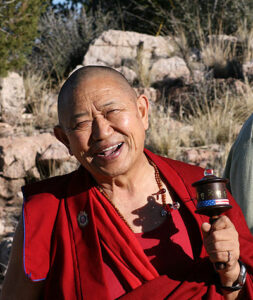
Wisdom Dharma Chat with H. E. Garchen Rinpoche – hosted by Daniel Aitken
Wisdom Dharma Chat with H. E. Garchen Rinpoche – hosted by Daniel Aitken – April 2026
Daniel [00:00:13]
Rinpoche, thank you so much for joining us on the Wisdom Dharma Chat. I wanted to start the first question talking about the mind. Science has made a lot of inroads in understanding the brain, but the mind itself remains elusive. And so I’m hoping that Rinpoche could tell us a little bit about how best to understand the mind and also the nature of the mind.
H.E. Garchen Rinpoche [00:00:40]
There are many instructions that teach on the nature of the mind. There are some who explain that very extensively in the scriptures, but to put it simply and essentially, first of all, samsara and nirvana have a single root. And that root is the mind. So, there are these more extensive, elaborate ways of explaining it, but in simple terms that are easier for ordinary people to understand, there was one thing that Drikung Pachung Rinpoche told me once. He was one who expressed the nature of the mind in a very direct, simple way. All he said to me was, “Look at the nature of your mind.” That is something that really made a difference for me. Of course, when I was a young boy, when I was very young, I received many different teachings on the nature of the mind. But when I received this instruction, it was very easy for me to understand. It says that what we need to do is to just view or look at the nature of the mind. So, that is extensively covered in the context of teachings on shamatha and vipasyana, but it is just looking at the mind. And Milarepa also taught about that viewing of the mind. He said that when you realize that there is no difference between mind and space, then you have actualized the dharmakaya. So, that is to put it in simple terms. And of course, the Buddha taught this extensively in the sutras, such as the Heart Sutra.
But essentially, mind is like space. And to see that is to see the dharmakaya. Actually, people often may think that it’s hard to see, thinking “I can’t see the nature of the mind.” But maybe if you actually just look directly without any other thoughts, then all there is is just mind looking at mind, mind looking at itself. And it’s that thought-free awareness that remains when there are no thoughts—that is like space. And seeing that is what we call seeing or realizing the nature of the mind. Longchen Rabjam said that, “Apart from seeing the nature of the mind, there is no higher learning,” or “There is no higher learning than to see or realize the nature of the mind.”
H.E. Garchen Rinpoche [00:02:56]
So, these are very precious teachings that I’ve also received when I was very young. But actually, when I encountered just these pith instructions, I found them to be most helpful and most precious. And also in the Ganges Mahamudra text, it says, “Without a single thought, decisively look at the true nature.” That means just look at your own mind. And that mind is inexpressible. We know the mind, but we can’t really express it. The Heart Sutra also refers to it as being inexpressible and being beyond words and thought. So, this may be a simple way for anyone to understand in terms of explaining the nature of the mind.
Daniel [00:03:40]
Rinpoche, people might think that they can read about these teachings in books and online. There’s so much information that’s available these days, and people might think that, well, if I have the information, what’s the role of a teacher? Why do I need a teacher if I already have the instructions, and so I was hoping Rinpoche could tell us a little bit about, the idea of transmission and the role of the teacher in transmission.
H.E. Garchen Rinpoche [00:04:09]
So now, this is from a practical perspective. While we are practicing, we must rely on a guru. But then that guru, that lama, must be someone that is an authentic guru, meaning that one who has himself or herself realized the nature of the mind. This means that it cannot be just an ordinary teacher. To realize the nature of the mind, you need a lama who has themselves realized the nature of the mind and therefore holds the lineage of practice and blessings. However, once you, yourself, have realized the nature of your mind and have understood the authentic view, then there is an absence of afflictive emotions. It is said that a sign of meditation or a sign of practice is an absence of afflictions. And that is the point, then, where you have seen that your own mind and the guru’s mind are inseparable. And when that is understood, when you realize that, then at that point there is no longer any need to rely on a lama. But in the beginning, before that, without a lama, it will be very hard to realize the nature of the mind. So, you need to rely on a lama or guru. And it must be an authentic guru and one who possesses this lineage of mind realization.
Actually, all beings ultimately possess that lineage. They all possess Buddha nature. But even though they possess Buddha nature, it is difficult for them to recognize it. In the Samantabhadra Prayer, it says “When you recognize it, you are a Buddha, and not recognizing it, you are an ignorant sentient being wandering in samsara.” So, what makes the difference between samsara and nirvana is realizing or not realizing the nature of the mind. And that’s clearly explained in the Samantabhadra Prayer, which is a very beneficial text for practitioners. But, in essence, to realize the nature of the mind, we must rely on a guru.
Daniel [00:05:43]
Thank you, Rinpoche.
H.E. Garchen Rinpoche [00:05:45]
So now, I will explain whether a guru or lama is needed from an experiential perspective, or from personal experience. We have said that we need a guru who understands the nature of the mind or the view. So, what is the actual view? What is the ultimate view? We, as ordinary beings, think that there are self and others. But the lama has realized that self and others are inseparable. So, reliance on a guru begins with devotion. Milarepa had said that “Devotion is most essential for a disciple.” So, on the disciple’s part, they must have devotion. And then, the lama or guru must have love and compassion for the disciple. That’s most important. Even in a mundane sense, compassion is the quality that’s most precious in the world. So, if there is mutual love between the lama and the disciple, that leads to this understanding that the mind is inseparable. The guru loves the disciple and all beings like a mother loves her child. And then, when the disciple’s devotion meets with the guru’s love, then their minds become the same. You realize that the mind is the same and the essence of devotion and the guru’s compassion is the same. It is essentially love. And as a result, you realize that the nature of the mind is non-dual.
H.E. Garchen Rinpoche [00:06:36]
By realizing that your own mind is one with the guru’s mind, that grasping at duality or dualistic thinking falls apart. And then you simply realize that your mind and the lama’s mind are no different. They’re not separate. From that, you realize that your mind and all sentient beings’ minds are not separate. The minds of all beings have a single ground, a single basis. That’s also explained in the Samantabhadra Prayer, where it says “There is a single ground, yet two paths and two fruitions.” So, when devotion arises, it is through that that this realization of selflessness ultimately arises. And a sign of that is an increase of great compassion for sentient beings and a decrease in self-grasping. So, through devotion, self-grasping naturally dissolves. And when that dissolves, you then naturally realize Buddha nature, which then reveals itself to you from within yourself. Then, seeing that directly is what we call recognizing or realizing the view and ultimately becoming a Buddha. In terms of a Buddha, there is the Buddha of the basis or ground, the Buddha of the path, and the Buddha of the result.
The Buddha of the basis or the Buddha of the ground means Buddha nature itself. It is like the example of ice which is by nature water but has temporarily frozen. And that occurs due to self-grasping. So, that is what we call samsara. When the mind has “frozen” due to self-grasping, that is samsara. And bodhicitta is like free-flowing water, like the ocean. In the Great Liberation Sutra, there’s this quote which says, “The Mahayana mind is like a vast ocean.” So, we as a disciple must have great faith in the guru. We extend our devotion to the guru and our compassion toward sentient beings. And the nature of that compassion and that devotion is one and the same. It is essentially bodhicitta or altruism. That is what makes self-grasping collapse. When that collapses, then the non-dual mind reveals itself and you see that there is no separation between self and other. That’s when one then realizes the so-called “view.” So, this is, now, from an experiential perspective. And so, when that view is recognized, the experience is the experience of the greatly blissful dharmakaya. And that greatly blissful dharmakaya is experienced whenever dualistic thinking has collapsed. When there is no dualistic thought, you come to experience the great-bliss dharmakaya by realizing that the nature of the mind transcends birth and death. When you realize the mind, you realize that the mind cannot die because it is like space.
H.E. Garchen Rinpoche [00:08:30]
With that realization, all fear of death naturally disappears, and this is how you become liberated from all suffering. When you’re liberated from all suffering, you experience great bliss, great happiness. That is really the meaning of that prayer, “May all beings have happiness without suffering.”
So, in brief, when you realize the nature of the mind, an experience of great bliss arises. The basis of Buddha is Buddha nature, the path of Buddha is the practice of cultivating bodhicitta, and the result is non-duality. On the path, relative bodhicitta arises first. When true relative bodhicitta arises, all appearances begin to manifest as a pure land. Then ultimately in the fruition, your lama or guru and your own mind merge indivisibly, and you realize that all the three realms are the celestial palace or the mandala of the deity. This is also the essence of sadhana or ritual practices. In those practices, we gain the experience of the nature of appearances, sounds, and awareness. The experience of realizing in their nature is the greatly blissful dharmakaya. Therefore, Milarepa said that, “Wherever I go, it is a pure land. Whoever I meet is a yidam-deity.” So that’s the true fruition, this feeling of great bliss that arises. So, this is explaining this from an experiential perspective.
Daniel [00:09:46]
Oh, wow. Incredible, Rinpoche. I think you have deserved all my questions now.
Thank you, Rinpoche, for these amazing advices [sic]. I’m wondering, Rinpoche, remember these profound ideas and instructions? How do we take them into our daily life? Into ordinary life?
H.E. Garchen Rinpoche [00:10:12]
When we speak about receiving a transmission, there’s benefit in receiving reading transmissions. But we want to look at what we need in order to actually receive that benefit in this very lifetime. To receive the benefit in this very life, we also must understand the meaning of the transmission. Therefore, we have to receive an explanation because without understanding the meaning of those words, it will not bring so much benefit in this life.
H.E. Garchen Rinpoche [00:10:34]
However, in the Secret Mantra text that speaks about the benefits of Vajrayana empowerment, it says that once one has received an empowerment, the benefits or results of that empowerment will ripen within seven lifetimes. So, if one has received an empowerment after having gone for refuge and generated the bodhicitta motivation, that will lead to the results ripening within seven lifetimes without any further understanding or subsequent practice. However, it will not ripen in this very lifetime. It does then require several lifetimes. If we already want the benefit in this lifetime, then we have to understand the meaning, we have to receive explanation. So we must go through three phases: understanding, experience, and realization. First, we need to understand the meaning.
And then we must experience it personally for ourselves—we must have a direct experience of the view. So, the view becomes an experience. When the view becomes an experience, the afflictive emotions become liberated. And that then leads to the third phase: the realization. When one experiences the view, one realizes that the afflictions themselves are actually primordial wisdom. For example, when strong anger arises, you gain the experience of looking directly at the nature of this anger. When you look directly at the anger, you will see that it is both empty and clear. And it is so clear that it outshines all other thoughts. In a moment of fierce anger, there are no other thoughts—the anger completely wipes out all other thoughts. That is because of its pristine clarity, and that is why the nature of that anger is referred to as the mirror-like wisdom. And so, this is when the true realization arises.
We have to realize it though, by going through those three phases—we have to first understand the meaning, then we have to personally and directly experience it, and then we realize it. Only then can receive the benefit of a transmission in this very lifetime. Otherwise, it will be hard to benefit from these transmissions in this lifetime.
Daniel [00:12:06]
Thank you, Rinpoche.
H.E. Garchen Rinpoche [00:12:09]
All of this must be connected to practice. It must all be practical. The 84,000 Dharma teachings are said to all be contained within bodhicitta. Bodhicitta begins as a mind of love or loving-kindness. We call it immeasurable love. Actually, once when Khenpo Jigme Phuntsok was in Washington, D.C., he gave a talk and said, “I studied all the different religions, and I found that of them, Buddhism is a little better because of that view of limitless, boundless love and compassion.”
This is really what makes it unique because in Buddhism, we speak about all mother sentient beings, limitless as space, and cultivate boundless love for them all. So, the love that we cultivate in the Dharma is really boundless, and that is what also makes it unique. It is boundless because we recognize that all these countless sentient beings have been our parents in past lives. Therefore, all of these teachings—the Dharma—come down to love alone.
And all the suffering in the three realms of samsara comes down to just one thing—self-grasping. The only medicine for that suffering, therefore, is love. That is the only thing that truly helps clear away suffering. It is therefore said to be the only cause of happiness, or the sole cause of happiness. If one understands the true causes of happiness and suffering, one begins to believe in karma. Then, even if you experience suffering, you will be able to think, “This is the ripening of my own karma from past lives. It is good that it becomes purified now.” And if you experience even the slightest happiness, you will also recognize that to be the ripening of your own karma, and it will motivate you to develop more of these causes of happiness. So, from this, a real trust in karma arises. When you begin to see that suffering is actually a good thing because it purifies past negative karma, you begin to feel more of a sense of gratitude and not so much fear. It also inspires you to eliminate those causes of suffering and to hold on to those causes of happiness.
I sometimes give an example or analogy of this boundless love as being like lion’s milk because a lion has no fear of any other animal. The lion is the king of animals. Likewise, someone with great love has no fear anywhere in samsara or nirvana. Therefore, we say this boundless love is akin to lion’s milk. That lion’s milk must be contained in a vessel to protect it from becoming spoiled, and the vessel that contains the lion’s milk must be a golden vessel. That golden vessel containing the lion’s milk of love is patience. So, the lion’s milk is love, and the golden vessel is patience.
H.E. Garchen Rinpoche [00:14:28]
We need patience to protect our love. People may be confused about that when they don’t understand the meaning, thinking “Why lion’s milk?” Maybe they mistake it for actual lion’s milk. Why do they need lion’s milk? It’s not about lion’s milk. It’s just an example because it’s the animal that has no fear. And if you have love, you have no fear. So, the real meaning is that love must be protected by patience. That begins with those around you or close to you, such as your parents, friends, and community. First, you cultivate love for all of them. When love arises, then you have truly found a wish-fulfilling jewel, and you recognize that your only true enemy is that mind of anger. If you do not apply the antidote to your anger, even if you have love, that love becomes wasted or spoiled because this hatred or anger destroys your love.
Therefore, the way to protect or safeguard your love is to have patience. You need to hold or contain this love in a vessel of patience. There’s a verse in the Thirty-Seven Practices of a Bodhisattva that you should memorize and always recite. It’s the verse on patience, and it says: “To those who desire a wealth of virtue, all those who do harm are like a precious treasure.” So, with that in mind, when anger arises, in that very moment, you will remember this and you will recognize right away that anger is a fault. You will think, “I must not lose my love. I must practice patience so as not to lose my love.” To recognize that, you must have a steady state of mindfulness. And that is the true view. Actually, that true view comes down to mindfulness. Also in The Thirty-Seven Practices of a Bodhisattva, it says, “In brief, whatever you do, always examine the state of your mind, and then abandon right away whatever brings harm to yourself and others. Acting only for the benefit of others with mindfulness and awareness is the bodhisattvas’ practice.” So then, through mindfulness, your ordinary consciousness turns into primordial wisdom. We call it the ordinary consciousness when there is a dualistic grasping. When that consciousness has realized the view, then it is called primordial wisdom, And that wisdom pervades all of samsara and nirvana.
Therefore, with a mind of wisdom, you can pervade all sentient beings throughout the six realms of samsara just by reciting a single Mani mantra or dedication prayer. That is the activity of the Buddhas. It is said that within the expanse of primordial wisdom, all the Buddhas are one. So, when your ordinary consciousness becomes primordial wisdom, you become one with the heart-mind of all the Buddhas. For that, you must first have undistracted mindfulness.
H.E. Garchen Rinpoche [00:16:35]
As it is said in that verse in the Thirty-Seven Practices of a Bodhisattva, in whatever you do, always look at the state of your mind and sustain an ongoing state of mindfulness and awareness. This is how we incorporate all of this into actual practice.
Daniel [00:16:53]
Rinpoche, could you please tell us a little bit more about devotion? And also, what is the meaning of blessings?
H.E. Garchen Rinpoche [00:17:01]
Regarding devotion, Milarepa said that for the guru or lama, compassion is most important, and for the disciple or student, devotion is most important. The Tibetan term for devotion is mos gus. So, there are two words in there, mos and gus. It’s good to understand the meaning of those two words to understand what devotion really is. Mos means to aspire. This first syllable connotes an aspiration to become free from samsaric suffering. First, you recognize the suffering of samsara, and then you think, “I must be free from this suffering.” And then you realize that to be free, what really must be liberated is the mind because there are some whose body seems to be liberated but their mind is not. That’s not true liberation. The mind must become liberated. So, your aspiration should be, “In order to liberate the mind, I have to understand the Dharma.” And then with that, then wanting to know the Dharma, you realize that the root of all that suffering is within the mind. It is the afflictive emotions, and at the root of the afflictions is self-grasping.
So, when you realize that ultimately, even this thought of “I want to be free from suffering” is a cause of suffering because we really need to eliminate this sense of need, this “I.” The only way to do that is by cultivating an altruistic mind of love and compassion. This is what the guru explains to you. That is where the second syllable, gus, which means to respect, comes from. So, one syllable refers to aspiration and the other one to respect. Because you aspire, then you also respect what the guru tells you. The guru tells you about karma, about cause and effect. To know about that, you must rely on that guru.
H.E. Garchen Rinpoche [00:18:16]
By relying on that guru, you realize that the guru is the embodiment of the three jewels. You recognize that by first feeling grateful for the Buddha’s existence in this world and then for the Dharma teachings, especially the teachings on karma that really open your eyes. They are so precious. And you feel grateful that the Sangha exist, the Sangha who show you the way to free yourself as someone who has already freed themselves.
When you see that, you will want to follow that path. That is when true devotion finally arises in you. Then, because of having devotion, you’re able to endure whatever hardships are necessary, just as Milarepa who was able to endure many hardships for the Dharma. But it all begins with first having an aspiration, having a wish to be free from samsara, and then realizing that the “I” that wants liberation is itself samsara. So, you must be liberated from that. To be truly free, you must let go of that self. And you do that by thinking of others, by wanting all other sentient beings to be free from samsara. In our prayer we say, “May I attain enlightenment for the benefit of all beings.” Just this aspiration, this line, is extremely important because we are no longer thinking, “I want to attain enlightenment.” because we recognize that this only increases self-grasping. Instead, we’re thinking, “May all beings attain enlightenment, may they be free from suffering.” Through this wish, your selfish thought disappears, and this is how you realize Buddhahood. And you recognize that all this knowledge is received from the Buddha.
You recognize the kindness of the guru, you see the kindness of the guru. You see the guru as the embodiment first of the three jewels. How is the guru an embodiment of the three jewels? The guru’s form is the sangha, their speech is the dharma, and their mind is the Buddha. According to the Nyingma tradition, we also see the guru as the embodiment of the three roots. Here, then, the guru’s form is the lama, the speech is the yidam, and the mind is the dakini. Then, from the perspective of the fruition, the guru is also the embodiment of the three kayas. That is the form as the nirmanakaya, the speech as the sambhogakaya, and the mind as the dharmakaya. Taken all together, we call the three jewels, three roots, and three kayas “the nine jewels.” The guru is the embodiment of these nine jewels, and ultimately, these nine jewels all are gathered in the dharmakaya, which is represented by the syllable hum. According to the Nyingma tradition, the nine jewels are also sometimes referred to by the hum syllable. In the hum sign, we have the sun, the moon, and the hum letter.
H.E. Garchen Rinpoche [00:20:24]
So, when we see the guru as his embodiment of the nine jewels, we recognize the kindness of the guru. And when you think of how precious and kind the guru is, often when you think of the guru, then tears will come to your eyes whenever you think of the guru. And that is what we refer to as outer devotion, when tears well up in your eyes.
Then, there’s inner devotion, which is when you think, “I must be free from samsara by cutting through self-grasping. And by doing that, I will see and realize the ultimate truth.” You then realize the ultimate devotion. That is when you realize that your mind and the guru’s mind are actually one. That union, that is the true, ultimate amount of devotion. One day, after again and again cultivating devotion to the guru, you realize that your own mind and the guru’s mind are actually one. Until that point, until that is realized, you have to always cultivate devotion. For a disciple, the one with the greatest devotion is the highest disciple, the one with average devotion is an average disciple, and the one with the least devotion is the lowest disciple. That’s also important.
H.E. Garchen Rinpoche [00:21:28]
Regarding blessings, blessings are very precious, and it’s important to understand them. They are something that we need to experience or feel in our own minds. We can feel them in our own minds. For example, blessings arise when we think about or bring to mind the qualities of those higher beings such as the three jewels. For example, if I would not have encountered the three jewels, without the three jewels, I might have been born in the lower realms as an animals, for instance, or as what we call like a “barbarian”—a human without any dharma. In the end, such beings will also take birth as animals and wander endlessly in the lower realms without any chance of being reborn again as a human being. We, on the other hand, are born as humans. On top of that, we have met with the Dharma. That’s an incredible kindness of the three jewels. It’s incredible fortune, and if you bring this to mind again and again, then whenever you see a form of the Buddha, for example, you will immediately feel that this is so precious. Toward higher beings, we develop pure perception and devotion.
H.E. Garchen Rinpoche [00:22:13]
The so-called “blessing” is that feeling of pure view and devotion. Toward sentient beings, blessings manifest in the form of compassion. When we see a sentient being, even a tiny animal, we recognize all beings as your parents because throughout countless lifetimes, we have taken on endless forms.
Therefore, every being in another lifetime has been our mother. If you know that alone, even if you don’t know much other dharma, if you truly think in this way when you see a sentient being, then love arises naturally. For those higher beings, this love or immeasurable love becomes devotion, and if it is extended toward ordinary beings, it becomes immeasurable love.
That feeling itself, what we call a “blessing.” And what does the blessing do? It makes self-grasping disappear. This thought of me, this “I”, dissolves through this blessing. When that dissolves, then the basis of your mind, that is Buddha, reveals itself. And then just naturally, you will feel great devotion and a pure perception toward all beings, devotion toward higher beings and compassion towards sentient beings. And that is what we call a blessing. And it’s something that must be experienced and felt from within one’s own mind.
Daniel [00:23:14]
Thank you, Rinpoche, so nice. Rinpoche, it’s said that when practitioners realize the nature of mind, compassion naturally arises. How does one move from an intellectual understanding of emptiness and touch this space of spontaneous compassion?
H.E. Garchen Rinpoche [00:23:33]
So, what’s the connection between emptiness and compassion? When there are many thoughts in your mind and you do not grasp at any of them, then all these thoughts settle and dissolve into emptiness. Then, what remains is clarity.
H.E. Garchen Rinpoche [00:23:44]
For example, when a body of water is left and it becomes still, it is very clear, then you can see all the beings within that water. Similarly, when the mind becomes clear because of thoughts having dissolved, then you clearly see sentient beings in the six realms of samsara. You see their suffering.
When you see their suffering, compassion naturally arises toward them. It arises because you also understand that all these beings have been your parents. And when you see that all these parents are suffering, then a feeling of unbearable compassion arises for them. You see their suffering and understand why they suffer. You understand that they suffer because of self-grasping and that they can become free from suffering when self-grasping and the afflictive emotions are destroyed. You wish for them to be free from those afflictions. That is great, boundless compassion. For that, we first need to have boundless love. First, you need to understand that all beings have been your parents. When you love them like your parents, then from that love also arises a wish for them to be free from suffering. So, compassion arises out of love. Then, you understand that for them to be free from suffering, they need to eliminate self-grasping. So, this great compassion pervades all beings in the three realms of samsaric existence.
In The Prayer of Excellent Conduct, it is said that the all-pervasive power is the power of love. That is also a good prayer. We understand by making this prayer that we can really only benefit beings if there is love. So, when we pray for them without real love, then the real benefit of this aspiration is lacking. The real benefit comes from loving sentient beings, from love. Understanding love, you also understand the root of all sentient beings’ suffering, which is self-grasping.
There’s another quote I came across when I was very young—I’m just sharing here from my own personal understanding—and that quote comes also from The Great Liberation Sutra. In that sutra, it says, “It is of a greater benefit to spend a session in meditation than it is to save the lives of all beings in the three realms of samsara.” That has also really benefited me in my practice.
These are very important words because what is being referred to here are these beings in the three realms and protecting their lives. So, there are six types of beings in the six realms of samsara. Of course, benefiting or saving their lives brings some benefit, but that only really benefits their bodies. It doesn’t really end their suffering, which originates in the mind. Merely helping someone’s body is therefore less beneficial than helping someone’s mind. If they let go of self-grasping in their mind, they would be free from all that suffering.
Even if there’s no self-grasping, all beings are actually buddhas. So, to be free from self-grasping, they must cultivate bodhicitta. When you understand that, then your aspiration or prayer for them will be really powerful because of three powers. The first one is the power of your own intention. That is your own pure intention—you think of beings with immeasurable love. Then, the second power is the power of all the buddhas. If you have immeasurable love, then you connect to the power of all the buddhas after three times, whose single aspiration is to benefit sentient beings. Once you connect to that, you also have the third power, which is the power of the dharmadhatu. That refers to the fact that fundamentally, in reality, all beings have Buddha nature. There are no real sentient beings—they are really buddhas. Through having those three powers, you know that you can benefit sentient beings by cultivating compassion for them and you know that bodhicitta will benefit them. All doubts about that will be cleared away. You first understand why there are so many sentient beings, you clearly see the karma that leads to that existence, and you understand what they need is bodhicitta. In this way, you benefit them because through your own boundless compassion, you pervade all these sentient beings.
This is a personal experience in which you can know how this compassion pervades all beings. There should be no doubt in your mind whether your aspiration will benefit them. This, then, is how your own obscurations gradually decrease as your compassion increases. And as those obscurations decrease, this experience or feeling of certainty that you are benefiting beings with your compassion just grows stronger and stronger.
It’s akin to ice gradually melting and pervading everywhere, pervading the earth so that everything can grow. If you have an ice block, even though its potential is to permeate the earth, if it doesn’t melt, it cannot nourish the earth at all. In the same way, even though all sentient beings are actually Buddhas, they also have to recognize that. So, by cultivating bodhicitta in this way, through this understanding, you are pervading Buddhas with devotion, and in this way, it becomes an offering to the Buddhas or higher beings. The same mind then becomes a purification for sentient beings. This is how the aspiration to benefit sentient beings is actually accomplished.
H.E. Garchen Rinpoche [00:27:22]
We must bring to mind and remember compassion again and again. That’s also the purpose of this prayer wheel. The prayer wheel’s top is shaped like a mother’s nipple. The reason it shaped like that is perhaps so that every time we see it, it reminds us of the mother’s love. If you’re always reminded of that, it’s a method for increasing compassion. And eventually there’s an ongoing state of mindfulness that always remembers that all sentient beings in the three realms have been my mothers. So, it’s really a method of sustaining mindfulness.
H.E. Garchen Rinpoche [00:27:54]
Regarding the meaning of lhundrub and kadag—that is spontaneity and primordial purity—these are in Dzogchen terms. Kadag, or primordial purity, refers to the empty space-like nature when the mind has become completely purified and there is nothing left to grasp at all. There’s nothing to grasp, just like empty space. That is the emptiness or the empty aspect.
Lhundrub, or spontaneity, means that within that empty space, there is clear awareness. Intrinsic awareness arises from within that empty space. Sogyal Rinpoche has explained this term extensively. In Dzogchen, it is explained through rigpa what the actual nature of the mind is. It is the union of clarity and emptiness. Whoever realizes that the mind is empty has seen oneself and yet also sees that there is no self or “I,” just awareness. This is rigpa. There’s just awareness. And that is what we refer to as Samantabhadra.
In brief, kadag or primordial purity is the empty, space-like nature, and lhundrub or spontaneity refers to the clear awareness or the clarity aspect that is there but cannot be grasped in any way, not even through scriptures and logic. It’s there, but it can’t be seized. So, it’s not an existing thing that can be seized, but it’s also not a non-existing thing, because there is a clear awareness. It is a nature that is free from names, labels, or any characteristics.
H.E. Garchen Rinpoche [00:29:11]
Also, regarding this lhundrub or spontaneity, from a practical perspective, when we meditate, resting in the nature of the mind, the view, then sometimes an obstacle may appear. And that is because we may feel, “Oh, this is amazing, this is so good” and begin to grasp when we have pure perception or an incredible vision. That is the obstacle, because that turns into a hope or expectation. There is also the counterpart of that, where sometimes things are not going so well or something unpleasant appears and we label it as bad and develop anger or aversion.
Hope and fear are the subtle counterparts to attachment and hatred. This hope is the subtle counterpart of attachment, and fear or a dislike is a subtle counterpart of hatred and also ignorance. Jigme Lingpa has said, “Do not lose the seed of your own awareness. Do not disturb others.” There is nothing else to be done besides not losing the stability of your own awareness. Remaining with stable awareness is the unchanging state of Vajradhara, and where there’s no more grasping to any concept as good or bad or neutral, there’s just no grasping at anything whatsoever. When there’s no grasping at anything whatsoever, then one actually knows how to meditate. In the Samantabhadra Prayer, it says, “Even if the three realms were to be destroyed, there is no fear, there is no attachment to the five desirables of the senses.” There is no fear even if the three worlds are destroyed because you have realized that the mind doesn’t die. And even if the world would collapse and fall apart, the mind would continue on, abiding like space. Realizing that state, one then sees the dharmakaya pure land. And the dharmakaya pure land is spontaneously existing, meaning that it naturally and effortlessly exists.
Daniel [00:30:28] Rinpoche, could you explain, please, how this idea of Buddha nature is connected with deity yoga?
H.E. Garchen Rinpoche [00:30:37]
This also connects to this lhundrub, or spontaneity. The nature of the deity is a union of appearance and emptiness. It is an expression, as such, of your Buddha nature. So, in the practice of the three roots, or the three kayas, it is explained that all dharmas or phenomena have the nature of the three kayas.
H.E. Garchen Rinpoche [00:30:53]
Specifically, the dharmakaya is like the sky, like space. The Sambhogakaya is like rainbows or clouds in the sky. And the Nirmanakaya is like rain falling down. That is the nature of your mind. It is the nature wherein the three kayas are spontaneously present. It is called the spontaneous existence of the three kayas within awareness, within rigpa. To recognize that, all that is necessary is continuous meditation. There’s nothing else required other than an undistracted state of mind. It is only when there is distraction that we encounter difficulties. But besides remaining in a state without distraction, nothing more really needs to be done because that’s a truly happy state.
Daniel [00:31:26]
Rinpoche, your life has been filled with teachings from some of the great masters. And I’m hoping, Rinpoche, you can share with us a little bit of a story from your life. Maybe with one of your teachers, where you encountered some of these profound things we’ve been talking about today.
H.E. Garchen Rinpoche [00:31:46]
In terms of personal experience of seeing the ultimate truth in my life, the first time that actually happened was not in relation to having met with a certain Lama. It happened when I was very young and was with my father, who was a retreatant. He always spent all his time in retreat. That’s how he has met my mother actually. She met him in his retreat and brought him offerings. He introduced me to the Vajrakilaya secret accomplishment and practice and made me memorize it when I was learning how to read and write. That was the text that I used. Nowadays, this text needs to be translated also. But that’s when I had an experience of the nature of mind. That experience came from that section about the four purbas, or the four kilas. One of them specifically is the all-pervasive wisdom awareness purba. There’s this line in the Vajrakilaya sadhana that says when the all-pervasive purba of wisdom awareness is planted into the Dharmadhatu space, dualistic thoughts collapse or are released. Through that, I glimpsed the nature of rigpa, of awareness. It was really through understanding this all-pervasive wisdom purba that I understood that.
H.E. Garchen Rinpoche [00:32:48]
By simply learning about that from the text of my father, that the mind is just like space, and by looking directly out into space and sending my mind directly into space, merging completely with the vastness of space, I experienced my mind and space as indivisible.
This is what my father also told me. Actually, that’s something that many Lamas also say, but it often hasn’t been so clear to me. Gelong Patrul Rinpoche, he said that also very clearly by simply just saying, “Look directly at the nature of your mind.” Khenpo Munsel Rinpoche also gave me a direct introduction to the mind according to the Dzogchen system. He simply said, “Do not lose the stability of your awareness.” By saying that, great devotion to him also arose, and through that, I also had this experience of rigpa. So, what I experienced was that the lama, wisdom, and awareness or rigpa are essentially one and the same.
H.E. Garchen Rinpoche [00:33:49]
Another experience comes from Adeu Rinpoche, during a Vajrakilaya drubchen [a Vajrayana ritual practice]. He gave an empowerment during this drubchen, and at the end there was a point when Adeu Rinpoche came with the main purpa, which is the material purpa or kilaya from the mandala shrine, and placed it on my forehead. That’s when we had this experience again—this feeling of immense compassion.
And it felt as though it touched all sentient beings. There was this feeling of the boundlessness of compassion that arose, seeing that all these sentient beings who are touched by this compassion possess Buddha nature themselves. My compassion for them being boundless means that there is no boundary between my mind and the minds of sentient beings. We are inseparable—self and others are inseparable. Therefore, my compassion will naturally benefit them. This is the feeling that arose during the drubchen with Adeu Rinpoche when he touched the purpa to my crown. This drubchen is actually extremely precious. I later also started a tradition of performing the Vajrakilaya drubchen in the West. Similarly, during the Yamantaka drubchen, I also had a very special feeling or experience. Therefore, I also started the tradition of having drubchens for Yamantaka in the West.
Daniel [00:35:14]
Rinpoche, thank you so much for your generosity in sharing with us the profound Dharma. It’s been such a pleasure to be with you today. We thank you for spending your precious time with us. Thank you so much, Rinpoche, for joining us on the Wisdom Dharma Chat.