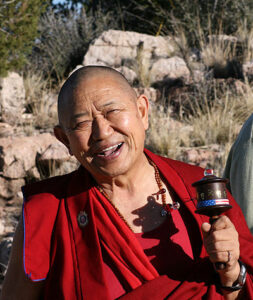
Garchen Rinpoche on Dzogchen Garab Dorje Three Statements
Garchen Rinpoche on Dzogchen Garab Dorje Three Statements
Three Statements Striking the Essential Point
- One is introduced directly to one’s own nature.
- One definitively decides upon this unique state.
- One continues directly with confidence in liberation
The special teaching or instructions on Mahamudra or Dzogchen is the means of liberating thoughts and negative emotions. When we put this into practice, whatever adverse conditions may arise is transformed into companions. Whatever negative emotions may arise they are transformed into primordial awareness. Thus it is said in the37-practices of bodhisattvas’ text, “To bodhisattvas who desire the wealth of virtue, all those who do harm are like a precious treasure.” So, whatever negative emotions may arise they are simply like fuel that sustain the flame of awareness. With the arising of negative emotions that flame will become stronger When we see our mind which is the union of clarity and emptiness, that is the Buddha.
Basically with this, we recognize that the mind of the Buddhas of the three times and our own mind is of the same basic nature. There is no distinction between good and bad to be made in the minds of ourselves and the minds of all the Buddhas. On the basis of this, then we must engage in practice and this leads us to the second statement. Absolute conviction in the practice is the second imperative. And so once we have had the introduction, get on the basis of that we must engage it and these first two of the three statements are simple or easy.
It is said in the 37 Bodhisattva practices in number 36, “In brief, whatever conduct one engages in, one should ask, “What is the state of my mind?” Accomplishing others’ purpose through constantly maintaining mindfulness and awareness is the bodhisattvas’ practice.” And so this mindful awareness is the awareness that recognizes whatever thoughts and negative emotions are arising. When we give rise to negative emotions, this awareness recognizes their fault and on that basis of that recognition we can abandon the arising. Even if you don’t understand completely everything that is being stated in English, simply abide in this awareness and through that you will receive the blessing of the transmission
Pure perception is a sign of the accomplishment of the nature of mind. If you engage in the practice of the Buddha dharma, you should regard gurus and spiritual guides as objects of refuge and as the object of your faith. And you should regard ordinary sentient beings as the object of your compassion. When you give rise to faith and loving compassion in this way, you will receive the blessings.
When the mind is abiding in the natural state, this is the view of Dzogchen. The special or extraordinary teaching of Dzogchen is about how to transform negative emotions into companions. Right now, negative emotions are enemies that do harm, so we need to first become skilled at practicing when negative conditions arise and then at bringing those conditions onto the path. If we always abide within mindful awareness, then however strong a negative emotion may be, it will be immediately destroyed through that awareness, just as we have a blazing fire, we can even feed iron to it and it will melt away. Of course, we now have some degree of mindful awareness, but that mindful awareness is like the flame at the tip of a stick of incense, it is very weak and it needs to be cultivated. Yet we must develop believe in the idea that mindful awareness is dharmakaya.
The mind of all of the Buddhas of the three times and our own mindful awareness are inseparable, so if we are looking at various root and lineage masters of the tradition, we should understand that their essential minds’ nature and that of the Buddhas of the three times and our own mind are ultimately inseparable. And there is no distinction between greater or lesser within that mind. All of the Buddhas of the three times are combined in our own practice of mindful awareness, and so in this regard, Lord Jigten Sumgon paid homage to the mandala of mind’s essence, that is the supreme palace of all the victorious ones of the three times.
When we see nature of mind that is like the sky, well, then we see it. In this regard, Lord Milarepa said when mind and space are recognized as inseparable, that is as Dharmakaya as it can get. And this mind’s nature is completely empty and clear. There is nothing that is obtained in that, nothing that we get when we look at the nature of mind. Often time, we think when we see nature of mind will result in some kind of, something that we obtain. But when we actually see the mind with the mind, there is nothing that we get at all. And so that point should be understood.
What is it that we need to know? All of the outer container and inner contents are immeasurable and without limit. All of samsara is vast and limitless, but this has all been created by mind. Mind is the creator of karma, both collective and individual. The basis of that accumulation of karma is self-grasping. And it is through collective and individual karma that all of the phenomena of the universe manifest. When we fail to recognize the natural state of the mind, we give rise to self-grasping and on the basis of that we accumulate the six negative emotions and on the basis of them we engage activities and we create karma. And on the basis of that all of the six realms of samsara manifest. Thus mind is the ultimate creator of all phenomena.
Milarepa taught that we should not sever the root of phenomena but rather sever the root of mind. If we look at the mindstream of a tiny insect, and the mindstream of a human being, they are essentially the same. They all wish to have happiness; they are the same in their generation of negative emotions and the three poisons of attachment, aversion and ignorance. Thus, however numerous sentient beings may be, their habit of self-grasping is one, it is the same. On the basis of this self-grasping, they engage various activities and accumulate different sorts of karma which condition the various physical forms that they take, but all of those forms have been created by mind. The entire six realms come into existence because of mental phenomena. This is something you should think about, consider well, investigate whether this is the case or not.
So really, all of the phenomena of samsara and nirvana are beyond the extremes of coming and going. On the ultimate level they abide, like the expanse of space, and all appearances manifest within that. Yet they are temporary, dream like and illusory. So in brief, what we are pointing to with this view is that there is no fixation on phenomena as being real at all. When we are free of fixation, then although phenomena still appear to exist, we recognize their empty nature.
The natural state of the mind is endowed with the knowing quality, the knowing aspect of the mind. That is the transcendent awareness that recognizes arising thoughts. When we are engaging in Shamatha or calm abiding meditation, the negative emotions of attachment, aversion and so forth are pacified, and within that peaceful abiding the awareness that recognizes arising thoughts is present. When those thoughts are recognized, they are spontaneously free and that is the practice of special insight or Vispasana. When we look at the mind, we will see many thoughts arising. If we recognize those myriad thoughts but do not fixate on them, then we don’t need to manipulate them in any way. And they naturally just subside; they do no harm to our practice, or to awareness. This is what is meant by the term non-conceptual. The text refers the clarity aspect of the mind as being inseparable from non-conceptual awareness wisdom. In this way, the thoughts that manifest are like waves that arise from the ocean and dissolve back into the ocean. Although there may be many thoughts, they do not disrupt the continuity of awareness, that is to say the mind does not waver at the arising of thoughts. When we are practicing calm abiding that is endowed with special insight, if we really wish to train in this, then we need to give rise to compassion and great loving kindness. If we lack this, then there is no way that the mind will abide in calmness and clarity. So, conventional bodhicitta is of greatest importance. When we have conventional bodhicitta, we will not give rise to gross conceptual thoughts and the very subtle thoughts that arise will be instantly destroyed through to the power of awareness. So, in this way, we cultivate conventional bodhicitta, which is love and compassion together with awareness wisdom.
When we engage the mind that is the union of emptiness and compassion, a great radiance manifests, what is that radiance? It is the spontaneously arisen light of wisdom and love that pervades all of the pure Buddha realms above and all of the six realms of sentient beings below. All of the sentient beings of the three spheres of existence have accumulated karma and are presently experiencing the ripened effect of former actions. When we give rise to the mind that is the union of wisdom and love, it is like the sunlight that pervades the dark areas of the six realms of sentient beings. So, however great our transcendent awareness is, we will give rise to a correspondingly great compassion. However, great our compassion is, we will give rise to the capacity to pervade all of the spheres of existence of sentient being.
And through awareness, those thoughts and negativities will dissipate. In this way, our self-grasping and ignorance are cleared away. And on the basis of this, we realize the meaning of selflessness. That realization is like a brilliant light that is more powerful than 100,000 suns. These are the qualities of giving rise to precious bodhicitta.
When we abide in the natural state of the mind, we recognize the awareness that is the sky like expanse of mind. We recognize the empty nature of the mind and that recognition is the view. Then having recognized that, we need to abide within that awareness. And that is meditation, simply remaining the continuity of the non-dual union of bliss and emptiness. Then within that mindful awareness, we recognize all phenomena to be like dreams and illusions; no matter what activity we engage in, we recognize its illusory nature and that is the conduct. If we abide in a state of Rigpa, or awareness wisdom, all of the view, meditation and conduct are combined within that.
Vision is Longchen Rabjam
Unelaborated view means is there is no fixation on phenomena as being real. The moment that fixation exists, there is elaboration. When we look at the natural state of the mind, it is like space and all of the phenomena of the outer container and inner contents are arisen from that space like mind. And that mind’s essence is the view, and so the first sentence of the text reads, “vision is Longchen Rabjam, the all pervasive vast expanse.” We should understand that the very meaning of his name “all pervading vast expanse” to be metaphor of the sky, which is the metaphor for the view.
When ordinary sentient beings abide in samsara, they think that the phenomena of samsara are real and true. This is like perceiving a block of ice and thinking this block is really like stone, and its true on a relative level, a block of ice is like a stone. But when you are introduced to the mind’s natural state, together with that introduction comes a recognition of the possibility of liberation, it is as though we finally recognize that the block of ice is not really a stone, because it can melt and become free flowing water.
Action is ‘Gwalwa Neugu’
There are different types of students of varying capacities, when one has trained well in former live times, and is a disciple of highest capacity, that person is referred to as one who is kind of instantaneously realizes. Or immediately understands. I asked Rinpoche “Understands what?” and he said,“ understands the natural state of the mind, what else is there.” And those who have not done this kind of training or who have trained in only a limited way. Then they are beings who gradually realize in progressive stages. So even if in this lifetime, they do not realize mind’s nature, then eventually within seven life times or whatever that realization will dawn. So, if those fortunate ones realize the natural state and if they engage in practice like Milarepa did, it is possible within a single lifetime to realize the state of Buddhahood.
It’s the mind that needs to attain the state of Buddhahood. And when we are free of fixation, then the mind abides like the expanse of space, then the body will attain liberation. But we don’t need to look kind of outwardly what we think the Buddha qualities might appear to be on a physical level, rather we need to look inward at the mind to understand the Buddha qualities. And on the basis of that turning inward, we will understand.
Milarepa taught that when negative emotions and transcendent awareness are recognized as indistinguishable. That is the perfection of the sign of realization. So, whatever happiness and suffering we may encounter, whatever thoughts, afflictions and delusion may arise they are recognized as none other than transcendent awareness. The mind does not waver regardless of the arisings, rather the minds abides like the expanse of space. And so of course, afflictions will arise, the point is for us to recognize them as awareness. Without this mode of practicing view, meditation and conduct, although we may intellectually understand the teachings, whenever we encounter adverse conditions in this life, negative emotions, suffering and so forth we will fall under their power.
What this is about is bringing adverse conditions onto the path. For example, if we give rise to great anger that blazes more strongly than a fire, if with awareness, we recognize the fault of that anger, then the awareness increases and the anger is overcome. All negative emotion no matter what they may be is to be dealt with in just the same way.
Meditation is Khyentse Odser
In this regard, the text it says meditation is Khyentse Odser and then Khyentse Odser is another name for the master Jigme Lingpa. In this particular translation, then the actual name Khyentse Odser is translated as the “radiance of wisdom and love”. And so if we really wish to cultivate the meditation, we need to habituate the view that is the union of love and compassion with wisdom. As said previously, when we engage the mind that is the union of emptiness and compassion, a great radiance manifests. It is the spontaneously arisen light of wisdom and love that pervades all of the pure Buddha realms above and all of the six realms of sentient beings below. All of the sentient beings of the three spheres of existence have accumulated karma and are presently experiencing the ripened effect of former actions. When we give rise to the mind that is the union of wisdom and love, it is like the sunlight that pervades the dark areas of the six realms of sentient beings. So, however great our transcendent awareness is, we will give rise to a correspondingly great compassion.
Jigme Lingpa is said to be one who attained his realization completely without training although there are countless great masters who through training and scholarly endeavor attained understanding of the teachings. Teachers such as Je Jongapa and Longchen Rabjampa and so forth. The Vidyadhara Jigme Lingpa is inconceivably precious in that he attained his understanding of the teachings as well as the omniscient wisdom of the Buddha through his realization of the view completely without training or education.
With regard to these three experiences of bliss, clarity and freedom from thoughts, people are different in the kinds of experiences that they give rise to, some will experience great clarity, and have many different clear experiences, but whatever it is that is arising, the important thing is to be free of fixation. If we have experience of clarity for example and we think “This is good” then that is fixation. The bliss experience is the same thing, the nature of the mind is naturally blissful, thus we speak of the dharmakaya as the great bliss. Yet if we have that experience and fixate on it, this is where we fall into error. Occasionally, when we are practicing looking at the nature of the mind, we will experience states free from thought, in which the flow of thoughts and emotions just ceases for a period of time. And within that we think “This is the view” we have given rise to fixation. Although these various experiences will arise, if we are free of fixation on them, then there will be of no harm.
In the three statements that strike the vital points, the first of which is about the direct introduction into the nature of mind, and with this come the recognition that all the phenomena of samsara and nirvana are created by the mind. Thus if we only understand the mind’s nature, we will understand all the phenomena of samsara and nirvana. That which has been made, that is all the phenomena of samsara and nirvana, is the nature of emptiness and likewise the maker, the creator of those phenomena which is the mind is empty like the sky
We talked about the non-conceptual state free of the three spheres, in which there is no longer, any division among self and others and the object, or activity that is engaged. And within this non-conceptual awareness, there is no distinction to be made between self and other and phenomena of samsara and nirvana and so forth. We see experientially that the natural state of our own mind, the mind of the Buddhas of the three times and the mind of all sentient beings are of one singular essence.
When we study the meaning about the natural state of the mind, we can begin to understand and eventually to recognize it. But with regard the third point about implicit confidence, in release, this is a little more difficult. When we are introduced to the natural state and then we continuously abide in that natural state, we see the arising thoughts and negative emotions, through their recognition they are liberated, thus no matter how many thoughts may arise they do no benefit to our mind they do no harm to our mind. They naturally are dissipated like water bubbles that spontaneously appear on the surface of water and just as quickly disappear. When we practice in this way, thoughts are naturally destroyed, thus no karma is accumulated. If no karma is accumulated, no karmic propensities are established and then one does not experience the fully ripening effect of karma.
This union of awareness and compassion is like hot water when it is poured over ice, it will immediately melt away that ice. If we lack this union of awareness and compassion, then this frozen block of ice remain just as it is. And this is an example of the delusion of sentient beings. If on the other hand, we never part from this union of mindfulness and compassion, thoughts will be liberated on rising, but in order to practice in this way, great diligent effort is required.
When we see fish in fish tanks. We look at all the fishes that is swimming around in the tank, you can follow after them and find out where they are going, and all of these fishes are like the thoughts and emotions that arise in our mind. If on the other hand, we shift the focus of attention to the water itself, this is like shifting one’s awareness away from the thoughts to the natural state of the mind. And within this shifted focus, one recognizes when thoughts are arising and when they are not, and there will be junctures in which when thoughts and emotions are not arising, in those junctures we can see the natural state.
We should attend to the natural state of the breath. Usually what happens when we are not attending to the breath, and the wind energies, we habitually follow after karmic wind energies. As an antidote to this, we can place the tip of the tongue against the hard palate. And when we breath in, we breath in through the nostrils, but then when we breath out, we gently breath out though the mouth maintaining the tip of the tongue on the hard palate, allowing the out breath to flow over the left and right sides of the tongue. At this time, we should be breathing very gently and naturally. This will be of great benefit and has the same effect as the vajra recitation. The important point is that we are not panting, we don’t have our mouth hanging open, we are not allowing all our breath to escape outwardly. By maintaining this point of contact with the tip of the tongue on the hard palate, this actually serves to separate out the pure essence of the wind energy from the gross wind energies.
So, whatever it is that arises the mind, it needs to be recognized through awareness. This is true of all thoughts, all emotions, all the experiences of bliss, clarity and freedom from thought. And when we abide in awareness, there is no attachment to so call good experiences nor is there aversion towards negative experiences. Even if Guru Rinpoche clearly manifests in front of you, still there is no need to focus on this arising as being so extraordinary, unique or precious. It is just the display of the mind’s natural radiance. It is the pure aspect of the mind manifesting and so at such moments, we don’t need to look into the appearance or to investigate it in any way. All that we need to do is maintain awareness in its own seed. Then, no matter how many thoughts, emotions or experiences may arise, there will be no harm in our practice.
“In this state of equilibrium and relaxation, abruptly utter a mind shattering PEH forcefully loud and short and there it is”. When we give rise to all of these diversity of meditation experiences, in that very instant, we should immediately shout the syllable PEH, to clear away the cloudiness and to clear away the over excited mind. To clear away fixation and various thoughts and emotions that arises. When we shout the syllable PEH, it should be like the flash of a bolt of lightning. Shouted as the text says, forcefully loud and short. Immediately after shouting this syllable PEH, we can see the natural state of the mind, we are completely free of any fixation at that moment, all the recollections of the past have ceased and all the ideas about the future have not yet arisen, so in between these two, in the gap between the two, we can look at the natural state of the mind which becomes like space in the moment that we utter that syllable. When we are alone, we can verbally shout this syllable in any case; the whole point is to reach a state completely free of any fixation, any concept about doing this practice, and when this is done then the thoughts and emotions are just scattered.
The view manifests very clearly and this is what is meant by the term “Zangtal”. It is translated in the text as all pervading freedom of mind. It’s kind of unobstructed freedom of mind. This term really refers to being completely free of any fixation on matter or on objects whatsoever. By way of example, if we are sitting in this room and we are meditation on the form of the deity and we visualize that deity as very large and we think, “now it can’t get any larger because the head has reached the ceiling”. This is a fault of fixation. If we are completely free of fixation, we can visualize the form of the deity filling all of space without any obstruction at all. And this is what is meant by the term unobstructed freedom of mind, it is the all-pervading mind of awareness without any obstruction posed by fixation.
All of the erroneous views can be condensed into two views of eternalism and nihilism. When we think that phenomena are actually existent they are real and true, then we fall into the error of eternalism. All phenomena are composites; they are the nature of impermanence. Understanding this, then we should stay clear of the error of eternalism. When we think that actually there is nothing that is truly existent at all, there is nothing that is real, even karma cause and effect is not ultimately real or true, then we fall into the other extreme of nihilism. If we give rise to negative emotions and on the basis of that we act on that then karma is accumulated and once that happens sooner or later we will eventually experience the ripen effect of that karma.
We can look at the example of anger alone and understand the nature of all of the five other negative emotions; anger has a connection to all of them, desire, attachment, ignorance and so forth. So, when we first give rise to a negative emotion, if we recognize that with mindful awareness, the awareness becomes stronger. Eventually, the negative emotion will arise simultaneously with mindful awareness. When we practice in this way, then the awareness is like a flame and the negative emotions are like wood or fuel that feeds that flame. If we can maintain awareness, these negativities are transformed into the five wisdoms. It is a method for transforming negativities into awareness and poisons into medicine. Milarepa referred to the aspect of the mind that recognizes negative emotions as being awareness. And so, if we are cultivating this awareness, it becomes stronger and stronger with each negative emotion that is liberated.
The wisdom dakini, Niguma said, “Even the flame of primordial awareness may be small, it can be refreshed again and again. And so each time we cultivate awareness it grows stronger and stronger. So, we must have confidence that through mindfulness primordial awareness becomes stronger and more powerful.
“Then, whether there is quiescence or flow, rage or lust, happiness or sadness, at all times and in every situation sustain that recognition of dharmakaya’s total presence”. So, having been introduced to the view, we need to engage the practice of meditation. In this regard, we must cultivate meditative absorption in a continuous flow at all times and in all situation as the text says. We must protect and preserve a kind of ceaseless continuity of mindful awareness.
For those who are instantaneous realizers based on the previous training they have engaged in former lives, it is possible for them to be introduced to the view and to immediately realize it in a stable and unchanging way. For such beings there is nothing that really needs to be cultivated nor is there anything that need to be stopped or ended. But such beings are very few, even for those who do recognize the nature of mind when you are introduced to it, many will give rise to pride, thinking “Oh, I have got it”. So, the point is once we have received the introduction, we must inwardly continue to cultivate it and meditate upon it.
Just like the sun and the rays that are spontaneously manifest from the sun, awareness itself manifests arising phenomena in an ongoing display. When we understand this then, there is nothing that particularly needs to be suppressed. No matter what arises it spontaneously manifests just like waves arising on the surface of water. And naturally dissipate like waves dissolving back into the water. Thus, things are naturally arisen and naturally liberated. In this way, there is no need to suppress arisings nor is there any need to kind of establish them.
With regard to this meditation that is free of meditation, when we see the natural state of the mind and we are totally free of doubt about that, we recognize the inseparability of the mind of the guru and the mind of all the Buddhas And on the basis on one’s devotion to the guru, which is nothing other than awareness, one can begin to experience the inseparability of one’s own mind, the guru’s mind and the minds of all the Buddhas. And so I find that this pith instruction makes the point more accessible.
Knowing one liberates all and really all of the methods of liberation are combined within Rigpa or within awareness. The guru is not the body of the guru, the actual guru is the guru’s mind. The mind is the Buddha and that is the principle importance, when we are cultivating mindful awareness that is the ultimate guru.
Simply by abiding in the natural state of the mind, thoughts are liberated. Just like the waves that arise on the surface of the water and dissipate back into the water. The Dharmakaya is the very basis, and thoughts are not separate from Dharmakaya just as the wave not separate from water. Thus, we really must understand or recognize that thoughts and mind are inseparable.
Looking at the mind itself and abide in the natural state this is like the meeting of the mother and son lights, the text says the son clear light uniting with the familiar mother light. And within this we must understand that these lights are not two; that is the knower and that which is known are of a singular nature. Thus we speak of nondual wisdom, the seer and that which is seen are one and the same. And it is through looking at the nature of the mind that we must recognize this
We say that the basic nature of mind is like a clear crystal or a mirror, although various images or forms that may be reflected in the mirror these are like thoughts that arise in the mind, they dissipate upon arising. Although forms may be reflected in the mirror, the mirror itself has no sense of good or bad with regard to these various appearances. And in a similar way, when thoughts arise in the mind, that which recognizes is completely free of fixation on that which has arisen.
When we perceive outward phenomena yet we do so while remaining in a state of awareness. All of these outward forms are not seen distinctly, or individually, rather they are just perceived as a whole. Do you understand the difference between looking at each individual thing and just looking at the broad general picture with awareness? Tank and fish, yes!
When we are abiding in awareness, there will be no fixation at all regarding good or bad, pleasant or unpleasant sounds that are heard. And we are thus free from fixation there is no obscuration in the mind. This is what is meant by forms being the union of emptiness and appearance. And everything that is heard being the union of sound and emptiness. When we abide in awareness in this way, we will not give rise to attachment to those things that are pleasant nor aversion to things that are unpleasant. This is one of the qualities of mindful awareness and within this there is nothing that really needs to be blocked or suppressed nor is anything that needs to be cultivated.
Whereas Rigpa or awareness, is when whatever thoughts and emotions may arise they are immediately destroyed through the power of that awareness. This is like a fire that is so strong that it will immediately incinerate whatever is placed inside it. So, the difference between what we are calling mind and Rigpa in this context is whether or not all mental arising are liberated. Thus, we speak about the transcendent awareness that goes beyond mind and that’s what we are referring to in this term Rigpa.
So, we need to merge our meditative experience that comes in our meditation sessions with our everyday activities. If we don’t have the leisure of remaining for a long time in isolated mountain retreats, still we can devote an entire Sunday, for example on a regular basis to doing retreat practices. We can devote half an hour to concentrated meditation. In fact, it is taught that we should engage short sessions again and again many times. So in this way, we cultivate an undistracted mind, eventually we will be able to merge that mindful awareness that is cultivated in meditation sessions with all of our ordinary activities. And so, if we have the thought “Oh I need to pee”, we don’t just get off the cushion immediately, but rather we look at the mind that’s thinking “I need to pee.” And we look at that mind and cultivate awareness, and then within that state of awareness, we get up slowly go take our pee. This is the way it should be with all our activities. They should be done conjoined with vigilant mindful awareness, and by doing that we merge meditation and post meditation experience.
If we want to understand these three precepts, we can again and again refer to the verses in the 37 Bodhisattva Practices text. If we hold these in our recollection and we can mentally recite them, it will cause the mind to become clearer and clearer. So, the first among these three is verse 22 and this relates directly to the first of the three precepts, which is a direct introduction into the nature of mind. So, in relation to this the 37 Bodhisattva Practices text says, “Appearances are one’s own mind. From the beginning, mind’s nature is free from the extremes of elaboration. Knowing this, not to engage the mind in subject-object duality is the bodhisattvas’ practice.” So, this verse is parallel to the direct introduction.
With regard to the second of the three precepts, absolute conviction in the practice, this is parallel to verse 30, which reads, “If one lacks wisdom, it is impossible to attain perfect enlightenment through the other five perfections. Thus, cultivating skillful means with the wisdom that does not discriminate among the three spheres is the bodhisattvas’ practice.” And then with regard to the third precept, implicit confidence in release, that is parallel to verse 36. “In brief, whatever conduct one engages in, one should ask, “What is the state of my mind?” accomplishing others’ purpose through constantly maintaining mindfulness and awareness is the bodhisattvas’ practice.” And so if you deeply contemplate these three verses again and again, it will over time give you profound insight into the three precepts that strike the vital point.
For whatever period of time that we are sitting in meditation, even if its only five minutes, for that period of time, we need to exert ourselves, making effort to meditate with clarity. Just as a seed planted in the ground must be nurtured with light and water and so forth in order to yield a flower, and just as that nurturing is ongoing, so too our cultivation of awareness must be without interruption in order to become strong. So when we are in a place of trying to stabilize awareness, it is said that we should have strict sessions and during those sessions really exert ourselves in the practice
So, how is it that we can avoid falling under the power of conditions, it is through stabilizing mindful awareness. When we go outside and we engage our daily activities, if we do so with mindfulness, then we will become like Milarepa, who sang “Whenever I go from one place to another, I am bring all appearances onto the path.” So, for example, if we are sitting down and suddenly we have the wish to get up and go do something, we should just for a moment look at the mind that wants to get up and do. When we do this, the wish to get up and go dissipates and then within a state free of needing to get up, we can get up and engage our activities. When we want to eat something, we should first just recognize that desire to eat, and then the desire itself is liberated. And within a state of desirelessness, eat the food. When we suddenly give rise to anger at something someone has said to us, we can look at that mind of anger and it will dissipate and then we can respond in a state free of anger. In this way, by cultivating mindful awareness, we can engage all of our activities in a state free of negative emotions. We can enjoy all of the five objects of senses pleasure in a state free of fixation. This is what it means to mix awareness with conduct.
When we are engaging activities, we should do so in the context of the Tregchod practice or the practice of destroying delusion. So what is this Dzogchen view of Tregchod? it is when the mind is abiding in a state free of fixation on negative emotions as being real. So, for example, when you are extremely hungry and then you see food, you immediately want to eat it, so that you mouth starts watering, and if in that moment, you look at the desire to eat, the desire itself dissipates. In this way, you directly cut through the fixation. That is what we call Tregchod or the direct cutting through. We also use this term “Trushak” in Tibetan, which means destroying delusion.
If we have pure water, for example, and we pour milk into it, the water becomes clouded, it is obscured and in a similar way, fixation on negative emotions obscures the mind. If we give rise to great anger and then we recognize the anger, it is purified through the recognition. So, we should understand that the fixation is what obscures the mind and when we are free of fixation, negative emotions are spontaneously purified. The awareness that we cultivate is like a flame that burns away the fuel of all arising afflictions. In this way although anger may arise, it does no harm at all.
“At all times and in every situation, watch the free play of Dharmakaya alone. Convinced that there is nothing other than that”. Abiding in this awareness is the medicine that cures 100 different illnesses. This is the inseparable union of Shamatha and Vispasana or calm abiding and special insight. With regards to calm abiding, it is whenever thoughts and delusions arise and the mind is completely free of fixation on them. They are naturally purified or pacified, within that state of pacification, we see the clear nature of the mind and that seeing is the special insight or Vispasana. So within this, what is translated as the free play of Dharmakaya in the text; within that state all of the teachings are complete, all of the paths are combined, the entire practice of Shamatha and Vispasana, all of the essential points of the Buddhist’s teachings are included within that. Thus the text says, “Watch the free play of the Dharmakaya alone. Convinced that there is nothing other than that”.
In the context of Dzogchen practice, it is simply through recognizing the nature or the essence of mind that that transformation is accomplished. However, many negative emotions may arise, or however gross they may be when they are met with mindful awareness, they are spontaneously liberated. When this is habituated, the negative emotions will arise simultaneous with awareness, and then there is no antidote that is needed. For example, anger arises and it’s like we conquer anger with anger. When the anger manifests together with mindfulness, it is immediately dissipated. The same is true of lust and desire. When it is co emergent with mindful awareness, it totally dissipates. And so we merge desire and lust with meditation and on the basis of this, no karma is accumulated. The desire itself dissipates this is what is meant by bring negativities onto the path.
With regard to the subtle ones if we are meditating and we become kind of dull in that meditation, then many subtle thoughts that we don’t feel may arise. And when we fail to recognize them, they become grosser and grosser until at some point they become gross enough that we recognize them, and realize “Oh I’ve gotten distracted.” So it’s important to understand that if we fail to recognize the subtle thoughts, those will also obscure the mind. And so the recognition is what is important. If we sustain clear awareness, then we will recognize gross and subtle mental arisings. Primordial awareness is like a flame and all the gross and subtle thoughts and emotions that arise are like fuel. If we continue to meet the thoughts with awareness, it is as though we continue to feed fuel to the flame, thus it increases in intensity
If we do not recognize the natural state that is the cause for the arising of all of samsara it is because of this non recognition that we continually wander in cyclic existence. So, all of samsara can be condensed into the three realms, the form realm, the formless realm and the desire realm. And what is the cause of all these? First, we should understand that there is like a fundamental alaya consciousness and really this is a mind of un-clarity or unawareness and it is taught about quite clearly in the aspiration prayer of Samanthabadra. In this state of un-clarity, beings follow after whatever thoughts and emotions that arise in the mind. Because of abiding in this really unclear unconscious state, one is said to attain or take rebirth in the formless realm. If from within this unclear state, a subtle consciousness arises, it is not really recognized for what it is. It is not seen. And on the basis of that we start to fixate on phenomena as real and that becomes the cause of rebirth in the form realm. And then from out of this mind, arise gross thoughts and emotions it condition rebirth in the desire realm.
When we generate the great primordial awareness, it is the cause for liberating ourselves from the three realms and also from all of samsara. This is because of the natural attributes of wisdom mind. For example, when we look at a flower, and we see its beautiful form, if we abide in stable mindful awareness, the mind doesn’t waver, it doesn’t go outside to the object of perception, it is not lost in that flower. And so, by holding this kind of stable mindful awareness, the mind is liberated from rebirth in the desire realm. So then, when we experience clarity, the clarity aspect of the mind, if we are free of fixation on the clarity, this purifies the phenomena of the form realm, thus the mind is liberated from rebirth in the form realm. Again we refer to the mind is the union of clarity and emptiness, and whenever thoughts and emotions arise, if we do not investigate them or manipulate them in any way, we give rise to confidence in awareness, and thus the mind becomes very clear, this purifies the kind of the keep unconscious or unawareness state. When we abide in this non-conceptual awareness, we do not need to investigate in any way the mental phenomena that arise. The mind is the union of emptiness and clarity, but the clarity aspect of mind cannot be lost, when it is sustained, it becomes the basis for liberating the mind from the phenomena of the formless realm. The alaya or base conscious as I mentioned before, is just a state of unawareness, unknowing and when we see the nature of the mind that is just like the sky, it is also endowed with clarity. That clarity is what liberates us from the formless realm.
When we see the natural state of the mind, it gives rise to three principle qualities or attributes. They are known as the sublime intent that fully liberates the three spheres, the three realms. This is an extraordinary Buddhist teaching. This liberation of the three realms is connected with the qualities of the Buddhist three kayas and those three kayas are complete within the mind itself. The mind’s empty nature, which is like the expanse of space is parallel to the Dharmakaya, the mind’s clarity aspect, which is endowed with wisdom, is parallel to the Sambhogakaya, and from within this the unobjectified loving kindness or the compassion without any reference point pervades all of space and this is parallel to Nirmanakaya. Thus the seed of the Buddhist three kayas is present in our mindstream. These three kayas are endowed with the same power as this sublime intent, which fully liberates the three spheres.
When we look at the natural state of the mind, it is said that form is the union of emptiness and appearance. That is to say we perceive the form with the eye but we do not investigate them, we do not engage the mind in contemplation on these forms. The mind does not waver outside to the form, or to become wrapped up in the image, rather it is perceived as being like the reflection in a mirror. There is no real substance to it. And so although all of the myriad phenomena of this realm manifest in one’s mind, they are seen with the eye, when there is no fixation in the mind, then the forms manifest while awareness is held in its own place. So, we give rise to a clear perception of the form yet we abide in a state free from fixation. So, this state is free from the dualistic notion of the perceiver and that which is perceived. The mind does not need to wander outside and become involved in that which is perceived. Now, the quality of this state is not something that will necessarily be fully grasped through mere understanding of the words, it is when you engage in the practice that you will see its attributes.
“By intuiting this liberating aspect of the Dharmakaya, and now to a figure drawn in water there is uninterrupted spontaneous arising and reflexive release.” So in brief, we talked of self-arising and self-liberating and this is when the thoughts manifest and spontaneously dissipate just like writing on the surface of water, the moment that we recognize the thoughts with awareness, they cease to be, just like a wave will arise out of the ocean and dissolve back into it
“Whatever arises is the fruit of naked presence and emptiness, whatever moves is the creativity of the sovereign Dharmakaya”. If we sustain unbroken awareness, then there is no harm when thoughts and emotions arise. It’ like if we have a strong fire burning in the hearth then how much fuel we put inside of it, it will spontaneously be burnt away. And so, it is when the flame of awareness is strong, whatever arises whatever thoughts and emotions may manifest simply are burnt away by awareness.
“The way thing arises the same as before, the crucial difference is in their release”. And so, for a practitioner the way that thoughts and emotions manifest in the mind, is just the same as the way in which they arise in the mind of an ordinary person. The difference is that for a yogin or yogini whatever arises is spontaneously liberated on arising. This is what is referred to as the play of awareness. So, for ordinary beings, thoughts and negative emotions arise they fixate on those arisings as real and their mind is bound by that fixation. Thus, they accumulate karma. For a true practitioner awareness arises simultaneously with the thought and it is liberated.
“Without this vital function of release, meditation is a delusory path. Imbued with it we abide in Dharmakaya non-meditation.” So, even though one may not have engaged this practice for a long period of time still when one cultivates the awareness that liberates thoughts on arising, that awareness is Dharmakaya. Without having cultivated that even if one has engaged meditation practice for many years, still it is nothing but a delusory path.
With regard to the fruition, it is all about abiding in the natural state of the mind. When we do that the very basis, which is Buddha nature, is realized. We speak about ground path and fruition and that ground is that innate indwelling Buddha nature. And when we know that natural state of the mind, and we cultivate that, we engage the path. And as a result we experience fruition which is the mind becomes pure. Thus, these three ground path and fruition are closely related to the view meditation and conduct. When we really can act in accord with the meditation that we are engaging, then without doubt we are practicing the path.
In this regard, there is a praise of Guru Rinpoche that says: “I pay homage to the one who is unstained by the obscuration of desire. Homage and praise to the Lotus born one.” So, this example of the lotus flower is that it rises out of the mud and yet bears a blossom that is unstained by mud is an example of the minds of the Buddhas. So, the example of the lotus flower is the example of great primordial wisdom. As I have mentioned that the lotus grows out of a muddy swamp yet its blossom is totally untainted. And so, when we talk about the term Rigpa, this is kind of a term that we find in the Dzogchen teachings and there are other terms that are common to the Mahamudra but really this term Rigpa is something that is easy to understand, it is the self-recognition of the natural state of one’s own mind and this is the mind totally unobscured by negative emotions. When we speak about transcendent awareness or Rigpa that is nothing other than the Buddha. If we recognize it now in this moment, then the mind is unobscured in this moment. When we give rise to fixation, that fixation obscures the mind. When we are completely free of fixation to various thoughts and negative emotions then awareness is sustained and there is no taint. Although thoughts and negative emotions will continue to arise, they will not obscure the mind.
If we have compassion for sentient beings, this is a sign that we have given rise to pure perception of the outer container, which is this universe, the inner contents which are sentient beings. Although sentient beings temporarily manifest in a deluded way like frozen blocks of ice, in truth sentient beings are unreal, they are dreamlike and illusory. In truth, beings are truly Buddha yet when we see the limitless suffering of sentient beings that drive them to madness. It is as though they are made crazy by the limitless sufferings that they experience, we naturally give rise to compassion. Yet at the same time, there is an understanding that beings are unreal they are not inherently established, thus it is said that there is neither compassion nor an actual object of compassion on the ultimate level. So, for example if someone is sleeping and dreaming, we do not see their dream yet the dream may seem so real to the sleeping person that he cries out in his sleep. Similarly, all the phenomena of samsara and nirvana are unreal and illusory. When we recognize that sentient beings are unreal and they lack any inherent existence, this is a sign of having generated pure perception.
So, we should give rise to conventional precious bodhicitta for all sentient beings without exception thinking that there is not one who has not been our kind parent. In this way, we should give rise to love for all sentient beings like the love of a mother has for her child. We should have special bond of love with our dharma companions and our vajra siblings. How does this arise? When we engage in practice and we see the natural state of the mind, all of our minds become the same and on the basis of this a great love arises and pervades. So, if we are free of the dualistic view of self and other, then what we will find is that others negative emotions of anger and pride and so forth will naturally melt away and dissipate and we will see all beings as our friends.
Khenpo Munsel taught that the measure of one’s realization of the view is the compassion that one has generated thus the most precious of attainments is great compassion. Like the rays that naturally manifest from the sun, compassion will spontaneously arise out of emptiness. Although there are other signs of accomplishment such as clairvoyance and many diverse experiences, we should not fixate on any if these but rather should understand that the greatest of all signs of accomplishment is compassion.
These teachings’ essential point on awareness are the essence of all the Buddha dharma. The mind of omniscient wisdom of a single Buddha pervades all of the Buddhas of all space and time. Likewise, the Buddhas of the three times of past present and future are complete in the mind of the root guru. The way that this can be so is the qualities of emptiness.
The first line of the text that we are working from is “I pay homage to the root lama of matchless kindness. Of matchless, peerless compassion.” So really the essence of this line is about the practice of Guru Yoga. It is taught that the Guru is all the embodiment of all of the Three Jewels. So, if at the outset in the text, we make prostration and pay homage to the Guru ,we should understand that by doing that we are prostrating and paying homage to all of the Three Jewels.
We should understand that the mind of the Guru is the essence of all of the minds of the Buddhas. All the Buddhas are present in the root Guru’s mind. And that root Guru is our own vigilant mindful awareness. Within that awareness, there is no distinction to be made between great and small, good and bad and so forth. The basic transcendent awareness of our own mind is the guru. The guru’s speech is the Dharma, and that Dharma, although it is vast, it is said to contain 84,000 aggregates, still it all comes down to two types of bodhicitta. Apart from conventional and ultimate bodhicitta, there is no other Dharma teachings to be found.
So, all of the Dharma is condensed in the speech of the root Guru, and likewise the body of the Guru is the sangha. With regard to the sangha, when we have listened to the teachings of the Buddha and we have put them into practice by cultivating love and compassion in our minds, we purify the obscurations of our minds. Having purified our own minds, then we are able to guide others thus we become members of the sangha. How is it that we can guide others? Through introducing them to the teachings on karma cause and effects and to the two truths and so forth. We can show beings the methods for practicing virtue and abandoning non-virtue which is the cause of suffering. So, when from our own side, we become liberated, then we can engage in activities to liberate others. This is what it means to be a member of the sangha. And it is said then that the Guru’s body is the sangha.
When one cultivates bodhicitta in his mindstream, that individual’s body is the Guru, his or her speech is the yidam and his or her mind is the dakini. Thus, we can say that the Guru is the embodiment of not only the three Jewels but also the three roots. Through relying on the body of the Guru, we receive the empowerments we are introduced to the nature of the skandha, dhatu and ayarthanas as pure from the very beginning. Likewise, on the basis of the Guru’s speech, we are given instruction in generation and completion stage practices. We are taught in the context of generation stage how to visualize ourselves as the deity and so forth. On the basis of this to engage in secret mantra practices, thus on the basis of speech, we can realize the Sambhogakaya and then on the level of mind, this is the prajna paramitra, the perfection of wisdom. It is the nature of emptiness, the nature of ultimate bodhicitta. And that nature is nothing other than the mind of the Guru. So the Guru, himself or herself is the embodiment of the three roots, of Guru, Yidam and Dakini.
When in this way, one engages the practice of the three jewel and the three roots, the fruition is to attain the three kayas. And those three kayas are complete in the Guru. The Guru’s body is the nirmanakaya or the tulku and so the Guru has cultivated bodhicitta in his or her mindstream and through that mind which is bodhicitta, emanations or tulku spontaneously manifest. On the outward level, the body of the Guru seems like the body of just another human being, like an ordinary person but the Guru is extraordinary in that on the level of mind, he or she has fully cultivated the two types of bodhicitta. So the Guru’s speech is the Sambhogakaya. That is to say on the basis of the words of the Buddha or the speech of the Guru, the Yidams and Mandalas manifest in inconceivably vast numbers. On the basis of the Guru’s mind, which is endowed with loving and kindness, the Dharmakaya is realized. Although the Guru’s mind is the nature of love, on the ultimate level it is empty, this is what is meant by the term the union of clarity and emptiness. So this Dharmakaya, which is vast like space, is the mind of the Guru and then the Sambhogakaya is like the various rainbows that arise in the expanse of the sky
What is this fourth kaya? When we are introduced to the Guru’s attributes, then we need to know, and deeply contemplate each of the Guru’s qualities. Then when through practice, we ourselves cultivate the qualities of the three kayas, at some juncture we really get insight into the ultimate nature of the Guru, which is none other than our own mind’s essence. When we realize this, we recognize the sameness of our mind and the mind of the Guru, and that there is no distinction between good and bad to be made between our mind and the Guru’s mind. This is the non-dual union of clarity and emptiness, it is the realization of the natural state of the mind. When we have this experience, we know definitively the non-dual nature of our mind and the guru’s mind; this is the realization of Svabhavikakaya.
It is through this practice that our mindstream transforms into the guru. The guru is endowed with perfect qualities, and right now we see a great distinction between ourselves and the Guru. But really the only distinction is in the fact the Guru has given rise to the mind wishing to benefit others. While we on the other hands have great self-grasping and negative emotions. So, at the very outset when we first received the vow of refuge, we are introduced to the outer three jewels, the Buddha, Dharma and Sangha. But then after having received the vows and beginning to really engage in the practice, we start to recognize our own mindful awareness as inseparable from those three jewels. So on the outer level, we look at the example Guru, or the Guru who manifests in human form. But on the inner level, the ultimate Guru is mindful awareness.
Having devotion to the Guru, on the outer level, devotion is the faith and the respect that we have for the teacher. But on the inner level, what devotion is, is holding the words and instructions of the Guru as precious and putting them into practice. So for example, although Marpa had many disciples, the real transmission or the complete transmission went to Milarepa and it is said that the one who really held to whatever the Guru taught was Mila Dorje Gyaltsen and that’s the real meaning of devotion to the Guru.
The term that we use in Tibetan for Guru Yoga is Lamei Naljor, the first two syllables Lamei means of the guru, the second two syllables Naljor, is yoga. This term Nal is referring to the natural state of the mind. So. yoga is the union with the mind’s nature. How is this accomplished? It is accomplished through mindful awareness and that mindful awareness is the inner guru. The outer body of the Guru is not the ultimate guru; it is just a conglomeration of particles that is subject to impermanence. When we look at the inner guru, we see that there is no dualistic distinction of good and bad. That awareness is the nature of mind and in order to maintain that connection, love is what is of principle importance. When we have this mind of love and awareness then there is no distinction between near and far. We have authentically united with the inner guru, that is the nature of the mind. And this is the true practice of Guru Yoga.
Sentient beings because they are temporary obscured by negative emotions do not recognize this and their mind becomes a frozen block of ice. But when they meet with the condition of having faith in the three jewels and compassion for sentient beings. It is like that ice begins to melt away into free flowing water. Particularly in the context of secret mantra practice, we are taught to cultivate a pure view of the outer container that is the universe and the inner contents, which are all sentient beings. All of the ways of accumulating virtues are combined in or encompassed by pure view. When we have pure view, what It means is that we are free of fixation, whether it is attachment based or aversion based. When we have purified fixation in this way, the ice of our ignorance melts away. And then we recognize the qualities of the inner guru. So if we have pure view, from our own side, whether the guru is a good and authentic master or not, does not matter, we will realize the Buddha qualities from within
Milarepa, when he was passing away, told his disciples, “Actually, I will never die. If you have love and believe in me, ”Milarepa pervades in the five elements, and thus is always present.” And so. it is on the basis of the disciple’s faith that we again and again connect with the Guru or the deity. On the basis of this. we receive the Guru’s blessings. So. the fact that Milarepa can pervade the five elements, is really one of the qualities of the Dharmakaya of the Buddha.