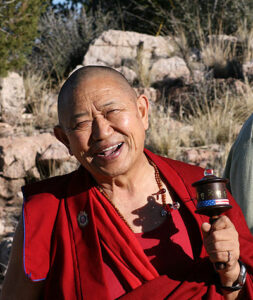
Yamantaka Empowerment Introduction Teachings – H.E. Garchen Rinpoche
Yamantaka Empowerment Introduction Teachings – H.E. Garchen Rinpoche
What is the main reason we practice Yamantaka? This is contained in the phrase, “Let the destructiveness of sorcerers, their gods and protectors descend upon themselves,” which we find in the retreat text.
What this means is that when you have loving kindness, compassion and Bodhicitta, any harm directed at you will fall back on itself. This is the root of the matter.
Why does this happen? Because here your mind is clean and pure. When you are meditating on loving-kindness and compassion for all, then you have no ego-clinging. Without ego-clinging, nothing can harm you.
So through Yamantaka, we meditate on compassion for all sentient beings and nothing – curses, sorcery or whatever – can harm us. If you understand this, then you understand all there is to know about Yamantaka retreat practice.”
– Garchen Rinpoche
I will give instruction on deity Yamantaka. What is purpose of these instructions? In general, according to Drikung Kagyu, it is widespread practice. because it is widespread, many disciples asked about the deity. They feel something is distinct about his deity. So, when they engage in this in the 3 vehicles it becomes a great elaboration, many distinct levels of teachings, which created doubts and questions in their minds, to clear these, I will instruct this deity to the best of my abilities.
So,, the precious teachings of Buddha were taught by Buddha’s for sentient beings.
Qualities of Buddhahood – the Three Kayas
First, we need to understand qualities of Buddha. When one attains Buddhahood, one attains qualities of the three kayas.
The Dharmakaya is the first, which refers to the spacelike, all-pervasive nature of mind, free from duality and limitations. It is neither one nor many, like space, it is indivisible. It is vast and profound. In that space-like Dharmakaya, all buddhas are one. Its nature is emptiness, but that does not mean nothingness. When sentient beings fully realize the truth of emptiness, they attain the state of great bliss, ever lasting happiness. When this is attained, they become buddhas and possess great, natural, unobjectifiable, all-pervasive compassion for all sentient beings who have not
From the Dharmakaya, the Sambhogakaya arises in many forms, for example, peaceful and wrathful deities.
Also, the Nirmanakaya arises to benefit sentient beings according to their abilities, whom include all the sentient beings that haven’t attained enlightenment. The Nirmanakaya has many forms as follows. The incarnate Nirmanakaya include tulkus. The created Nirmanakaya are images and statues. The manifold Nirmanakaya are any natural occurrences that appear to bring happiness to sentient beings, for example, the four elements and so on. The mind is emptiness and compassion. From that arises the forms of the emanations, Sambhogakaya and Nirmanakaya.
Wrathful Deities
In terms of the deities, the deities are Sambhogakaya, there are peaceful and wrathful deities, especially about the wrathful, there are questions, so we say the essence of the Buddhas’ teachings are the 37 bodhisattva practices. On the other hand, the wrathful practice. People wonder how to reconcile them. With the flesh offerings and so on. These are good questions. They show you are really thinking about them with intelligence. There seems to be a contradiction, so I will try to clean this away to the best of my abilities.
Thus from the qualities of the Buddhas, the Dharmakaya, Sambhogakaya and Nirmanakaya appear to benefit beings through the four enlightened activities of pacifying (to promote well-being), increasing (for example to increase wealth, peace, and harmony), magnetizing (to summon/restrain people), and subjugating (to wrathfully oppose any enemy who may harm). When you have realized the meaning of all phenomena, the four activities are explained in the 37 Bodhisattva Practices, especially in verse 16: If someone for whom one has cared as lovingly as one’s own child regards one as an enemy, to cherish them as dearly as a mother does an ailing child is the bodhisattva practice.
So, from the qualities of the Buddhas, the Dharmakaya, Sambhogakaya and Nirmanakaya appear to benefit to sentient beings, through the 4 enlightened activities, also, relate to our mundane activities. For example, if a president or someone is trying to administer a country, must be through the 4 enlightened activities of pacifying, creating well-being, increasing, increase wealth, magnetizing, to summon/ restrain people, and wrathful to oppose any enemies who might harm the country. These relate to enlightened activities too. Pacifying, increasing, magnetizing and wrathful. If we don’t understand clearly, it seems a contradiction. When we read 37 bodhisattva practices may be hard to reconcile. When you have realized the meaning of all dharma, all the 4 activities are explained in the 37 bodhisattva practices, especially “if someone for whom one has cared as lovingly as one’s own child regards one as an enemy, to cherish them as dearly as a mother does an ailing child is the bodhisattva practice.“ (16th Bodhisattva practice)
There are some sentient beings who can’t be subdued through the first three activities, their karma is too strong. The only way to subdue them is through wrathful means. It is like a sick child. Certain illnesses can be cured by medicine. Sometimes, we need surgery. When we undergo surgery, it is beneficial, so we are happy about it, it is good for us. In the same way, the wrathful activities have a curing quality. It all depends on our intention. Anything we do with angry attitude will become the cause of suffering. But any one of the four activities done out of altruism is beneficial. We have already known, were taught in 37 bodhisattva practices.
For this reason, it is important to understand the meaning of all three levels of the Buddha’s teaching on the buddhist path— Pratimoksha, Bodhisattva, and Vajrayana. On the level of Pratimoksha, we recognize the faults of our afflictions. On the level of Bodhisattva, we recognize that the root of fault is grasping. On the level of Vajrayana, we realize there is no self-grasping, and that our Buddha-nature is always there.
In the beginning, one may think that Vajrayana is difficult to understand, but it’s not. Since it’s not yet habituated, it feels difficult. Everything has its outer, inner, and secret aspect. Take a person as an example, the outer aspect of a person is the body that we see. The inner aspect is the temporary afflictions and thoughts in the mind. The secret aspect is their Buddha-nature. That Buddha-nature pervades all beings. Because of this, on the level of the Buddha-nature or Vajrayana, there is nothing to be liberated, there is no duality (subject and object), nothing to be slained. If there were any actual duality, then we would be committing killing, cutting, and so forth. To kill something, there needs to be two. In the reality of the space-like nature of the mind, there is no agent to liberate and nothing to liberate. This is the ultimate nature of Vajrayana, the purpose of all four activities—to establish all sentient beings in enlightenment, to realize non-dual ultimate nature of reality. In that sense, verse 16 of the 37 Bodhisattva Practices about the sick child really fits for wrathful practice.
Written instruction of Yamantaka not only refers to Yamantaka
We need to understand general meaning of wrathful deity.
Some people think that Yamantaka is a very distinct deity, different from other deities. Actually, the practice instructions are not specific to Yamantaka; we need to understand the general meaning of a wrathful, enlightened deity. All the wrathful, enlightened deities arise from the state of great compassion and bodhicitta, just like Manjushri. For example, when a child is naughty, the mother will be wrathful to a child for the child’s benefit. In the same way, the deities appear in wrathful form with many implements, etc.
Here, we need to understand the purpose that these ornamentations fulfill. Vajrayana are shown through symbols, signs, and actual meanings. Not something someone made up, but they show us the nature of deity that appears to us naturally, like a rainbow in the sky. In the past, great masters accomplished a deity, and through accomplishment, the deity appeared to them in an aspect. From that, the sadhanas arose. Such termas and teachings arose from their mindstreams.
During the deity generation, there are three important aspects. First, clearly visualizing the deity, the implements and so on (the clarity aspect). Second, recollect the meaning of the deity’s attributes and implements (the purity aspect). Third, generate stable divine pride that “I am that deity” (the stability aspect). Most important is to cultivate bodhicitta. If you have done that, you have cultivated the deity’s mind even if the visualization isn’t so clear. The mind and life force of a deity is bodhicitta. You can see that your mind is the mind of the deity, which is bodhicitta. This is how we also should recognize the essence of teachers as being the embodiment of bodhicitta. All practice is to cultivate bodhicitta – purify self-grasping and cultivate altruism. The real mind of the deity and all buddhas is bodhicitta. The deity that appears in the mind appears like a reflection in a mirror. When that appears, it is always in your mind, it never leaves you. It is important to practice a Vajrayana deity in these three aspects—clear visualization (clarity), recollection of the symbolic meanings of every aspect of the deity (purity), and stable divine pride (stability). All three can be done in your practice simultaneously. When done so, all the habitual patterns will be purified. This is how you should understand the secret mantra practice. Vajrayana teachings are shown through signs, symbols and meaning.
Vajrayana shown through symbols, signs, and actual meaning
What does it mean, the “Vajrayana is shown through signs?”
Take Manjushri holding a sword as an example, the sign is the sword which symbolizes the wisdom mind. What can you do with a sword? You can cut up things. What can Manjushri cut up? The 2nd part, it symbolizes wisdom, wisdom mind. The meaning is that the sword of the wisdom mind cuts delusions and afflictions. If the delusion of an inherently existing self and others is cut, afflictions will not arise. If afflictions are cut, we don’t accumulate karma. The wisdom mind has the quality of dispelling false perceptions of duality.
Because sentient beings are ignorant of true nature, they perceive a self. From the self, they see the other. On that basis, we get 84,000 delusions rooted in self-grasping. But when you look at the mind directly, it is of space-like nature, inseparable from outer space. The wisdom mind realizes the nondual nature. The quality of the sword is cutting, it can cut a rope that binds you. The symbolic meaning is that it is a sword of wisdom that cuts the rope that binds you in dualistic perception and liberates you. It is important to understand the meaning of all the deity’s attributes and ornaments since it is the purifying aspect of visualizing the deity. In this way, you can understand Vajrayana, and can apply this to the implements of the wrathful too. Each ornamentation, each sign is an outer representation of an inner symbolic quality of the deity’s mind. We should understand the symbolic nature of Vajrayana.
What is benefit of understanding these symbols? Through knowing these signs and symbols, one understands the qualities of the deity’s mind that correspond to our inner enlightened qualities. Various levels of realization, qualities of realization are presented as ornamentations. Bringing these to mind can help us to purify our ordinary thoughts, six afflictions, and self-grasping delusion that are the cause of the six realms of samsara.
Some beginners don’t feel inspired by the generation stage; dismissing it as “just another thinking in the mind.” But we need it. It purifies ordinary perceptions; it’s not habituated, so it feels difficult. People prefer meditation without concepts. But the purpose of conceptual visualization is to eliminate ordinary mundane thinking. Our ordinary thinking creates more thoughts of a concrete, solid reality and solidifies our attachment. However, when we think of pure form of deity, the ordinary pure forms of thinking are purified. Then, when we do completion stage, all those are completely purified. That is why it is important to do (both) generation and completion.
When we do Completion stage, we eliminate our belief / our perceptions are true. In the Creation stage, we eliminate first our idea that thoughts are not true, so there is no duality grasping.
This is summarized in what the Buddha said, “perfectly purify your own mind.”
For this purpose, the Vajrayana teachings are shown thought signs, symbols and meaning.
Meaning of the Garland of Human Skulls
One of the wrathful ornamentations is the garland made of skulls of human heads. It is an outer symbol, an outer aspect, this skull garland. But what about the inner meaning? What they represent are the ordinary afflictions, the ordinary thinking mind. The inner symbolic meaning is cutting the head of our ordinary afflictions, the ordinary thinking mind. What makes it ordinary? A sentient beings that hasn’t realized the nature of mind is constantly afflicted. No matter what affliction arises, they don’t recognize it as affliction.
Some are able to overcome affliction by cultivating loving-kindness. For example, if you get angry with child, partner, you will have regret and cultivate compassion. Others are able to abandon anger on basis of wisdom, mindfulness, For example, you get angry with child, you recognize “this is a moment of anger”, it dissolves in that instant. If you cut the head off a person, they can’t do anything anymore. Likewise, if you cut the head off an affliction, it collapses. If it remains ordinary, you will just be controlled by anger, will say bad things offend others make them angry, and leads to more conflict. Actually, a lot of conflict between counties between people arises form harsh words arising from anger. We say harsh things which leads to conflict that leads to more karma.
Coming back to Manjushri, the symbol is the sword, the sign is it’s cutting, and it’s meaning is the wisdom that cuts through afflictions. If we cut through the affliction, we don’t’ accumulate karma. It is important to understand when you practice deity. If you understand the meaning of the ornaments, you practice all deities. We practice first by visualizing the deities, then recollect meaning, then generate divine pride.
Clearly recollect deity, implements and so on.
Purify – the meaning of the implements.
Divine pride- “I am that deity.” We are devoted to the deity, but don’t feel like we are the deity, that approach is – Kyra tantra.
When we cultivate Bodhichitta, we understand we are somehow similar to deity – performance tantra. If we cultivate Bodhichitta, we have cultivated the deities mind, even if the visualization isn’t’ so clear. The mind of deity is Bodhichitta. You can see that your mind is mind of deity, which is Bodhichitta. This is how we should recognize essence of teachers- embodiment of Bodhichitta. All practice is to cultivate Bodhichitta – purify self-grasping and cultivate altruism. The real mind of the deity is Bodhichitta. The deity that appears in the mind that appears like reflection in mirror. When that appears, it is always in your mind, it never leaves you. When you practice a Vajrayana deity, it is important to do so in those 3 steps: Clear visualization, recollection of deity, and divine pride. These three can be completed in your practice simultaneously. When done so, all the habitual patterns will be purified. This is how you should understand secret mantra practice.
Meaning of Lotus, Sun and Moon disk
All the deities have a seat of a lotus flower – a symbolic meaning, not a substantial lotus flower, refers to a quality that arises but is undefiled. Like a lotus that grows from a muddy swamp but remains undefiled, in the same way, bodhisattvas appear in samsara to benefit sentient beings, are not defiled by self-grasping, not in bondage, don’t fixate on dualities, duality, are undefiled by faults of samsara.
Then we often visualize a seat of sun and moon, and above that, the seed syllable Hum. The sun symbolizes emptiness which is the nature of all phenomena. Phenomena do not truly exist, they lack inherent existence. The sun burns all delusions away. It refers to the Dharma. Moon symbolizes compassion. The light of the moon refers to the sangha, the compassion light of sangha. These 3 – refers to Buddha, Dharma, and Sangha. The seed syllable HUM refers to the Dharmakaya mind of the Buddha. When you visualize a deity, the most important aspect is the mind of the deity – the seed syllable HUM. What is the meaning? Why so significant? It is because the mind of the Buddhas is related to your own mind.
Purification of birth in sadhana practice
The visualization of the sun, moon, HUM relates to birth. When the consciousness is about to enter the womb of the mother, it is through attachment that one is drawn to the womb in between white and red drops of father and mother. Actually father and mother are represented by sun and moon respectively while your consciousness is the seed syllable HUM which is ultimately Buddhanature. When you have mindfulness, there is wisdom. Without mindfulness, you are in a state of delusion in samsara.
Visualizing yourself in a pure form, you are purifying birth. Four types of generation stage are to purify the four ways to take birth—birth through womb, egg, heat and moisture, and miraculous birth. These four stages should be practiced according to your mental capacity.
Generation stage also purifies and transforms our aggregates, elements, sense sources, eight consciousnesses, and senses and their objects during the vase empowerment. If you know that, you will really acquire the true powers of the generation stage even if you don’t know how to read the sadhana. If you can visualize the deity and cultivate great devotion, you will remember the deity in the bardo. You will become the deity – since you are empty and lack true existence the deity appears. In that instance, you become the deity, which is the power of the generation stage. Even in this life, when you encounter problems, when you think of deity, the mind’s habitual thoughts stop, and the mind relieves. Like heat that melts thoughts, the thoughts are like cold weather that solidifies thoughts. When we are overwhelmed, if we don’t understand the precious human body, one might commit suicide. Because we believe so much in the reality of our perceptions and our own identity. The visualization of a deity brings an end to our usual way of thinking, it brings benefit to this life, and when you leave this body, the mind will think of the deity and become the deity in the bardo. So, you see the great power of the generation stage in this way.
In general, the various wrathful deities of Vajrayana have the same qualities and they are practiced in the same way.
Though I personally don’t have much learning, I’ve encountered many such great masters I’ve practiced to best of abilities. Based on this, I will share with you.
My Connection with this Yamantaka Practice
A few words on my connection to Yamantaka. In general, the practices in Drikung Kagyu are from Dharmakirti. The foremost deity of Lord Jigten Sumgön is Chakrasamvara, then Vajrayogini, and then Yamantaka. This Yamantaka has been practiced in Gar monastery and throughout the Drikung Kagyu until 1958. It was a special strict and difficult retreat. Not quite the same as other retreats. I said before that all the deities are the same, it’s not the practice that is different, rather it is the ways of practice that are different, there is a special way of practicing, of approaching the deity in this Yamantaka retreat. I practiced it from very young until 1958. I always had very significant feeling and faith in this deity. There was an interruption from 1958 onward for 20 years when I was in prison. When I returned from prison in 1980, I was able to find an old Yamantaka thangka image which was hidden during the cultural revolution. That thangka was from the time of the 4th Garchen Rinpoche, I found it and restored it. Since then, this practice has been done continuously. First was in Tibet, and then second when I came to India, I led Yamantaka retreat on behalf of long life of masters, then 3rd time, I led it in Lumbini during consecration of stupa. After than, I brought it to the west.
In the U.S., even though it is a quite difficult retreat, and we didn’t announce this practice widely, people got interested in it. In the beginning, in the U.S., we did it in a very small group. Some with great merit and wisdom did it. We didn’t announce, but more people got interested.
With whatever deity is practiced, if the approach and accomplishment are successful, the activities will naturally increase. A special feeling arises in people. Of course, this doesn’t arise immediately in some people, and hardships occur, but this is because individuals have karma. At first, not feeling any connection, but then, it is like when the sun is shinning, and the ice is thick, but a feeling starts to arise. A feeling that I have personally experienced in this practice. It becomes very popular naturally, even though it is quite a difficult retreat. But happiness, great blessings, and endurance purify much difficulty. However, at times there can also be signs showing that afflictions are getting thicker. For example, even Lord Jigten Sumgön, a great master, got incurable leprosy (which was a great sickness in Tibet at the time) at the edge of his enlightenment. He prepared for death. But when he generated such indomitable bodhicitta, the power of bodhicitta healed him completely and he attained buddhahood. Through bodhicitta, we can purify much negative propensities.
Even if we are not able to endure hardships likes Milarepa.
When you practice dharma, a single headache can purify karma of a deity in the lower realms. People…. it, come from all around, and practiced in various traditions. This form of Yamantaka, the version I have done, comes from tradition of Gar Monastery. Therefore, I share this practice with my disciples that are interested. So far, we have been able to establish this retreat in place in US, Thailand, and Germany. The purpose is to eliminate hatred and jealousy in whole world.
There are many people interested in engaging in Yamantaka practice. In general, we are taught the need to recite Manjushri mantra. It is also advisable to recite ‘Uttering the words of Manjushri’ – since all the meaning of tantra is in these words. They contain tremendous blessings. So, if you practice Yamantaka after doing that, great blessings will arise, in whatever Buddhist practice you do. As Gampopa said, ‘bless me that my mind may become one with the dharma. Bless me so dharma becomes the path.” What is the point? To be free of suffering, the root of suffering is self-grasping, all afflictions arise from self-grasping. That afflictive mind has created all the suffering in the past, present, and future through negativities, imprints of self-grasping, etc, since beginningless time. Grasping of all sentient beings and of one single person are of the same nature. The point is to eliminate self-grasping.
The point is to eliminate afflictive emotions, Lord Jigten Sumgön – in Gong Chik, said the 84,000 teachings are for a single purpose. Therefore, when we engage in tantric deity practice, we should not perceive beings that we encounter as ordinary, rather we perceive them in the nature of the deity. Whatever appears, the surrounding is a pureland. All beings are deities by nature. Everything that is seen has the nature of the deity. All sounds heard have the nature of the inconceivable. All thoughts arising in the mind have the nature of dharmata. This is the path of transformation. The goal is to transform our normal grasping into pure perception. This is the main objective of the Secret Mantra Practice.
I have personally carried this lineage uninterruptedly. I have explained to my disciples, if one practices from the ultimate truth, Mahamudra, this practice will have great power. By engaging in this practice properly, we can realize Mahamudra—the nature of mind, the Dharmakaya, buddhahood. This is why it is so significant. Lord Jigten Sumgön in Gongchig, said: The 84,000 collections of the teachings are all one as a method of achieving buddhahood. If you practice the deity generation, recollecting the aspects of clarity, purity, and the stability of divine pride, and if you know all that, any deity you practice will become very powerful.
Suggested Foundational reading – Khenpo Samdrup’s book
So, there are many people who have entered Buddhism in this world, but there are other religions, spiritual paths, they all have same significant, if we know how to practice properly, if we don’t know how to practice a religion properly – even Buddhism- it will become a cause of suffering. So, even though I want to introduce my dharma friends to the essential meaning of Buddhism, I didn’t have the merit in this life to do much study. So, I may not do much study. So, it was necessary that Khenpo Samdup wrote this book to understand. He practiced at my own monestary, and then he dedicated his life to dharma, he is an incredible scholar.
But I have experienced more suffering in this life, but he has greater background of study, I encourage you to all read this book. It is a great intro to Buddhism. If you only understand the meaning in this book, you will turn away from bias to any religion, and understand why all religions are good, in Buddhism, there is only 1 intention of all the Buddha of the 3 times, they all wished for the eliminate of the suffering of beings, the 84,000 teachings are said to be included in bodhichitta. Understand one thing, the perfect Buddha come from the altruistic mind.”
That is the essence. In the beginning, is essential to understand that essence. So, I encourage you to read this book I wrote intro for. It would be very good if he gave an introduction.
Nowadays in this world, people learn things, and that is a great quality. Really important, within Buddhism, especially, in Vajrayana, is important to understand meaning of texts. They have been translated, but it is important to understand meanings. The literal sound of words is excellent, but it is really important to understand the meaning of that word. Even one word personally, when I was a young boy, even if I heard one word and really thought about it, it was like opening up a heart. That is why it is so important to have texts translated instead of remaining phonetics. I also encourage you to discuss with each other, there are many senior disciples that have a lot of knowledge. Sometimes, you may ask teachers to clarify doubts, but it is important you discuss with each other too. So, you can discuss with each other. For example, even if 3-4 disciples come together to discuss meaning of text, is very important, with that I will conclude morning, Om Mani Padme Hum.
Even though you have received many empowerments, if you understand the nature of the deity, you understand that it is sufficient to only practice a single deity. By practicing a single deity genuinely, you are accomplishing the essence of all deities. In fact, it is better to focus on the practice of just one deity, because then it will be easier to habituate to the deity to the point where you will not forget about the deity. To accomplish the deity means to never forget about the deity, it means that the deity always remains in your mind, it never separates from you. As it is always in your mind, you become the deity. If you never separate from the deity, you will also remember the deity in the Bardo after death, upon which you will attain enlightenment into the samboghakaya form of the deity.
Sometimes, people worry about receiving too many empowerments because they think that they cannot keep all the samayas. Actually, if you practice the root samaya of love, compassion and mindfulness, you are keeping all samayas of all deities, even if you only recite the mantra of one deity. In order to understand this, you must understand the essence of the deity. If you think that the deities are all separate, there will be a conflict. Actually, the power of one wisdom deity is contained within all deities. Various deities appear in order to suit the various thoughts and inclinations of sentient beings, but actually their nature is one and the same. The nature of all deities is bodhichitta. Therefore, if you practice bodhichitta and mindfulness, and only recite the mantra of one deity, you are keeping all your samayas. If you do not practice bodhicitta and mindfulness, no matter how many different mantras you recite, you are not keeping your samayas. That is because bodhicitta is the very life-energy of the deity. Without bodhicitta, the deity is like a dead body.
However, it is necessary to practice at least one deity on a daily basis. In the various empowerment texts, it is mentioned in the section of repeating the samaya that one must recite the mantra of that deity, but this must be mentioned in each sadhana because in old days the masters would only receive this one empowerment and then practice this for the rest of their lives. For this reason, it must be mentioned in each empowerment text. But for us, since we receive so many empowerments nowadays, it is crucial to understand the meaning and essence of the empowerment. It is said: “In the expanse of primordial wisdom, all the Buddhas are one.”