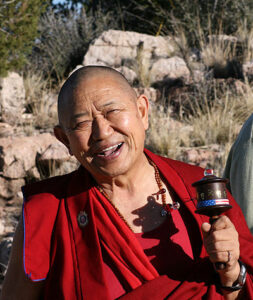
Garchen Rinpoche’s Commentaries on Thirty-Seven (37) Bodhisattva Practices
 Commentaries on Thirty-Seven Bodhisattva Practices – By Garchen Rinpoche

I have explained the ‘Thirty-Seven Bodhisattva Practices many times, over many years, because this is what we need to recite, this is what we need to train in.
For someone who knows how to practice, there is nothing that is not included in the ‘Thirty-Seven Practices. All of the Buddha’s speech is contained within the transcendental perfections, and they are contained within this short text.
What does it mean to say that all of the Buddha’s speech is contained within this text? To put it simply, all the 84,000 heaps of Dharma teachings are nothing other than methods to cultivate bodhicitta. At the end of every practice, we always mention precious supreme bodhicitta. In what way is it precious? All sentient beings only want to be happy, and they do not want to suffer. The source of all happiness, the crucial poinr from which all benefit and well-being arises, is bodhicitta. The temporary benefit of bodhicitta is the achievement of the happiness of the three higher realms. Ultimately, it leads precisely to the ground of Buddhahood. It is like a precious jewel; we consider gold, diamonds and so forth to be precious, and we are pleased to wear them around our necks. Yet they are the cause of suffering; we desire them, we grasp at them, and we cling to them. In order to buy them we work hard, we have to spend a lot of money, and when we lose the money, we suffer. Thus, they cause suffering.
But if you possess bodhicitta in the depths of your heart, then from lifetime to lifetime it will follow you wherever your mind goes. You cannot lose bodhicitta even when you lose your body, so bodhicitta is the true precious jewel. First and foremost, you should understand the meaning of precious bodhicitta. Where is this precious jewel? It is known as the “mind set on enlightenment” and thus it abides within our mind. It is the love we have for our father, mother, siblings, and friends. But right now, it is very small.
The Tibetan word for bodhicitta is Jang Chub Sem. ]ang means all self-cherishing has been cleared away. Chub means that the mind that seeks to benefit others has been mastered. When you continually think, “May I be of benefit,” then the altruistic mind and love have arisen. Once the self-grasping and self-cherishing mind has been cleared away, a great and genuine altruistic attitude arises within one’s mind-stream. This is what is meant by Jang Chub. A bodhisattva is one who, having mastered this mind, has absolutely no fear of the suffering of samsara and the lower realms. The Tibetan word for bodhisattva is Jang chub sem pa, and pa means hero. Someone who has bodhicitta has become a true hero. There is no more fear, because in the mind of a bodhisattva, there is no self, and the root of all fear is the self. When there is no self, then there is no fear.
The Bodhicitta Prayer says, “Bodhicitta, the excellent and precious mind; may it arise where it has not arisen, may it not decline where it has arisen, and may it ever increase, higher and higher.” The first step in cultivating bodhicitta is to recognize suffering through pondering The Four Thoughts that Tum the Mind. [These are the thoughts that turn the mind away from samsara and towards the Dharma. 1) The precious human incarnation is rare; 2) Death is a certainty for all that lives, and all that exists is impermanent; 3) There is no true happiness in samsara, only suffering; and 4) Karma, like a shadow, will follow one life after life.]
The absence of bodhicitta is the nature of suffering, and bodhicitta is the most supreme method for attaining liberation from suffering. First, on the basis of the Pratimoksha vehicle – the vehicle of individual liberation – one recognizes suffering and that the root of all suffering is self-grasping. Unless you rid yourself of self-grasping, you will not find liberation, but rather you will circle endlessly in samsara and eventually be reborn in the lower realms. After training in the Four Thoughts that Turn the Mind you train in the Six Perfections. [2 Generosity, moral ethics, patience, diligence, concentration and wisdom.] The Bodhicitta Prayer summarizes the Pratimoksha, Bodhisattva, and Vajrayana paths: “May it arise where it has not arisen” is the Pratimoksha path, “may it not decline where it has arisen” is the Bodhisattva path, and “may it ever increase, higher and higher” is the Secret Mantra path.
Homage to Lokeshvara! I prostrate to the Protector Chenrezig!
Chenrezig is the protector of the world. He is like the father of all Buddhas, but this does not mean that we have to exchange our fathers! A Buddha has great compassion, and one cannot become a Buddha without giving rise to compassion.
Chenrezig is the Powerful Lord of Compassion, and as he is the embodiment of compassion, he is like the father of all Buddhas. Samsara has come about based on our fears and sufferings, and Chenrezig is called the ”Protector of the world” because he is one who protects us from the suffering. When we say “I prostrate” it is paying homage to him, like saying, “Oh! He is great, he protects from suffering.”
At all times I prostrate with respectful three doors of body, speech, and mind to the supreme guru and the Protector Chenrezig who, though realizing that all phenomena neither come nor go, make single-minded effort for the sake of all sentient beings.
This is an expression of reverence for Chenrezig. Once Chenrezig and all the Buddhas of the three times achieved the state of Buddhahood, they realized chat all phenomena of samsara and nirvana neither come nor go, they abide like space. When there is the concept of a self, the six afflictive emotions arise. Impelled by these afflictions we engage in all sorts of actions and accumulate karma. Thus, we circle continuously within the six realms of samsara, like an ever-revolving wheel. Although Chenrezig realizes that all phenomena neither come nor go, infinite samboghakaya (enjoyment body) and nirmanakaya (emanation body) emanations arise out of his compassion for us. All the spiritual friends (teachers) manifest as the nirmanakaya emanations of Chenrezig. Nirmanakaya emanations appear in all of the six realms, each in their particular form. These lines express our reverence for this ability.
In the text, the lama is mentioned before Chenrezig, making an important point. The mind of the lama, the genuine spiritual friend, is endowed with the attributes of the three higher trainings, and possesses the same qualities as a Buddha. This mind is a union of emptiness and compassion. But in terms of kindness, our lama or spiritual friend is the one who is most kind to us. The author of the Thirty-Seven Bodhisattva Practices, Ngulchu Thogme Zangpo, directly realized bodhicitta within himself. The Buddha’s teachings are vast and endless, and unless we rely upon a spiritual friend, we are unable to use them effectively. Thus, although the lama’s qualities are equal to those of the Buddha, his or her kindness to us exceeds even that of the Buddha.
As for the meaning of lama, the first syllable, la, means high. This is to be understood in terms of a high mind. We should always remember it. For example, everyone in the world with some intelligence always thinks of His Holiness the Dalai Lama with reverence. You should always be thinking of your lama or spiritual master. When we think of him or her, what do we think? He or she does not give us any great gifts, but when we think of him or her, we are happy. What is that? That is love. He loves us like a mother loves her child. If he loves all sentient being like a mother loves her child, then those beings will think of the lama like a child thinking about its mother. la means higher than sentient beings, and ma means mother, like mother of all sentient beings. This is the meaning of lama. What we should remember is that the genuine spiritual master is endowed with the attributes of the three higher trainings, and therefore he or she is indeed a true successor of the Buddha. This is how you should contemplate. The lama always thinks of all sentient beings with love, so when we think of him or her, we establish a direct connection to him or her, a connection of love. First, we have to contemplate the feeling that a mother has for her child. When we take the bodhisattva vow, we give rise to the attitude of the mother has toward her child, and extend it to all sentient beings. If it has not yet arisen, the method to give rise to bodhicitta is love, which is like a wish-fulfilling jewel. Having a complete scientific understanding of everything in the world is of no help in realizing the method that liberates from the suffering of samsara, the method that arouses bodhicitta where it has not arisen. Therefore, the lama, the spiritual friend, is extremely precious, a thousand times more precious than a wish-fulfilling jewel. The spiritual friend actually arises within the mind, and this can only be passed on from mind to mind. Thus, if one does not rely on a spiritual friend, this cannot be passed on by mere lip-service.
At all times I prostrate with respectful three doors of body, speech, and mind.
There is a very important point to be understood in relation to prostration. When our heads touch the ground, it is a physical prostration. First, we give rise to devotion, then we join our palms, and then prostrate our bodies. But the real prostration is actually when, remembering the good attributes of the three Jewels [Buddha, Dharma, and Sangha], we cultivate trust in karma – the benefits of virtuous actions and the harm resulting from non-virtuous ones. After cultivating trust in karma, abandoning the non-virtuous deeds of the body is the prostration of the body, and abandoning all non-virtuous speech and engaging in virtuous verbal actions such as reading prayers, verses of offering or praise, listening to the Dharma, or reciting mantra is the prostration of speech. The prostration of mind is most important. The mind’s prostration is to have unchanging faith and continually seek the benefit of others. Of the prostrations of body, speech, and mind, the mind’s prostration is most important. Because their faith is very strong, many elderly lamas try to touch the ground with their heads even if they are physically unable to do so. Bur even if they cannot physically perform a prostration, in their minds they remember each Buddha in great detail, and each of these recollections is a prostration in itself. They thus prostrate to countless Buddhas. When you visualize that there are a hundred, a thousand, or ten thousand Buddhas manifesting, and each of them has wonderful qualities, you are offering wisdom prostration in front of every one of them, and this has great benefits. This type of prostration of the mind is very important. For some people, for example those who are ill, it is very difficult to prostrate. They may think that they have to prostrate with their bodies and try to do so, but they eventually become exhausted and unable to do more. But then, they can still engage in the prostrations of mind and speech. Even someone who cannot do physical prostrations can recite many refuge prayers with a faithful mind. The principal purpose of prostrating one hundred thousand times is to cultivate unchangeable trust in the Three Jewels. The fruition of prostration is to think, “The Three Jewels are completely trustworthy! From lifetime to lifetime there is absolutely no refuge superior to the Three Jewels.” It can be said that it is good to prostrate, but it is also good not to prostrate; “although some are in retreat, they go to town.” Gampopa said that once you have achieved complete control over your mind it does not make any difference whether you stay in retreat or go to town. Similarly, if you have already: given rise to complete faith, it does not make any difference whether you physically prostrate or not, because you are actually paying homage at all times.
The perfect Buddhas, source of benefit and happiness, arise from accomplishing the sublime Dharma. As that accomplishment depends on knowing the Dharma practices, I will explain the bodhisattvas’ practices.
“Benefit and happiness” refer to the temporary benefit and ultimate happiness. Bodhisattvas experience the benefits in this life, and ultimately achieve the state of Buddhahood. Another way to understand them is as the benefit to oneself and the happiness of others. How is that? The root of suffering of ourselves and all others is self-grasping. When two people have love and treat each other with love, any form of anger will be eliminated. Someone who receives love will be happy and joyful. Love arises when self-grasping is absent, but when self-grasping is present, love cannot arise. Love is like the sun, it alleviates everyone’s suffering and fears. It is the inseparable union of self and others that simultaneously accomplishes the highest purpose of self and others. So, we can understand love to be both for our own benefit and for the happiness of others. Where does this love arise from? It arises from bodhicitta; it arises from the Buddhas.
What is a perfect Buddha? “Perfect” refers to the manifestation of all the enlightened attributes of Buddhahood. Having attained enlightenment as the Dharmakaya Vajradhara, you will actualize the attributes of the Dharmakaya (wisdom body) for your own purpose. Then you will act for the welfare of others by manifesting the two rupakayas (form bodies.) for as long as space endures. This is the perfection of merit and enlightened attributes. There is nothing that is not perfected within the Buddhas. This is the meaning of “all attributes are perfected.”
The word for Buddha in Tibetan is sang-gye. Sang means that all dualistic fixations are cleansed. This is the non-dual primordial wisdom of the Buddhas. Samsara and nirvana are an indivisible union; all phenomena neither come nor go. Gye means that the mind of the Buddhas abides like space and pervades all sentient beings, so all sentient beings are endowed with the mind of the Buddha. Therefore, you can prostrate to your own nature.
The perfect Buddhas have arisen from accomplishing the sublime Dharma. Simply put, the sublime Dharma is loving-kindness and compassion. It is said that the 84,000 “heaps” of Dharma teachings gather within bodhicitta. To attain enlightenment, you have to know how to engage in the Buddha’s path, and so our text says, “I will explain the bodhisattvas’ practices.” A bodhisattva is someone who has given rise to bodhicitta, and thereby become a child of the Buddhas. Whoever possesses bodhicitta is a child of the Buddhas. Atisha said, “I prostrate to whoever trains in bodhicitta.” AII the Buddhas are endowed with bodhicitta. If you are a child of the Buddhas, you have to do the work of the Buddhas.
First of all, you have to understand the significance of a precious human incarnation.
1: At this time when the difficult-to-gain ship of leisure and fortune has been obtained, ceaselessly hearing, pondering, and meditating day and night in order to liberate oneself and others from the ocean of cyclic existence is the bodhisattvas’ practice.
Milarepa told the hunter Gonpo Dorje, “A precious human incarnation is indeed rare, but a birth like yours isn’t really rare.” You have to contemplate each of the eight leisures and ten fortunes that you are endowed with in order to understand the great attributes of this human body.
The eight leisures are the freedom of rebirth as: a hell being, a hungry ghost, an animal, a barbarian, a long-lived god, someone holding wrong views, someone with imperfect faculties, and someone living in a time when a Buddha has not come. Even though you may have obtained a human incarnation, you cannot find freedom from samsara without all of these leisures complete. The life of someone without them is not very different from an animal’s. When we contemplate each one of these leisures, we find that we haven’t been born into one of those states without freedom, but we must also have the ten fortunes complete.
First, the five external fortunes that a Buddha has come to this world, the Buddha has shown the Dharma, the teachings are still present, there are followers of the teachings, and you cultivate the mind that seeks the benefit of others.
Then, the five personal fortunes are that: you are human, you are born in a central land, your sense faculties are complete, you have not engaged in wrong livelihood, and you have faith in the Three Jewels. If you have the complete collection of these eighteen qualities, then you possess a truly precious human incarnation. It seems that all of us who have entered the gate of the Buddha’s teachings has these eighteen factors complete. When you reflect on each of these eighteen leisures and fortunes you should think, “Oh! I have been able to enter the gate of the Buddha’s teachings, this is truly precious!” Then you give rise to the attitude that your incarnation is truly precious, like “a precious jewel, and you become determined to make the best use of it and not waste it.
Many people do not consider these preliminary practices very important, thinking that just because they have read a text, they already understand the eighteen leisures and fortunes and don’t have to think about them any longer. This is very mistaken.
First you have to study the Four Thoughts in fine detail and then you have to practice them continuously. You must be able to remember them in an instant. When we wake up in the morning we think, “Oh! I would like to sleep a little longer.” But then, we should immediately remember, ”Ah! Wait a minute! I don’t want to waste this precious human incarnation that is so difficult to obtain.” Then we will wake up immediately. We have to recall this every single day.
Lord Jigren Sumgon said that the preliminaries are more profound than the main practice, because engaging in the preliminaries is like building a strong foundation for a house, so the house will also be strong. To practice these preliminaries, first you must understand the idea, then gain an experience of it. You must think about each aspect, each of the sufferings and joys of the six realms until you truly understand, and then you will recognize that all of samsara is really suffering. You will become convinced that, for example, even though the gods experience joy and riches, their lives have no essence, because they do not lead to the state of enlightenment. This is why Milarepa said that the human incarnation is very powerful in terms of both virtue and non-virtue. The human incarnation is so extremely powerful that if we practice virtue we can attain enlightenment within one single lifetime. On the other hand, if we practice non-virtue we will fall into the lower realms for a very long time. This is all because of the human body. The Sakyapa said that one’s body is like an enemy, and if you fail to put the holy Dharma into practice, this body is indeed an enemy. Because of this body we accumulate a lot of karma that is the cause for rebirth in the lower realms, so the body is an enemy. This body also creates all mental suffering. Only if there is no fixation to this body are we free of mental suffering. This is an important point.
In the Thirty-Seven Bodhisattva Practices the human incarnation is likened to a ship that carries us across the vast and deep ocean of the suffering of samsara. This ocean of samsara seems vast, but we must look inside our own minds. The ignorance of even those whose bodies are very small is extremely vast and deep, as it has accumulated since time without beginning. The transcendent knowledge inherent within every mind must be awakened. The jewel within the mind must be obtained. We do have to sustain this body with nourishment, but we should do so according to the Buddha’s instruction not to fall into either of the two extremes. [extreme hedonism and extreme asceticism]. Of course, being able to bear hardships like Milarepa, who didn’t fall under the sway of either the body or the mind, is something else, but we should do just as the Transcendent Conqueror, the Buddha, has prescribed, and sustain our bodies without excessive indulgence or deprivation. The most important thing is to use this body so as to obtain a good result. We must obtain the fruition of mind, which is bodhicitta.
By following the path of the Six Perfections, the ship of the body will carry us to the precious island of enlightenment. On your side, you must cultivate faith, and on the external side, the teachings must still be present; these two must come together. The Buddha must have given the teachings, and his teachings must still remain. But if you fail to follow these teachings, they are meaningless. Even if the five external fortunes relating to the Buddha’s teachings are present, they are meaningless unless you become a follower of these teachings. You must enter the gate of the Buddha’s teachings through taking refuge and so on. If the Buddha’s teachings have remained and there is a Dharma center, for instance, if you don’t establish a connection with them, it is meaningless. Any Dharma center of the four traditions represents the Buddha’s teachings; so as long as there is a Dharma center, it can be said that the Buddha’s teachings remain. When you become a follower, you cultivate faith and train in bodhicitta. This is what it means to be a follower. If you deeply contemplate how it would be if the Buddha’s teachings had not remained, and that samsara is in the nature of suffering and lacks any essence, an unbelievable fear will arise within your mind. You should particularly ponder the ten fortunes with great care, again and again. First you must listen carefully, and then you must contemplate again and yet again. The point that has been understood must become a part of your outlook through repeated contemplation. In the morning, meditate on the difficulty of obtaining the leisures and fortunes.
Throughout the day, during all your activities, clean your mind by contemplating the inevitability of karma, cause and effect. In the evening, before sleeping, meditate on death and impermanence. Lama Jigme Dorje said that every day you must meditate continuously in such a manner. This helps. Sometimes when you are tired and feel like going to sleep, if you remember the difficulty of obtaining the leisures and fortunes, you will quickly wake up. It is said that one must practice day and night. You may wonder when you will sleep and work, but you shouldn’t think like that. Of the three, body, speech, and mind, the mind is most important, and if you practice the Vajra recitation of breaching as you fall asleep, focusing on each breath, it is practice. This mindfulness is the absolute truth. Each time you remember the suffering of sentient beings and cultivate love, you are accumulating love, just like a bee collecting honey. The varja recitation of breathing is an easy way to practice virtue continuously. If you really want to practice you will understand this. Milarepa said, “If virtue dawns within your mind, then even earth, stones, bushes, and trees will become the cause for virtuous deeds.” Wherever you go, when you see earth, stones, bushes, and trees you can make them a mandala offering, and it will become virtuous. If your mind lacks virtue, if bodhicitta is absent, then of course the earth and so on will not be a cause of virtue. For example, if you fall asleep practicing the Vajra recitation of breathing, meditating on OM AH HUNG as you breathe, then the breath of the Vajra recitation will flow incessantly, day and night, and thus its benefits are great.
When listening to the Dharma, we must keep in mind the essence of what the lama, the spiritual friend, says, whoever he is and whichever tradition he belongs to. We must keep the root of the teachings in mind, and however many subsidiary details we are able to remember. We can’t remember everything, but we must understand the essence in a nutshell. The essence of what I will talk about now is bodhicitta. There are various methods to make it arise where it has not arisen, and then not to let it decline. In the Vehicle of Characteristics, you engage in the practice of the Six Perfections throughout all your activities; this is the way you accumulate merit.
In the Secret Mantra, the creation and completion stage practices are the methods to realize the absolute truth. If you understand the essence, then all Dharma teachings, from any lama, will be beneficial, you do not need to have many concepts about that. Whatever empowerment you receive it will be beneficial. Of course, different lamas say different things, proclaiming the views of the lineage that they hold. But we don’t have to be afraid and hide like a child under a big coat. We can receive different teachings for the sake of practice, but we do not have to hold that particular lineage. When we listen to Dharma teachings we must listen very heedfully. Bodhicitta is most important, and in order to cultivate bodhicitta, the Secret Mantra teaches the creation and completion stages, and the Paramita Vehicle teaches the Six Perfections. From the perspective of your own personal practice, the most important thing is to cultivate the two-fold bodhicitta. When proponents of the different tenet systems argue it is of no benefit, it is very harmful. It is very harmful to create schisms between the lineages, saying that one is good and another is not so good. We actually need all the different lineages; they all maintain the Buddha’s teachings. If we do not take this approach, all that are left for us to do is to be afraid like a little child hiding in a big coat.
2: The mind of attachment to loved ones wavers like water. The mind of hatred of enemies burns like fire. The mind of ignorance which forgets what to adopt and what to discard is greatly obscured. Abandoning one’s homeland is the bodhisattvas’ practice.
Why does one have to abandon one’s homeland? What is the reason Milarepa said that one should abandon one’s homeland? In order to sever attachment and aversion from deep within, one should abandon one’s homeland. Attachment and aversion are always attachment and aversion, even if they occur in the context of the Dharma. For example, if someone has a bias for his own tenet system, he does not understand the true attributes of Dharma. Some only debate, when in reality there is no disagreement. If we only listen to the words of the Dharma and then cultivate attachment and aversion based on them, this attachment and aversion is the same as that in an ordinary worldly situation. Attachment and aversion are always attachment and aversion. Desire is the cause for rebirth as a hungry ghost, and anger is the cause for rebirth in the hell realm. Gampopa said all the 84,000 “heaps” of Dharma teachings have arisen as antidotes against afflictive emotions. When you consider what you need and what you don’t need, then you should realize that, basically, what you really need is bodhicitta. What prevents bodhicitta from from arising? Attachment and aversion do. The Buddha, the Transcendent Conqueror, said that all beings are Buddhas, but this is concealed by adventitious stains. What are the worst adventitious stains? Attachment and aversion are. Our Attachment and aversion are the reason we have to abandon our homeland. This is why Milerapa abandon his homeland.
Some people leave their homeland and go somewhere else full of people, and attachment and aversion arise again. Of course, this is of no benefit. As Gampopa said, “One may say, ‘I have given up attachment and aversion, I have given up samsara.’ Then, one goes somewhere else and again fosters attachment to a family and aversion to others.” This is of no use, it has no essence. Most importantly, once you have recognized that attachment and aversion are mistaken, then whenever a circumstance that would arouse attachment or aversion arises, you will not blame the circumstance. Instead, you will think that you must abandon the attachment or aversion.
In the Dzogchen teachings it is said that one who is attached will be fettered even by the yidam deity. If you think, ”Ah! My yidam deity is so precious,” you will be shackled in the end. If you do not realize the yidam deity is inseparable from yourself, you will be bound. But we don’t have to worry about that right now. First, we have to habituate ourselves to the deity, so for now we do need to have some attachment to the yidam. But once we reach the view, we realize we are indivisible from the deity. This is explained in the Dzogchen teachings.
When you fixate, compassion does not arise; compassion is fettered by ordinariness. Actually, there is really no need to explain much about attachment and aversion. It isn’t necessary to abandon your homeland if you have no attachment and aversion. Once you have realized that self and others are equal, you do not have to abandon your homeland; then you can practice in your homeland.
The three poisonous afflictive emotions are the roots of samsara, and the main root· is ignorance. Where does ignorance come from? The mind is like clear water. The initial obscuration arises with attachment to oneself. Then, after the thoughts of me and my side, anger arises for the other side, one’s enemies. When these thoughts arise, it is like pouring red and black substances into dear water, changing the color of the water. This is how our Buddha-nature is obscured. The mind, the Buddha-nature is primordially pure, but out of attachment and aversion we accumulate karma. This is the very origin of the hell and hungry ghost realms. Therefore, first and foremost we must recognize the problems of attachment and aversion. Both attachment and aversion have their origin in ignorance. The basic characteristic of ignorance is the idea of a self. We develop this “self” into something very important and then we cling to it. We see ourselves as most important. If something undesirable happens to our “self”, we are angrily opposed to the other side. Thus, we develop attachment to the self and hostility towards others. In this dualistic frame of mind, we attach to everything we claim as ours: material possessions, kith and kin, child and spouse. From there, all those enemies who cause harm begin to appear. For instance, if we want to buy a house, we do not really care if the house collapses before we have bought it. But once we own the house, if we see someone starting to throw a rock at it, we immediately become furious. Another example is a king who must take care of his country. His sense of self and ownership is very strong, and he considers his country very precious and valuable. If someone tries to inflict harm on his country, he will get out his weapons and fight. This is what attachment and aversion are.
To practice we must contemplate, “Where has the enemy arisen from? Where have kith and kin arisen from?” First, we have to train in the uncertainty of enemies and friends. In the Drikung Kagyu tradition, as a special preliminary practice, we have to place all enemies who hate us above everyone else. This is because, of all the afflictive emotions, anger is by far the worst. It is said that there is no greater negativity than anger. Why is it the worst? Bodhicitta encompasses all the 84,000 “heaps” of Dharma teachings, so we have to keep loving kindness and compassion very dear to our hearts, but their opposite is anger. The two of them will always be mutually exclusive, so if there is anger there is no love, and if there is love, there is no anger. There is only one seat, so one of these two has no place to sit.
First, we must contemplate the problems that anger brings. All the moments of anger coalesce into a solid lump of anger, and from this, hell naturally arises. The nature of anger is hell. By thinking about the faults of anger again and again, we apply the method for eradicating it. You think of all sentient beings as your mother in order to cultivate love for them, but when a harmful obstructer arises it is difficult to cultivate love. Therefore, you have to examine this “enemy.” Where has he come from? Just as a small spark of fire can burn away a mountain of hay, when very strong anger arises, even in someone who has meditated on bodhicitta and spent his entire life in meditation retreat, all the root of virtue he has accumulated transform into poison, like medicine transforming into poison. The root virtue has become a very powerful poison. In this moment one’s aspiration that all sentient beings have happiness transforms into a wish to harm someone. This is how evil spirits come into being. It is said that the root-virtues, or merit, accumulated over eons can be destroyed by an instant of anger.
The Buddha, the Transcendent Conqueror instructs us to gather accumulations for three countless eons. All the Buddhas, enduring many hardships while engaging in the Six Perfections, accumulated love. Having gathered great love, they are truly able to proclaim that they love all mother sentient beings, who are as limitless as the reaches of space. This is how they attained enlightenment. Having attained enlightenment, the buddhas are able to act for the welfare of sentient beings through manifesting the samboghakaya and nirmanakaya emanations. This is how you should examine the benefits of virtuous deeds and the manner in which anger leads to your ruin. Then you should think, “Oh! Bodhicitta is truly precious. I must not lose it.” When anger arises in your mind you should recognize it immediately as a great enemy. If you fail to do so and someone does something you dislike, you will think, “Of course I’m getting angry with him, he did that.” In this way, you will only increase your anger. Where did our enemies, those we feel anger towards, come from? How did those who separate us from our wealth and possessions, our power, our kith and kin, or anything else that we love, arise? In a previous lifetime, this “enemy” was extremely kind to us, he or she was our parent or a friend that we loved. At that time, we abused him badly, without any concern for cause and effect. If we treat a loved one badly, he transforms into an angry enemy. Within a single moment, anger can overcome the mind, he begins to fixate on it, and plans revenge. Through the power of this aspiration made in a previous lifetime, he has become our enemy in this lifetime.
Even if you haven’t caused any direct harm in this life, you may have previously incurred a great karmic debt, similar to a financial debt. Someone who borrows a huge sum from a loan shark may even get killed if he is unable to repay the debt. For example, I heard a story about a young businessman who went to China and borrowed money from an acquaintance to start a new factory. When his business went bad, he lost millions of Yuan and was unable to repay his debt, and in the end the acquaintance that had lent him the money shot him. It is certain that in a previous lifetime this acquaintance had been that businessman’s parent, he wasn’t always his enemy. In the same way, anyone who causes you harm was first your friend. When you think about it this way, your anger will weaken and you will realize that once he actually was very dear to you, but you abused him, and therefore you now receive harm in return. Then the anger towards your enemy will decrease. It is also possible that those who we love now, our friends and relatives, will transform into our enemies even in this lifetime. If you create a debt to those friends and don’t repay it, they may transform into enemies, and even kill you. Then they may be reborn as your son or daughter. Katayana, who had psychic vision, once saw a man holding his child, eating a fish, and hitting a dog that tried to eat the fish. He said, “That man eats his father’s flesh while striking his own mother, and cradle in his lap the enemy he killed.” This is to show that enemies and friends are inconstant and indefinite. There is not a single sentient being who has not been our parent. When you become convinced of the reality of this, then even when you are in a room full of people whose names you don’t know, you will still think of them as having been your parents. When you see younger people, you can think that they have been your friends, and when you see an older man, you can think that he has been your father; if you can think like this, then we will truly become connected to each other.
If attachment and aversion do not arise, you will possess equanimity and all ordinary thoughts will be purified; so, if you uproot attachment and aversion, there is no need to abandon your homeland. If you are unable to uproot attachment and aversion, then you haven’t really abandoned your homeland, even if you live somewhere else. Even someone who generally has a good understanding of karma can forget what actions need to be adopted and what actions need to be discarded, when very strong concepts of attachment and aversion, such as strong anger, arise. Then he forgets about the cause for happiness and engages automatically and intentionally in non-virtuous conduct. If very strong anger arises, then even someone who knows that it is a misdeed to take the life of others might still kill the other person in a rage. Or when strong desire arises someone might steal, even knowing it is a misdeed. Others, impelled by afflictive emotions, may unknowingly engage in misdeeds. But even someone who generally knows about the nature of negative actions will still deliberately engage in negative deeds if attachment and aversion are too forceful. This is what the verse means by “the mind of ignorance which forgets what to adopt and what to discard.”
Consider what happens when only a little attachment and aversion arise. For example, when you are describing a certain person to others, if he is your friend, you will only mention his good qualities; bur if you slightly dislike him, you will only talk about his faults. We have all experienced this. If he is my friend, I will only see his good side, but if l don’t like him I will only see his faults. I don’t see him completely objectively, and the one who forgets what to adopt and what to discard is my ignorance. If there is someone who is neither my friend nor my enemy, if he is just someone, I have no feelings for or against, I will be able to point out his good qualities and his faults very accurately. Then we are very honest about it. When we think about situations that are less emotionally charged, we come to understand that true intelligence arises within a mind of equanimity, a mind that remains uncolored by attachment or aversion. That mind can judge very frankly. Therefore, you should continuously monitor your mind, and immediately recognize attachment and aversion when they arise. When you are able to do that you will be heedful, for example, in conversation you will immediately recognize when you are tempted to say something negative about someone just because you don’t like him very much. Still, if an afflictive emotion arises very forcefully, many people who actually know it is wrong will still engage in a negative deed, for example, going to war. How many people in the world go to war? Of course, they know that it is wrong to kill people. There are even monks who bear arms and fight.
Attachment is also a fault, although sometimes attachment can have a quality of compassion. Out of love and compassion it is possible to develop attachment, and it is said that attachment and love can easily be confused. Love means to feel sincere love without any sense of ownership or self-grasping. If you become attached to someone, as your attachment is imbued with self-grasping, there might be an aspect of love or compassion, but it will still be the cause for bondage. We have to cultivate a love that is free of any sense of ownership. What are the faults of attachment? In our present lives, when we feel attachment to the sensory pleasures here and there, it is not too bad. However, after you die, if your attachment is very powerful, the self will magnify. Then after you have cast aside your body, the sense of a self will become very strong and you will be unable to let go of it.
The basic thought of I am arises, but when we look for that I, we cannot locate it. When one Drugpa Kagyu lama requested teachings from a siddha, the siddha replied, “First you must give me your thought of I.” The lama said he couldn’t find it anywhere, and the siddha told him to go away and think about it. But the lama couldn’t find it, and when the siddha came and asked him, “What are you doing?” the lama replied, “I am practicing.” Right there, the I came in. When someone asks what you are doing, you reply, “I am doing such and such.” Automatically, the I will pop up, but when you look for it you will not find it. Unless we can free ourselves from this I, we will accumulate more karma, for tens of thousands of years, and remain like a fossilized creature. Scientists say that fossilized creatures have no life-force, but the Buddha said that they do actually possess a life-force. Until that I is extinguished we will have to experience suffering. The self is the root cause for having to remain in samsara, and the self has arisen due to attachment. Therefore, attachment is also a serious problem. Anger is an immediately destructive fault, but if you don’t recognize attachment and transform it into unbiased love and compassion, it is a strong fault. When these faults of anger and attachment are gone, your mind will become clear. You should ponder the problems of both attachment and aversion, again and again.
Sentient beings are ignorant because they grasp at a self where there is no self. When you realize the meaning of Mahamudra, there is no self whatsoever; it does not exist. First you have to resolve the non-existence of the self. Then you also have to let go of the thought that it does not exist. This is the view of the Middle Way; it transcends both extremes of existence and non-existence. This is the primordial nature of mind’s reality, it can neither be said to exist nor can it be said co not exist. The actual ignorance is that which is known as the “self.” If you look into your own mind and reflect on what that “self” is, you may think that the “self” is your body. It is not the body. I am not this body, and I am not this house. You may think that the “self” is the mind. Then you look into the mind again and again, and it will turn out to abide like space. Then it cannot be said to either exist or not exist.
3: When harmful places are abandoned, disturbing emotions gradually diminish. Without distraction, virtuous endeavors naturally increase. Being clear-minded, definite understanding of the Dharma arises. Resorting to secluded places is the bodhisattvas’ practice.
When you have become disenchanted with samsara, after pondering the Four Thoughts that Turn the Mind and understanding the suffering nature of samsara, even if you can’t practice in solitary retreat for long periods of time, even if you just do it a week at a time, you will come to understand the wonderful qualities of isolated hermitages. Actually, abandoning your homeland is sometimes difficult and mistaken; sometimes in Tibet, someone with faith in the Dharma decides to leave his homeland, thinking that it will be of benefit, but this can be a mistaken idea. Abandoning your homeland really means to abandon the self-grasping in your mind.
“Resorting to secluded place” means to practice.in a retreat-hut, getting up early and meditating. The benefit of relying on a secluded place is that its freedom from distraction makes the mind workable. Discursive thoughts do not scatter widely, and you will be able to turn inward and watch your mind for long periods of time. Then the urge to engage in virtuous actions will increase. You will be clear-minded and you will give rise to compassion for sentient beings. These are the great attributes of hermitages. In a hermitage you also have to isolate your mind. It is said that you have to isolate your body from frivolous entertainment, and you have to isolate your mind from discursive thoughts. When you isolate your body from frivolous entertainment, your mind will be isolated from discursive thoughts. When you do a week-long retreat, first you isolate your body, next you observe silence, and then your mind will be at ease. You will not feel any need for conversation, you just take your meals and remain at ease. This is very joyful. In contrast, places where anger and the other afflictive emotions arise are harmful. When we meet people, we easily give rise to attachment towards some and anger towards others, so places where there are many people can be very harmful. When we are involved in daily life in our homeland we have to deal with all sores of problems. Our friends and relatives may try to persuade us not to do retreat, and so we give rise to afflictive emotions and thus our home becomes a harmful place. Any place conducive to afflictive emotions is a harmful place. When you go into retreat you separate yourself from all that. You do not even answer the phone, otherwise you would end up gossiping on the phone. When you stop all that and look into your mind, you will find that it loosens up. You will gain some experience and realize that when you abandon harmful places, afflictive emotions diminish. We generally perceive our friends and relatives to be good, but when it comes to Dharma practice, they actually cause a lot of harm. On the other hand, when we are able to cultivate patience for an enemy, that enemy has actually been very helpful. From the perspective of the Dharma, friend and enemies change roles.
4: Long-associated companions will part from each other. Wealth and possessions obtained with effort will be left behind. Consciousness, the guest, will cast aside the guest-house of the body. Letting go of this life is the bodhisattvas’ practice.
All the Buddhas have realized char all phenomena neither come nor go. They have seen that samsara is like one night’s dream. If we have some learning, we will see that and think, “Oh! This life is like a dream!” and our attachment will instantly diminish. Strong hopes and fears will instantly vanish. But we will still continue to engage in activities. When you think about it, it does no good to feel attached to friends, as long-associated companions will part from each other. No matter how much wealth and possessions you have, even if you owned everything in the world, they can only be used temporarily; at the time of death they are of no use whatsoever, and in fact they only cause harm. Moreover, even your own body is only like a guest-house. If you think about this again and again, your cherishing of your body will diminish. Your circle of companions, wealth, your land, this lifetime, all are like one night’s dream. From the time we are born to our mothers until the day we die, this life is like one night’s dream. How is it like a dream? In the morning, last night’s dream doesn’t exist anymore. You may think that last night’s dream is empty but this life is real, but this life is no more than the appearance of our karmic propensities, and in this way, it is exactly the same as a dream. In the bardo a dream-like body, known as “the four name aggregates,” will continue to wander. Although it lacks the aggregate of form (a physical body), all the other aggregates (feeling, cognition, formatives, and consciousness) arc still there. We experience all of our problems based on the “self,” and when we realize that this life is like a dream, our minds will be a little calmer. In the bardo we will not have a physical body anymore, but we will still have a mental body, composed of the four aggregates apart from form. Because of our self grasping, we will chink that we also have a physical body. In the bardo, nothing of this life is seen; this life becomes like a dream, and the bardo is like awakening from sleep. Only the appearances of the bardo will manifest, and the appearances of this life will no longer exist, but we will still have a fixation to our body. Unless it has come to an end, the I will still be there, our self-grasping will still be there, and because the other four aggregates of feelings, cognition, formatives, and consciousness are still there, we will experience the exact same sufferings and problems as we do now, only much stronger. For instance, in this life, if you are in a fire, there is an end to the pain; you either die or you escape and gradually heal. But in the bardo, the suffering is much more intense and lasts longer; you can neither escape nor die. Similarly, for drowning: in this life you quickly lose consciousness, but in the bardo you neither lose consciousness nor die. The bardo is like a dream, and this life will have also become like a dream. You cannot control the appearances of the bardo, it will seem just as real as this life does now. At that time this life will have become like a dream and the bardo will be real. Lord Jigten Sumgon said, “I am a yogi who realizes this life, the next life, and the bardo to be one.” If you look properly, they actually are all the same.
5: When evil companions are associated with, the three poisons increase, the activities of listening, pondering, and meditation decline, and love and compassion are extinguished. Abandoning evil companions is the bodhisattvas’ practice.
In samsara, our family and friends are generally the objects of our attachment and aversion, and thus they cause the three poisons to increase. First, we attach to them, then we establish relationships and spend every day together. With them we experience some happiness and a great deal of unimaginable suffering. “If one dwells within samsara, one will not experience so much as a needle-tip’s width of happiness,” as it is said, although Milarepa said, “In the beginning one enjoys oneself in samsara as a householder.” First, when you are young, you may experience some happiness in samsara, but when we examine its defects, we will see that it has the nature of suffering. For example, consider how, if we do not work, we cannot sustain ourselves. This work is suffering, but if you don’t work at all, you won’t have any food to eat, and you won’t be able to receive care in the nursing home. So, you have to go to work. This is small. Bur if we don’t make good use of this precious human incarnation that we have obtained only this one single time, we will fall into the three lower realms and will have to experience far worse suffering there. You must become convinced that samsara has the nature of suffering. Constantly think about samsara having the nature of suffering. Some people don’t have time to think about it, but if you can practice this for a week at a time, you are truly fortunate.
Because in their company we let go of loving kindness and compassion and fall under the sway of the afflictive emotions of attachment, aversion, and ignorance, we must abandon evil companions. This is what our text says, but it is due to previous karmic connections that a man associates with a bad woman and a woman associates with a bad man, so it is very difficult to give up. If you cannot give that connection up, what can you do? You have to abandon the afflictive emotions. (In the twenty-seventh bodhisattva practice we will discuss transforming an “evil companion” into a good person.) Why must we abandon evil companions? Because of attachment and aversion. If you can abandon the evil companion, you should do so, but even if you abandon one evil companion, the next one will come along if that is your karma. Samsara has the nature of suffering, so it is really samsara who is the evil companion. You have to embark on the path to liberation. This is how you should think. If you cultivate a sense of sorrow for samsara, you will naturally abandon evil companions. But if you get annoyed with one friend after another and decide, “I must abandon evil companions, and the two of us always argue, so it is better if we go our separate ways,” this is of no benefit. What we must do is get on the path to liberation, because it is the wish to be liberated from samsara that is the real giving up of evil companions.
It is also said that one should not associate with tirthikas. In ancient India a tirthika was someone who did not accept karma, cause and effect, and held wrong views. Of course, there are still many people like that today. Such associations can be very dangerous. For example, if someone who is perhaps a little smarter than you, or more knowledgeable in science, tries to convince you that the laws of karma are not true, and questions your belief in loving kindness and compassion, there is some danger that you won’t be able to defend your ideas so you give them up. Basically, someone ·who has not accepted the concepts of bodhicitta and karma will not accept the idea of unbiased love. Such a person only loves his dear friends and thinks it is proper co feel hostile cowards those he dislikes. But if you accept karma, you know that, whether for a friend or an enemy, love is necessary. Anyone who causes harm t0 this idea is a “tirthika.” If we have no choice but to associate with them where we live or work, we must be skillful. We definitely must not give rise to ayersion or place ourselves in a situation of aggression. We must keep to ourselves but maintain harmony with them, and do whatever agrees with them and doesn’t provoke their anger. Khenpo Jigme Phuntsog said, “Do not lose your stability and do not aggravate the minds of ochers.” Your faith in the Three Jewels and your trust in karma must be unchanging, and your external conduce should be in harmony with others. This is how you should act. You should have the attitude that you all have to work together and not immediately chink of someone as an evil companion. Even if he annoys you a little, or worse, you have to practice patience. We are Buddhists. We agree to cultivate loving kindness, compassion, and bodhicitta for everyone, so we cannot say “everyone except him.” Still, we muse nor accept his wrong views. Whatever someone with wrong views, attachment, aversion, or sectarianism says, you should not listen to it. You have to keep your mind pure and clean. In brief, we have to keep our minds clean; if loving kindness and compassion vanish, our minds will become polluted.
6: When sublime spiritual friends are relied upon, one’s qualities increase like the waxing moon. Holding sublime spiritual friends even more dear than one’s own body is the bodhisattvas’ practice.
You should consider a spiritual friend to be extremely kind and precious, holding him even more dear than your own body. Why is that? When we rely on a spiritual friend, we are like a blind person gaining sight. Worldly people are only able to see the ordinary world, but when we open the eyes of karma, cause and effect, we become acquainted with the workings of karma-that my present suffering is the result of non-virtuous deeds in previous lifetimes, and that the causes for future happiness are virtuous deeds. Simply by being introduced to karma, we are shown the path to abandon the causes of suffering and accomplish happiness for many lifetimes. In this world there are many people who are very kind. Our kind mother has given us a precious human body, and our teachers have taught us about this world. When we think about all the kindness we have received from the beginning of this life up to now, we can see chat the one who has been kindest of all to us is the one who introduced us to karma, cause and effect: our spiritual friend. This body will be lost when consciousness, the guest, will case aside the guest-house of the body. Then we can only take with us from lifetime to lifetime the qualities that we receive from our spiritual friend. What are those qualities? “One’s faults are exhausted and one’s qualities increase like the waxing moon.” The first quality is that one’s faults are exhausted. The cause for suffering in past and future lifetimes, and all the suffering we experience in this lifetime, is the afflictive emotions. When you recognize these afflictive emotions, and recognize their defects, your faults will be exhausted. Then your positive qualities will increase like the waxing moon. Realizing that precious bodhicitta is the cause for happiness, and the afflictive emotions are the cause for suffering, you recognize afflictive emotions as the enemy, and the great qualities of precious bodhicitta. Then you will apply the methods to make it arise where it has not arisen, and so it will not decline where it has arisen, and to make it ever increase, higher and higher. How does one obtain the short-term happiness of the three higher realms and the ultimate happiness of buddhahood? From following a spiritual friend. This is why a genuine spiritual friend is even more dear than your own body.
You must listen to the teachings of the spiritual friend with great respect. When we hold the spiritual friend dear, we have to hold his or her speech dear, as it is authentic. Then this authentic speech must be applied to your mind stream. You do accumulate merit by simply listening to the teachings, but you must grasp the essence of his words and consider it precious. First one listens, then one ponders, and finally one meditates. First, we have to understand. Then your mind has to experience it again and again. For example, when you reflect on the difficulty of obtaining the leisures and fortunes, a certain sensation will arise in your mind, and you will feel very moved. If you contemplate love again and again, and think about how precious bodhicitta is, love will expand and you will know how to hold it dear. Finally, when you fully realize them, loving kindness and compassion will prevail unceasingly. Then you will have become a true bodhisattva. Whether we are explaining the teachings, listening to them, meditating, or practicing, we must always hold the teachings of the spiritual friend to be perfect. This is necessary in order to perfectly complete your understanding, experiencing, and realizing.
7: What worldly gods, themselves also bound in the prison of cyclic existence, are able to protect others? Therefore, when refuge is sought, taking refuge in the undeceiving Triple Gem is the bodhisattvas’ practice.
In different religions people seek the protection and help of worldly gods, haughty local gods, or local spirits. All of these are themselves worldly beings involved with the eight worldly dharmas, so they are still conjoined with suffering; they are afraid and suffer. They are unable to provide you with protection so it is pointless to seek refuge with them. What is the supreme refuge? Of the Three Jewels,’ the Buddha refers to the countless Buddhas of the three times. The Sutra of Great Liberation elaborates on the innumerability of the Buddhas. If you try to count all the grains of sand of the Ganges River – ones, tens, hundreds, thousands, ten thousands, hundreds of thousands-they cannot be counted. Likewise, there are innumerable Buddhas. Although there are countless Buddhas, the enlightened intent, the precious bodhicitta, of one single Buddha is one and the same as the enlightened intent of all the Buddhas. How does one realize the enlightened intent? One realizes it based on the holy Dharma. What is Dharma? There is nothing in the Dharma that is not encompassed by loving kindness and compassion. This is the Dharma. Having taken refuge in the Buddha and his speech, the sangha appears. The sangha arises in reliance on the Buddha and Dharma. The sangha is a spiritual friend, someone who is liberated from suffering and shows the path to liberation. He is truly liberated from the suffering ocean of samsara and engages in the welfare of sentient beings.
The refuge of the Three Jewels is infallible. It is said chat the buddha is the ultimate refuge, the Dharma is like the path, and the sangha is like the companion. Looking only at the sangha, the spiritual friend: his body is the sangha, his speech is the holy dharma, and his mind is the buddha. The sangha alone encompasses all three Jewels. This is how you should see him or her.
There are three outer Jewels, the buddha, the Dharma, and the sangha. Then, when practicing the inner refuge, the Three Roots become one’s refuge. One’s body is the yidam deity, one’s mind is the lama, and one’s speech, reciting the mantra and thus accomplishing enlightened deeds, is the dakini. This is how to engage in actual practice. Ultimately, you will attain the state of the three kayas as the fruition. So, when you go for refuge to the Three Jewels, they become your infallible and steadfast refuge. The Three Jewels protect us from lifetime to lifetime. They do not arrive at buddhahood together with us, but they have arrived there before us and show us the path to liberation. From the time we receive the refuge vow onwards, ow· mindfulness knows what actions must be adopted and what actions must be discarded. This mindfulness is the buddha. Its loving kindness and compassion is the Dharma. Because of that, iris love that actually protects us. You have vowed, “If l possess love, even at the time of death, even at peril to my life, I shall not let go of my love. From this time onwards, until attaining the heart of enlightenment, I shall remain inseparable from wisdom and compassion.” So basically, once you have made the commitment not to forsake love, as long as you possess loving kindness and compassion, then you will achieve the temporary happiness of the three higher realms. Out of love, we practice generosity. From generosity derives wealth, from moral discipline we obtain a precious human body, from patience arise good friends, a long life, and a beautiful face. Then diligence, concentration, and wisdom will also arise. So, from lifetime to lifetime we will temporarily achieve the qualities of the three higher realms and close the doors to the three lower realms. Ultimately, because of bodhicitta, we will attain the state of Buddhahood. As the fruition we will -achieve the qualities of the three buddha kayas (bodies).
All wealth and possessions in this world derive from generosity. Some become rich and are able to help others, while others do not even have food to eat, although they are all the same in being human. These differences are due to karma; because of virtuous deeds one experiences happiness, and because of non-virtuous deeds one experience suffering. 1his is the path chat the Buddha has shown. This is how the Three Jewels protect us. Mindfulness is the buddha, love is the Dharma, and I am the sangha. Anybody who has love is the sangha. Once you have taken the refuge vow, you become a good person. When you give up self-cherishing and cherish others, you are the sangha. The sangha doesn’t protect only himself, he or she is also able to protect others, as a good person who assembles some disciples and helps them by teaching them the workings of karma, came and effect. Teaching them karma opens their eyes; not knowing about karma is like having only one eye, but understanding karma is like having two open eyes. These two eyes are the relative and absolute truths. Relative truth is the infallibility of karma, cause and effect, and absolute truth is emptiness. The realization of these two is the view of the indivisible union of the truths.
8: The Subduer said that all the unbearable suffering of the three lower realms is the fruition of wrongdoing. Therefore, never committing negative deeds, even at peril to one’s life, is the bodhisattvas’ practice.
Where did all the unbearable- suffering of the three lower realms come from? It has arisen from the afflictive emotions, the three poisons. Due to ignorance, one is reborn as an animal, from anger arises hell, and from attachment comes miserliness, from which arise the hungry ghosts. Some people have doubts about the reality of these sufferings. We usually say that outer negative deeds are what create karmic results, such as rebirth in the lower realms, but the true agent of karma are the inner afflictive emotions. When afflictive emotions are present· within one’s mind, then they, the afflictive emotions and the mind, are the same. The Buddha compared them to seeds of the Ashoka tree; this tree (the karmic result) is very big, yet its seed (the afflictive emotion) is very tiny. Whether or not one is aware of the afflictive emotions, once their fruit ripens, the appearance of the three lower realms will manifest for thousands of years. This will actually happen, there is no doubt about it. If you can release all mental arisings and afflictive emotions into emptiness, you will realize that they are no more than a delusion. If you don’t realize this, you will experience far greater suffering than now, you will experience the suffering of the three lower realms. The afflictive emotions, the three poisons, lead to rebirth in the three lower realms; karma is infallible.
All the suffering of the three lower realms actually exists within this world; it can be said that hell actually exists in this world. How does it exist? In reality, hell is the agony of one’s own obscurations, it is not a punishment.
The full maturation of the karma you have accumulated ripens on yourself. For example, if you have a serious condition, you have to undergo surgery, or else you won’t be cured. When you have only a small problem, you only need a minor procedure, but if the problem is very serious, your body has to be cut open. The hellish suffering you experience is the agony resulting from your own obscurations. Hell is the fully ripened result. Once you have taken rebirth in hell, when the karma for hell comes to an end, even if you then take rebirth as a human, the result which corresponds to the cause comes into effect. The result which corresponds to the cause is two-fold, the result of action corresponding to the cause and the result of experience corresponding to the cause. An example of the result of action corresponding to the cause is, if someone had been a thief in a previous life, he will again engage in stealing; if he had been a murderer, he will again engage in killing. Then the result of experience corresponding to the cause comes into effect, and so he again will experience suffering. This is how the results of one negative action will multiply. Then the dominant result will also come into effect. Someone who understands karma, cause and effect, looking at all the happiness and suffering in this world, will know what has led to each specific result. When we think about the countries that are engaged in warfare, we know that this is the result of their actions, this is the result of anger. Then you should examine your own anger. If there is anger, then the results of anger will manifest. The fact that some people are not fighting right now doesn’t mean they won’t fight tomorrow. Until anger has come to an end, there will be wars in this world, they are the result which corresponds to the cause, the result of action corresponding to the cause, and the result of experience corresponding to the cause.
There are many people who lack wisdom, and we have to cultivate kindness and compassion towards them. The reason some people do not kindness and compassion is their self-grasping. But there are also many people in this world who do possess bodhicitta, and it is bodhicitta which is of true benefit. Chenrezig realized that all phenomena neither come nor go, but even though they neither come nor go, they always come about.
Although many have the form of a human in this life, their behavior is that of an animal. Some take drugs, drink alcohol, don’t work, they are a burden to the country, they harm others, and so on. They do not understand cause and effect. Due to some virtuous karma, they have obtained a human rebirth, but they have also accumulated karma of ignorance, such as taking drugs. Although they appear to be humans, their behavior is no different from that of animals, whose main characteristic is ignorance. Thus, they are in one of the eight states without freedom. For this we have to give rise to compassion.
If you do not have wisdom, supplicate the Three Jewels, and engage in the meditation and recitation of Vajrasattva. Once you have entered the gates of Buddhist teachings, something can be done. Also, someone lacking wisdom should mainly reflect on the Four Thoughts that Turn the Mind. If you contemplate suffering again and again, things will get better. Then you will know that negativities can be purified.
Milarepa said. “The root of the lower realm is anger. Cultivate patience “even at the cost of your life.” There are many types of anger: the anger from attachment, the anger from jealousy, and so forth. Anger can be combined with any of the five afflictive emotions, so it is very important to cultivate patience, even at the cost of your life. For example, even if someone tries to kill you, you should be more afraid of getting angry than of death.
What is the root of the suffering of the three lower realms? The suffering of the three lower realms arises within the mind and has its root in the afflictive emotions, the three poisons. The teachings on the three lower realms allow us to recognize the harm of afflictive emotions. The suffering of the three lower realms is taught in many religions, for example Christianity. When you know about the suffering of hell, you will feel strong desire to abandon its cause. Otherwise, the wish to abandon it will not arise and you may even think the afflictive emotions are your friends. But if you know about the suffering of the lower realms, you will know they are not friends, they are your true enemies. This is why learning about the suffering of the three lower realms must not be neglected, it has to be studied thoroughly. When you study, you will know that fr6m anger arises hell, from attachment arises the hungry ghost realm, and from ignorance arises the animal realm. No one wants to be reborn as an animal, but some ignorant people destroy their minds with drugs and alcohol. Such a person will not be admitted to the army and will not find a job. Although he is a human, he is not even considered human. Who has created that? He has created that himself. From what fault? From the fault of ignorance. When you contemplate this again and again, your mind will become dear. You have to think about this.
Beginning practitioners who do not recognize afflictive emotions see them as friends, so it is important that they first recognize that afflictive emotions arc actually enemies. Someone with the view of Secret Mantra is able to deal with the afflictive emotions as friends, but unless a beginning practitioner sees them as enemies, he will welcome them as friends and they will defeat him. When he realizes the view of Mahamudra, the afflictive emotions will be his friends because he will be able to defeat them. Someone who has gained realization can deal with the afflictive emotions, so they become his friends, but now, as beginning practitioners, if we see them as friends, they will take over and deal with us. That is the difference. This is why there are stages of Vehicles. The lower stage is for beginning practitioners. The higher stage is for someone who has realized the nature of mind and thus become powerful.
9: The pleasure of the three realms is as fleeting as a dewdrop on the tip of a blade of grass, vanishing in a single moment. Striving for the supreme state of never-changing liberation is the bodhisattvas’ practice.
The three realms are the realms below the earth, on the surface of the earth, and above the earth. All embodied and disembodied beings abiding within these three realms are attached to the bliss of sensory experience. They experience short-lived happiness, and the enjoyment of the humans is especially great, so we cling to this happiness. In brief, one clings to this life. But once this life comes to an end, none of the enjoyments of this life will last, none of them will bring benefit to the mind. In order to accomplish small temporary happiness, we engage in great suffering and hardship. Everything is impermanent, changing moment by moment, and as insubstantial as the dream of one night. To be deceived by just that is extremely ignorant. Temporarily, you do have to use your body, but your mind must understand this properly. You should contemplate how the happiness of the three realms is only like one night’s dream. It is like a dewdrop on the tip of a blade of grass; before dawn there is a dewdrop on the tip of the blade of grass, but when the sun rises, it is gone. To grasp at the reality of the happiness of the three realms is deluded.
The happiness of the three realms is a tainted happiness. As the Buddha said, ”All that is tainted is the cause for suffering.” We should take care of our bodily needs by partaking in the sensory pleasures in moderation. Patrul Rinpoche gave an analogy for extreme attachment and clinging to sensory pleasures, “The eye sense, attached co form, is like a moth attracted by the fire of a butter-lamp.” He is pointing out that at first there is an experience of some bliss, but in the end, it turns into suffering. This is the suffering of change. For example, if we eat something sweet it is very tasty, but then we want more and form an addiction, so we have to eat it again and again. Eating it again and again it will cause diabetes, which creates all sorts of suffering. So, based on the example of eating sweets, evaluate the faults and good qualities of indulging in sensory pleasures. If the qualities and faults are equal, or if the faults are greater, you must abandon the action. Eating sweets has more faults, right? One should contemplate all the pleasures in this manner. All pleasures are blissful at first, but in the end, they are the causes for suffering. If you think about the suffering in the end, then you will naturally be wary.
This life is fleeting. In the beginning there is happiness, and in the end, there is suffering. If you think about the suffering in the end, you will be able to resist the sensory pleasures. You have to be careful, otherwise all your activities will become heedless. Unless you are careful, you will devour sweets gluttonously, or drink alcohol excessively. There is nothing wrong with drinking only a little bit of alcohol, as it can be medicinal. If you drink about an inch of alcohol in the evening it can be beneficial. But if you drink excessively and get drunk, then eventually you will drink yourself to death, and then it’s over. Using your intelligence, think about how you initially experience happiness when enjoying the pleasures of the senses. Then investigate both the benefit and harm. If you think about it on a large scale, the pleasures of this life and samsaric happiness are actually causes of suffering. Samsara has the nature of suffering. Only the never-changing state of liberation, the state of the three buddhakayas, the two-fold goal of self and others, is unchanging happiness.
There are five analogies for the senses’ objects of desire. The eye’s attachment to form is like a moth’s attraction to flame. The ear’s attachment to sound is like a deer captivated by a hunter’s flute. The tongue’s attachment to taste is like a fish taking a baited hook. The body’s attachment to touch is like an elephant mired in a swamp. And the nose’s attachment to smell is like a bee’s attraction to a carnivorous flower. Each of those animals experiences a particular type of suffering because their pleasure kills them. The best, which is the deer, is attracted to sound. As the hunter plays the flute, the deer is enchanted by the sweet sound, and the hunter is able to shoot it. You can find a story illustrating each analogy in Patrul Rinpoche’s Words of my Perfect Teacher. Besides The Words of my Perfect Teacher, the entire path is also contained in the Great Stages of the Path of the Gelugpa tradition, as well as in the Path and Fruit of the Sakya tradition. In the Kagyu tradition it is found in the ]ewel Ornament of Liberation. All stages of the path are complete within these texts. If the body gets attached to physical pleasure you will continue to roam in samsara. All the tactile pleasures are ensnarements. All physical samsaric happiness pertains to tactile pleasures. For example, the elephant finds it very blissful to be in the cool mud, but he is so heavy that he easily becomes mired in the swamp and will die there if he can’t get out. Likewise, we think that samsara is pleasurable, and in the beginning, we enjoy ourselves.
In the middle we experience miseries in samsara, and in the end, we will find no liberation, like the elephant sinking into the swamp.
When beginning practitioners of the lower stage understand that samsara has the nature of suffering, the wish to escape from samsara will arise, and they will ponder what they can do in order to be liberated. Self-grasping must be destroyed. In order to destroy self-grasping, we must give rise to bodhicitta. This is where the practice of bodhicitta stares. The beginning of bodhicitta is referred to in the next verse.
10: When mothers who have been kind to one since beginningless time are suffering, what’s the use of one’s own happiness? Therefore, generating the mind of enlightenment in order to liberate limitless sentient beings is the bodhisattvas’ practice.
Since time without beginning we have taken on countless bodies in samsara. Every time we took on a body, we had parents. As they were very kind to us, we must feel gratitude for the kindness that we received. First, we have to remember their kindness, then we have to feel gratitude for this kindness; this is how we must contemplate.
To begin to cultivate bodhicitta, we must first recognize the fault of self-grasping again and again. Whenever we recite practices, hold Dharma teachings, or receive empowerments, we always say, “May all sentient being have happiness and the causes of happiness.” This iii love. Then we say, “May they be liberated from suffering and the causes of suffering.” Although there are innumerable sentient beings, there is only one single cause for their suffering. It is their grasping at a self. There is no other cause than that; the root of all of samsara comes down to self-grasping. On the other hand, all of the attributes of the buddhas come down co love. When we understand that the root of all samsaric suffering is self-grasping, we will see that self-grasping is our real enemy. So, when we say, “May they be liberated from suffering and the causes of suffering,” we are praying, “May their self-grasping be eliminated.”
This prayer needs to be repeated again and again. This is very important. If we remember the fault of self-grasping each and every day the self-grasping will gradually diminish. Each time you remember it, it will decrease.
Trying to destroy someone’s self-grasping by killing him with an atomic bomb or cutting him open will only make him think, “You killed me,” and so his self-grasping will increase. As self-grasping becomes increasingly coarse, the thought of I, I, I intensifies. The Buddha, having realized the nature of mind, saw that it is this self that we have clung to since beginningless time. The only method to eradicate it is through a mind that seeks the benefit of others. When we think about our parents and how much they have given us in this life, beginning with our precious bodies, and then we chink, “I should give a gift to my mother,” then we finally think with an open mind. As soon as you think of others with love, your mind opens up. Otherwise, your mind becomes narrow. The greater our focus on our self becomes, the more tense we become. When you look into your mind with discriminating wisdom, you will see that this is really true. If you give rise to the mind seeking the benefit of others, both others and yourself will he benefitted. The Six Paramiras arise with bodhicitta; their mastery is the complete elimination of self-grasping. Bodhicitta is truly precious and self-grasping is like poison. The benefits of bodhicitta make it more valuable than all of the world’s riches combined. When this understanding arises, you will truly comprehend the great attributes of bodhicitta. Otherwise, as long as self-grasping is very thick, you won’t care much about bodhicitta.
11: All suffering without exception comes from wishing for one’s own happiness. The perfect buddhas arise from the altruistic mind. Therefore, completely exchanging one’s own happiness for the suffering of others is the bodhisattvas’ practice.
Why do we need bodhichitta? Because all the buddhas of the past, present, and future arise from bodhicitta. In a previous lifetime our Buddha was the son of a poor Brahmin. At that time, it was the Buddha Mahamuni who came to this world. The poor Brahmin’s son was endowed with great intelligence, and he gave rise to precious bodhicitta. He had nothing else to offer, so he spread his hair out on the ground and prayed to the Buddha Mahamuni, “I have nothing to offer, but if you are a buddha, please place your feet on my hair,” and the Buddha heard this prayer with his clairvoyant powers. The great king had laid silken brocades on the road for the Buddha Mahamuni to walk on, but when the buddha arrived he walked over the boy’s hair and asked him, “What do you wish for?” And the boy replied, “I wish to become like you.” When we now pray, “May my body become like yours, Tatagatha. May my retinue, life, and pure lands become like yours. Just like you, may I obtain the major and minor buddha-marks,” we too make an aspiration to become just like the Buddha.
The Buddha gathered the accumulations for three countless eons. What we call the “accumulations” is nothing but the accumulation of love and compassion, bodhichitta. Cultivating the mind. that seeks the benefit of others is the path of the buddhas. It is the path of all past buddhas, it is the path of all future buddhas, and it is the path of all present buddhas. The buddhas are like great victorious kings. They are liberated from suffering and so they are able to show us the method that leads to liberation. We are children of the buddhas, because the buddha-nature inherent within our minds is the buddha. Therefore, we are like buddha children. It is said that all sentient beings are buddhas, as the mind itself is the cause for buddhahood, but if we wish to reach the state of buddhahood, we must know the path. We must engage in the bodhisattva practices because, like the son of a king who has to rule the kingdom, we first have to acquire certain qualities.
Someone who has bodhichitta will exchange his own happiness for the suffering of others. ‘1here are some people who naturally have great compassion within their minds; this is because they accumulated merit in past lifetimes. ‘When loving kindness and compassion arise within the mind, there is nothing more meritorious. Thus, what we call “merit” is really love.
For example, if there is a war somewhere and we see pictures of it on TV, then naturally we will feel compassion; the suffering will come to our mind and we will feel a very strong sense of uneasiness and sorrow. At that time suffering will actually have arisen within us. Then compassion arises from it. Why? Because we love. If we didn’t love, compassion would not arise. Then we would just think about making war and being victorious, and think of the fighting as being like a game. Someone who has love will understand what is happening, and know that the root of this suffering has arisen from the actions committed in previous lifetimes because of self-grasping and the afflictive emotions. Due to karma, all of those people gather in one place and fight. These battles are the results of hatred, attachment, ignorance, and jealousy. What we are attached to is mainly the self; attachment is primarily the thought I want. If we do not get what we want we ger angry. When anger arises, jealousy arises. Then, because of these three, we engage in action, and later, as a karmic result, we come together in one place and kill each other. The root of all this is self-grasping. What do those people need? They need love. They need loving kindness and compassion. They need compassion. Through compassion their karma can be weakened; once you have given rise to compassion, you will be alright. Even if a country is engaged in warfare, if all its citizens would give rise to love in their mind-streams, then the negative karma of hatred would be purified and their self-grasping will collapse. Of course, this would not happen instantly, but it will gradually diminish. Like snow with sun shining on it, it will gradually melt away; you won’t see it decrease from moment to moment, but only in the long term. When you understand the pain that arises from self-grasping, you will be able to transform everything within your mind. You will also engage in the practice of the Six Paramitas with physical and verbal actions, and in the actual practice of exchanging self with ocher, sending out compassion and taking in the suffering of others. When you have compassion, you will naturally wish to exchange your own happiness for the suffering of others. and when you then witness how naturally this exchange arises, you will develop strong trust in the power of love. Once you give rise to bodhichitta you engage in the actual practices.
12: Even if others, influenced by great desire, steal all one’s wealth or have it stolen, dedicating to them one’s body, possessions and virtues accumulated in the three times is the bodhisattvas’ practice.
While you are training in bodhichitta, various circumstances, good and bad, will occur. For example, there was a great bodhisattva named Metog Damdze who taught the dharma in a Muslim country. He was told that teaching the Dharma was not allowed in this country, but everyone there wanted to listen to his teachings. So, he said, “If you want to listen, I will teach,” and he taught the Dharma. The king cut his throat for it, but when he saw milk flow from the wound, the king felt remorse and gave rise to faith. This country then became a Buddhist country. Many different circumstances can occur, so even if all your wealth and possessions are stolen, or no matter how terribly you may be treated, do not get angry but pray with love and compassion that the one who harms you not be reborn in the lower realms. This is the commitment [ If you have taken the Bodhisattva Vow]. You must remember that, whatever difficulties you encounter, you have this commitment. Whoever harms you, and even if all your wealth and possessions are stolen, you have vowed not to get angry. You must adhere to this commitment.
13: Even if others try to cut off one’s head when one is utterly blameless, taking upon oneself all their negative deeds by the power of compassion is the bodhisattvas’ practice.
If someone comes with a weapon and tries to kill me, what should I think? I must remember that, although this body may be killed, my bodhichirta cannot be killed, and offer my body and life-force for the sake of bodhichitta. In this way the merit of countless eons is accumulated. On the other hand, if I get angry, I have lost my bodhichitta, and so when I get angry, I have truly been killed. Even if your body is killed, if you don’t lose your bodhichitta, you won’t be harmed, but in fact you will be benefitted. Such a way of thinking must be habituated. You must constantly think that bodhichitta is precious and ask yourself, “If somebody were to kill me right now, would I get angry with him or not?” You may see that you would get angry. Or you might think you wouldn’t get angry, but you would try to prevent him from killing you. Then you should question whether or not you would be able to do so. If it is your karma to be killed, there is nothing you can do about it. If it is not your karma to be killed, you cannot be killed. There are many people who have survived wars and plane crashes, for example. So, if you don’t have the karma to die, you won’t die; even if someone wants to kill you, he will be unable to do so. So, the most important thing is to adhere to bodhichitta and not get angry. Don’t be afraid of being killed because whether or not you can be killed depends on your karma. Thus, you should only think, “I must hold on to bodhichitta.” If you think about this now, then someday, if a robber or some other menace appears, you will immediately recall bodhichitta. Then you will indeed be able to hold on to it. Unless you contemplate the preciousness of bodhichina again and again right now, it will be difficult to give rise to it when a bad situation suddenly occurs.
How can you cultivate compassion for someone who wants to kill you? Of course, it is difficult, but if you really think about cause and effect, you will see that the other person is truly worthy of compassion. First, he has no intelligence; and second, he has a lot of anger. But within you, bodhichitta has arisen. It is a more grave error to harm a bodhisattva, even slightly, than to seriously harm ordinary sentient beings. As a result of harming a bodhisattva, he will fall into the lower realms for countless eons, so you should think, “He is stupid, like a fool. Even if he kills me, he cannot really harm me. My bodhichitta is steadfast, so I cannot be harmed. Even if I have to give up this body, my bodhichitta will only increase further. He has really lost out.” If you think in this way, compassion for the other person will arise.
You should always pray, “If good circumstances arise and I perform offerings, may it be meritorious. If bad circumstances arise, if l am beaten, killed, or have my life taken away, may it not be harmful.” Bodhisattvas have to become pure. We pray, “May all those taking the lives of others attain the happiness of perfect, unsurpassable enlightenment.” In the end they will achieve happiness. Temporarily they will fall into the lower realms, but in the end, they will be liberated from samsara; therefore, they too will attain buddhahood. There are many stories about that. Because bodhichitta is for the benefit of all, it has a connection to the positive qualities and a connection to the negative faults. Due to the latter, one temporarily experiences suffering.
14: Even if someone broadcasts throughout the billion worlds all sorts of offensive remarks about one, speaking in turn of that person’s qualities with a loving mind is the bodhisattvas’ practice.
Some will praise us and some will blame us, so again, we must take care not to lose bodhichitta. If someone broadcasts throughout the billion worlds all sorts of offensive remarks about you, what should you do? First, thinking about the way things really are can be a method to not get angry. How does it go? If one has faults, one is harming oneself, and if one has good qualities it is to one’s own advantage. Whatever someone else is projecting onto me, if I don’t have the fault that he projects onto me, it is his own fault. On the other hand, if I do not have great qualities but a fault, then pointing out that fault is like giving medicine. This is how you should look at it, and make it your practice to think about it again and again. If you do not have that fault, even if someone points it out, this is their own fault. You must not point out their faults in return. In fact, if they point out your faults and you speak about their good qualities, then even from a worldly perspective this is truly astounding. People will think, “He is transforming the unwholesome words and praising the qualities of the one who is criticizing him. Of the two, his criticizer is inferior. Even when someone criticizes him, he responds with praise. He is a true practitioner.” In this way, others’ faith will increase. No matter how many of your faults are pointed out, if you examine it, you will see that the fault is actually falling back onto the one who has pointed it out. The evil-intentioned mind that criticizes will get the worst of him. So, we have to point out the good qualities of that person. Especially amongst us disciples, this should become our main practice, because ordinary people have such a strong fixation on the words others speak. We must not grasp at words in any way. Someone who is very happy only talks about good things, but if something small happens that he doesn’t like, he says all sorts of negative things about it. We must see this as the fault of afflictive emotions, and remember that everyone is endowed with buddha-nature. Jealousy in particular is behind a lot of talking, so you should then think, “Oh, it is just the fault of jealousy,” and not grasp at it. Non-grasping is the samaya of the absolute truth. On a relative level we must evaluate our own faults and qualities and be a good person. You must be straightforward with yourself If you can agree with yourself it doesn’t matter whether others agree. When you die, it is you who is going, and you have to depart with a clean mind. Other people’s accusations and criticisms do not go, and if you can stay they cannot harm you. The samaya of the absolute truth is non-clinging; appearance-emptiness, and sound-emptiness. As for sound-emptiness, it is to recognize talk to be empty, and thus it can cause no harm.
15: Even if, in the midst of a public gathering, someone exposes faults and speaks ill of one, humbly paying homage to and perceiving that person as a spiritual friend, is the bodhisattvas’ practice.
This verse is about being criticized directly, being addressed in a hurtful way directly. This is a little bit difficult, Criticism that points out faults that you really have should be taken to heart, and untrue criticism, about faults that you don’t have, can be ignored. You should feel grateful to someone who points out the faults that you truly have, as it actually benefits you. We cannot see our own faults; the one who sees his own faults is a buddha. At times of heedlessness, when we are unaware of our own faults, all our actions of body, speech, and mind naturally cause harm to others, even if no harm is intended. Even if we don’t want to cause any harm, we engage in all sorts of conversation, one idea leads to the next, and negativities proliferate, This is what causes harm. You should just think, “It’s really nothing.” The most important thing is not to ding.
Because of heedlessness we engage in all sorts of conversation and activities. Even if we don’t intend to cause. harm, due to our mental fixations we cause harm. I may not want to harm someone, but I say something hurtful and then he gets angry and retaliates. We should not blame him; his retaliation doesn’t really harm me, he has only pointed out my heedless faults. If I really don’t have this fault, I shall be more careful in the future. But if I get angry in return; I will lose my bodhichitta. Then externally, it is a shame, and internally; I lose out a great deal. So, in brief we must always guard our bodhichitra. There are many circumstances that can occur, but of all the fixations, the fixation on words is the worst. If you do not cling to the afflictive emotions that arise, they do not cause any harm. But if you cling to forms, and especially to sound; for example, if someone said something nasty to you last year, and still, right now, you feel resentful when seeing this person – it is this resentment, this clinging, that harms you. It is like poison. Milarepa said, “The thorn of delusion is engraved in our mind.” We must recognize that fixation is truly harmful, and when the mind is free from fixation it is at ease. When you fixate on something the mind is unhappy and unclear. As this grows increasingly stronger, you begin to have disagreements end fights.
16: Even if someone for whom one has cared as lovingly as one’s own child regards one as an enemy; to cherish that person as dearly as a mother does an ailing child is the bodhisattvas’ practice.
This is extremely hard to bear, but it happens a lot. What is the fault? The fault is self-grasping. For example, sometimes a parent of two children feels more affection toward one child and a little less for the other child, an1 the child he loves more says or does something hurtful to him. This happens a lot in samsara. To put this verse into practice we must first identify the fault, which is self-grasping. Once self-grasping is present, no matter what object the self grasps at, it is a fault. Even tough love can be genuine love, but if love is mingled with concepts such as “This is my sofi,” and “I have done so much to benefit him/’ it will be a fault and of no benefit. It will be the fault of self-grasping. Secondly, even if it is not about your child, if you have strong love for your friends, it is still mingled with self-grasping when you think, ”This is my friend.” If the fixation is very strong, you will be jealous of his other friends, and when you get jealous your friend won’t like it. If he likes his other friends and you get angry at them, your friend won’t like it. Bur if you want to keep that friend, and you are able to not grasp at the self, you. should think, “Oh, he is my friend. The more friends he has the better.” Then, when he experiences all sorts of conflict in his other relationships, he will truly appreciate you. Otherwise, ff you tried to keep him from having other friendships, it would be just like saying, “I don’t want you to be happy” right away. We should relate to all friends and relatives free from jealousy, and if it comes up, we should remind ourselves of bodhichitta and not get angry.
When you look at the situation described in the verse, what has created it? You must understand that there are two faults. One is the transgression of bodhichitta. Even if it is not one of your relatives, if you have strong love for someone who harms you in return, if you get angry you lose your bodhichitta. Secondly, if you look for what has created this situation, you will see that it has been created by self-grasping. If you cling to the self and say, “You cannot have other friends apart from me,” jealousy arises. If then, through your self-clinging, you are jealous of his other friends, the love of your friend will be destroyed; it will be just like saying: “I don’t want you to be my friend.” If you really want him to be your friend, you will say, “The more friends you have the better’ and then your friendship will always be harmonious. This is love free from self-grasping. If you understand this you will see that all of the fault is self-grasping. There are many people who experience this difficulty. In brief, you must not get angry at your friend. If you have to separate from your friend that you have loved, you must keep your love for him; your love for him is yours, and the love he has is his. So, think that this love is bodhicitta. Even if you do not see this friend anymore, you must keep the love and pray that he is always happy. If you have to separate, it is your karma. In brief, you must eliminate anger. This is extremely important.
Bodhicitta is love. You think that what you feel for your spouse or child is love. It is love, but it is imperfect love. Why is that? When you think, “This is my child,” the love becomes faulty; it becomes poisonous because it is mixed with the poison of self-grasping. How can we keep our love pure? If you understand bodhicitta, you will think, “This is my family for now. The benefit I bring to them, the expenses I engage in, that is generosity. Not ‘harming them is moral discipline. Not getting angry at them, even if they create difficulties for me, is patience.” If you see it as a practice of generosity, moral discipline, and patience, you will not get angry at your child, even if he creates great difficulty for you. You should think, “Whether he benefits me or not, he is my support for practice.” In this way, you will benefit, as there is no self-grasping. Then the love in your mind will be pure, like pure food. As soon as you think, “It is mine,” as soon as I arise, everything will become poisonous. The same is true for your root virtues. That is why we pray, “May I attain enlightenment for the sake of all sentient beings” in the beginning. As long as you think, “I must attain enlightenment,” you belong to the lower vehicle. Then, even if your mind becomes cleansed (sang, the first syllable of sang-gye, which means buddha) and you realize selflessness, you will not yet become extensive (gye, the second syllable). You will be like a shravaka of the lower vehicle, one who has attained the stare of an arhat by realizing emptiness, but not full enlightenment. In brief, they realize the selflessness of person, but they do not possess extensiveness because they do not possess vast bodhicitta. In the beginning, when we arouse bodhicitta by thinking, ”All mother sentient beings, as extensive as space, are my children,” we develop a vast intention. When this intention has been cultivated and you realize emptiness, you become both extensive (gye) and cleansed (sang). Then you will have the power to benefit beings like someone who works to benefit a powerful country. When you realize the meaning of emptiness, or selflessness of person, self-grasping will wither like an old flower.
Self-grasping is a fault, and pure love is inconceivable. If you think about your family, there has not been a single being who has not been your relative in a previous lifetime. Once you are convinced that we all have been each other’s parents and relatives, you will feel the same towards everybody, whether you know them or nor, whether they are your friends or not. You will have love for everyone. This is indeed a supreme instruction.
17: Even if, influenced by pride, an equal or inferior person treats one -with contempt, respectfully placing that person like a guru at the crown of one’s head is the bodhisattvas’ practice.
If someone in a higher position treats you with contempt, there is nothing you can do about it; you just have to take it. If an equal treats you with contempt, you get angry, and if an inferior person treats you with contempt, you really get very angry. You must be very careful about this; it happens all the time. ‘When we hold onto this anger, we are holding on to samsara. We must apply methods to prevent anger and jealousy. This happens especially often amongst those who are always staying close together, such as the Dharma friends and disciples,
The idea in this verse may contradict the views in a country where independence and equality are very highly regarded, because people are proud of what they can do on their own and don’t want to accept help. But in the view of the bodhisattvas, you place others before yourself, and the most important thing is to benefit others, to help others, to establish a connection of love towards others. For bodhisattvas, even the thought of seeing others as equal in importance to yourself is not as good as placing them before yourself. If you cultivate the thought of equalizing self with others in a family where there is lots of quarreling, it is of course very good. But for example, if there are two people who love each other from the depths of their hearts and then there is some disagreement, if they see their needs as equally important, they may think it is better to split up than to compromise. That would also contradict the practice of patience. To think, “No matter how badly others treat me, I shall practice patience and take it” is the view of a bodhisattva. In an independent country people hold the view of not accepting abuse. If you have that view, sometimes you will lose out, in this and future lifetimes. If you are in the right, of course you can talk about your side of things; you don’t have to accept false accusations or abuse. If you are in the right, it is alright to talk about it, but without anger. For example, if someone treated me with contempt and abused me, I would make sure not to retaliate angrily. I would think, “Oh! This is his afflictive emotion. This is his anger, but from the perspective of law it is alright to respond. His behavior is not okay.” It is okay to talk about somebody’s bad behavior from the perspective of the law, but you should talk about things without anger. You certainly don’t have to think you must accept anything he wants to do. A bodhisattva would think, “Let him kill me.” But in an independent country this does not work. Still, you must be able to discuss the situation free from anger.
18: Though one may have an impoverished life, always be disparaged by others, afflicted by dangerous illness and evil spirits, to be-without discouragement and to take upon oneself all the misdeeds and suffering of beings is the bodhisattvas’ practice.
I have a lot of experience with this. Sometimes suffering is incredibly intense, even when we are engaging in Dharma practice. Some people enter the Buddhist teachings because they have met with great suffering and difficulties and they have great hopes that the Dharma will end their suffering right away. But it is difficult for Dharma practice to be ·of immediate benefit. & it is said, “To know what you did in the past, look at your present body.” The karma for this body and all your experiences have already been created in the past. Also, “To know where you will go in the future, look at your present actions.” We have to prepare for the future, the next life. We may now have an impoverished life, or be afflicted by severe illness or eyil spirits. Why do we suffer like this? In past lifetimes we accumulated karma due to self-grasping and afflictive emotions. Whenever you experience suffering, you should remember that it has been created by afflictive em9tions, and recognize the enemy of afflictive emotions. Also, remember _that there are countless sentient beings that experience such suffering, dud even worse. 1hink about others who experience far greater suffering; how much suffering do people in countries with wars or natural disasters experience? You will be able to think, “My suffering is nothing. In other places beings truly experience great suffering. Why do I get depressed about such small suffering? By this suffering I am purifying negativities. I am cleansing my karma.” Then you will regain courage. When you experience suffering, you must give rise to courage and not become discouraged. Mediating on the yidam or reciting mantra will keep you from becoming discouraged. This is of direct benefit. If you become discouraged you will not accomplish anything, in the world or in the Dharma. You must not become discouraged.
In some of the prisons in Tibet there were only ordinary people, and some prisons only held lamas and monks. Most lamas would have a good time and play many games on Sundays. They would laugh and joke. The Chinese officers would say, “What’s up with you? You are prisoners. You are anti-revolutionaries, don’t you know that this is a prison?” But the lamas wouldn’t think about that; if they felt joyful, it was alright, it was their karma. They were very happy. In the other prisons people would commit suicide. They would think too much, and this constricted their minds. The difference lies in whether or not they had grasping minds. Grasping is the fault, it is mistaken. The suffering was the same, but there was a difference in whether they grasped or didn’t grasp onto it. Those who do not grasp will be released one day, but for those who commit suicide it is all over. This is the fault of grasping and the good quality of non-grasping. This is how you must think when you experience suffering and difficulties. It is karma. When you feel angry, it is helpful to direct your anger toward the afflictive emotion itself. Recognize the afflictive emotion, and resolve that, no matter how much hardship you encounter, you will eliminate the afflictive emotions.
In The Benefits of Bodhicitta it says, “When you are sick, cultivate bodhicitta. When you are happy, cultivate bodhicitta. When you are sad, cultivate bodhicitta.” In brief, if you remember bodhicitta at all times it will be of benefit. When everything goes well, you have money; possessions, friends, and a harmonious family, life is happy, isn’t it? At such a time you must understand bodhicitta, and realize that your happiness arises from the qualities of bodhicitta. Due to generosity, you are rich, due to moral discipline you have this human body, due to patience you have nice companions and a pleasant appearance. To get these comfortable circumstances again, you have to exert yourself in bodhicitta again. To cultivate bodhicitta when you are suffering, think that you are purifying karma. If you have cultivated bodhicitta, you will be able to think about the suffering of others. If you have not cultivated bodhicitta, you will only be able to think about yourself and not about all the suffering in the world. Then, even when you only experience a little bit of suffering, you shrivel and cry. If you always think about the suffering of others, you will see that your own suffering is nothing compared to theirs. If you have bodhicitta and are always thinking about the suffering of others, your mind will be Vast. Your own suffering will not get the better of you, and you will not lose your strength of mind. You should also meditate on the deity, and because the deity has love, bodhicitta will arise. When you discard negative thoughts and remember Jetsun Tara or another deity, your mind will relax.
To take upon ourselves all the misdeeds and suffering of beings we practice tonglen. “‘What.is tonglen? When some people think about the suffering of others, it arises-in their minds so vividly that they too experience unbearable suffering. How can we deal with this suffering? Emptiness suffused with compassion is necessary. To begin with, you must understand the reality of suffering. All the various sufferings of self and others can be reduced to one thing, a sense of dislike of the circumstance one encounters. This sense of dislike is suffering, and when it arises, practice calm abiding and try to discover what sort of substantial thing this suffering is. The suffering does not exist as any shape or form, so when meditating on it with calm abiding, it is like rock salt melting in water. If you really understand the fact that suffering lacks any true existence, when you take on the suffering of others, your compassion will be sealed with emptiness. Then you will be free from harm and you will be able to destroy the suffering of others. If you do not apply emptiness and compassion but you continue to fixate on your suffering, then you will be harmed; it will become unbearable and you will cry and go crazy. So, when suffering arises, seal compassion with emptiness, practice calm abiding, and try to dissolve this suffering. When you are successful, it ‘is like a lizard eating a scorpion, you will digest it. If he doesn’t digest it, it will bore a hole in the lizard’s stomach and emerge again.
When we think about the suffering of sentient beings together with our own suffering, we are taking on the suffering of others. This has two benefits. First, your own suffering decreases if you take on the suffering of others. Then, to eliminate any grasping at suffering, meditate on emptiness, visualize the deity, or visualize the fire of tummo [Tummo is one of the Yogas of Naropa] and think that as your intrinsic awareness burns away your suffering, you are thus relieved. The suffering of yourself and others will truly have been eliminated, as there is only one suffering. This suffering is collected into one mass and then burned away by the fire of intrinsic wisdom awareness, the union of emptiness and compassion.
19: Though one may be famous and revered by many people or gain wealth like that of Vaishravana, having realized that worldly fortune is without essence, to be unconceited is the bodhisattvas’ practice.
This verse is about pride. Pride is the seed of the gods, the cause for rebirth in the god realm. Even if you obtain great wealth and are famous and revered, you still have to practice bodhicitta; as they say, “When you are happy, give rise to bodhicitta.” All enjoyments are like morning dew on the tip of a blade of grass. This life is like one night’s dream; after we have died, nothing of it remains. However, much time you have, if it does not become the cause for the benefit and happiness of sentient beings, then it was useless. Where has everything you enjoy arisen from? It derives from the bodhicitta of past lifetimes. Your pleasant circumstances were created by your previous generosity, moral discipline, and patience. If you want to plant the seeds for happiness to arise in the future, you should know that your present happiness has arisen from your previous cultivation of bodhicitta. If you don’t understand bodhicitta, you will proudly think that it is all due to your culture, your education, your effort, and in short, you. Your pride will increase, and you will first be reborn in the god realm, but in later rebirths you will again fall into the lower realms. “When you contemplate the benefits of bodhicitta, you plant the seed of bodhicitta, and this is the antidote against pride.
Pride is generally stronger in those with more ignorance. Intelligent people are generally peaceful, with tame minds, and they can relate well to others. They believe in karma, cause and effect. These are all qualities of transcendent knowledge. On the other hand, even if ignorant people are not very capable, they do not want to study the Dharma; they have no belief in the benefits of virtuous actions and no fear of non-virtuous actions, they feel bold and they take pride in that, When you look into your mind, you can see the benefits of virtuous deeds and the shortcomings of negative deeds. You will understand all worldly activities, discern right from wrong, and know which actions should be adopted and which ones should be abandoned. If someone does whatever he wants without thinking much about it, this is foolish pride, and as long as he is prideful, he can’t give rise to great qualities. When you really think about it, someone who is prideful has no fear of the lower realms and death. If you are not afraid of death you can act like a hero, but when you die and take your afflictive emotions with you, your fearlessness has no foundation. Your foundation should be bodhicitta. If there is no bodhicitta, but only pride, jealousy; and anger, you can be sure that you will experience the fruition of that karma. Definite suffering will fully ripen on you. Those with unclear minds have great ignorance; and ignorant people have a lot of pride. So, look into your own mind ‘to see whether you are ignorant or not, whether you are prideful or not. When you investigate and find even the slightest pride, you have to recognize and abandon it. However great your learning is, if you perceive the afflictive emotions, the five poisons, as good qualities, it is unacceptable. Pride is a fault; it is an afflictive emotion.
20: If outer foes are destroyed while not subduing the enemy of one’s own hatred, enemies will only increase. Therefore, subduing one’s own mind with the army of love and compassion is the bodhisattvas’ practice.
Even if you have temporary external enemies, the greatest enemy is the afflictive emotion, or poison, of anger. The afflictive emotions can all be combined, so each one contains all five emotions. For example, there is the anger that arises from attachment, anger that arises out of pride, and so on. Failing to recognize an afflictive emotion in the first place is ignorance, so ignorance is the root of all. From ignorance arises self grasping, and from self-grasping arises anger. What is the fault in anger? It is an enemy. The root of all suffering was created by anger, and your anger will produce more suffering in the future. As soon as anger arises it is like a poisonous thorn piercing your mind. It has the nature of suffering. Whenever there is anger in the mind, there is always some hostility. You know it just by looking at someone’s face. Someone who has ignorance has anger; unknowingly, his mind becomes unhappy. His face becomes harsh, and no one is attracted to such a face, no one wants to come close to him. Then he gets upset because no one likes him. If he thinks his wife and children don’t like him, he gets angry. The wife and children are not to blame; he insults and berates and scowls at them. If you love someone, you smile at them. If you don’t smile, nobody wants to come near you, even if they are your parents. In the end, anger will lead to the three lower realms, essentially hell. Hell is created by anger. Your worst enemy is anger. It says in Engaging in the Bodhisattvas’ Conduct that there is only one enemy that destroys all happiness; there is no external enemy at all. Once one has defeated one’s own anger, no external enemy exists at all. Of course, even if you don’t have any anger there will still be some people who will try to harm you. But when anger is destroyed, you will become connected to everyone.
To begin with you must recognize the fault of anger, the suffering nature of anger, and the harm it causes to self and others. For example, contemplate how anger never solves a problem, it only escalates and proliferates. We have a saying, “If you kill one enemy, three more enemies will arise. If you kill three enemies, ten more enemies will arise.” Then think how, if there is anger in your mind, you will dislike even your family, and they will become your enemies. When there is dislike within your mind, you angrily think, “They don’t like me,” even if they love you. From the perspective of the family you are angry. If there is anger in the mind it is like being poisoned. When we are around a loving person, we are very happy, right? But if we are around someone who fights and is unhappy, immediately our mind will become tight and unhappy. The antidote for anger is loving kindness and compassion.
Compassion devoid of loving kindness is ordinary compassion. Loving kindness is, first, recognizing kindness; then, remembering kindness; and finally, giving rise to gratitude for this kindness. Think about your parents, relatives, friends, and all those you love, with great love. If you contemplate and think about their kindness, you will feel a great desire to benefit them, to repay their kindness. Some people give rise to even greater love after someone has died. When someone dies, they do not simply go out of existence, they are still somewhere within the six realms. As Drugpa Kunleg said, “Some are in the pure lands, and some are in hell.” So you should think about your deceased loved ones, still wandering somewhere in the six realms, and remember again and again that there hasn’t been a single sentient being who has not been like that loved one; all of them have been close to you. When you realize that this is really true, then you will feel a sense of familiarity with everyone, even if you do not know them. You will naturally establish a connection to all of them. This is loving kindness. If one of them encounters suffering and difficulties, you will immediately help that person if you can. Without loving kindness, someone will only help his friends and not feel a connection of love to someone else. Here people are intelligent, they have love for those in other countries who experience difficulties. If one country experiences difficulties, then the other countries help. This is very good.
You should clean your mind continuously with the samadhi of loving kindness. You should understand that loving kindness is also for your own benefit. Then, even if someone comes to harm you, you won’t feel any need to get angry. For bodhisattvas, the method to eliminate anger is loving kindness and compassion, and if you give way to anger, you will have lost bodhicitta. By contemplating that all others are your parents, your anger will be eliminated.
Milarepa said, “The root of the lower realms is anger. Thus, cultivate patience even at peril to your life.” When anger arises, bodhicitta, the life-force of liberation and omniscience, is cut. Anger destroys the lifeforce of liberation, but when you do not give rise to anger, the life-force of liberation cannot be taken from you. The life-force of this body, a compounded aggregate, can be taken, but the life-force of liberation, bodhicitta, cannot be taken unless you allow anger to arise.
The method of subjugating anger is different in Mahamudra and Dzogchen. When anger arises and other concepts do not intervene, there is mindfulness observing anger, you meditate on anger itself, and see its suffering nature. Anger is devoid of self-nature, and if you watch it, it will vanish into emptiness. If you look for the shape or color of anger, you find that it actually is not there. Grasping at the existence of something that lacks existence, grasping at the duality of subject and object, we create samsara. If you look at the mind and settle within its nature, anger doesn’t exist, it vanishes in one moment, and reappears in another. Students complain because they think it is gone for good, but it keeps coming back again and again. But when you understand the nature of anger, you aren’t surprised when it disappears and reappears again and again. Milarepa said to Lugtsi Repa: “During meditation there is no suffering; when one is not meditating, there is suffering. You have to meditate uninterruptedly.” You have to maintain a continuous stream of practice. You have to meditate uninterruptedly.
In the tradition of Mahamudra, whenever an afflictive emotion, such as anger, arises, there is a knowing capacity, mindfulness, which recognizes it. As soon as mindfulness is activated, it remains stable in itself, nothing else is needed. Thinking about anger as either good or bad and investigating it is unnecessary. Mindfulness is like fire and the afflictive emotions are like firewood; when you meditate and bring them together, the afflictive emotion will be burned away.
21: Indulging sense pleasures is like drinking salt water-however much one indulges, thirst and craving only increase. Immediately abandoning whatever things give rise to clinging and attachment is the bodhisattvas’ practice.
Samsara has essentially arisen from attachment. After this body has perished, the consciousness in the bardo arrives at the deepest level of buddha-nature. After all concepts of attachment, aversion, and ignorance have ceased, one abides within the mind’s buddha-nature. Like awakening from sleep, the basic luminosity of the first bardo appears. Then the self-grasping thought of I am arises and one chinks, “I have died.” When the consciousness does not recognize the nature of mind, it becomes obscured by the thought of I am. Then from this arises the thought, “I want to be happy and I am afraid of suffering.” One desires happiness, and the concepts of attachment and aversion arise simultaneously. Based on these habitual propensities, one enters the womb of one’s karmic parents impelled by attachment. Once the womb is entered, the twelve links of interdependent origination begin to operate, starting with ignorance. One desires peace and bliss, but desire itself is like a rope that binds and fetters, and holds us back from peace and bliss.
When we go for refuge in the Dharma we say, “I take refuge in the Dharma, supreme among those free from attachment.” When you understand the path of the holy Dharma and the suffering nature of samsaric existence, you will not have even the slightest desire for samsaric happiness. Those who don’t know the Dharma cling to samsara. Those who understand conventional truth, the workings of karma, cause and effect, and the truth of suffering will have no attachment to samsara. From the perspective of the ultimate truth, attachment is emptiness. When you realize the afflictive emotions are empty of self-nature, you are able to defeat attachment.
In the context of the path of practicing the Six Paramitas, moral discipline is the antidote for attachment. In the context of the Seven Limbed Prayer, the limb of making offerings is the antidote for attachment. When you make many offerings to the deities of whatever is desirable, your own grasping at the objects of desire of the five senses will diminish. If there is no clinging fixation there is no harm in partaking of the objects of desire. Milarepa said in the Lama Chopa, “I offer the six sense consciousnesses’ freedom from attachment.” Someone who is endowed with mindfulness and the understanding that the objects of desire are not inherently pleasurable, who is content whether the objects of desire are there or not, can partake without being harmed. When there is no clinging, the mind of the deity and the mind of a person are the same. The most supreme amongst all offerings is freedom from attachment to the objects of desire. Making offerings is the antidote against attachment. The true meaning of making offerings to the deities is to cultivate a freedom from attachment of the six sense consciousnesses, freedom from attachment to bliss.
There should simply be no fixation to bliss and no aversion against suffering. Milarepa said, “Joy and sorrow are equal; this is the unexcelled instruction.” Joy and sorrow are the same, both are nothing but concepts. The thought that something is good is just a short-lived thought. When you have grown accustomed to beautiful forms, sweet sounds, pleasant fragrances or tastes, whatever has become familiar will be perceived as good. There is not one thing that everyone perceives as good. The idea that something is good is mental confusion. When you think, “This is so good,” but then with mindfulness recognize that it is a delusion, you will be able to be aware that it is delicious, but discard the deluded thought that you need it. You should become content whether it is there or not.
We have the idea that something is delicious, but if it really was delicious then everybody would think so, and this is not the case. It is just because of habituation that we think certain things are delicious. This is just a confused idea. For example, we might think that orange juice tastes sweet, but if we have a bite of cake first, the orange juice suddenly tastes sour. This is all confusion, grasping at the reality of something non-existent, something that lacks any true existence. Whatever desirable thing you attach to, whatever you cling to, must be given up.
Indulging sense pleasures is like drinking salt water. It doesn’t matter what you cultivate attachment to, it is this clinging that obscures your mind. This clinging is confusion. Of course, we do not completely forsake all enjoyment of the objects of desire. But if you think something is so incredibly delicious, so incredibly good, then a special feeling arises and you cling, and that clinging fetters you. How does is fetter you? If you don’t have any, you are devastated and think you must get some no matter what, and so your clinging has bound you. First, before you enjoy something, you should recognize that it is mistaken. Whatever you enjoy, before you partake, give rise to mindfulness and heedfulness. If you are wise, you will not grasp, because you understand that your clinging is confusion. If you partake with mindfulness and heedfulness, it will become a feast offering. The wisdom deities do not abandon the objects of desire, but neither do they need them.
There is a famous phrase, “I am a yogi that possesses the instructions on loosening the six senses.” To loosen the six senses means that one is content whether something is there or not. If this is the case, then there is no harm. This is how it should become. When clinging arises, practice mindfulness and think, “This is confusion. There is nothing to be attached to.” When you find you are thinking, “I need this” again and again, you have to apply mindfulness.
If you only grasp at the flavor and taste of food, and eat without moderation, without thinking about your body, that is also a fault of clinging. For example, if you have a sweet tooth, you must always have sweets, even though sugar is very harmful. When you think about this, you will realize that you have to give it up, because you will apply the wisdom that knows what actions need to be adopted and what actions need to be abandoned. You must understand that thinking about the delicious taste of something truly is mental confusion. How much harm do sweets, for example, cause the body? They harm the precious human body, which is your support for Dharma practice. With wisdom you will practice moderation. On the other hand, some people become obsessed with their bodies and eat all sorts of medicine, always thinking about what is good for the body. If you go overboard like this, you will actually harm your body in the end. We have to practice moderation. Too much of anything is harmful. You shouldn’t be obsessed with eating things that are good for you, you should just practice moderation. There should be a balance of food, and also sleep. You should use self-control to only eat a certain amount. If you think everything is delicious, you will want to eat it all, but you really shouldn’t. Give rise to mindfulness and heedfulness, and recognize the confusion of your thoughts.
A beginning practitioner should investigate the benefits and harms of what he desires. Those things that are truly of harmful, such as beer, cigarettes and so on, must be abandoned through relying on wisdom. Those who have practiced will possess self-control, so they will be content whether the things they enjoy are present or not. They know how to loosen their six senses, and they possess mindfulness and heedfulness. Whatever you are attached to, whether it be chocolate, beer, cigarettes, or anything else, if you are miserable without it, it is harmful. You must come to the conclusion that all these desires are confusions. You have to make up your mind.
We generally find it blissful to possess precious things, such as jewelry, nice clothes, shoes, and so on, for the body. In actuality they are yet another cause for suffering. For example, a friend gave me a very precious watch. I liked it so much, I was really delighted with it. But whenever I wore it I worried that it would be lost or stolen. As it was causing worry and suffering, I immediately offered the watch up to my root lama, and after that I felt very happy. Whatever is most precious to you fetters your mind. It always creates some miserliness in the mind, some worry that it could be lost. Therefore, all those things desired by the senses have the nature of suffering. I have experienced this myself. If you immediately give away whatever you consider most precious for your body, you will be very happy.
When you wear nice adornments, remain inseparable from the clear appearance of the deity. Males are Chenrezig, and females are Jetsun Tara. Remaining inseparable from the clear appearance, think that your mind is the deity. Then when you wear adornments you will be gathering accumulations. This s is a method of Secret Mantra. On the other hand, if you think, “I have this,” and foster competitiveness by comparing what you have and what someone else has, jealousy will arise. There will be clinging, attachment and jealousy. Pride also develops when you feel you have outdone someone. Then hordes of afflictive emotions besiege you; it will get crowded.
Some people buy more and more clothes and shoes no matter how much they already have. But you have to prepare for the future; you have to save up money for your stay at the nursing home. You need money. You may think having many different outfits is good, but that is actually confusion. You don’t need more than one set of clothes to wear, and another to change. If you have two or three sets of good clothing, it is enough. It is suffering to find places to store all those clothes in your house, not to mention the money it takes to buy them. Some people spend all their money on clothes and shoes. Or they have all sorts of things in their home, all sorts of knicknacks, all piled up in their house. These things are of no use, and all their money is gone. This creates difficulties for the mind. Maybe it is miserly, but you should only buy those things that you actually need and not those things you don’t really need. Then you will have more money and your house will be neat. Think about all this. Whatever things you cling to, such as thinking that this dress is better, or that one is better, is of no benefit. Be content with one or two dresses. Then your mind will be at ease. When you think about this, you can apply it to everything, during all your activities. Please give up everything you don’t need. You have to give it up.
22: Appearances are one’s own mind. From the beginning mind’s nature is free from the extremes of elaboration. Knowing this, not to engage the mind in subject-object duality is the bodhisattvas’ practice
This verse is about the absolute truth, the nature of mind. In Mahamudra, we are introduced to the arising of appearances from mind and mind itself as emptiness. It is said, “Resolve that appearances are your own mind.” The outer container, this universe, is naturally established in dependence upon collective karmic propensities, and is created by the propensities of mind. That which is established is a compounded phenomenon. In brief, it is impermanent. It abide within the openness of space. This is the way scientists now understand it; in the past the Buddha explained it precisely, but people then didn’t know about it.
For example, this planet moves within open space, just as the stars do, and one day it will be destroyed. This is also what the scientists say now. From the moon, our planet looks insignificant, it is tiny. It is a compounded phenomenon, established by the propensities of mind. The inner contents, all the sentient beings of the six realms, possess this one mind, just as, even though there are hundreds of bodies of water in this world, there is only one such thing as water. In the Prayer of Samantabhadra it says, “There is a single ground.” The minds of the buddhas, the minds of all sentient beings in the six realms, the minds of tiny creatures, the minds of embodied and disembodied beings, the minds of humans, all have one single ground. It also says that there is a single ground, yet two paths and two fruitions. What are the two paths? One is the pure path leading to enlightenment, as “the perfect Buddhas arise from the altruistic mind.” Endowed with the altruistic mind, infinite buddhas will arise, and there will be infinite purelands in the ten directions. Self grasping, and the arising of the six afflictive emotions, bring the six realms of samsara into existence. Even when beings are reborn there, however many sentient beings there may be, the mind never changes. Through the accumulation of karma, propensities are formed, and depending on these, various good and bad bodies are established. The mind is one and the same. The mind of a tiny little bug with its afflictive emotions, its three poisons, its wish to be happy and its aversion to suffering, is the same as that of a human. The attachment, anger, and ignorance of a human and the attachment, anger, and ignorance of a little bug, are the same. Think about this again and again until you are convinced that, although there are an infinite number of sentient beings, they are the same. The basic mind is the same, and the afflictive emotions are the same. If you look into your own mind, you realize that mind itself primordially transcends all extremes of elaboration. So, if everything has been created by this mind, you will conclude that appearances are mind. Because of karma and self-grasping, distinct afflictive emotions have come about. If you understand this, you must conclude that appearances are mind. The basic mind of all sentient beings in the six realms is the same, and all of samsara and nirvana are your own mind. We can say the upper branches of a big tree represent the state of buddhahood, or bodhicitta, and the root below represents the six realms, or self-grasping and the afflictive emotions. Bur it is all just one tree.
When we generate the mandala, first there arises the crossed vajra of wind, then fire, water, and earth, in sequence. This is how the universe really came into existence. Before wind, there was empty space, and our world will crumble into empty space again, just like the moon. The inner contents, the sentient beings, and the outer appearing objects arise based on collective propensities. For example, according to the tradition of unsurpassed tantra, the body is the microcosmic representation of the outer universe, while the mind is the representation of all inner sentient beings. The universe is naturally established based on collective karma and propensities. It is only temporary, and it will be completely destroyed in the end. As it is created by the propensities of mind, it has the nature of compounded phenomena, and thus it is impermanent, lacking any truly existence. The same is true for the inner sentient beings. The outer macrocosm of the universe precisely corresponds to the microcosm of a person. Both are composed of the five elements, which are primordially empty and are in the nature of the five dakinis. According to the tradition of the unsurpassed tantra, this universe is the all-encompassing mandala.
The Buddha explained how this world came into existence in different ways, although the slight differences are probably not significant in the end. Basically, one sees whatever one thinks. People who think it is three dimensional, will see it as three-dimensional, and those who thought it was flat, perceived it as flat. What they perceived was created by their minds; in reality it lacks any true existence. Even the mind itself lacks any true existence. That which is called “mind” lacks any real existence, it is emptiness, and it has the nature of being like space. From this perspective the mind has to he understood to be non-existent. Within the mind there is room for everything non-existent.
Appearances are emptiness. The Buddha, the Transcendent Conqueror, said in the Heart Surra: “Emptiness is no other than form, form is no other than emptiness.” This refers to everything we see. In reality all appearances lack any true and substantial existence. The mind is emptiness, and everything arises from this emptiness, thus appearances arise from mind. If you look at mind’s nature, it abides like space.
Mind’s nature is free from the extremes of elaboration. If mind abides like space, if there is no difference between mind and space, appearances arise from space and subside back into space. In reality their true existence cannot be shown. Neither can the five elements be shown to have true existence in any way. Because all appearances arise from mind, they are identical to mind’s essence, and so they can be defined to lack existence. Samsara arises from engaging the mind in subject-object duality. Samsara arises from clinging to objects. One enters the bardo of becoming, then takes on another incarnation, accumulates karma, and then, again, everything will be scattered into emptiness. Samsara is devoid of real existence.
Not only does samsara lack true existence, but nirvana also lacks true existence. You realize the meaning of this when you realize that samsara and nirvana are contained within the mind. Mind and space are not different. There is nothing which is not encompassed within emptiness. If you realize the nature of your own mind, you see that everything is inseparable from it, as indicated in the Seven Verses of Supplication to Tara. This nature of mind is indistinguishable from space, it is the naked, clean mind free from all grasping. Mahamudra, glimpsed in an instant, is indistinguishable from space. Within it all appearances arise, and all appearances subside back into it. They have arisen from emptiness and will subside back into emptiness, and so they do not remain at all. It is really necessary for us to understand that all appearances are created by the mind. How are they created by the mind? They are created by thoughts. If you look without grasping at the nature of those thoughts, their nature is revealed to be emptiness. When you realize this, samsara is emptied for you. If you do not grasp at thoughts, they will be emptied from your own side. Whoever realizes this will attain enlightenment.
The Prayer of Samantabhadra says, “Realizing this, you are a buddha. Not realizing it, you are a sentient being wandering in samsara.” Upon seeing mind’s nature, all perceptions grasping at duality dissolve in an instant. As you meditate, even the occasional fixation of “I have to meditate” is utterly emptied. This is how grasping is purified. This is the nature of enlightenment. Beholding mind’s nature as it is, is enlightenment. In sang-gye (buddha), sang refers to the purification of all perceptions that grasp at duality. Purified mind has become like space, free of all extremes of existence and non-existence. Sentient beings wandering in samsara may glimpse it for an instant, but the thought I am arises again. They may glimpse it many times, but each time the thought I am arises again. Therefore, it is said that, having seen mind’s nature, one must habituate it.
23: When encountering pleasing sense objects, though they appear beautiful like a rainbow in summertime, not to regard them as real and to abandon clinging attachment is the bodhisattvas’ practice.
Any pleasing sense objects such as forms, sounds, smell, or tastes you are attached to, you think they are wonderful. And when you actually encounter one, you think it is fantastic. Your mind gets excited and you are carried away. At this time dualistic grasping to subject and object has arisen. As soon as it arises you should realize it is delusion. Everything is impermanent and doesn’t actually exist, it lacks any true existence. If you cling to anything you will be deceived. Because your mind attaches to an object, you will grasp at the object’s reality. This grasping at reality is delusion. Contemplating this, give rise to mindfulness and stabilize it. If you don’t dwell on any of the various good and bad thoughts and your mindfulness remains stable in itself; the attachment will disappear. You will become disconnected from it. The object of desire will become divorced from your mind. Then when you see the object, you will feel neither desire nor aversion. Milarepa said, “There is no difference between pleasure and pain,” and so the same is true for suffering. In brief, all concepts either relate to suffering or happiness. When you recognize the nature of desire towards a pleasing object, the desire will disappear.
When the object becomes disconnected from your mind, desire for it will disappear. The grasping will collapse. For instance, first a fixation arises: you see something and think it is very nice. This admiration is a fixation. If you understand that, in reality, the object is also a compounded phenomenon and thus impermanent, you will understand this fixation is just a delusion. From the ultimate perspective, if you abide within the nature of mind, you will not have to think about anything. If you abide within the nature of Mahamudra, you are simply aware that something is nice, but the mind does not fall under its sway. Even if this is not the case, if you understand its nature, you know that it is a compounded phenomenon. From both the relative and the ultimate perspectives you have to abandon desire, so that when you see something appealing such as a flower, you can appreciate it, but you don’t feel disappointed if it isn’t there.
From the relative perspective you know that it is a compounded phenomenon, and you understand that compounded phenomenon is by nature impermanent. Within the perspective of ultimate truth, you don’t have to think anything. When you are aware of a grasping to desire and your awareness remains stable in its natural state, the thought disappears, it does not connect with your mind, and the bondage of dualistic grasping is cut. For example, when you are mindful, all images appear in the mind as if in a mirror. The awareness of those who have not realized the nature of mind will he directed outward and they will fall under the sway of the objects that appear. When the mind falls under the sway of the external object, it is delusion. If your mind is controlled, when dualistic objects appear you will not grasp at them, you will not be carried away by desire. Nor will you be carried away by aversion when seeing an unpleasant object. Your mind will remain clean.
When dualistic grasping arises, this is how samsara comes into being. After you die, you wander in the bardo until you see your future parents in union. If vou lose self-control you will give rise to desire, enter a womb, and take rebirth. If you don’t lose self-control, and even when you see your karmic parents having intercourse you don’t give rise to desire, you will not have to take rebirth.
24: Diverse sufferings are like the death of a child in a dream. By apprehending illusory appearances as real, one becomes weary. Therefore, when encountering disagreeable circumstances, viewing them as illusory is the bodhisattvas’ practice.
Suffering is the arising of whatever you don’t want to arise, for instance, illness. If you have a serious illness, it is due to your karma; the karma for the illness to arise has already been accumulated, and it will arise whether or not you want it to. But the suffering of thinking “I have this illness” is redundant, and through it you are creating suffering upon suffering. In this way your illness will grow worse. But the concept of suffering is just 1 thought. If you know how to look into your mind you understand that the suffering and pleasures of samsara come like ripples on water. To cling to this pleasure and to resist that suffering will pollute your mind. When suffering arises and you look at its nature you should think of how there is suffering everywhere in the world, so what will you accomplish when you grasp at it? From this perspective you see that suffering has no true reality. Suffering is just a samsaric concept without any independent nature. If continuing to dwell on your suffering would make your illness goes away, then of course it would be alright to dwell on it. But dwelling on it is pointless, so you should think, “This illness is karma. There is no need to suffer about it.” If you then meditate on the deity or recite mantras, half of the illness will disappear. Thus, the nature of all illness and suffering is impermanence, like a dream. For instance, when you suffer because your mother has died, you will feel bad for about a month, but then the worst of it is gone. Thus, suffering is impermanent, it is not really there. If you contemplate this, suffering will disappear. In brief, from the ultimate perspective, both happiness and suffering are emptiness. From the relative perspective they are compounded phenomena, and thus subject to change. If you think about it in this way, your mind will not grasp at either happiness or suffering.
From the perspective of the ultimate truth, when you have realized the nature of mind and abide within its nature, both happiness and suffering will become empty. From the perspective of the relative truth, when you ponder whether or not there any benefit in thinking about your suffering, you will conclude that there is no benefit. For example, some people remember how, when they were young, their parents treated them badly. Then they get angry about it, over and over again. Every time they remember the cause of their suffering, their suffering comes to the surface, again and again. They are bound by their suffering. This is their great difficulty. To think over and over again about how they were abused is of no benefit. Whatever happened in the earlier part of your life, that karma has already come to pass. If you experienced suffering but you think that it was actually beneficial, because it purified your evil deeds, then the suffering will transform into joy.
Making great plans for the future, having great hopes of accomplishing something and fears of not accomplishing it, is not of any benefit either. If you have the karma to accomplish something, it will be accomplished naturally. Because it is karma that obstructs the accomplishment, then no matter how much effort you make, you will not accomplish it. If you just relax about it and adopt the attitude that you would like to accomplish it, but whether you can or not is up to your karma, the deity, and the Three Jewels, you won’t suffer about it. When there is no suffering of entertaining thoughts of the past and no suffering of anticipating the future, your mind will become flexible and ready for virtuous activity. If you think about your suffering from the relative perspective, reflecting on its nature, contemplating whether it is beneficial or nor, and you find that method is not helpful and you still cannot stop dwelling on it, meditate on the deity and recite mantras. Then, if you do not think about the cause of your suffering but instead think about something else, such as something nice that happened in the past, you will laugh. But when you think about the suffering, immediately you will cry again. Then you will realize how the mind can be regulated. When you feel suffering but then remember something you enjoyed, your mind will shift. This is what you have to do. Using various methods, you have to eliminate suffering.
Although there are various methods which can provide relief from suffering, it is necessary that we understand the suffering is karma. To keep suffering from arising you should meditate on the deity and recite mantras. Meditation on the deitv is precious, and if you have a guru that you are devoted to, it is also very good to remember the guru and practice guru yoga. When you meditate on the deity and recite mantras you are not thinking about your suffering, and then, even if there is a cause of suffering, your mind will not experience suffering. This is what needs to be done. The cause, the karma, is already there, but the suffering will be reduced by your deity meditation and mantra recitation; there is nothing superior.
25: If it is necessary to give away even one’s body while aspiring to enlightenment, what need is there to mention external objects? Therefore, practicing generosity without hope of reciprocation or positive karmic results is the bodhisattvas’ practice.
The Six Paramitas will eliminate suffering. Each paramita is an antidote against one of the six afflictive emotions. The first Paramita is generosity. The Tibetan word for enlightenment is jang-chub, and the first syllable, jang, means co purify. What we must purify is self-grasping. Chub, the second syllable, means to master, and what we must master is the altruistic intent. Out of altruism, all previous buddhas have given up their bodies, their life-forces and kingdoms. We aren’t capable of that yet, but in accordance with our own abilities we should practice generosity with body, speech, and mind as much as possible. Generosity is the remedy against self-grasping. For example, if you have a hundred dollars, you have a hundred self-graspings. Even if you give only a single dollar away, you will have one less self-grasping. Giving away is merit, and to grasp is a fault. Examine how each of them feels within your mind. The benefit of generosity is that, with each act of generosity, self-grasping diminishes. Even if we don’t have the resources to make an actual offering, we can offer mandalas. This is of great benefit because through offering a mandala again and again we eliminate self-grasping. The ocean of samsara, the samsaric ocean of suffering, exists only due to the self-grasping of all sentient beings. When you have offered a hundred thousand mandalas, what will be in your mind? Everything will belong to the Three Jewels. Your body, speech, and mind will belong to the Three Jewels. You will have nothing at all, and then your mind will become very light.
There are three types of generosity. They are the generosity of giving freedom from fear, the generosity of giving material things, and the generosity of giving Dharma. The first, the generosity of giving freedom from fear, giving food, medicine, and so on to vulnerable suffering beings, is also called the “generosity of giving protection.” To give them actual objects is called the “generosity of giving material things.” To protect life, for instance releasing fish sold for food, is the generosity of giving protection. If you possess wealth and resources, your principle practice should be the generosity of giving materials. If you are someone who works physically, you can practice the offering of generosity through the body. If you work, you should think that it is your offering. If you have little money and few resources, you should think of all your payments for bills and necessities as your practice of generosity, then you won’t be miserly. You have to give, whether you give it for the Dharma or for worldly matters. If you have to spend money for your family, for your children or wife, you should think of it as practicing generosity. Once you think of it as generosity, there will be no miserliness. If you have nothing, then practice the generosity of giving Dharma. This is the best type of generosity. When you think of all sentient beings throughout the six times of day and night and recite OM MANI PADME HUNG, dedicating any root of virtue for the welfare of all sentient beings, and each time you remember loving kindness and compassion, it will pervade all sentient beings in the three realms. Thus, the generosity of Giving the Dharma is the most supreme generosity. If we give rise to an altruistic mind, to loving kindness and compassion, and say: “I am offering my body, speech, and mind to the buddha,” if we give rise to the wish to benefit ochers, then this is, of al1 types of generosity, the best. This is because we have dedicated our body, speech, and mind to sentient beings. After vou have taken the Bodhisattva Vow, this is the ultimate generosity.
26: If, lacking ethical conduct, one fails to achieve one’s own purpose, the wish to accomplish others’ purpose is laughable. Therefore, guarding ethics devoid of aspirations for worldly existence is the bodhisattvas’ practice.
In brief, if you give rise to an altruistic intent, and thus entirely abandon any harm towards others, you must then only work to accomplish the welfare of others through actions that benefit them. If you lack ethical conduct you won’t even be able to accomplish your own purpose, so how could you accomplish the purpose of others? All the lamas and spiritual friend, in particular need ethical conduct. They must possess the three higher trainings or else they cannot accomplish the purpose of others. In the context of our practice now, ethical conduct has three parts; the discipline of refraining from bad conduct, the discipline of gathering virtuous qualities, and the discipline of acting for the benefit of sentient beings.
The discipline of refraining from bad conduct is the abandonment of the four root downfalls or the ten non-virtuous deeds. To resolve to give up causing any harm to others is the key point, and the best discipline. Then of course there are many more specific sets of rules, such as abandoning the ten non-virtuous deeds and the five sins of immediate retribution. The discipline of refraining from bad conduct is generally encompassed within the laws of any country. If you don’t abide by the laws of the country, you cause harm to yourself and also the general public.
The discipline of gathering virtuous qualities is to always use your body, speech, and mind for virtuous deeds. All dharma practices, such as purifying negativities, are part of the discipline of gathering virtuous qualities. The discipline of acting for the benefit of sentient beings includes such things as dedicating all your roots of virtue for the welfare of sentient beings. In brief, the altruistic mind seeking the benefit of others is part of the discipline of acting for the benefit of sentient beings. It is a vow to act beneficially, as much as you can, with your body, speech, and mind. The discipline of acting for the benefit of sentient involves engaging in deeds to directly benefit others, and if you cannot benefit them directly, you dedicate all your roots of virtue for their benefit. Lamas and spiritual friends act for the welfare of sentient beings when they show the stages of the path.
All of these disciplines are somewhat interrelated. If you first practice and give rise to bodhicitta within your mind stream, you will abandon harm towards others. Then, for example, if you have a good understanding of karma, cause and effect, and tell others about it, they will actually benefit from it. The basic act for the benefit of sentient beings we all should engage in is to dedicate our roots of virtue. Another way to practice the discipline of acting for the benefit of sentient beings would be to work hard for a Dharma center. The altruistic thought to benefit others is ethical conduct, as is the resolution to abandon harm. When you have entirely given up any thought of harm towards others, the wish to fully accomplish their benefit will arise. These intentions are ethical conduct.
27: To bodhisattvas who desire the pleasures of virtue, all those who do harm are like a precious treasure. Therefore, cultivating patience devoid of hostility is the bodhisattvas’ practice.
Patience is very important, especially inner patience, which is to adhere to the bodhisattva vow. If you have very great bodhicitta, you will overpower any harm, no matter how great, others may cause; it will be like a bonfire that will melt even iron and stones. Patience is most important, and all those who help us develop it are like a precious treasure. For instance, if a man has a girlfriend who treats him badly, but he has bodhicitta, he can think, “If I practice patience when she constantly troubles me, then she is like a guru. So then, try to provoke my anger as much as you can, and I will work on developing patience.” Eventually all his anger will come to an end, and eventually the bad girlfriend will become good, thinking, “Oh, he wants to protect me.” If you understand this, you should ponder what happens when someone harms you and your anger stays like a bad disease. When it flares up you think some enemy has provoked it, and do not recognize it as your fault, so you retaliate. Instead, we must develop the attitude that the more harm someone tries to cause, the better. Then all those who cause harm are like precious jewels and you will be courageous, thinking, “Harm me as much as you want.”
It is said that with bodhicitta all faults will he transformed into good qualities. All enemies will become friends, and all poison will become medicine, as in the previous example. If you don’t have bodhicitta but you have a bad girlfriend, it is really painful. But if you do have bodhicitta it will become like medicine. This is a very potent instruction, one that can be applied at all times and places.
28: Even hearers and solitary realizers, who accomplish only their own welfare, strive as if putting out a fire on their heads. Seeing this, taking up diligent effort-the source of good qualities-for the sake of all beings is the bodhisattvas’ practice.
We must practice diligence. All the hearers and solitary realizers practiced with great austerity, sitting upright and fearing death. Our practice is not like that. The source of all good qualities, the aid by which we accomplish the dual purpose of others and ourselves, is precious bodhichitta. If all previous buddhas have exerted themselves in bodhicitta in order to achieve the state of buddhahood, then of course we also must make diligent effort. Now we continuously, day and night, make great effort just for the purpose of this life. You should ponder how hard you work, onlv for this life, even though after you die, only bodhicitta and love will be of any benefit. Do you have them or not? If you find that you don’t have them, you should resolve to give rise to bodhicitta and practice patience. You must adhere to and keep bodhicitta and love. Thus, diligent effort is the bodhisattvas’ practice. Diligence means your inner diligence to guard and increase bodhicitta. You guard it through the practice of patience, and you increase it with compassion. That is it.
29: Having understood that disturbing emotions are destroyed by insight possessed with tranquil abiding, to cultivate meditative concentration which perfectly transcends the four formless absorptions is the bodhisattvas’ practice.
When the attitude of the Four Immeasurables (Love, compassion, joy, and equanimity) has arisen with stability, it is calm (or tranquil) abiding, also known as samatha. It should be based on a on a mind that is free from the bias of attachment and aversion, a mind of equanimity. Based on such a mind, you can resolve the true nature of mind. Then any thought that arises will be pacified with ease. If you fail to give rise to a mind of complete equanimity but practice calm abiding by itself you might abide while you meditate, but when you encounter an adverse circumstance, your shortcomings will be revealed.
When strong attachment or anger arises, you will immediately accumulate karma; this is the shortcoming. The samsaric afflictions are hidden, like poisonous snakes that always hide in holes. When you practice calm abiding and let the mind be, it will abide; but then, as soon as a negative circumstance arises, the shortcomings that were concealed will reveal themselves. However, when you have given rise to an attitude of the Four Immeasurables, especial1y a mind of equanimity, nothing is concealed, because attachment and aversion have been uprooted. Then your mind will easily and continuously abide calmly. When you begin to practice calm abiding, the habituation of bodhicitta and the Four lmmeasurables is most important. To cultivate calm abiding, first, all biased thoughts of attachment and aversion must calm down. Then the mind should neither entertain the past nor anticipate the future, but be left in the moment. When the mind naturally abides, it will settle, like murky water becoming clear. When you primarily focus on the aspect of clarity, transcendent awareness becomes clearer. This is special insight, also called vipassana. This is also the meaning of Mahamudra and Dzogchen meditation. It is said, “Do not fabricate anything. Let your mind settle, and don’t do anything to it.” Then meditate. When the mind instant is when relaxed, clear and at ease, free of discursive thoughts, there will be an instant when clear and vivid awareness shines forth. This is the special insight, to see the reality of mind as it is. Right now, we see it like water mixed with milk. In the end we wil1 separate the water from the milk. When the aspect of clear awareness is emphasized, it is special insight.
Calm abiding is quite important. We have a strong belief in a concrete reality; we grasp at the truth of external appearances and sounds, the universe and sentient beings. We believe them to exist the way they seem to exist. These things that seem to be there, self and others, must be realized to be untrue. As long as we are unable to recognize their lack of truth, as long as we cling to this reality, the mind will not be able to abide calmly. When we cling to the reality of a concrete existence, we will inevitably give rise to thoughts of attachment and aversion. We must identify appearances to be our own mind, and mind itself to be emptiness. Although the phenomena of sights and sounds appear, the external universe and the internal sentient beings are compounded phenomena, impermanent by nature. As long as we grasp at them as concrete reality, we will wander in samsara, and whoever does not grasp at such a reality will be liberated. Concrete reality was created by samsaric thought; by grasping at the truth of a momentary samsaric thought, one accumulates karma, and thus creates samsara. If you don’t grasp at anything, not at self or others, the mind will abide calmly. When the mind abides calmly, you will eventually understand the nature of mind.
If you understand that everything is created by the mind, then you will understand that in the end, as it is a compound, it is impermanent. Every day myriad planets and stars in the universe are destroyed. Again and again, they are created and disperse. A momentary thought is the same. Again and again, thoughts arise and disappear. Since they are all the same, if you meditate in calm abiding and a thought arises, it is like watching TV. We see the show of the phenomena of samsara and nirvana. When we watch TV we don’t grasp at its reality, right? We don’t really believe in the reality of the show. Actually, being in the middle of a war and watching it on TV are not the same. If we were actually there, we would experience great fear and inconceivable suffering. But when we see it on TV we have no special feeling, even though the war on TV and the actual war are the same. When the actual war is broadcast on TV, it doesn’t seem real, it is like a dream. This is how it is when your mind is in calm abiding. All phenomena of samsara and nirvana run by. A momentary samsaric thought gathers karma, and in that moment seems to truly exist. Then you recognize again that it doesn’t really exist. When a clinging thought arises in the mind, you will understand that the thought is a compounded phenomenon, and thus impermanent. You will think, “Yet temporarily it seems to be true.” That thought temporarily it seems to be true itself also creates the cause for samsara. You think, ‘Temporarily it seems to be true,” but when you settle within the nature of mind, the thought temporarily it seems to exist, is not there either. Neither true nor untrue exist. When one finally abides calmly, both true and untrue are absent. Then true calm abiding will dawn.
If you do not grasp at either true or untrue but settle within the nature of mind, then the mind is not obscured. When the mind is not obscured, you will gain insight into its nature. If, due to perfect calm abiding, you don’t grasp at the concrete reality of external phenomena, all internal thoughts and afflictive emotions will be recognized through special insight. Then all afflictive emotions arises and cast off, again and again. However, if you have not already realized their lack of true existence, it will be difficult to oppose and turn them away right away.
Within the actual nature of mind there is no grasping whatsoever. When there is no grasping you will be able to overcome the afflictive emotions and transform them into wisdom. If there is grasping, it is only a meditative concentration which transcends the four formless absorptions. If you meditate on calm abiding and your understanding of emptiness is based on words, and you grasp at the thought all phenomena are like space, again and again while you meditate, this is the cause of rebirth in the formless realm of Infinite Space. If you grasp at the thought, the consciousness is inconceivable and vast like space, and habituate it, you will be reborn in the formless realm of Infinite Consciousness. The grasping at each of these understandings is very subtle. In the beginning stages of meditation, we must sever any fixation on “this is how it is” because these fixations arc the cause for rebirth in the formless realms. There are four of them, known as Infinite Space, Infinite Consciousness, Neither With nor Without, and Nothing Whatsoever.
In each of these four, the mind engages in a particular form of grasping. In order to abide in the actual nature of mind, we habituate bodhicitta in the beginning, before severing the fixations of With or Without. If we habituate Bodhicitta and the Four Immeasurables, we will naturally realize the actual nature of mind. In the views of Mahamudra and Dzogchen, we realize complete emptiness naturally. Within it there is no grasping whatsoever, since fixations on thoughts such as being or not being do not arise in the first place. This then leads to authentic perfect insight.
When you are calmly abiding, then at times all clinging naturally ceases and the mind will become completely empty. You will then spontaneously realize the view of Mahamudra, or special insight. It is the utterly clean mind, like crystal-clear water devoid of the slightest murkiness. It is unchanging; the realization of mind is unchanging like space. There are various temporary experiences that might occur during calm abiding meditation. These experiences are impermanent, but the actual realization is unchanging.
30: If one lacks wisdom, it is impossible to attain perfect enlightenment through the other five perfections. Thus, cultivating skillful means with the wisdom that does not discriminate among the three spheres is the bodhisattvas’ practice.
The perfect view unites emptiness with compassion. If you possess compassion but fail to realize emptiness, it is a cause of bondage, the cause of samsara. If you have an understanding of emptiness but lack compassion, it is also a cause of bondage. Emptiness and compassion can be compared to a bow and arrow, where the bow represents the mind realizing emptiness and the arrow is great compassion. The union of emptiness and compassion is a unique feature of Buddhism. Garab Dorje called it “meditation on emptiness conjoined with compassion.” This is what it comes down to. In our verse, “skillful means” refers to compassion. If, endowed with wisdom, one actualizes compassion naturally. This is the wisdom that does not discriminate among the three spheres. The three spheres arc self, others, and all phenomena of samsara and nirvana, which all arise from the mind. Resolve appearances to be mind and mind itself to be empty, this is the actual nature of mind. Appearances were created by the mind, thus everything comes down to the mind. When you look at the actual nature of the mind, within this nature, there is not the slightest grasping. This view devoid of all mental grasping is the view of the Middle Way. There is absolutely no grasping at self, others, or phenomena. This wisdom that does not discriminate among the three spheres leads to compassion free from any reference point.
When we practice meditation and first give rise to bodhicitta, we meditate conjoined with compassion, but our compassion is concept-bound. In this case, when we witness suffering we give rise to compassion, but when there is no object of suffering, compassion does not arise. Then, when you realize the nature of mind, you understand that everyone who has not realized the nature of mind only suffers, and your compassion expands beyond partiality. From the ground of your realization of emptiness, the radiance of compassion united with emptiness naturally issues forth. The nature of compassion is emptiness, and the nature of emptiness is compassion. This is wisdom.
When we have gained an understanding of the views of Mahamudra and Dzogchen, we understand that there is no separate wisdom apart from that. The views of Mahamudra, Dzogchen, and Madhyamaka all refer to the actual nature of mind, the utterly pure mind-itself, and this is the perfection of wisdom. There are two types of wisdom. One is mundane wisdom, which includes non-Buddhist sciences, because everything, every phenomenon, is established by the mind. Likewise, all spiritual systems are created by the mind. By nature, all these compounded phenomena are impermanent. The second is supramundane wisdom, wisdom that realizes its own inner nature. When it realizes the nature of wisdom, mind becomes like space. Mundane wisdom ultimately has the nature of suffering and is the cause for samsara, and only by realizing supramundane wisdom does one reach the state of buddhahood. When you rest within the nature of mind just as it is, then at time there will be no grasping and your mind will become empty like space. Then you will naturally recognize your own true nature. The nature of awareness is emptiness and the nature of emptiness is awareness.
When there is no self-grasping and you realize that the self is not established, you also realize that others are not established either. Then, as all phenomena of samsara and nirvana are created based on the dualistic grasping at self and others, you realize that there is no phenomenon that is truly established. Nothing can be shown to possess any true existence, not even the smallest sub-atomic particle. Understanding all this, you will be free of grasping at the phenomena of samsara and nirvana, free of a belief in a true reality. When grasping at true existence collapses, the mind becomes like space, appearance-emptiness, and sound-emptiness. Of course, all phenomena really do appear. They appear, yet they are empty. And they are empty, yet they appear. When there is no grasping at their appearance, everything will transform into a pure land. Once you realize this view, wherever you go will be a pureland, and whoever accompanies you will be a deity, always and uninterruptedly. You will see everyone as the yidam deity. This is how it is.
It is one’s own mind that attains buddhahood (sang-gye). It is one’s mind that is purified (sang) and expanded (gye). In the lower vehicles they realize the meaning of selflessness through wisdom, thus their minds are purified, yet they lack bodhicitta, so they are unable to expand. On the other hand, if you only have compassion but no wisdom, you will feel the suffering of others but lack the means to purify suffering. When both emptiness and compassion are inseparable, through wisdom one purifies self-grasping, and then, having purified self-grasping, one expands with compassion. What expands is compassion, bodhicitta.
The mind’s essence is empty, its nature is clarity, and its compassion is all-pervasive. The qualities of the buddha’s three kayas are ceaseless. The sambhogakaya and nirmanakaya emanations will act for the objective of sentient beings until samsara is emptied. Complete, the syllable dzog of Dzogchen, means that when all enlightened qualities are utterly complete, the qualities of the buddha’s three kayas are perfected. This is what is meant by the complete buddha. At enlightenment, all self-grasping within the mind has been purified, compassion expands, and this mind pervades everything. Without compassion the mind cannot expand. Without wisdom the mind cannot be purified.
Wisdom must be present at all times. Wisdom is like fire, and the afflictive emotions and samsaric thoughts are like firewood. Each one of us has the buddha within our own mind; our wisdom-awareness is the buddha. When you are introduced to the view of Mahamudra and Dzogchen, you recognize wisdom-awareness, and thus you recognize the buddha within your own mind. That buddha is with you at all times. Once you recognize that, the samsaric thoughts and afflictive emotions will naturally transform into primordial wisdom, just as all the firewood becomes fire. When you gain this understanding, you will realize that this wisdom is and always has dwelled within your own mind.
31: If, having merely the appearance of a practitioner, one does not investigate one’s own mistakes, it is possible to act contrary to the Dharma. Therefore, constantly examining one’s own errors and abandoning them is the bodhisattvas’ practice.
It is a mistake to grasp at the reality of your afflictive emotions and thoughts; by this grasping you accumulate karma. If they are seized by your mindful awareness and recognized as afflictive emotions and confusions, the afflictions will transform into wisdom. Through recognition we must constantly transform our afflictions into wisdom. If we don’t really transform them but only act like we are practicing Dharma, our actions will actually be contrary to the Dharma. For instance, someone who is a Dharma practitioner or a spiritual mentor but gives way to worldly ambitions and biased thoughts of attachment and aversion can then transmit this view of attachment and aversion to the mind streams of the disciples. In brief, no matter what the reason, if you give way to attachment and aversion, it is a cause for lower rebirth. If you are able to liberate attachment and aversion, you will attain enlightenment. If you merely give the false appearance of a practitioner, you won’t be able to benefit yourself, not to mention others, and you may actually harm them. As Gampopa said, “Unless you practice Dharma according to the Dharma, Dharma itself will become the cause of lower rebirth.” All spiritual mentors must employ methods to liberate the afflictive emotions within the mind streams of sentient beings. They must employ methods to liberate sentient beings. The mind stream of someone who engages in actions contrary to the Dharma is moved by afflictive emotions, and actions impelled by the afflictive emotions cause harm to sentient beings. Actions that cause harm to sentient beings are actions contrary to the Dharma. Dharma means to engage in activity that benefits sentient beings.
32: If, influenced by disturbing emotions, one points out another bodhisattva’s faults, oneself is diminished. Therefore, not speaking about the faults of those who have entered the Great Vehicle is the bodhisattvas’ practice.
In his Prayer to be Reborn in Dewachen, Chagme Rinpoche says that the fault of denigrating a bodhisattva is worse than any of the five deeds with immediate result. The five deeds with immediate result are patricide, matricide, killing an arhat, causing a bodhisattva to bleed, and killing a gelong (fully ordained monk). It is said that to denigrate a bodhisattva is a greater fault then these five. Why is it such a serious misdeed? A bodhisattva, one who acts for the welfare of sentient beings, places loving kindness, compassion, faith, and respect into the mind streams of many sentient beings. If someone denigrates such a bodhisattva, all those beings will turn away from devotion, and this becomes the cause for their plunge into the lower realms. Thus, to denigrate a bodhisattva is an extremely serious misdeed, as it results in harm to many sentient beings.
This is an important point to keep in mind. All the spiritual masters of the different schools, such as the Sakya, Gelug, Nyingma, and Kagyu, uphold their own tenets, and there are slight differences amongst all of them, and these differences often become topics of debate. For example, many Nyingmapas, when they assert their view of Dzogchen, strongly refute the Kagyu view of Mahamudra, and then the Mahamudra practitioners counterattack. Everyone tries to affirm their own school’s view and challenge the others’ understanding, posing certain comments in order to test their opponent’s level of knowledge. Someone who holds on to these words, a practitioner who hears these words and clings to them, will commit a fault. Therefore, all the spiritual masters clearly say that you don’t need the words, you just have to practice free from any bias. That is because we have to clean our minds. The tenet holders may have no grasping within their minds when they engage in verbal debate, but those of us who do not understand this will think chat these verbal expressions indicate actual disagreement within the debaters’ minds. Then thoughts of attachment and aversion will arise. A Nyingma practitioner may think, “Oh, these Sakyapas are the worst, they are not good at all.” This mind that thinks the they are not good is a dirty mind. Of the ten non-virtuous deeds, the three absolutely unworkable deeds are covetousness, ill-will, and wrong views. The misdeed we are talking about here is a wrong view. Once you have wrong views, no matter how much you attempt to purify your mind stream, it cannot become pure.
It is said that everything that appears and exists is all-encompassing purity, and also that within every sentient being dwells the buddha. The Secret Mantra Vajrayana teaches that the external universe is an immeasurable place, and all the internal sentient beings are viras and dakinis. This is how it truly is in reality. When you apprehend this, your mind becomes like space, very blissful and happy. Bur if you hold a biased view of attachment and aversion, you will think, “Oh, he is Gelugpa. I take refuge in the Kagyu! The Kagyu tradition is so precious, but the Gelugpas are not good.” You will have slandered others. In the precious teachings of the buddha there is only one single mind of bodhichitta; there is only one teacher. Moreover, Jigten Sumgon said that we cannot do without even the non-Buddhist traditions, such as Christianity and Hinduism. The faults and qualities other traditions may have are irrelevant, what causes harm is your own hostile negating mind. Once your own hostility vanishes, it does not matter whether others are pure or impure. For instance, if one gives rise to strong faith in a dog’s tooth, relics will emerge from it. The dog’s tooth is impure, but relics will emerge if your own mind is pure. We will have to purify our own minds.
We must be careful not to fall under the sway of wrong views, ill-will, and covetousness. Therefore, it is especially important to know how to listen to what the tenet holders say. We should not cling to their words.
They may have the skill to debate and not cling to the words, but for us it would be like a small child trying to wear a cloak that is too big, we could suffocate. We do not have to debate and uphold tenets, but we must uphold the Buddha Dharma. The Buddha Dharma is loving kindness and compassion, and whoever possesses loving kindness and compassion upholds the Buddha Dharma. Whoever does not possess loving kindness and compassion does not uphold the Buddha Dharma. In the Buddha Dharma there is no hatred or jealousy, and if we are in the grip of hatred and jealousy, we do not uphold the Dharma. Thinking in this way, we have to clean our minds.
When we engage in practice, we have to remain separate from bias towards any particular view advocated in the tenets. It is because of such bias that we denigrate and criticize bodhisattvas. In the Seven Verses of Protection of Tara, Lord Jigten Sumgon used the phrase, “deceived by errant dogma” actually, it is not the tenet that is bad, but rather the mode of apprehending it that is bad. What is bad is the thought that you must uphold your tenets and affirm the validity of your own view. It is through the impure perception of your own and others’ tenets that you are “deceived.” We practitioners must clean our mind and cultivate pure view free from any bias, thinking that everyone is a buddha, all sentient beings are our parents, everyone who has entered the Three Vehicles has Dharma, and all traditions are valid. Then the mind will become very pure and abide like the sky. When your practice has developed, you will not denigrate anyone, much less a bodhisattva.
The great spiritual master Gungthang Tenpey Dronme, one of the highest lamas of the Gelug tradition, a true scholar, composed an excellent explanation. In it he describes the benefit of the medicinal compound of listening, pondering, and meditating. It must become an antidote against the afflictive emotions. The medicinal compound of listening, pondering, and meditating must be the remedy against the illness. What is the illness? The illness is the afflictive emotions. This being the case, to give rise to attachment, aversion, and pride in relation to the Dharma, increases the illness. The corrupt medicine of attachment, aversion, and pride will not suppress the illness, but add to it. It is the medicinal compound of listening, pondering, and meditating that must become the remedy for the illness. We place our hope in the spiritual masters to benefit sentient beings by helping them reach the path to liberation. If one fails to benefit beings in this way, and instead transmits thoughts of attachment, aversion, pride, and misconception, one will plummet into hell. If he says that one thing is good and another thing is bad, such as, “The Gelugpas are bad and the Nyingmas are good,” this is a sign that the spiritual master doesn’t have good qualities. A spiritual friend without good qualities will just say whatever he thinks, and if he has a bias of attachment and aversion, he will praise himself and his tradition and denigrate others. This is a sign of inferior wisdom. But towards all, including those with inferior wisdom, we must practice equanimity. It is important to understand the proper way to listen and practice.
33: Because the influence of gain and respect causes quarreling and the decline of the activities of listening, pondering and meditation, to abandon attachment to the households of friends, relations and benefactors is the bodhisattvas’ practice.
If we fail to separate from all biased thoughts of attachment and aversion, if we fail to separate from self-grasping, we will create discord amongst our companions. All conflict arises out of the biased tendencies of benefactors, disciples and so forth. We all have to traverse the path of ripening and liberating. Those not ripe must be ripened. Those not liberated must be liberated. When we give way to bias, the activities of listening, pondering and meditation will not be useful to us, much less the activities of ripening. They will become like burned seeds; they will have become defiled. If the activities of listening, pondering and meditation deteriorate, we can forget about benefitting sentient beings, they will actually be harmed. This is an especially important consideration for gurus, spiritual masters, school teachers, or any teachers, not only in the context of the Dharma. If you perceive all students as your children and yourself as their mother, this is Dharma. You must treat them all impartially, free from any prejudice in your mind. This is especially important for spiritual masters.
People want everything to be good for their relatives, friends, and children, and along with that comes hostility towards those who aren’t friends and relatives. This is one-sidedness. We must be able to treat everyone the same, without making the slightest distinctions. The fault lies in showing preference for one’s own side and shutting out others. For instance, it would be terrible for a lama to say, “Oh, this disciple is so good, he treats me very well. I have to take good care of him. But those disciples are not so well-behaved, so I will not teach them. He should think that the disciples’ faith is the same. Some may be richer and more resourceful than others, yet the faith within their minds is the same; their wish for liberation is the same, and he must treat them all equally. In terms of donations, one disciple may offer a lot of money and another may only offer a little, but a hundred dollars for a rich student and a single dollar for a poor student are the same. So, from this perspective, we must ripen and liberate all disciples, we must possess unbiased compassion. This is true of all situations; parents should treat all their children with the same love, and teachers should not give preference to students who give them gifts. Everyone should be treated with equanimity and without partiality.
34: Because harsh words disturb others’ minds and cause the bodhisattvas’ conduct to deteriorate, abandoning harsh speech which is unpleasant to others is the bodhisattvas’ practice.
If our speech is harsh, even if you have love in your heart, it is useless. The parents of a child may love him, but when they speak harsh words to him, it will not benefit his mind. The child will not want to listen if they speak harshly. If one constantly uses harsh speech, all beings will be affected negatively. The four non-virtues of speech are telling lies, divisive talk, harsh speech, and idle talk. Idle talk is meaningless talk.
If saying something will help someone gain a certain understanding, if it will benefit that person, these things must be said. However, if what I say will create a wrong understanding or afflictive emotions to arise, it is harmful speech. You must examine your speech. Talking extensively about meaningless things that waste time that could be spent on the meaningful activities of dharma and the world, entertaining the past and anticipating the future, all this is idle talk.
For some people these days, defining what is the non-virtuous act of telling a lie can become a bit tricky. Milarepa said that sometimes we have to tell lies. There are basically two types of lies, beneficial lies and harmful lies. A. bodhisattva will tell a beneficial lie. As Milarepa said, “Ignorant of what is necessary, unskillful fools will tell the truth.” For example, if someone says something bad about someone else, a fool would go to the person talked about and tell him what was said. He will justify it because he isn’t telling lies, the first person actually said those things. This is a case where telling the truth is foolish. He makes the second person get angry and fight with the first person, so it is divisive speech.
On the other hand, the lie of a sensible person knowing what is needed is virtuous.” This is a beneficial lie. For example, if someone says bad things about someone else to you, and you respond, “Ah, don’t say that. This person said that you are great. Aren’t you ashamed?” Then he will think maybe he shouldn’t say things like that, and he will begin to doubt his bad opinion of the other person. Later you meet the other person, and he says something bad about the first person. Now you tell him, “Please don’t say that. He is saying that you are great.” Then they will both feel ashamed and wonder about each other’s feelings, and in the future the two may end up becoming good friends. In this case, the lie was beneficial. One must not speak harmful lies but it is permissible to tell beneficial lies.
The worst are divisive speech and harsh speech, although only harsh speech is mentioned in this verse. If one possesses the bodhisattva vow, divisive speech is the worst. In general, speech is divisive when it severs the bond of love between harmonious people. It brings love to an end and stirs up problems. For example, if two people are friends and I say things such as how they are not good for each other and so on, and this tears them apart, it is divisive speech. We must always examine our speech and make sure it is virtuous. It is an error to blurt things out because you lack awareness of what is appropriate. The elders say, “If you eat food without chewing it well, it will harm your stomach.” Likewise, we must not speak without considering carefully what we are saying; we must not say all sorts of things. Especially when we use harsh words even to someone we love, their love transforms into anger. There are some who use harsh words especially to the ones that they love the most, and I’m also like that. To the ones I love, I use very bad language.
35: When disturbing emotions are habituated, it is difficult to overcome them with antidotes. By arming oneself with the antidotal weapon of mindfulness, to destroy disturbing emotions such as desire the moment they first arise is the bodhisattvas’ practice.
We have habituated disturbing emotions since beginningless time in samsara. Even a genuine Buddhist practitioner does not always recognize disturbing emotions through mindfulness and conscientiousness. These disturbing emotions assert themselves and we feel we must get angry, we must get jealous. It seems natural that we need to engage in these emotions.
When we take refuge, we learn that the inner buddha is mindfulness, the perfection of wisdom. If we lack wisdom, we cannot attain enlightenment, even if we possess the other five perfections. Mindfulness has the same essence as wisdom. Mahamudra, the Great View, Dzogchen, the Great Middle Way, however you want to label it, it all refers to mindfulness. The wisdom of all the buddhas of the three times and an instant of your own mindfulness are exactly the same in essence. It is said that “Appearance and existence have a single ground.” The single ground is transcendent insight. It is the “antidotal weapon of mindfulness” because we use transcendent insight and conscientiousness to guard bodhichitta, cultivate love, and recognize disturbing emotions as enemies.
The Pratimoksha and the Bodhisattva Vehicles have different antidotes for the disturbing emotions. For instance, in the Pratimoksha, the meditation on ugliness is an antidote to desire, the meditation on love is an antidote to hatred, and the meditation of interdependent arising is an antidote to ignorance; each disturbing emotion has its antidote. In the Bodhisattva Vehicle, we meditate on love, seeing all sentient beings as our mother. We only meditate on love. Once you have been introduced to the view of Mahamudra and Dzogchen, you don’t need an antidote. You don’t need anything apart from mindfulness; if you have trained well in the Pratimoksha and Bodhisattva Vehicles, and if mindfulness is finally able to hold its own, then you don’t need anything except mindfulness. In the Bodhisattva Vehicle, we practice patience to remedy hatred, remembering that all sentient beings are our parents. If someone tries to harm you, for instance, by trying to steal your money, and you start to get angry at him, you should think, “Oh! My bodhichitta is most precious. If I lose my money so be it, as long as I do not lose my bodhicitta, because it is the cause for happiness throughout all lifetimes.”
You can also think that the experience is just an old karmic latency arising, and that he is a karmic creditor. If you think in this way you will not get angry. You should apply the antidote against the disturbing emotions, mindfulness, immediately. Ideally, if you are able to overcome the anger with mindfulness, you don’t need anything else and the disturbing emotion will be transformed into wisdom. If you cannot overcome it with mindfulness, you must apply the antidote. For example, in the Pratirnoksha Vehicle when you get angry, you must contemplate the hell realms, and that the root of such an evil rebirth is anger. When you think about that, after you have studied the suffering of the hell realms, you will be able to suppress anger right away. This is how the antidote must be applied.
A beginning practitioner must contemplate the suffering of the hell realms until he becomes afraid of anger. Then in the Bodhisattva Vehicle, he contemplates love, thinking of all beings as his parents. Then he will overcome anger. In the context of Secret Mantra, all that is necessary is to maintain the view.
36: In brief, whatever conduct one engages in, one should ask, “What is the state of my mind?” Accomplishing others’ purpose through constantly maintaining mindfulness and awareness is the bodhisattvas’ practice.
If one were to summarize all the all practices of Pratimoksha, Bodhisattva, and Secret Mantra into four lines, they are condensed into this verse. When we meditate on the meaning of emptiness, we sustain singlepointed conscientiousness. When we let our minds settle in emptiness, conscientiousness will occur. It is said ‘What is known as emptiness is heedfulness.’ When sustaining conscientiousness, an attentive mind, a heed of emptiness, all your daily activities will become mindful and conscientious. This mindfulness has the ability to nullify the disturbing emotions and thoughts, it renders them powerless. This is the meaning of emptiness. We must practice mindfulness throughout all activities. Milarepa said: “Observe your mind, when walking, moving about, lying, or sitting. Practice this with unbroken continuity.” The method to sustain this is the OM AH HUNG vajra recitation. We sustain OM AH HUNG with mindfulness. OM AH HUNG can always be practiced because there is not a single moment where we do not breathe. If OM AH HUNG is combined with each breath, your attentive mind will be unbroken. This is the root, you should always hold it in your mind. You must observe the nature of your mind moment by moment to see whether there are any disturbing emotions lingering there or not, whether you are under the influence of disturbing emotions or nor.
37: In order to clear away the suffering of limitless sentient beings, through the wisdom realizing the purity of the three spheres, to dedicate the virtue attained by making such effort for enlightenment is the bodhisattvas’ practice.
The virtue attained by making such effort is loving kindness, compassion, and bodhichitta. The cause of suffering of all sentient beings is selfgrasping, and it can only be dispelled through the wisdom realizing the purity of the three spheres. We must give rise to a mind of boundless great compassion for all sentient beings pervading space, and through the power of having given rise to such great compassion, sealed with the wisdom realizing the purity of the three spheres, this mind will pervade all sentient beings. This can occur because sentient beings and buddhas, samsara and nirvana are non-dual. For an instant, like the sun melting the morning frost, infinite sentient beings will behold the truth. We must dedicate with great compassion, sealed with the wisdom realizing the purity of the three spheres. First there is great compassion. When all the suffering of infinite sentient beings becomes apparent, great compassion arises. Once compassion has arisen, we must seal it with emptiness. Then we dedicate, sealed with the wisdom realizing the purity of the three spheres.
It will pervade because there is no duality of self and others within the wisdom that does not discriminate among the three spheres. Self and others are inseparable. Love pervades all sentient beings, it pervades both samsara and nirvana. Immeasurable equanimity pervades everything. When the mind relaxes within the wisdom that does not discriminate among the three spheres, self and others have become identical. That is the dedication with the wisdom realizing the purity of the three spheres. The wisdom realizing the purity of the three spheres simply rests within the view and does need to do anything else. When one rests within the view, it naturally pervades. For example, when a solid block of ice melts into the ocean, it pervades the entire ocean.