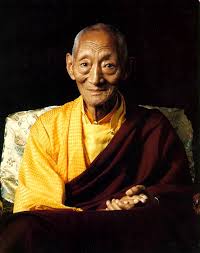
Approaching Refuge & The Grace of the Lama – Kalu Rinpoche
Approaching Refuge
The distinction between Buddhists and non-Buddhists resides in taking refuge in the Three Jewels. Buddhists take refuge, non-Buddhists do not.
The Three Jewels-Buddha, Dharma, and Sangha-are identical in the Hinayana and Mahayana, but the teachings have some differences in the notion of approaching refuge.
In the Hinayana, one takes refuge for oneself, with the purpose of liberating oneself from the suffering of samsara.
The vision of Mahayana is larger. In the Mahayana, one takes refuge for the purpose of liberating all beings in samsara, or by thinking of all beings as taking refuge at the same time and by doing so, eliminating their suffering. In the Hinayana, the practitioner takes refuge until death occurs, while in Mahayana, it is done until attaining Awakening.
Finally, the Vajrayana offers a unique approach. One takes refuge not only in the Three Jewels, but also in the Three Roots.
The lamas, that is to say, the source lama and the lamas of the lineage, are the root of the grace
The yidams, the root of accomplishments
The protectors of the Dharma and the dakinis, the root of activity that removes obstacles on the path
Vajrayana also establishes a distinction among outer, inner, and secret levels of taking refuge.The outer level refers to taking refuge in the Three Jewels and the Three Roots as they are usually conceived.
The inner level means taking refuge in the source lama considered only as the union of all places of refuge. In this case, the lama’s body represents the Sangha, the lama’s speech, the Dharma, and the lama’s mind, the Buddha. Or, the body represents the lamas, speech represents the protectors and dakinis, and the mind represents the yidams.
The secret level refers to taking refuge in our own mind. This implies that we experience our mind’s emptiness as the Absolute body (Sanskrit, dharmakaya), its clarity as the body of perfect experience (Sanskrit, sambhogakaya), and the union of emptiness and clarity as the body of emanation (Sanskrit, nirmanakaya).
– Kalu Rinpoche–Secret Buddhism/Vajrayana Practices
The Grace of the Lama
For those who practice the Vajrayana, either the phases of creation or of completion of the meditation, or even Mahamudra, it is extremely important to open to the grace of the lama.
Indeed, the lama is viewed as the union of the Three Jewels and the Three Roots.
Or,
The lama is the Buddha, the lama is the Dharma.
The lama is also the Sangha,
In front of the lama, who is the union of the Three Jewels,
I prostrate.
The lama’s body: the Sangha,
The lama’s speech: the Dharma
The lama’s mind: the Buddha.The lama’s body: the lamas
The lama’s speech: the dakinis and protectors,
The lama’s mind: the yidams.
Why is so much importance granted to the lama? The sun emits great light and heat, nevertheless this heat is too diffuse for a piece of paper or cloth to catch fire. On the other hand, when one uses a magnifying glass to focus the rays, they become more powerful and burn the paper, yet the nature of the rays has not changed. In the same way, the lama also focuses the grace of Awakening in order to transmit it to the disciple. When one considers the master as the union of the Three Jewels and the Three Roots, when one prays from the depths of the heart, this grace will consume ignorance, conflicting emotions, faults, and veils.
Importance of the lama
The Tibetan term lama is composed of two syllables, each possessing a definite meaning.
– Ia means “the highest,” or “unsurpassable,” precisely as a canopy (/a-dray, Tibetan) is the highest (Ia) piece of cloth (dray) in the temple. The lama is for his or her disciples, the highest being.
– rna signifies mother, implying that a lama looks upon all beings with the love of a mother for her only child.
For the disciple, the source lama is more important than all the Buddhas. If you rely on the Buddhas to reach Awakening, this requires much time. On the other hand, it is said that if one prays to the lama from the depths of the heart, one will very quickly attain Awakening.
The grace of Buddhas and bodhisattvas resembles the radiance of the sun. Even in the hot season, the sun cannot make a piece of paper on the ground catch fire, but if you have a magnifying glass, the paper will easily burst into flames. The Vajrayana consists of inserting the magnifying glass of the lama between the grace of the Buddhas and bodhisattvas and the mind of the disciples
There is the story of an Awakened being called Lekyi Repa. After having prayed to his lama for six months without interruption, he gained the realization of Mahamudra and other powers such as the ability to pass through rocks.
When one accomplishes the practice of a yidam, one always must keep in mind that the yidam is one with the source lama. Thus, one receives both the grace of the yidam and that of the lama and quickly makes progress toward liberation.
The importance of the source lama is great. It is said that one can stop making offerings to the Buddhas and keep only making those to the lama, because these offerings will be incomparably powerful in accumulating merit and wisdom.
Each lineage offers meditations relating to the great masters of the past, whether it is Padmasambhava for the Nyingmapas, Marpa, Milarepa, and Gampopa for the Kagyupas, or Tsongkhapa for the Gelukpas. When one practices these meditations, these masters of the past are, in essence, not considered as different from the source lama.
– Kalu Rinpoche–Secret Buddhism/Vajrayana Practices